
Case Background
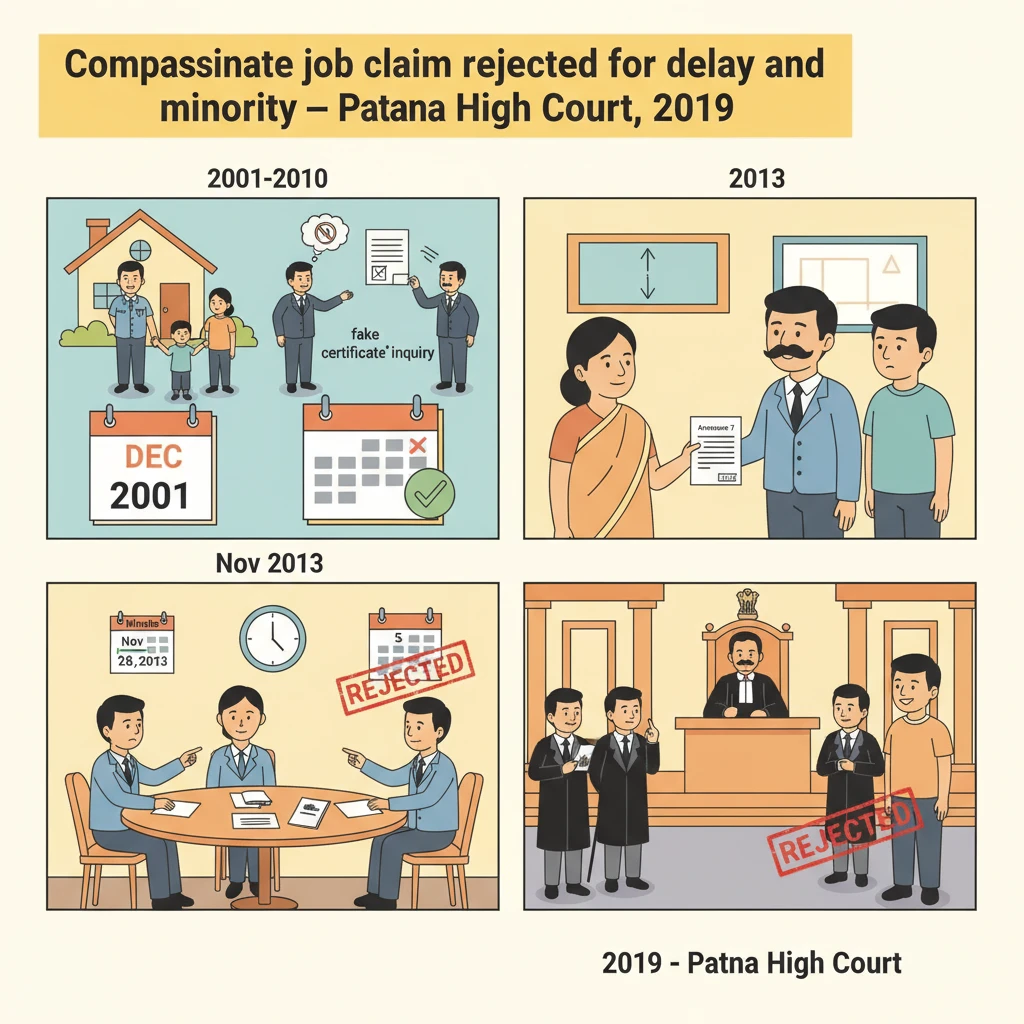
The case arises from the death of a government employee on 31 December 2001. After his death, his family became entitled to seek consideration for a compassionate appointment under the State’s rules.
The deceased employee’s widow initially moved an application for compassionate appointment. However, she did not finally accept employment herself. Instead, she wanted her son, the present appellant, to be appointed on compassionate grounds.
Years later, a controversy arose about the deceased employee’s own appointment. There were allegations that he had obtained his job using a fake certificate. Because of this, the family’s claim for compassionate appointment remained pending while the department conducted an enquiry.
In 2010, the department concluded that the allegation of a fake certificate was incorrect. Only after this finding did the department move ahead on the request for compassionate appointment.
By a letter dated 1 March 2013, the department wrote to the mother of the appellant. She was asked to submit the necessary documents so that her claim for compassionate appointment could be considered. This letter was annexed as Annexure 7 to the writ petition.
At this stage, the mother did not submit her own documents to take the job. Instead, she requested that her son be appointed. This change in claim — from the widow seeking appointment to the son seeking appointment — became central to the later dispute.
The Department placed this request before the Central Compassionate Appointment Committee. The Committee met on 28 November 2013 and turned down the request for the son’s appointment. It held that the appellant was a minor at the time of his father’s death and that his claim could be raised only within 5 years of the employee’s death as per the Rules. Since the claim surfaced after 11 years, the Committee refused to consider it.
On the request of the appellant, the matter was again placed before the Committee. On 28 May 2015, the Committee reiterated its earlier decision and again rejected the request due to the delay.
Based on these decisions, a communication dated 19 June 2015 was issued, rejecting the compassionate appointment claim. This led to the filing of Civil Writ Jurisdiction Case No. 12305 of 2015 by the son.
A learned Single Judge of the Patna High Court, by judgment dated 2 August 2018, dismissed the writ petition. The Single Judge held that the appellant was a minor at the time of his father’s death, and his application had been filed after more than five years, contrary to the Rules.
Challenging that judgment, the son filed Letters Patent Appeal No. 1209 of 2018 before a Division Bench of the Patna High Court.
What the Court Examined and Decided
The Division Bench, consisting of Hon’ble the Chief Justice and Hon’ble Justice Smt. Anjana Mishra, heard arguments from both sides on 16 April 2019.
Counsel for the appellant argued that the delay could not be blamed on the family. It was submitted that the mother of the appellant had filed her claim earlier, and that the matter remained pending because the department was investigating the allegation about the deceased employee’s alleged fake certificate. This allegation was finally found to be false in 2010.
The appellant’s side said that after this controversy ended, they pursued the matter within time. According to them, the delay up to 2010 was caused by the department, not by the family of the deceased employee. Therefore, the Committee and the authorities were said to have misunderstood the factual position when they treated the claim as delayed by 11 years.
They also questioned the Single Judge’s approach. It was urged that the learned Single Judge had calculated the appellant’s age on the basis of affidavits and concluded he was a minor at the time of his father’s death, and that his application was made after more than five years. On that view, the Single Judge held that the claim was not entertainable under the Rules.
On the other hand, the State relied on the undisputed timeline. The government’s stand, as recorded in its counter affidavit, was that the Central Compassionate Appointment Committee had correctly applied the Rules. The Committee had considered the claim twice, on 28 November 2013 and 28 May 2015, and found that the appellant’s claim was set up 11 years after the death of the employee, beyond the 5‑year limit.
The Division Bench closely examined these facts. It noted at the outset that the appellant was “admittedly” a minor at the time of the death of his father in 2001. The initial claim was indeed set up by the mother, and it was correct that the enquiry regarding the fake certificate remained pending till 2010, when the allegation was found to be incorrect.
However, the Court stressed an important point: the mother’s claim for compassionate appointment was not pursued by her. When the department, by its letter dated 1 March 2013, called upon the mother to submit her documents for considering her claim, she did not comply by submitting her own documents.
Instead, she made a specific request that the department appoint her son on compassionate grounds, now that he was eligible to be considered. In other words, the widow effectively gave up her own claim in favour of her son.
The Court inferred that the claim which now mattered legally was the son’s claim, not the mother’s earlier claim. When that claim is measured from the date of the employee’s death (31 December 2001), it was set up only after almost 11 years.
The Bench held that this gap of 11 years could not be ignored. Even if part of the period was taken up by the departmental enquiry, the decisive fact was that the son’s claim as a dependent was raised for the first time long after the maximum 5‑year period laid down in the Rules.
The Court agreed with the authorities’ conclusion that, “insofar as the appellant is concerned”, the claim was beyond five years from the date of death. The reasoning of the Central Compassionate Appointment Committee, as reflected in its resolutions dated 28 November 2013 and 28 May 2015, was held to be correct.
The Court also pointed out that there was, in fact, no specific legal challenge to those two Committee resolutions themselves. The appellant had challenged only the communication dated 19 June 2015. But this communication was merely a consequence of the Committee’s decisions. Since those underlying decisions were neither directly challenged nor shown to be illegal, the communication could not be faulted.
Looking at the situation as of the date of hearing, the Court further observed that, by then, 17 years had passed since the death of the employee. To consider a fresh compassionate appointment at such a late stage would, in the Court’s opinion, neither be equitable nor lawful.
The reason is tied to the very purpose of compassionate appointments. Such appointments are meant to provide immediate financial relief to the family at the time of crisis caused by the sudden death of the breadwinner. They are not meant to be a source of employment long years later, detached from that moment of crisis.
The Bench underlined that the Rules required an application to be moved within five years of the death. In this case, the son’s request surfaced only after 11 years, and as of the hearing date, 17 years had passed. Granting relief in such circumstances would defeat the scheme and spirit of the Rules.
Consequently, the Division Bench declined to interfere with the judgment of the learned Single Judge. It held that the Single Judge had correctly appreciated the factual and legal position regarding delay and the appellant’s minority at the time of his father’s death.
The Letters Patent Appeal was therefore not entertained and was “consigned to records,” effectively dismissing the appeal and upholding the rejection of the compassionate appointment claim.
Why This Judgment Matters
This judgment is important for families of government employees in Bihar who may seek compassionate appointments. It makes clear that the five‑year time limit in the Rules is real and will be strictly applied.
If a dependent seeks to change the claimant from one family member to another, that change must still fall within the five‑year period from the employee’s death. The Court will look at when the specific claimant’s own claim was first set up, not just at earlier communications by another family member.
The decision also shows that compassionate jobs are meant to meet an immediate crisis, not to guarantee employment to children many years later. Waiting for over a decade, even if some delay is due to internal departmental issues, can make the claim legally weak.
For widows and children of deceased employees, this ruling sends a clear message: they must act promptly, understand who exactly will apply for the job, and follow the time limits under the rules. Otherwise, even sympathetic circumstances may not lead to relief from the Patna High Court.
Legal Issues and Answers
Issue: Whether the son of a deceased government employee could claim compassionate appointment when his claim was first raised about 11 years after the employee’s death, beyond the 5‑year limit, and when he had been a minor at the time of death.
Answer: No. The Patna High Court held that the son’s claim was time‑barred under the Rules, as it was set up long after five years from the date of death, and the mother had given up her own earlier claim in his favour. The Court refused to interfere with the rejection orders.
Cases Cited by the Court
- No prior judicial precedents are expressly cited or relied upon in the text of this judgment.
Case Details
Case Number: Letters Patent Appeal No. 1209 of 2018 in Civil Writ Jurisdiction Case No. 12305 of 2017 (noted as 12305 of 2015 in body of judgment)
Case Title: Aditya Yuvraj Gond v. The State of Bihar & Anr.
Coram: Hon’ble the Chief Justice Amreshwar Pratap Sahi and Hon’ble Justice Smt. Anjana Mishra
Citation: 2019 (3) PLJR 241
Advocates: Mr. Mrigank Mauli, Advocate and Mr. Prince Kumar Mishra, Advocate for the appellant; Mr. Dhirendra Kumar, A.C. to A.A.G. 6 for the respondents/State
Nature of the Case: Letters Patent Appeal against dismissal of a writ petition (Civil Writ Jurisdiction Case) challenging rejection of a claim for compassionate appointment
Date of Judgment: 16 April 2019
Link to Full Judgment: Patna High Court Judgment
If you found this explanation helpful and wish to stay informed about
how legal developments may affect your rights in Bihar,
you may consider following Samvida Law Associates for more updates.







