
Case Background
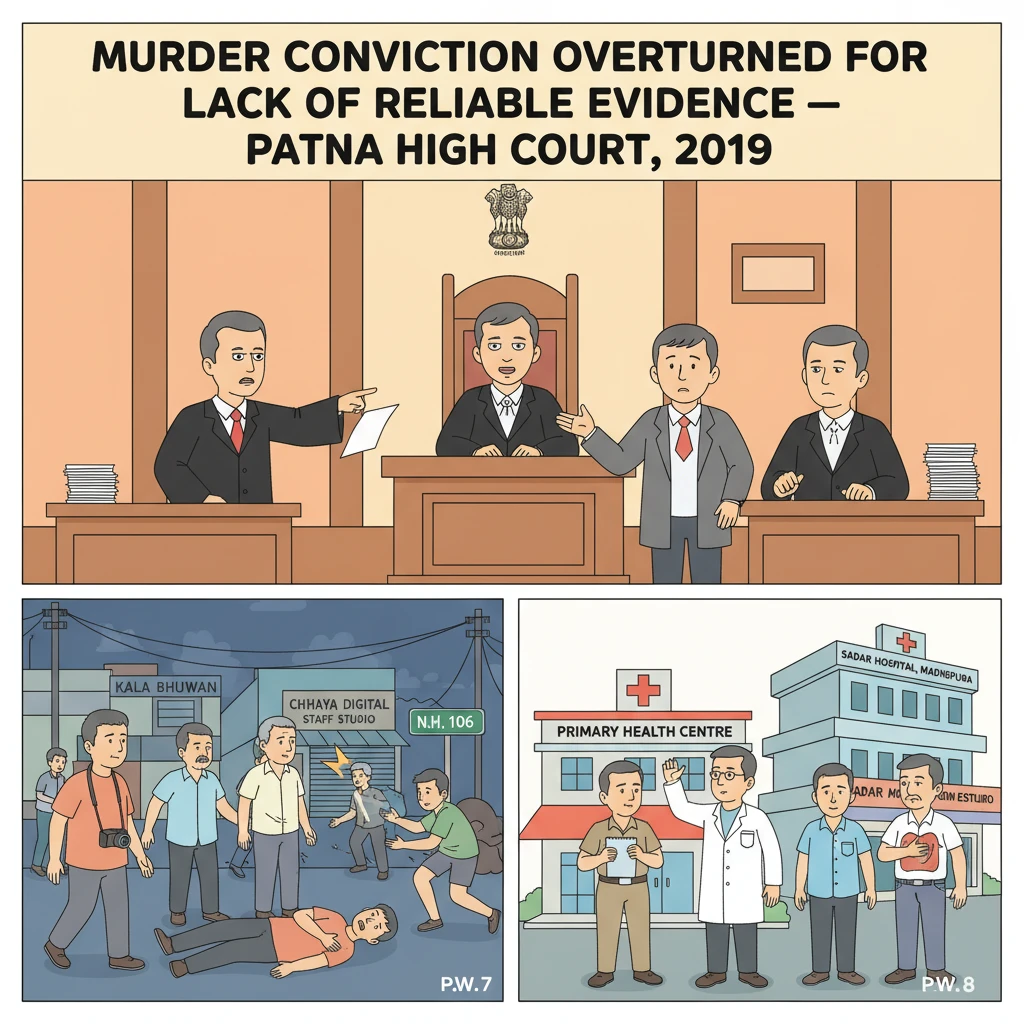
This case arose from a night-time shooting on 18.05.2009 in Gwalpara market, Madhepura district. The deceased, a young man of about 25 years, ran a digital photo studio named “Chhaya Digital Studio”.
According to the first version, his father (later examined as P.W. 6) closed the shop with him and they started walking home around 9:00 p.m. They were said to be accompanied by a staff member, Arvind Kumar Rai (P.W. 4), and a nearby shopkeeper, Pramod Yadav (P.W. 3).
When they reached the metalled road (N.H. 106) opposite Kala Bhawan, the informant claimed he heard a single gunshot from behind. The bullet allegedly hit his son, who fell on the road with bleeding chest. In the light of a torch, he stated he saw the appellant running away with a pistol, along with two unidentified associates.
The injured son was taken to the Primary Health Centre, Gwalpara, where the doctor declared him dead. At 22:15 hours (10:15 p.m.) the same night, Sub-Inspector Sanjay Kumar (P.W. 7), Officer-in-charge of Gwalpara O.P., recorded the father’s fardbeyan at the Primary Health Centre.
On the basis of this fardbeyan, Udakishunganj (Gwalpara) P.S. Case No. 58 of 2009 was registered on 18.05.2009 under Sections 302/34/120B of the Indian Penal Code and Indian Penal Code of the Arms Act against the appellant and two unknown persons. The FIR reached the Chief Judicial Magistrate, Madhepura, on 20.05.2009.
The Investigating Officer prepared the inquest report, sent the body for post-mortem, and attempted to arrest the accused, who were initially absconding. On 20.08.2009, a chargesheet was first submitted against one Naresh Yadav (not named in the FIR), with investigation kept pending against others. Cognizance was taken on 22.08.2009.
The appellant was arrested on 06.10.2009. A supplementary chargesheet was filed on 30.11.2009 against the appellant, Pankaj Yadav and Dharmendra Yadav. The case of Naresh Yadav proceeded separately. On 27.04.2010, the case of the appellant and two co-accused was committed to the Court of Session, Madhepura.
On 30.09.2010, the trial court framed joint charges under Sections 120B and 302/34 IPC and Section 27 of the Arms Act. The accused pleaded not guilty and claimed trial. After a full trial in Sessions Trial No. 49(A) of 2010, the Additional Sessions Judge Adhoc-II, Madhepura, convicted the appellant under Section 302 IPC and Section 27(1) Arms Act by judgment dated 18.12.2014, sentencing him to life imprisonment and seven years’ rigorous imprisonment respectively, with fines, to run concurrently. The two co-accused were acquitted.
The appellant then filed the present Criminal Appeal (DB) No. 372 of 2015 before the Patna High Court under Section 374(2) Cr.P.C.
What the Court Examined and Decided
The Division Bench of Hon’ble Mr. Justice Rakesh Kumar and Hon’ble Mr. Justice Anil Kumar Sinha heard arguments from both sides and then carefully reviewed the entire trial record.
The prosecution had examined eight witnesses. Among them, P.W. 6, the informant and father of the deceased, was projected as the only eye witness. P.W. 8, Dr. Shekhar Prasad Bishwas, conducted the post-mortem. P.W. 7, Sanjay Kumar, was the Investigating Officer. P.W. 3 was a formal witness who only proved his signature on the inquest report. P.Ws. 2, 4 and 5 turned hostile and did not support the prosecution. P.W. 1 said he only heard that the appellant was involved, without disclosing the source of his information.
The entire case against the appellant therefore rested on the testimony of P.W. 6, supported, if possible, by medical and other evidence.
Inconsistencies between the first statement and later testimony
In his fardbeyan recorded soon after the incident, P.W. 6 stated that he was walking ahead of his son. He heard the sound of one firing from behind, turned back, and then saw his son lying injured and the appellant fleeing with two associates. He did not say he saw the actual firing. He only claimed to have identified the appellant in the torch light while the appellant was running away.
However, in his deposition during trial, P.W. 6 changed this version in an important way. He now claimed that, after hearing a sound, he turned back, flashed his torch and actually saw the appellant firing at his son from the back. He stated that the bullet entered from the back and exited through the chest, causing the son to fall down.
In cross-examination, he admitted that at the time of the occurrence he had gone ahead and that the deceased and two others (P.W. 3 and P.W. 4) were behind him. His attention was drawn to his earlier statements. The Investigating Officer (P.W. 7) confirmed in his own evidence that P.W. 6 had not, in the fardbeyan or his police statement, said that he saw the appellant fire the shot. This showed that the new statement about witnessing the actual firing was an improvement during trial.
The High Court noted that this kind of “development” of the prosecution story by the sole eye witness created serious doubt about the reliability of his evidence. The Court treated the inconsistency between the first version (no actual sight of firing) and the later version (claim of seeing the firing) as a major weakness.
Conflict between oral evidence and medical evidence
The medical evidence came from P.W. 8, the doctor who performed the post-mortem on 19.05.2009 at 8:30 a.m. He found a firearm entry wound on the front of the chest, on the right lateral side of the sternum. There was blackish depigmentation around the wound, indicating a close-range shot. There was an exit wound at the back (inter-scapular area) corresponding to this entry wound. The cause of death was haemorrhage leading to cardio-respiratory failure.
The High Court observed that this medical evidence clearly showed that the bullet entered from the front of the body, not from the back. This was directly contrary to P.W. 6’s trial testimony that his son was shot from behind and that the bullet ruptured the chest while exiting. The doctor’s findings, together with the post-mortem report (Exhibit 7), did not support the version given by P.W. 6 in court.
Because P.W. 6 was the only witness claiming to see the firing, this contradiction between his version and the medical evidence further weakened the prosecution case.
Hostile witnesses and lack of independent support
The prosecution had alleged that P.W. 3 (Pramod Yadav) and P.W. 4 (Arvind Kumar Rai) were accompanying the deceased and P.W. 6 at the time of the incident. However, during trial, P.W. 2, P.W. 4, and P.W. 5 did not support the prosecution version and were declared hostile. P.W. 3 only proved his signature on the inquest report and did not speak about the occurrence.
P.W. 1 merely said that he came to know that the appellant was involved but did not say from whom he got this information. The Court found it unsafe to rely on such vague, hearsay-type evidence.
As a result, there was no independent witness to support P.W. 6’s improved claim that he actually saw the appellant firing.
Identification in torch light and missing physical evidence
P.W. 6 had stated that the transformer in the area was out of order at the time of occurrence. This meant that there was no street lighting. He claimed he identified the appellant in the beam of a torch.
The High Court emphasised that when identification depends on a light source like a torch, it is the duty of the prosecution to place the source of identification on record. Here, no torch was seized or produced in evidence. The Court noted that “time without number” it has been reiterated that failure to bring such a source on record goes against the prosecution case.
Thus, the claim of identification in torch light, without seizure or production of the torch, was treated as doubtful.
Standard for conviction on sole witness testimony
The Bench acknowledged that in criminal trials a conviction can be based on the testimony of a single witness, even when others turn hostile, but only if that sole witness is wholly reliable and his evidence is free from doubt.
In this case, the Court found that P.W. 6’s evidence suffered from:
- clear exaggeration compared to his earliest version,
- material contradiction with medical evidence regarding direction of the shot,
- lack of independent corroboration, and
- weakness in the claim of identification in torch light when the torch itself was never produced.
Because of these serious problems, the Bench held that it would not be safe to uphold a conviction and life sentence on such evidence alone.
Final decision
After examining the entire record, the Patna High Court concluded that the prosecution had failed to prove its case beyond all reasonable doubt. The benefit of doubt had to go to the appellant.
Accordingly, by judgment dated 25.04.2019, the Court allowed the criminal appeal. It set aside the judgment of conviction dated 18.12.2014 and the order of sentence dated 20.12.2014 passed by the Additional Sessions Judge Adhoc-II, Madhepura, in Sessions Trial No. 49(A) of 2010 (arising out of Udakishunganj (Gwalpara) P.S. Case No. 58 of 2009, G.R. No. 687 of 2009).
The appellant was in custody at the time of the High Court decision. In view of the acquittal, the Bench directed that he be released forthwith, if not wanted in any other case.
Why This Judgment Matters
This judgment is important for anyone facing criminal trial, especially where there is only one so-called eye witness and the incident happens at night or in poor lighting.
The Patna High Court stressed that:
- The first version given to the police (like fardbeyan) is very important. If a witness changes his story later to make it stronger, courts will treat it cautiously.
- Medical evidence, such as post-mortem findings, must fit with the witness’s account. If the doctor’s report shows something different, the court may doubt the witness.
- When identification depends on torch light or other artificial light, the prosecution must prove the actual source. Otherwise, the claim of recognition may not be trusted.
- A life sentence cannot be upheld on weak or doubtful evidence, even for serious crimes like murder.
For ordinary people, this case shows that courts do not simply rely on accusations or later-improved stories. The prosecution has to give clear, consistent, and scientifically supported evidence.
Legal Issues and Answers
Issue: Whether the conviction of the appellant for murder and Arms Act offences could be sustained when it was based mainly on the sole testimony of the informant-father, whose statements differed from his first report and conflicted with medical evidence.
Answer: No. The Patna High Court held that the prosecution failed to prove the case beyond reasonable doubt due to inconsistencies in the sole witness’s evidence, contradiction with post-mortem findings, lack of independent corroboration, and doubtful identification, and therefore set aside the conviction and sentence.
Cases Cited by the Court
- The judgment does not expressly cite or rely upon any earlier reported case law. The Court applied settled principles on appreciation of evidence without naming specific precedents.
Case Details
Case Number: Criminal Appeal (DB) No. 372 of 2015; arising out of Udakishunganj (Gwalpara) P.S. Case No. 58 of 2009, G.R. No. 687 of 2009; Sessions Trial No. 49(A) of 2010.
Case Title: Arun Yadav v. The State of Bihar.
Citation: 2019 (3) PLJR 197.
Court: High Court of Judicature at Patna.
Coram: Hon’ble Mr. Justice Rakesh Kumar and Hon’ble Mr. Justice Anil Kumar Sinha.
Date of Judgment: 25.04.2019 (uploading date 03.05.2019).
Advocates: For the appellant – Sri Bakshi S.R.P. Sinha (Senior Advocate), Sri Mrigendra Pratap Singh (Advocate), Shri Sanjay Kumar (Advocate). For the State – Sri Ajay Mishra (A.P.P.).
Nature of the Case: Criminal appeal under Section 374(2) of the Code of Criminal Procedure, 1973, against conviction under Section 302 IPC and Section 27(1) of the Arms Act.
Link to Judgment: Patna High Court official judgment link
If you found this explanation helpful and wish to stay informed about
how legal developments may affect your rights in Bihar,
you may consider following Samvida Law Associates for more updates.







