
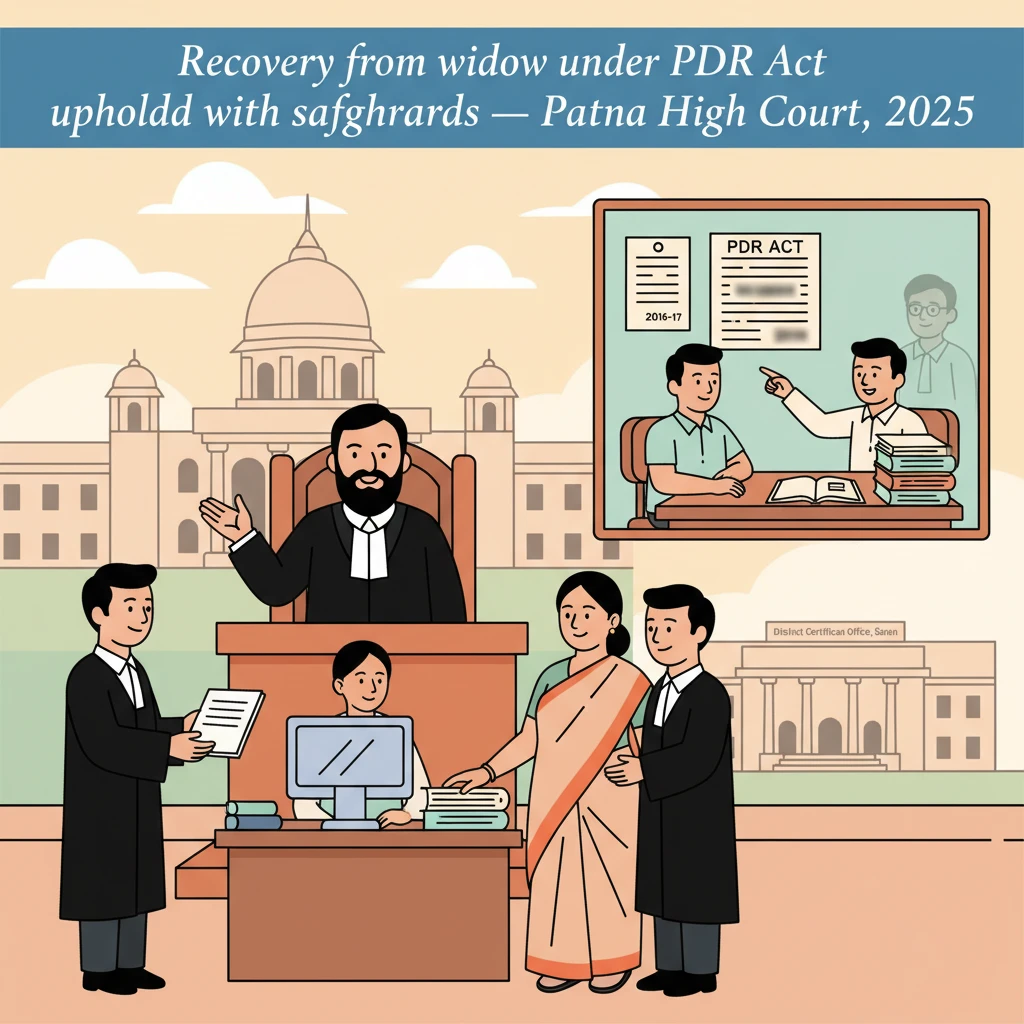
The Court refused to cancel the Lokayukta’s order or stop the certificate case.
However, it directed that recovery can proceed only as per Section 52 of the Public Demands Recovery Act and only against property of the deceased in her hands.
No coercive action can be taken against her until this legal process is properly followed.
Case Background
The petitioner is the widow of a Panchayat Secretary who worked in Mashrakh block, Saran district. In 2012, a case was registered before the Lokayukta, Bihar, Patna regarding alleged defalcation of government funds meant for beneficiaries under the Indira Awas Yojna.
This Lokayukta case was numbered 01/Lok (Panchayati Raj) 224/2012 (Sri Upendra Kumar Sah vs. Block Development Officer, Mashrakh, Saran). In that proceeding, the petitioner’s husband and several other employees were made parties. According to the State, these allegations led to criminal proceedings, departmental proceedings and a certificate proceeding under the Bihar & Orissa Public Demands Recovery Act, 1914 (Act No. 4 of 1914).
On the certificate side, Certificate Case No. 05 of 2016-17 was started before the District Certificate Officer, Saran, for recovery of Rs. 13,91,453/- (Rupees Thirteen Lakh Ninety One Thousand Four Hundred Fifty Three only) from the petitioner’s husband as certificate-debtor.
The petitioner’s husband challenged steps in the certificate proceeding by filing C.W.J.C. No. 14092 of 2017 before the Patna High Court. On 06.04.2018, that writ was disposed of with a direction to the authorities to decide his objection filed under Section 9 of the PDR Act. Till decision on that objection, no coercive step for recovery was to be taken.
The Certificate Officer later rejected his objection on 21.02.2019. He then filed another writ petition, C.W.J.C. No. 21140 of 2019, against that order. That case was dismissed for default on 23.11.2021. To restore it, MJC No. 2218 of 2021 was filed, which the petitioner stated was still pending.
During the pendency of these matters, a distress warrant was issued in the certificate case. On an interlocutory application (I.A. No. 01 of 2020), an order dated 04.05.2021 stayed operation of the distress warrant against the petitioner’s husband.
Meanwhile, by order dated 19.04.2021 in the Lokayukta case, the learned Member (Judicial), Lokayukta, Bihar, issued directions to the district authorities, Saran, to conclude pending proceedings to their logical end against all guilty persons, including the petitioner’s husband.
The petitioner’s husband died on 29.08.2021. After his death, the authorities continued with the certificate proceedings for recovery of the amount. The widow felt she was being harassed on the basis of the Lokayukta order and ongoing certificate case.
She therefore approached the Patna High Court in C.W.J.C. No. 595 of 2022 seeking, among other reliefs, quashing of the Lokayukta’s order dated 19.04.2021, a declaration that the Lokayukta had no jurisdiction to initiate such proceedings against her husband, a restraint on the authorities from acting against her, and a direction to grant benefits allegedly due to her late husband.
What the Court Examined and Decided
The single-judge Bench of Hon’ble Mr. Justice Dr. Anshuman heard both sides on 15.12.2025.
On behalf of the petitioner, it was argued that after the death of her husband, continuing proceedings against her on the strength of the Lokayukta’s directions was “bad in law.” Her main contention was that Section 52 of the Bihar & Orissa Public Demands Recovery Act, 1914 lays down a specific procedure to be followed when the certificate-debtor dies, and that this procedure had not been followed.
Counsel for the petitioner submitted that Section 52 talks about “procedure on death of certificate-debtor” and, according to her, since this was not complied with, any order of the Lokayukta leading to continuation of certificate proceedings against her was non-jurisdictional and liable to be set aside. She also submitted that the authorities should not proceed against her merely because she is the wife of the delinquent certificate-debtor.
The State, however, gave a very different picture. The State’s counsel described the matter as having a “chequered history,” pointing out that criminal, departmental and certificate proceedings were all pending against the petitioner’s husband. According to the State, he repeatedly filed writ petitions in the High Court to delay or avoid realization of the certificate amount.
The State pointed out that:
- C.W.J.C. No. 14092 of 2017 had already given him liberty to file objections in the certificate case, and those objections had been duly considered and rejected.
- His subsequent writ petition, C.W.J.C. No. 21140 of 2019, had been dismissed for non-prosecution on 23.11.2021.
- After his death, the present petitioner (his wife) filed MJC No. 2218 of 2021 for restoration, which she claims is pending.
- A distress warrant issued in the certificate case was stayed only to the extent ordered in I.A. No. 01 of 2020 on 04.05.2021.
The State argued that the certificate amount remained unpaid and had to be realized. It contended that though the husband had died on 29.08.2021, the “certificate is still thirsty” and the legal representative (in this case, the widow) is liable to the extent provided by law. Therefore, it was submitted that the Lokayukta’s order was within the framework of law and did not suffer from lack of jurisdiction.
After hearing both sides, the High Court focused on the legal framework under which the recovery was proceeding: the Bihar & Orissa Public Demands Recovery Act, 1914. The Court examined Section 52 of this Act in detail.
Section 52, titled “Procedure on death of certificate-debtor,” was reproduced in full in the judgment. In simple terms, this section says:
- If a certificate-debtor dies before the certificate is fully satisfied, the Certificate Officer may proceed to execute the certificate against the legal representative, but only after serving a notice in the prescribed form.
- Once such notice is served, the legal representative is treated, for procedural purposes, as if he or she were the certificate-debtor and the notice is treated as a notice under Section 7 of the Act.
- The legal representative is liable only to the extent of the property of the deceased that has come into his or her hands and has not been duly disposed of.
- For finding out this liability, the Certificate Officer can, on his own motion or at the request of the certificate-holder, compel the legal representative to produce accounts, as the officer thinks fit.
- For Hindu families, property in the hands of a son or descendant that is liable under Hindu law for the ancestor’s debts is deemed to be the property of the deceased for the purpose of this section.
The Court observed that this statutory provision “clearly states that the certificate has to be fully satisfied even after death of certificate debtor from the legal representative of the deceased,” but only after following the procedure of notice and limiting liability to the property of the deceased in the hands of the legal representative.
Applying this to the case at hand, the Court declined to interfere with the findings or directions of the Lokayukta. Instead, the Court clarified how the authorities should act going forward.
The Court explicitly directed the Certificate Officer and respondent authorities to proceed against the present petitioner only in accordance with Section 52 of the Act of 1914. This means they must:
- Issue the prescribed notice to her as legal representative;
- Treat her as certificate-debtor only for procedural purposes under the Act; and
- Limit recovery only to the extent of the property of her deceased husband that has come into her hands and not been duly disposed of, with proper assessment.
To protect the petitioner from immediate harsh action, the Court also made one more important clarification. It held that, before fully exhausting the procedure set out in Section 52 of the Act of 1914, “no coercive steps shall be taken against the petitioner.”
In summary, the writ petition was disposed of with directions, without granting the petitioner’s prayers to quash the Lokayukta’s order or to declare that the authorities had no jurisdiction. The Court balanced the State’s right to recover public money with the widow’s procedural protections under Section 52.
Why This Judgment Matters
This judgment is important for families of government employees who die while recovery proceedings are pending against them. It clarifies that death of the certificate-debtor does not wipe out liability under the Bihar & Orissa Public Demands Recovery Act, 1914.
However, it also makes clear that authorities cannot directly and harshly proceed against the widow or legal heirs as if they themselves committed the defalcation. Recovery can be made only from the property of the deceased which has come into the hands of the legal representative, and only after proper notice and enquiry as required by Section 52.
For ordinary people, especially widows and legal heirs, this decision from the Patna High Court shows two things: government money can still be recovered after the employee’s death, but the law gives them specific safeguards. They cannot be personally targeted beyond the assets they actually received from the deceased.
Legal Issues and Answers
-
Issue: Can the Lokayukta’s directions and the certificate proceedings for recovery of public money continue against the widow after the death of the certificate-debtor, and did the Lokayukta act without jurisdiction?
Answer: The Court refused to hold the Lokayukta’s order as without jurisdiction and did not quash it. It held that recovery may continue, but only in accordance with Section 52 of the Bihar & Orissa Public Demands Recovery Act, 1914, treating the widow as legal representative liable only to the extent of the deceased’s property in her hands and after following the prescribed procedure, with no coercive steps until that process is exhausted.
Cases Cited by the Court
- No prior judicial decisions are cited or relied upon in the text of this judgment. The Court’s reasoning is based directly on Section 52 of the Bihar & Orissa Public Demands Recovery Act, 1914.
Case Details
Case Number: Civil Writ Jurisdiction Case No. 595 of 2022
Case Title: Ranjana Chaurasia Wife of Late Ramesh Prasad Chaurasia @ Ramesh Prasad vs. The State of Bihar & Ors.
Citation: 2026(1) PLJR 529
Coram: Hon’ble Mr. Justice Dr. Anshuman
Advocates:
- For the petitioner: Mr. Shashi Nath Jha, Advocate; Mr. Sunny Kumar, Advocate
- For the respondents: Mr. Vinay Kirti Singh, Government Advocate 2; Mr. Sumant Kr. Singh, AC to GA2
Nature of the Case: Writ petition under civil writ jurisdiction challenging an order of the Lokayukta and continuation of certificate proceedings under the Bihar & Orissa Public Demands Recovery Act, 1914.
Date of Judgment: 15.12.2025
Link to the Judgment: Click here to access the full judgment of the Patna High Court
If you found this explanation helpful and wish to stay informed about
how legal developments may affect your rights in Bihar,
you may consider following Samvida Law Associates for more updates.







