
Case Background
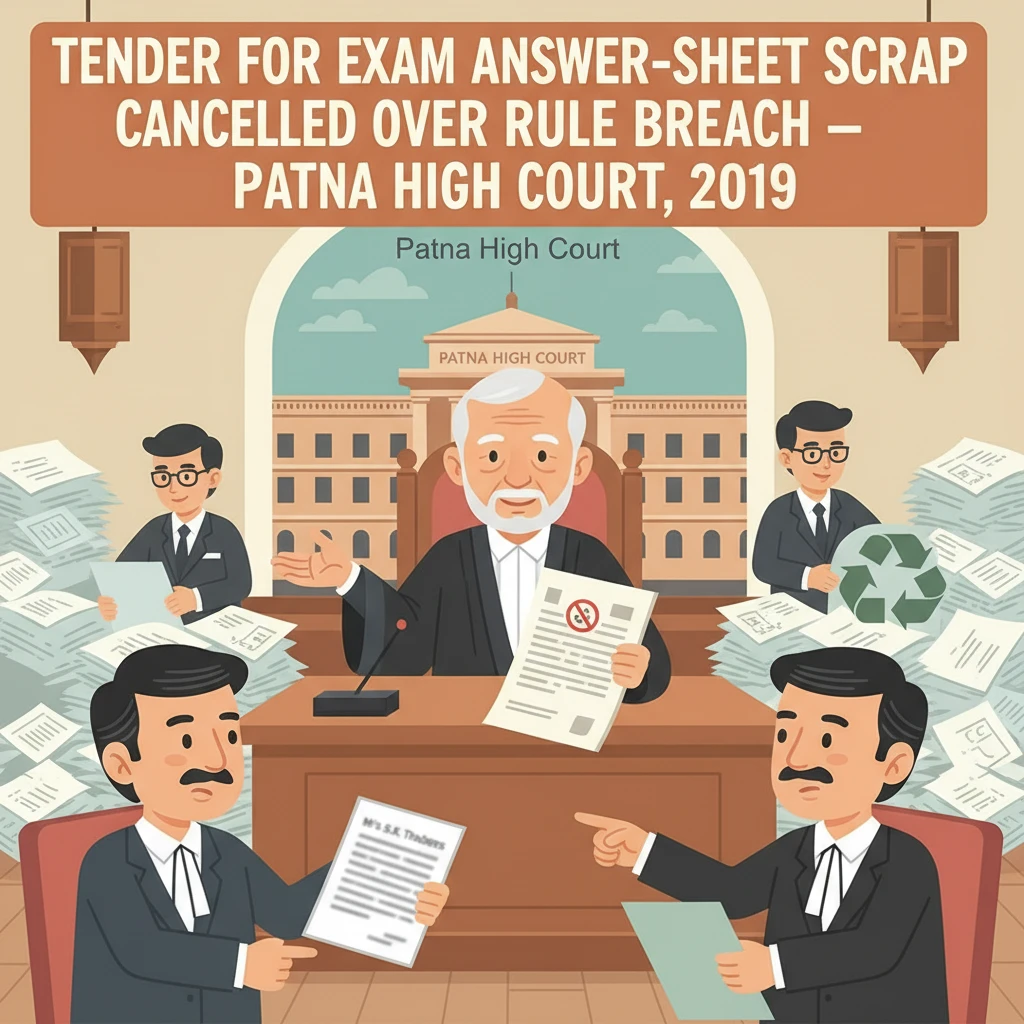
The Bihar School Examination Board issued Tender/Auction Notice No. PR-198/18. The tender was for auction of used answer books of Intermediate compartmental examination 2017, used practical answer books of Annual Intermediate Examination 2018, and other scrap papers like flying slips, award sheets, marks files, attendance sheets and other “utilityless” papers and documents relating to Intermediate and matriculation compartmental examination 2018.
The Board’s clear purpose was to auction this material for recycling and safe destruction, to avoid misuse of answer books and to protect the environment. To secure this, the Board inserted specific conditions in clauses 14, 15 and 16 of the tender document. These clauses required that all answer books and related papers must be recycled in a paper mill and not used for any other purpose, and that the bidder must file a certified copy of an agreement with such a paper mill along with the tender. Those who had earlier purchased such paper from the Board were also required to file proof that the previous lot had actually been recycled.
The petitioner, a local trader, submitted his bid along with an agreement dated 24.09.2018 with M/s Multiwal Pulp & Board Mills Pvt. Ltd. He claims this showed his arrangement to send the purchased answer sheets and old records to that mill for recycling.
Two other traders, later arrayed as respondent nos. 5 and 6, also submitted bids. The petitioner alleges that they did not submit any proper agreement with a paper mill as required under clause 15. As per the writ petition, respondent no. 6 only made a declaration naming VSM Paper Pvt. Ltd., which, according to an RTI reply dated 01.02.2019, was not yet a functioning mill.
When the technical bids were opened on 26.09.2018, the petitioner objected in writing to the technical eligibility of respondent nos. 5 and 6. Despite this representation, the Board proceeded to open their financial bids and eventually declared them successful for item nos. 1, 2, 3, 5, 6 and 8 of the tender. The petitioner was given item nos. 4, 7 and 9 and was asked to deposit Rs. 13,37,024/-.
Later, by letter dated 07.02.2019, respondent nos. 5 and 6 were formally treated as successful bidders and asked to deposit the required amounts. Another communication dated 12.02.2019 called upon respondent no. 6 to deposit Rs. 1,26,55,000/- so that he could lift the specified items. These letters became the main subject of challenge before the Patna High Court.
What the Court Examined and Decided
The core complaint before the Patna High Court was that the Board had not followed crucial, self-imposed conditions in its own tender document. The petitioner argued that clauses 14, 15 and 16 were designed to ensure that answer books and examination records were not misused and were properly recycled. According to him, respondent nos. 5 and 6 did not meet these conditions but were still treated as qualified bidders, while he was placed at a disadvantage even though he had complied.
The petitioner stressed that clause 15 made it mandatory to file a certified copy of an agreement with a paper mill, ensuring that all purchased waste paper would be used only for recycling. He also highlighted clause 16, which required prior successful bidders to produce a certificate that the earlier material purchased from the Board had in fact been recycled in a paper mill.
On the other hand, the Bihar School Examination Board, through a counter affidavit, defended its actions. The Board said that it had treated all tenderers equally and that the paper mills’ “undertakings” and the bidders’ declarations were treated as substantial compliance with clause 15. The Board admitted that even the petitioner’s agreement did not explicitly state that the paper mill would recycle the waste paper received from him, but since he had filed a declaration, he too was declared eligible.
According to the Board, this showed that there was no discrimination. The Board further argued that the contract was awarded in good faith and in public interest. It said there was an urgent need to create space for safe custody of answer books of the 2019 examinations and upcoming exams, and that disposing of old answer books would help achieve this. The Board contended that even if there were some procedural lapses, the Court should not interfere in such contractual matters in exercise of judicial review under Article 226.
The Board also took the position that whether VSM Paper Pvt. Ltd., named by respondent no. 6, was functional or not was not relevant at the stage of tender. According to the Board, the tender only asked for an undertaking/agreement/declaration about using the waste paper for recycling. If later any bidder misused the material, the Board could always take legal action, including lodging an FIR.
Respondent no. 5, in his counter affidavit, stated that he had submitted a certificate issued by “Indira Paper Mill Pvt. Ltd.”, Patna. The certificate said that the mill might take supply of waste paper from respondent no. 5 if he succeeded in the BSEB tender and if terms were successfully negotiated.
Respondent no. 6, in his counter affidavit, claimed to be a major paper merchant in Bihar dealing with several paper mills. He produced what he called an “agreement-cum-certificate” dated 15.09.2018 from Kawatra Papers Pvt. Ltd. The document certified that answer books and other waste papers purchased through respondent no. 6 as authorised supplier by tender of the Bihar School Examination Board would be used for pulp making by the mill. Respondent no. 6 also highlighted that he had set up his own company, VSM Paper Pvt. Ltd., registered under the Companies Act, 2013 and registered as a micro or small enterprise, intending to manufacture pulp from waste paper in future.
Respondent no. 6 further alleged that the petitioner had used a forged agreement from Multiwal Pulp & Board Mills Pvt. Ltd. He claimed to have an email dated 25.02.2019 from that company stating that the person shown as signatory in the petitioner’s agreement had left the company in 2016 and had no authority to sign documents thereafter.
Justice Rajeev Ranjan Prasad first looked closely at clauses 14, 15 and 16 of the Board’s tender. Clause 14 required a specific undertaking that all used answer books and waste papers would be recycled in a paper mill and not used otherwise. Clause 15 required the bidder to submit a certified copy of the agreement with the paper mill for recycling. Clause 16 demanded proof of recycling from bidders who had purchased waste paper from the Board in earlier years.
The Court directed the Board’s counsel to produce original records to see if there had been any conscious decision by a competent authority to amend or relax clause 15. On examining the record, the Court found no such decision. The Board’s counsel admitted that there was no document showing that clause 15 had ever been relaxed. The Court therefore concluded that these clauses remained fully binding.
Turning to the documents of respondent no. 6, the Court examined the certificate from Kawatra Papers Pvt. Ltd. It merely stated that answer books and other waste papers purchased through respondent no. 6 by tender would be used for pulp making. The Court held that such a certificate could not be treated as an “agreement” as required under clause 15. An agreement, the Court explained, is a binding document between parties, whereas the certificates filed were nothing more than loose assurances.
The Court also noted an important admission by respondent no. 6 in his counter affidavit. He stated that in the previous year also, he had been the highest successful bidder in a similar BSEB tender and was awarded the contract. However, he did not produce any certificate proving that the earlier lot of answer books and waste papers had been recycled, as clause 16 required. The Bench held that, on his own showing, respondent no. 6 was bound to file such a certificate but had not done so. This indicated non-compliance with a key tender condition.
Similarly, the certificate filed by respondent no. 5 from Indira Paper Mill Pvt. Ltd. was found to be weak and conditional. It stated that the mill “may” take supply of waste paper from respondent no. 5 “if negotiated successfully” after success in the tender. The Court described this as a mere eye-wash. It showed clearly that there was no firm agreement between respondent no. 5 and the mill.
The Court observed that neither respondent no. 5 nor respondent no. 6 produced any proof of the authority of the persons who had signed these certificates on behalf of Kawatra Papers Pvt. Ltd. or Indira Paper Mill Pvt. Ltd. The documents were therefore even more doubtful as binding commitments.
On the wider issue, the Court underlined that clauses 14, 15 and 16 served an important public purpose. They protected environmental interests by ensuring recycling of huge quantities of paper and also protected the secrecy and integrity of examination records. To explain the importance of recycling, the Judge even referred to general information from sources like Wikipedia, and to similar tender conditions used by CBSE, which demand proof of experience in disposing of waste paper and insist that such paper be used only for recycling or destroyed in a way that ensures official secrecy.
Justice Prasad emphasised that the Board’s counter affidavit gave the impression that it was only interested in freeing up storage space and collecting the sale price, without paying enough attention to environmental concerns or examination secrecy. In the Court’s view, ignoring clauses 14, 15 and 16, which were “heart and soul” of the tender, could not be justified by saying that all bidders were equally benefited.
The Court relied on paragraph 66 of the Supreme Court judgment in B.S.N. Joshi & Sons Ltd. v. Nair Coal Services Ltd., which summarises principles of judicial review in tender matters. One key principle is that essential conditions in a tender must be strictly followed, and if a relaxation of such essential condition is wholly illegal, the Court can interfere.
Applying these principles, the Patna High Court held that clauses 14, 15 and 16 of the BSEB tender were essential and mandatory. The tender committee had no authority to ignore or dilute them, and there was no written decision by the Board to do so. Hence, the entire decision-making process in awarding the tender to respondent nos. 5 and 6 suffered from violation of essential conditions and from failure to protect public interest.
Regarding the allegation that the petitioner had submitted a forged agreement with Multiwal Pulp & Board Mills Pvt. Ltd., the Court refused to decide that question within this writ petition. It held that if respondent no. 6 believed the document was forged, he could raise the issue before the Board or other appropriate forum. Still, because this serious dispute existed, the Court declined to issue a straight mandamus directing award of the disputed items to the petitioner.
In the result, the Court set aside the letter dated 07.02.2019 by which respondent nos. 5 and 6 were declared successful bidders under Tender Notice No. PR-198/18. It directed the Board to examine the genuineness of the petitioner’s agreement within thirty days of receiving the order, after giving him an opportunity of hearing.
If, on examination, the tender committee finds the petitioner’s agreement to be genuine and in compliance with the tender conditions, it may decide to award the remaining items (earlier allotted to respondent nos. 5 and 6) to the petitioner. If it finds the agreement to be not genuine, the committee is free to take appropriate action, including going for a fresh tender.
Before parting, the Court also gave guidance to the Board for future tenders. It said that the Board should ensure that those who previously purchased answer sheets and waste papers must submit certificates showing actual recycling of that material. For every new tender, successful bidders should be required to produce similar certificates within a reasonable period, to be fixed by the Board. Only bona fide participants with proper recycling arrangements or their own recycling units should be allowed to participate.
Why This Judgment Matters
This judgment is important for traders, contractors, and public bodies dealing with sale of examination answer books and other sensitive scrap. The Patna High Court made it clear that when a public body writes strict conditions into a tender, it must itself follow them. Those conditions cannot be treated as optional only to speed up the process or earn more money.
For bidders, the ruling shows that if tender rules demand an actual agreement with a paper mill, a vague certificate or a future promise will not be enough. Bidders must have clear and binding arrangements with recycling units, and repeat buyers must be ready to show proof that earlier lots were recycled.
For examination boards and other authorities, the decision highlights the responsibility to protect both environment and examination secrecy. The Court treated these as matters of public interest strong enough to justify interference with the Board’s commercial decisions. Authorities cannot ignore such safeguards merely because it is convenient.
The decision also sends a message that courts will scrutinise the decision-making process in public tenders where essential conditions are not followed, even if all bidders appear to have been treated similarly. Equal violation of the rules is not a defence.
Legal Issues and Answers
-
Issue: Could the Bihar School Examination Board treat clauses 14, 15 and 16 of its tender (requiring binding recycling arrangements and proof of past recycling) as flexible and still declare respondent nos. 5 and 6 successful bidders?
Answer: No. The Patna High Court held these clauses to be essential and mandatory. The Board had no recorded decision relaxing them, and the certificates produced by respondent nos. 5 and 6 were not proper agreements or proof of recycling. The tender award was therefore vitiated. -
Issue: Was the Court bound to direct that the disputed items be allotted to the petitioner as the next highest bidder once the award to respondent nos. 5 and 6 was set aside?
Answer: No. Because there was a serious dispute over the genuineness of the petitioner’s own agreement with the paper mill, the Court did not grant automatic allotment. Instead, it directed the Board to verify the agreement within thirty days and then either award the items to the petitioner or take other lawful steps, including retendering. -
Issue: When can a High Court interfere in tender decisions under Article 226 of the Constitution?
Answer: Relying on B.S.N. Joshi & Sons Ltd. v. Nair Coal Services Ltd., the Court held that it may interfere where essential tender conditions are violated, particularly when such conditions serve public interest. In this case, the violation of clauses 14, 15 and 16 justified judicial review.
Cases Cited by the Court
- B.S.N. Joshi & Sons Ltd. v. Nair Coal Services Ltd. & Others, (2006) 11 SCC 548 (relied upon for principles of judicial review in tender matters).
- Poddar Steel Corporation v. Ganesh Engineering Works & Others, (1991) 3 SCC 273 (referred to in arguments by respondent no. 6; distinguished by the Court while holding BSEB’s clauses 14, 15 and 16 to be mandatory).
Case Details
Case Number: Civil Writ Jurisdiction Case No. 3129 of 2019
Case Title: M/s S.K. Traders v. The Bihar School Examination Board & Others
Citation: 2019 (3) PLJR 450
Court: High Court of Judicature at Patna
Coram: Hon’ble Mr. Justice Rajeev Ranjan Prasad
Date of Judgment: 13-03-2019
Advocates:
- For the petitioner: Mr. Brisketu Sharan Pandey, Mr. Prince Kumar Mishra, Ms. Kumari Shubham
- For the Bihar School Examination Board: Mr. Satyabir Bharti, Mr. Gyan Shankar, Mr. Alok Chandra
- For respondent no. 5: Mr. Subhash Kumar Singh
- For respondent no. 6: Mr. S.D. Sanjay, Senior Advocate, assisted by Mr. Alok Kumar Agrawal
Nature of the Case: Writ petition under Article 226 of the Constitution challenging award of tender/auction for sale of used answer books and scrap papers and seeking mandamus for re-allotment.
Link to Judgment: View full judgment on Patna High Court website
If you found this explanation helpful and wish to stay informed about how legal developments may affect your rights in Bihar, you may consider following Samvida Law Associates for more updates.







