
Case Background
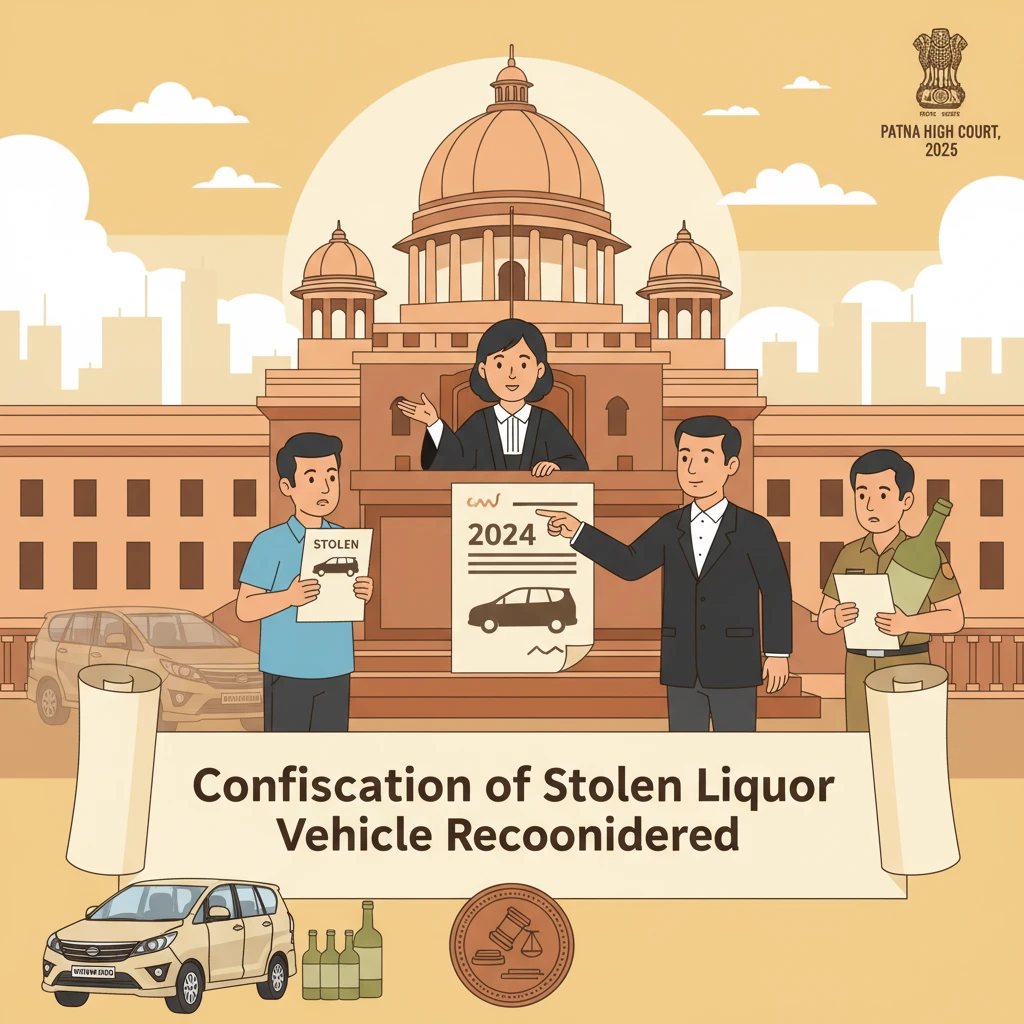
This case arose from the seizure of an Innova Crysta car in Patna. The vehicle, bearing registration number BR01HM-5806, engine no. 2GDA779788 and chassis no. MBJJB8EM101656705-0124, was intercepted and found carrying about 198.720 litres of liquor.
On 03.03.2025, Excise Patna P.S. Case No. 336 of 2025 was registered for offences under Sections 30(a) and 56(b) of the Bihar Prohibition and Excise Act, 2016 and the Amendment Act, 2022.
After seizure, the Assistant Commissioner, Excise started Vehicle (Acquisition) Case No. 212 of 2025-26 as a confiscation proceeding. Treating the vehicle as involved in the transportation of illicit liquor, the confiscating authority ordered its release only on payment of 10% of the insured value of the vehicle as penalty, plus an additional 3% of that amount, invoking Rule 12A(2) of the Bihar Prohibition and Excise Rules, 2021 as amended.
The vehicle owner challenged this order in appeal. When the appellate authority dismissed the appeal, he went in revision in Excise Revision Case No. 24 of 2025. The revisional authority, by order dated 18.09.2025, upheld the confiscation and the penalty, even while recording that the vehicle had been stolen and that the owner was not involved in the liquor offence.
Aggrieved, the owner approached the Patna High Court in Civil Writ Jurisdiction Case No. 19659 of 2025, asking for release of his vehicle and questioning the legality of the penalty, especially the extra 3% imposed in favour of Bihar State Beverages Corporation Ltd. (BSBCL).
What the Court Examined and Decided
The Division Bench of the Patna High Court, comprising Hon’ble Mr. Justice Rajeev Ranjan Prasad and Hon’ble Mr. Justice Sourendra Pandey, heard the writ petition on 18.12.2025. The petitioner’s case and the State’s stand were placed before the Court.
The owner’s main argument was that his vehicle had been stolen long before it was caught with liquor. He relied on Shastrinagar P.S. Case No. 788 of 2024 dated 08.10.2024, registered under Section 303(2) of the Bharatiya Nyaya Sanhita, 2023, where he had reported the theft.
He pointed out that his actual registration number was BR01HM-5806 but when the car was seized with liquor, it was found with a different number plate bearing registration BR01FQ0101. This, he said, clearly showed theft and misuse by others. He argued that he had not played any role in the alleged liquor transportation and was not named as an accused in the excise case.
The petitioner’s counsel relied on a Division Bench judgment in Bittu Kumar Gupta v. The State of Bihar and Ors. (C.W.J.C. No. 13174 of 2025, decided on 14.11.2025). In that case, the Court had held that if a vehicle is stolen and the owner has not participated in any offence and is not an accused, he cannot be burdened with penalty under the prohibition law.
On the other side, learned GP-6 for the State accepted that about 198.720 litres of liquor had been recovered from the vehicle. She submitted that the confiscating authority had relied on an earlier Patna High Court decision in Ramprakash Paswan v. The State of Bihar and Others (C.W.J.C. No. 11678 of 2022, decided on 02.09.2022) to justify imposition of penalty equal to 10% of the insured value of the vehicle.
However, she fairly conceded before the Court that the competent authority had no power to impose an additional 3% over and above the penalty amount of 10% and that part of the order could be set aside.
The High Court then closely examined the revisional order dated 18.09.2025. It noted that the revisional authority had clearly recorded, on the basis of the FIR of Shastrinagar P.S. Case No. 788 of 2024, that the vehicle in question was in fact stolen. The revisional authority had also mentioned that the petitioner was not involved in that theft case.
Despite these findings, the revisional authority had refused to interfere with the confiscation and penalty on the ground that it could not be denied that the vehicle was used to transport illicit liquor.
The High Court disagreed with this reasoning. It observed that the facts that the vehicle was stolen and was running with a false number plate at the time of seizure were “important facts which cannot be ignored.”
The Court underlined that a confiscation proceeding is essentially a civil proceeding. A vehicle is the property of its owner, and the owner can be deprived of this property only if it is found that he was involved in the commission of the offence with the help of that vehicle.
To support this view, the Bench referred to an earlier judgment of a Coordinate Bench in Amarjeet Yadav v. State of Bihar and Others (C.W.J.C. No. 9517 of 2023). Paragraph 24 of that judgment, quoted by the Court, explained that when a vehicle is stolen or robbed and used by criminals to carry liquor, it cannot be said that the owner was involved or in connivance with the offence. In such a situation, the owner cannot be punished by seizure and confiscation of the vehicle for the illegal act of others.
The Court then examined the reliance placed by the authorities on the judgment in Ramprakash Paswan. It noted that after that judgment, the Bihar Prohibition and Excise Rules, 2021 had been amended by the Amendment Rules, 2023 through notification no. 3671 dated 31.05.2023.
Under the amended Rule 12A(4), guidelines are laid down for imposing fine where valuation or insurance of the vehicle is not possible. While doing so, the Collector or authorised officer has to consider:
- the economic status of the individual,
- the nature of his involvement in the crime, and
- the quantum of intoxicant recovered.
The Court held that this mandate in the second part of Rule 12A(4) is very important. These factors must be considered whenever penalty is imposed, whether based on a valuer’s assessment or on insurance value. The nature of involvement of the vehicle owner is an “important guiding factor” and cannot be ignored.
The Bench observed that at the time when Ramprakash Paswan was decided, this specific statutory provision was either not in existence or was not brought to that Bench’s notice. Therefore, blind reliance on that earlier case, without applying the amended Rule 12A(4) and without properly considering the owner’s non-involvement, was legally unsound.
On this basis, the Court set aside the impugned confiscation, appellate and revisional orders. It directed the confiscating authority to pass a fresh order for release of the vehicle within 30 days of receiving the Court’s order. While doing so, the authority must keep in mind:
- the legal mandate under Rule 12A(4), and
- the judicial pronouncements cited on the treatment of stolen vehicles in prohibition cases.
The Court then turned to the question of the extra 3% penalty. It declared in clear terms that the confiscating authority has “no power to impose an additional 3% over and above the penalty amount.” It expressed surprise that the authority had directed the petitioner to deposit 3% of the penalty (Rs. 5,698/-) in the account of “BSBCL”, understood as Bihar State Beverages Corporation Ltd.
The Bench strongly criticised this practice, stating that “by no stretch of imagination” can the confiscating authority assume power to impose penalty beyond what the law sanctions. It noted that a similar order had recently been passed by a confiscating authority in Nalanda district in Shantanu Kumar v. The State of Bihar & Ors. (C.W.J.C. No. 18561 of 2025, decided on 11.12.2025). The Court described such impositions as “wholly unjust and improper” and termed them “an act of undue enrichment” of a government company, which is not permissible.
Finally, the Court issued a wider direction. It ordered that its judgment be brought to the notice of all District Magistrates in Bihar and officers authorised by them who deal with confiscation matters. These officers have been told not to impose any additional amount of penalty over and above what the law permits.
Further, the Court directed that such wrongly realised penalties in all other cases must be refunded within three months from the date of receipt or production of a copy of this order.
With these directions, the writ petition was disposed of.
Why This Judgment Matters
This decision is important for vehicle owners whose cars or other vehicles may be misused for liquor transport without their knowledge.
The Patna High Court has clearly said that if a vehicle is stolen and the owner is not involved in the crime, he should not be punished through confiscation or heavy penalty merely because liquor was found in his vehicle. The authorities must examine the owner’s role carefully before taking away his property.
The judgment also protects citizens from unlawful financial burdens. It stops confiscating authorities from adding extra percentages and directing amounts to be deposited into accounts like that of Bihar State Beverages Corporation Ltd. Any penalty must strictly follow what the law allows.
By ordering refund of illegally collected extra penalties and instructing all District Magistrates and authorised officers, the Court has tried to correct a wider administrative practice, not just in one case. This will help many vehicle owners across Bihar who may have faced similar demands during confiscation proceedings under prohibition laws.
Legal Issues and Answers
- Issue: Can a vehicle owner, whose vehicle was stolen and used to carry illicit liquor without his involvement, be subjected to confiscation and penalty under the Bihar Prohibition and Excise law?
Answer: No. The Court held that in confiscation, the owner can be deprived of his vehicle only if his involvement in the offence is found. In case of a stolen vehicle with no role of the owner, he cannot be burdened with such penalty. - Issue: Can the confiscating authority impose an additional 3% amount over and above the statutory penalty (10% of the insured value) and direct its deposit to BSBCL?
Answer: No. The Court ruled that the authority has no such power. Imposing an extra 3% is wholly unjust, improper, and amounts to undue enrichment of a government company. - Issue: What factors must authorities consider while imposing penalty under Rule 12A of the Bihar Prohibition and Excise Rules, 2021?
Answer: Authorities must consider the economic status of the individual, the nature of his involvement in the crime, and the quantum of intoxicant recovered. These factors apply whether valuation is based on insurance or other methods.
Cases Cited by the Court
- Bittu Kumar Gupta v. The State of Bihar and Ors., C.W.J.C. No. 13174 of 2025, decided on 14.11.2025.
- Amarjeet Yadav v. State of Bihar and Others, C.W.J.C. No. 9517 of 2023.
- Ramprakash Paswan v. The State of Bihar and Others, C.W.J.C. No. 11678 of 2022, decided on 02.09.2022.
- Shantanu Kumar v. The State of Bihar & Ors., C.W.J.C. No. 18561 of 2025, decided on 11.12.2025.
Case Details
Case Number: Civil Writ Jurisdiction Case No. 19659 of 2025
Case Title: Bimlesh Kumar v. The State of Bihar & Ors.
Citation: 2026(1) PLJR 367
Court: High Court of Judicature at Patna
Coram: Hon’ble Mr. Justice Rajeev Ranjan Prasad and Hon’ble Mr. Justice Sourendra Pandey
Date of Judgment: 18.12.2025
Advocates:
- For the Petitioner: Dr. Satyendra Kumar Srivastava, Advocate
- For the State: Ms. Archana Meenakshee, GP-6; Mr. Rana Veer Prawar, AC to GP-6
Nature of the Case: Writ petition (challenge to confiscation, appellate and revisional orders in vehicle acquisition/confiscation proceedings under Bihar Prohibition and Excise law)
Link to Judgment: Click here to view the official Patna High Court judgment
If you found this explanation helpful and wish to stay informed about
how legal developments may affect your rights in Bihar,
you may consider following Samvida Law Associates for more updates.







