
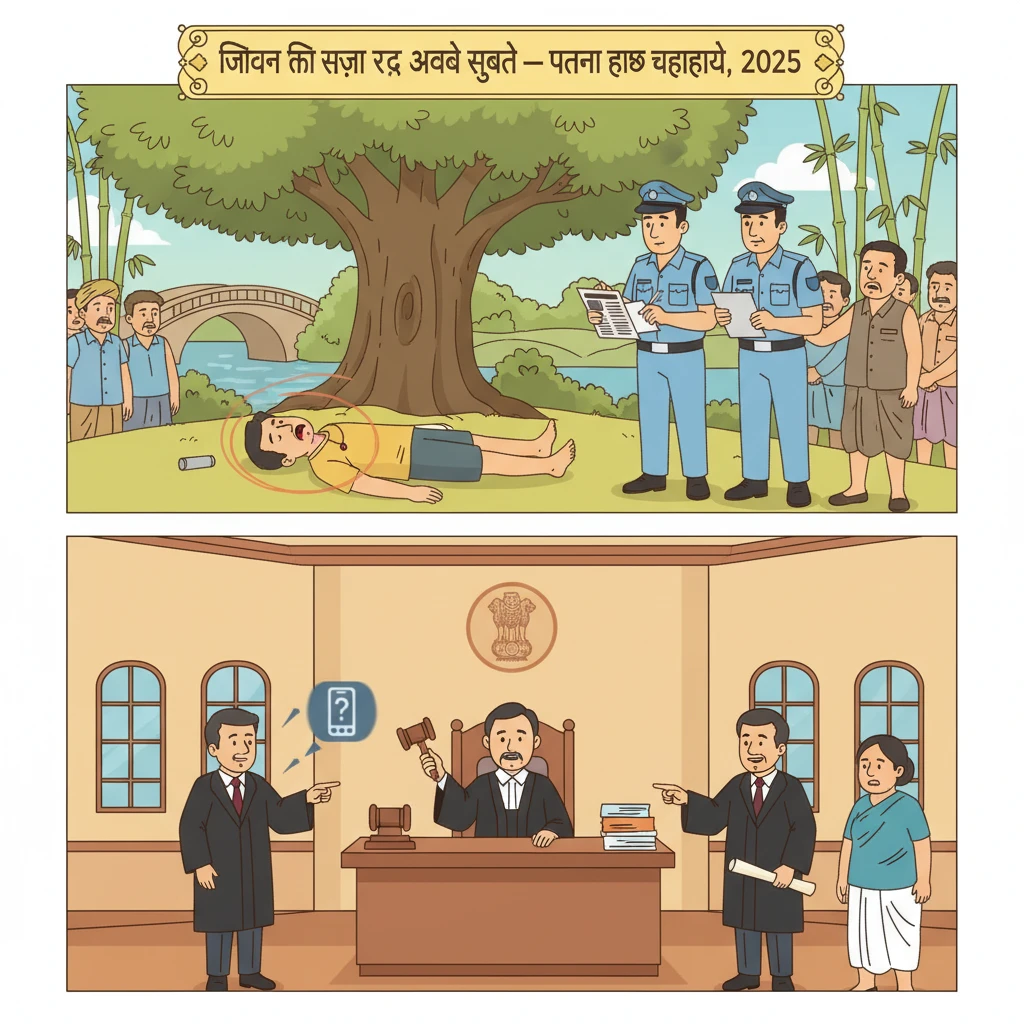
Case Background
The case began on 23 December 2016, when a village chowkidar of Azam Nagar, Kushimar, in district Araria, received information around 8:30 a.m. that a dead body of an unknown man was lying near Diwari Fatak bridge, in a bamboo grove belonging to one villager.
The chowkidar went to the spot and found that the police had also arrived. He saw the body of a man, about 35 years old, with a blackish ligature mark around the neck and bleeding from the left ear. The man was wearing several layers of clothes and had a black thread with a locket bearing “786” and “92” around his neck. A blank cartridge of .315 bore was found in one pocket.
Local people gathered, but no one could identify the deceased. The chowkidar suspected that the man had been killed elsewhere and the body brought and tied to a Simul tree with a rope, with a belt around the neck.
A Sub-Inspector of Police, Ashok Kumar Singh, recorded the chowkidar’s statement and treated it as the First Information Report. On that basis, Araria P.S. Case No. 856 of 2016 was registered on 23 December 2016 under Sections 302/301 of the Indian Penal Code (IPC) against unknown persons. Investigation was entrusted to Sub-Inspector King Kundan.
After investigation, the Investigating Officer submitted a charge-sheet against one Vijay Kumar Yadav @ Vivek Kumar @ Golu under Sections 302/34, 201/34 and 120B IPC. The case was committed to the Court of Session, and then transferred to the Court of the learned 3rd Additional Sessions Judge, Araria, as Sessions Trial No. 203 of 2017.
On 13 June 2017, charges under Sections 302/34, 201/34 and 120B IPC were framed against the accused. He pleaded not guilty, and the trial commenced. The prosecution examined eight witnesses, including the village sarpanch, the mukhiya, seizure witnesses, the chowkidar-informant, the Investigating Officer, the autopsy doctor, and the elder brother of the deceased, Niyaz Ahmed.
By judgment dated 11 April 2018, the trial court convicted the appellant under Section 302/34 IPC and sentenced him to life imprisonment with a fine of Rs. 1,00,000, with one year’s simple imprisonment in default. He was also convicted under Section 201 IPC and sentenced to three years’ rigorous imprisonment and fine of Rs. 10,000, with further three months’ simple imprisonment in default. The sentences were to run concurrently.
The appellant remained in custody for about seven years. He filed multiple applications before the High Court seeking suspension of sentence and bail, but they were rejected, with the Court at that time also relying on the same evidence that was later found inadmissible.
What the Court Examined and Decided
The Division Bench of the Patna High Court, comprising Hon’ble Mr. Justice Bibek Chaudhuri and Hon’ble Mr. Justice Dr. Anshuman, examined in detail what evidence was actually admissible and whether it was sufficient to uphold a conviction for murder and causing disappearance of evidence.
First, the Court looked at the evidence of the village-level witnesses. PW-1, the sarpanch, and PW-2, the mukhiya, only stated that they saw a dead body in the bamboo grove about seven to eight months before their depositions. They could not identify the deceased and had no knowledge of the incident. They also could not identify the accused.
Next, the Court examined the evidence on alleged seizure of key materials from the appellant’s house. PW-3 and PW-5 were cited as seizure witnesses for items said to have been recovered from under the pillow on the appellant’s bed—one ATM card, two Nokia mobile phones, and some documents.
However, both these witnesses clearly stated in court that they were not present at the time of seizure. They said the items were not recovered in their presence and that they had merely signed at Maranga Police Station on the asking of the police. They also failed to identify the accused during trial. Importantly, the prosecution did not declare these witnesses hostile, meaning their version stood unshaken on record.
On this basis, the High Court held that the prosecution had failed to prove any seizure of articles or documents from the appellant’s house. The Court also referred to Section 100 CrPC, which requires that searches of houses be conducted in the presence of two or more independent and respectable witnesses from the locality, and that the seizure list be signed by such witnesses. Here, the supposed witnesses did not support the prosecution, so the seizure remained unproved.
PW-4, the chowkidar-informant, only corroborated his initial report about finding the body. He had no knowledge of who committed the crime.
PW-8, the elder brother of the deceased, identified the deceased as Niyaz Ahmed. He explained that his brother had been missing since 22 December 2016. After the police published a photograph of the deceased in an Urdu daily on 24 December 2016, he recognised his brother, went to the police station, and then to the post-mortem room, where he identified the body and received it after applying in writing. This application was marked as Exhibit 5/A.
In cross-examination, PW-8 stated that before his brother’s death there had been disputes over land with certain named persons, and that these persons had threatened his brother with dire consequences and abduction. He expressed his belief in his application that those persons might have murdered his brother and thrown the body where it was found. The Court noted that none of these persons was made an accused in this case, and the Investigating Officer did not examine their possible involvement.
Crucially, PW-8 also could not identify the appellant as the offender.
The main link connecting the appellant to the crime, according to the Investigating Officer (PW-6), came from mobile phone and bank records and from an alleged confession by the appellant in police custody.
The Investigating Officer said he obtained the deceased’s mobile number, 9204249967, and collected the call detail records (CDR) and customer details from the office of the Superintendent of Police, Araria. The CDR was marked as Exhibit 6. He found that two SMS messages from “DM-IDBI Bank” were received on this number on 22 December 2016. On 26 December 2016, he went to IDBI Bank, Purnea, and learnt that the deceased had an account there and that Rs. 75,000 had been withdrawn on 24 December 2016 and paid to Maa Lakhi (Laxmi) Jewelers.
According to the Investigating Officer, the jeweller, Vimal Kumar Soni, stated that on 24 December 2016, a boy came to his shop at about 4:00 p.m. with his mother and sister, ordered some jewellery, and paid Rs. 75,000 by ATM card. He said the boy was an old customer and gave the name of the appellant. The officer claimed to have seized a receipt from the SBI swipe machine and CCTV footage of the shop, under a seizure list marked Exhibit 7.
The appellant was then arrested on 27 December 2016. The Investigating Officer stated that the appellant admitted his guilt in a statement recorded by him, on which he took the appellant’s signature. This statement was marked Exhibit 9 at trial and treated as the centrepiece of the prosecution case.
The officer further deposed that, on the basis of this statement, he went to the appellant’s house with two independent witnesses and recovered a black purse, an IDBI ATM card in the name of Niyaz Ahmed, receipts of Maa Lakhi Jewelers and of the swipe machine, two Nokia mobile phones, and a WagonR car registered in the name of the appellant’s brother-in-law. The receipts and ATM card were marked as Exhibits 10, 10/A, 11, 12 and 12/A, and the seizure list as Exhibit 1/B.
The High Court then turned to the legality of this evidence. It pointed out that Section 25 of the Indian Evidence Act clearly prohibits use of any confession made to a police officer against an accused. Section 26 further bars confession made while in police custody unless in the immediate presence of a Magistrate.
The Bench explained that any statement recorded by an Investigating Officer in the course of investigation is treated as a statement under Section 161 CrPC. Section 162(1) CrPC specifically forbids such statements, if reduced to writing and signed, from being used as evidence except for contradicting a witness as per Section 145 of the Evidence Act.
On this basis, the Court held that the appellant’s alleged statement admitting guilt before the Investigating Officer was wholly inadmissible. It should not have been marked as an exhibit and could not lawfully be relied upon. The trial court committed illegality by treating this statement as evidence and using it to convict the accused.
The Court then examined Section 27 of the Evidence Act, which creates a limited exception for information leading to discovery of a fact, even when given by an accused in custody. Only that portion of the information which distinctly relates to the fact discovered is admissible. The Bench discussed that the word “distinctly” limits what can be proved to what is clearly and directly connected to the discovery, and cited the Supreme Court decision in Govind v. State of Haryana, 2025 SCC OnLine SC 2456, in support.
However, in this case, there was no reliable proof that the alleged recovery of ATM card, purse, receipts and other materials was made in accordance with law. The independent seizure witnesses did not support the prosecution and stated they were not present at the time of seizure. There was also no clear evidence that the appellant actually led the police to the place of recovery. Therefore, even the limited benefit of Section 27 could not be applied in favour of the prosecution.
The Court also noted serious defects in how electronic evidence was handled. The CDR, customer details, SMS messages, CCTV footage, and ATM swipe receipts are all electronic records. Under Section 65B of the Evidence Act, such records must be accompanied by proper certificates from the person or authority in charge of the computer system or device that generated them.
In this case, the Investigating Officer had not obtained any certificate from IDBI Bank regarding the SMS messages or account transactions. No certificate was collected for the CCTV footage or the swipe machine receipt. Further, the jeweller, who was said to have taken payment from the ATM card and identified the appellant, was not examined as a witness at all.
The Court emphasised that no independent witness, apart from the Investigating Officer, identified the appellant in connection with either the murder or the alleged use of the ATM card. Without properly admitted seizures, independent identification, or valid electronic evidence, the chain of circumstances against the appellant was completely broken.
Taking all these defects together, the High Court concluded that the trial court had convicted the appellant by overlooking the basic requirements of the Evidence Act and criminal procedure. The accused had been kept in custody for more than seven years on the strength of inadmissible and unproved evidence.
Accordingly, the Court allowed the appeal, set aside the judgment of conviction dated 11 April 2018 and the order of sentence dated 17 April 2018 in Sessions Trial No. 203 of 2017 (Araria P.S. Case No. 856 of 2017), and directed that the appellant be released forthwith, if not required in any other case.
Why This Judgment Matters
This judgment is important for ordinary citizens because it shows that a conviction for a serious offence like murder cannot rest on confessions to police or on documents and digital records that are not properly proved.
For families of accused persons, it underlines that the police must follow strict rules when seizing items from a house, recording statements, and collecting mobile or bank records. If independent witnesses do not support the seizure, and if electronic records are not certified, the court cannot treat them as reliable evidence.
For investigators and trial courts, the decision from the Patna High Court is a warning that shortcuts in investigation can lead not only to innocent persons being jailed for years, but also to the real offenders never being brought to justice.
The ruling also highlights that appellate courts will not hesitate to correct wrongful convictions, even after many years, when the basic safeguards of the Evidence Act and the Code of Criminal Procedure are ignored.
Legal Issues and Answers
- Issue: Can a conviction for murder be sustained mainly on an accused’s statement recorded and signed by the police during investigation, and on alleged seizures and electronic records not properly proved?
Answer: No. The Patna High Court held that such a conviction is illegal because confessions to police are inadmissible, Section 161 CrPC statements cannot be used as substantive evidence, the alleged recoveries were not proved through independent witnesses, and electronic records lacked the mandatory certification under Section 65B of the Evidence Act. - Issue: When can information given by an accused in custody be used to prove discovery of material objects under Section 27 of the Evidence Act?
Answer: Only that part of the information which distinctly relates to the fact discovered is admissible, and the prosecution must prove that the discovery actually took place in consequence of such information, usually with the support of independent witnesses. In this case, seizure witnesses did not support the prosecution, so even Section 27 could not be invoked. - Issue: Is seizure of articles from a house valid when the supposed independent witnesses deny being present at the search and say they signed at the police station?
Answer: No. The Court held that the prosecution failed to prove any lawful seizure from the appellant’s house, as required by Section 100 CrPC, because the cited witnesses did not support the search and seizure in their testimony.
Cases Cited by the Court
- Govind v. State of Haryana, 2025 SCC OnLine SC 2456 (relied on regarding the scope of Section 27 of the Evidence Act and the meaning of “distinctly relates to the fact thereby discovered”).
Case Details
Case Number: Criminal Appeal (DB) No. 673 of 2018, arising out of Araria P.S. Case No. 856 of 2016
Case Title: Vijay Kumar Yadav @ Vivek Kumar @ Golu v. The State of Bihar
Court: High Court of Judicature at Patna
Coram: Hon’ble Mr. Justice Bibek Chaudhuri; Hon’ble Mr. Justice Dr. Anshuman
Date of Judgment: 17-12-2025
Citation: 2026 (1) PLJR 462
Advocates: Mr. Ajay Kumar Thakur, Advocate; Mrs. Vaishnavi Singh, Advocate; Mr. Ritwik Thakur, Advocate; Ms. Sushmita Mishra, Advocate for the appellant; Ms. Shashi Bala Verma for the State.
Nature of the Case: Criminal appeal under Section 374(2) CrPC against conviction and sentence in a sessions trial for offences under Sections 302/34 and 201 IPC (with charge also framed under Section 120B IPC).
Link to Judgment: Patna High Court Judgment
If you found this explanation helpful and wish to stay informed about
how legal developments may affect your rights in Bihar,
you may consider following Samvida Law Associates for more updates.







