
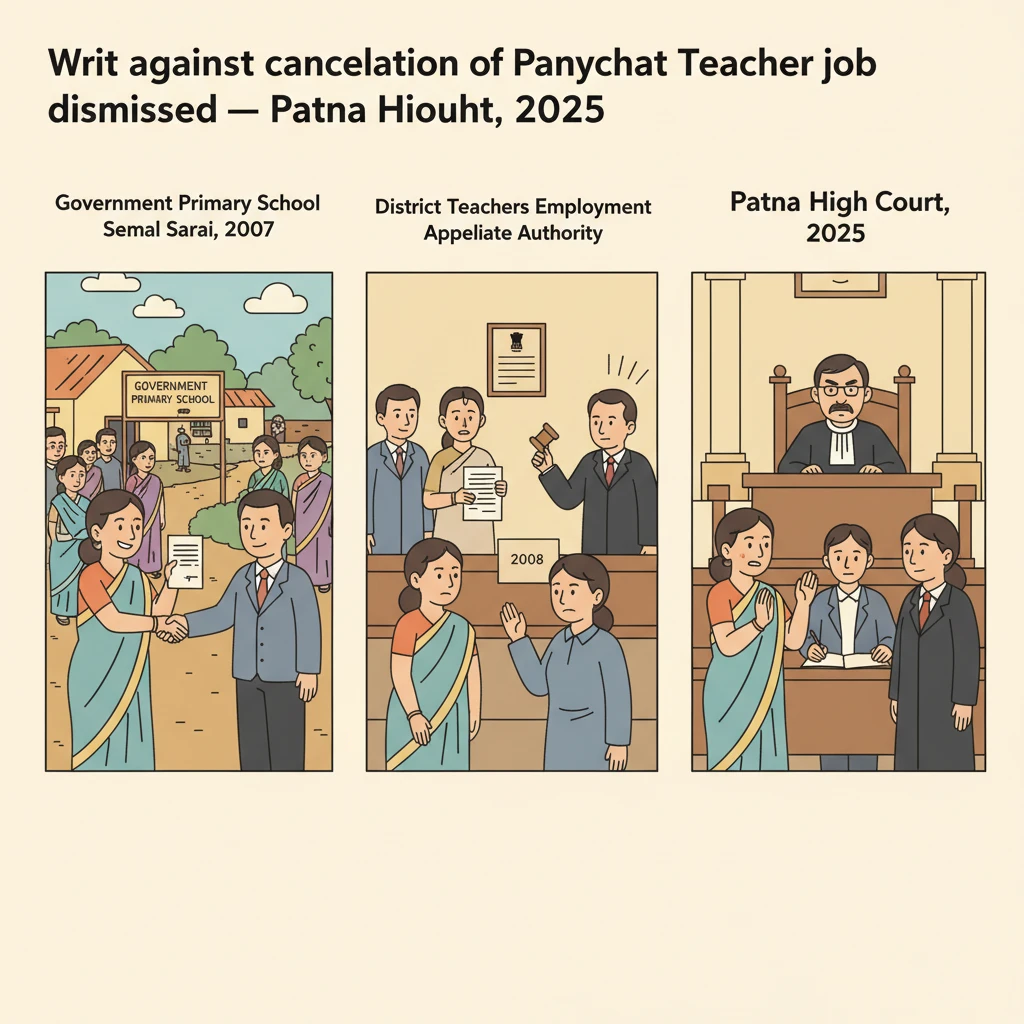
Case Background
The petitioner was working as a Panchayat Teacher in a Government Primary School at Semal Sarai, Block Marhawrah, District Saran.
According to her, she was selected in counselling held between 15.02.2007 and 19.02.2007, based on a schedule issued by the District Magistrate, Saran. She received an appointment letter dated 20.02.2007 from the Panchayat Secretary, Gram Panchayat Raj, Bahuara Patti, under memo no. 07. She joined her post on 23.02.2007.
The petitioner claimed that she was appointed from the waiting list because several candidates with higher merit did not attend counselling. One of those candidates was respondent no. 12, another woman candidate from the same village.
Later, respondent no. 12 raised objections against the petitioner’s appointment, asserting that she had higher merit and should have been appointed instead. An enquiry was conducted by the competent authorities. The dispute then reached the District Teachers Employment Appellate Authority, Saran.
By order dated 28.02.2017, in Appeal Case No. 33/2016, the District Teachers Employment Appellate Authority allowed the appeal of respondent no. 12 and set aside the petitioner’s appointment.
The petitioner challenged this before the State Teachers Employment Appellate Authority, Bihar, in Appeal No. 56/2017. On 14.07.2017, the State Appellate Authority dismissed her appeal, effectively upholding the District Authority’s order.
Aggrieved by these two appellate orders, the petitioner approached the Patna High Court under Article 226 of the Constitution by filing Civil Writ Jurisdiction Case No. 10692 of 2017.
What the Court Examined and Decided
The petitioner asked the Patna High Court for several reliefs.
First, she wanted a writ of certiorari to quash the order dated 14.07.2017 of the State Teachers Employment Appellate Authority in Appeal No. 56/2017 and the order dated 28.02.2017 of the District Teachers Employment Appellate Authority, Saran, in Appeal Case No. 33/2016.
Secondly, she asked for a writ of mandamus directing the authorities to allow her to continue as Panchayat Teacher at Government Primary School, Semal Sarai, Marhawrah. She stressed that she had been selected in 2007, had been working since 23.02.2007, and had continued for more than ten years with teaching experience and age now against her.
Thirdly, she sought a writ of prohibition restraining the authorities from disturbing her functioning as Panchayat Teacher and from implementing the impugned appellate orders dated 14.07.2017 and 28.02.2017. She also pointed out that she had passed the Teachers Efficiency Test.
Lastly, she prayed for any other suitable relief.
The core of the dispute before the High Court did not turn on whether she was actually more or less meritorious than respondent no. 12. Instead, it turned on an earlier order passed by the Block Development Officer (BDO), Marhawrah, on 13.09.2008/16.10.2008, referred to as Annexure 10.
The respondents’ counsel highlighted that this BDO order was the “foundational order” which revived respondent no. 12’s claim and opened the door for the later appellate proceedings. They argued that this order had never been challenged by the petitioner.
The appellate orders dated 28.02.2017 and 14.07.2017 clearly referred back to the BDO’s order and relied on it. The District Appellate Authority’s order dated 28.02.2017 even directed the Selection Committee to submit a compliance report in terms of the BDO’s order dated 13.09.2008.
On this basis, the respondents contended that since the foundational order was still valid and unchallenged, the petitioner could not successfully seek to quash only the later, consequential appellate orders. They asserted that the writ petition was not maintainable.
On the other hand, the petitioner’s counsel argued that she was validly appointed from the waiting list after counselling, that respondent no. 12 did not participate in counselling, and that she had been in continuous service with no complaints. They claimed the appellate authorities had exceeded their powers under Rule 18 of the Bihar Panchayat Elementary Teachers (Appointment and Service Conditions) Rules, 2006.
The petitioner relied on three earlier Patna High Court decisions: Alok Kumar v. State of Bihar (CWJC No. 16423 of 2008), Sunil Kumar Ojha v. State of Bihar (CWJC No. 8800 of 2008), and Prakash Kumar v. State of Bihar (CWJC No. 4878 of 2007). According to her, these judgments held that settled appointments should not be reopened lightly and that the jurisdiction under Rule 18 was limited.
Justice Alok Kumar Sinha first framed four issues. The first and main issue was whether the writ petition was maintainable when the petitioner had not challenged the foundational BDO order dated 13.09.2008/16.10.2008.
The Court closely examined the materials on record. It found that the appellate orders of 2017 derived their “procedural foundation” from the BDO’s 2008 order. That BDO order was described as the “originating and determinative order” which revived respondent no. 12’s claim and allowed the selection process to be reopened nearly a decade later.
The Court noted that the petitioner had admittedly not challenged this foundational BDO order. Despite this, she was trying to challenge only the later appellate orders.
The Court then applied a basic legal principle: when a later order flows directly from an earlier foundational order, a person cannot normally challenge only the later order while leaving the earlier one untouched. If the base order stands, the consequential orders cannot easily be set aside on their own.
Justice Sinha held that, because the petitioner had not attacked the BDO’s order, she could not selectively challenge the District Teachers Employment Appellate Authority’s order or the State Teachers Employment Appellate Authority’s order, both of which were built on that foundation.
The Court observed that if the foundational order is left unchallenged, consequential orders flowing from it “cannot be set aside independently”. On this ground, the writ petition “fails at the threshold”.
Regarding the earlier judgments cited by the petitioner, the Court stated that those decisions indeed laid down settled principles about jurisdiction under Rule 18 and interference with settled appointments. However, they were distinguishable on facts.
In those earlier cases, the foundational action itself was either challenged or found to be without jurisdiction. In the present case, the foundational BDO order was not challenged at all. Therefore, those precedents did not help the petitioner.
Once the Court held that the writ petition was not maintainable, it considered that this finding “goes to the root of the matter” and was sufficient to non-suit the petitioner.
As a result, the Court did not find it necessary to examine the remaining three issues, namely: whether the appellate authorities had acted without jurisdiction; whether the petitioner’s long service gave her any vested right; and whether the impugned orders required interference under Article 226. These issues were expressly left open.
Finally, the Court concluded that the writ application was liable to be dismissed solely on the ground of non-challenge to the foundational BDO order dated 13.09.2008/16.10.2008. Consequently, the appellate orders dated 28.02.2017 and 14.07.2017 did not warrant interference. The writ petition was dismissed without any order as to costs.
Why This Judgment Matters
This judgment is important for Panchayat Teachers and other contractual or local body appointees in Bihar who challenge cancellation of their appointments.
The Patna High Court has made it clear that if a person is aggrieved by a chain of official actions, they must challenge the very first basic order that started the process, not only the later appellate or review orders.
In simple terms, if your job is cancelled based on an earlier enquiry or direction, and you want to fight it in court, you must also attack that earlier enquiry or direction. Ignoring it can make your whole case fail, even if you have been working for many years.
The judgment also shows that long service and passing efficiency tests, while relevant in equity, cannot cure basic legal defects such as not challenging the root order. Courts will first see whether the case is maintainable in law before looking at hardship or length of service.
Legal Issues and Answers
- Issue: Can the petitioner challenge only the appellate orders cancelling her appointment without challenging the earlier foundational order of the Block Development Officer dated 13.09.2008/16.10.2008?
Answer: No. The High Court held that since the appellate orders were based on the unchallenged foundational order, the writ petition was not maintainable and failed at the threshold. - Issue: Did the Patna High Court decide whether the appellate authorities exceeded their jurisdiction under Rule 18 of the 2006 Rules or whether long service gave the petitioner a vested right?
Answer: No. After finding the writ not maintainable for non-challenge to the foundational order, the Court expressly left these issues open and did not decide them.
Cases Cited by the Court
- The Court referred to and distinguished the following Patna High Court judgments cited by the petitioner: Alok Kumar v. State of Bihar (CWJC No. 16423 of 2008), Sunil Kumar Ojha v. State of Bihar (CWJC No. 8800 of 2008), and Prakash Kumar v. State of Bihar (CWJC No. 4878 of 2007). It held that those cases involved situations where the foundational action was itself challenged or found to be without jurisdiction, which was not the case here.
Case Details
Case Number: Civil Writ Jurisdiction Case No. 10692 of 2017
Case Title: Mamta Kumari v. The State of Bihar & Ors.
Citation: 2026 (1) PLJR 435
Court: High Court of Judicature at Patna
Coram: Hon’ble Mr. Justice Alok Kumar Sinha
Date of Judgment: 15.12.2025
Counsels:
For the petitioner: Mr. Umesh Kumar Mishra, Advocate
For the respondents: Mr. Subhash Chandra Mishra, SC-16, and Mr. Abhinay Raj, Advocate
Nature of the Case: Writ petition under Article 226 of the Constitution of India challenging orders of the District Teachers Employment Appellate Authority and the State Teachers Employment Appellate Authority regarding appointment of a Panchayat Teacher.
Key Orders Involved: Order of the Block Development Officer, Marhawrah dated 13.09.2008/16.10.2008 (Annexure 10); order dated 28.02.2017 in Appeal Case No. 33/2016 by the District Teachers Employment Appellate Authority, Saran (Annexure 14); order dated 14.07.2017 in Appeal No. 56/2017 by the State Teachers Employment Appellate Authority, Patna (Annexure 15).
Link to Judgment: Click here to read the full judgment of the Patna High Court
If you found this explanation helpful and wish to stay informed about
how legal developments may affect your rights in Bihar,
you may consider following Samvida Law Associates for more updates.







