
Case Background
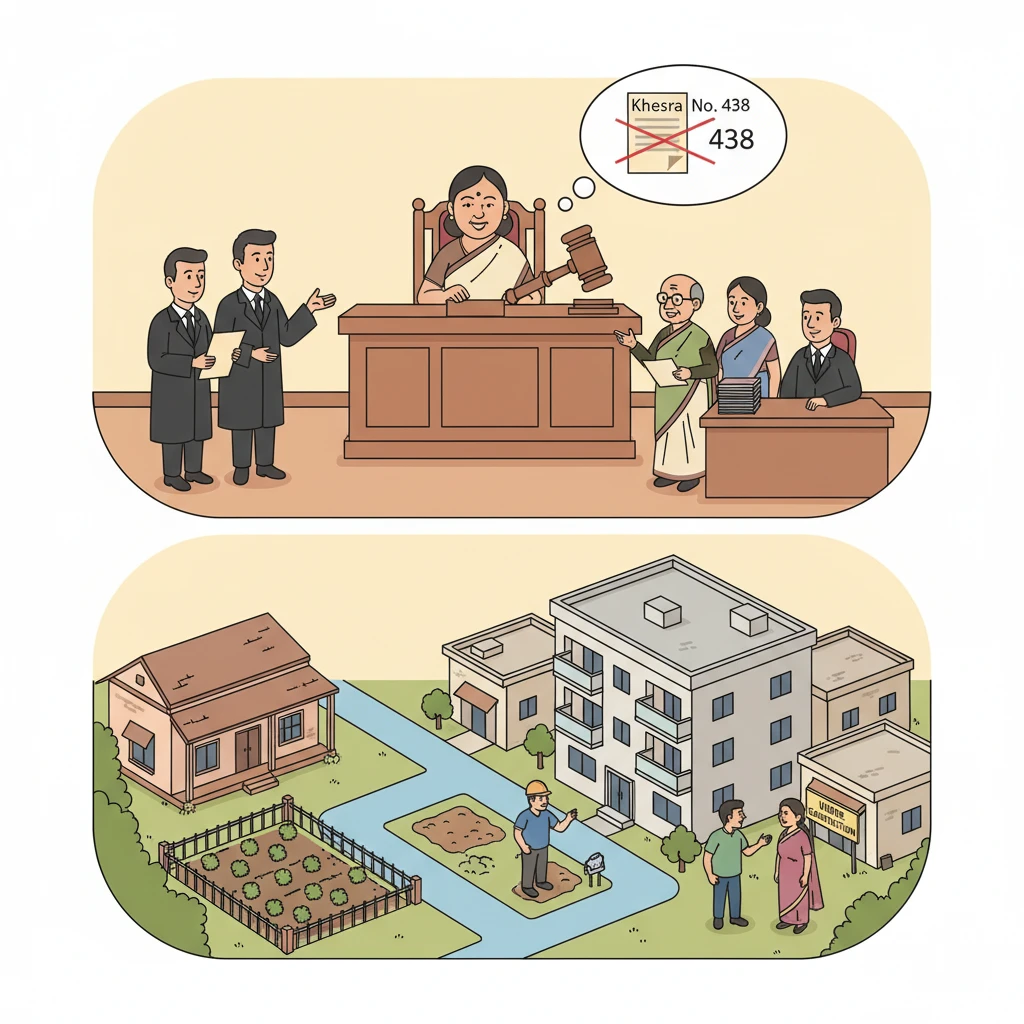
The dispute arises from a small strip of land described as a service lane in Mohalla Jogsar, Chandi Prasad Lane, Ward No. 20, under Kotwali Thana, District Bhagalpur.
The plaintiffs claim this lane is a private “rasta” attached to their house and kitchen garden, situated on land purchased by their common ancestor, Ram Narayan Tiwary, through a registered sale deed dated 27.10.1944. In that sale deed the lane is described as “gali niz wo waste aamadraft mehtarani” and has been used, according to them, as a common service lane for the family. It is commonly known as Shiv Jatan Pandey Lane.
The plaintiffs say the lane is 90 feet long and 12 feet wide, covering 1080 sq. ft., and shaped like a big “L”. One arm touches their kitchen garden to the west of their house, and the second arm meets the main road running north–south.
According to the plaint, the first set of defendants (respondent nos. 1 to 3) entered into a development agreement with a builder and developer (respondent no. 5) for construction of a multi-storeyed apartment on their adjoining plot, lying to the south of the plaintiffs’ house.
The plaintiffs allege that after construction started, the defendants, in collusion, tried to dispossess them from this service lane. They further claim that the apartment is being built in violation of municipal laws, leaving no open space, and that their easementary rights to light and fresh air are being affected. They say defendant no. 5 wants to dig a trench on the service lane along with the adjoining plot handed over by the first party defendants.
When their requests were allegedly ignored, plaintiff no. 1 served a legal notice on the builder (defendant no. 5) and filed an application before the Town Commissioner, Municipal Corporation, Bhagalpur. Alleging inaction and collusion between the Town Commissioner (respondent no. 10) and the builder, the plaintiffs filed Title Suit No. 487 of 2021 before the Sub Judge-1, Bhagalpur.
In that title suit, they sought a declaration of their title and confirmation of possession over the service lane (described in Schedule 1 of the plaint), along with an ad interim injunction restraining the defendants from interfering with the lane, and a direction that the defendants follow municipal and building by-laws.
The defendants filed written statements contesting the suit. Before issues could be framed by the trial court, the present petitioner (plaintiff no. 1) filed an application under Order 6 Rule 17 read with Section 151 of the Code of Civil Procedure (CPC) on 16.03.2022, seeking several amendments to the plaint.
On 15.02.2023, the Sub Judge-1, Bhagalpur, rejected that amendment application. Aggrieved, plaintiff no. 1 approached the Patna High Court in Civil Miscellaneous Jurisdiction No. 257 of 2023, seeking to set aside the trial court’s order.
What the Court Examined and Decided
Hon’ble Mr. Justice Arun Kumar Jha of the Patna High Court examined whether the Sub Judge was right in rejecting the proposed amendments to the plaint at this pre-trial stage.
The petitioner argued that the impugned order was perverse, illegal and irrational. He stressed that the suit was still at an early stage, issues had not been framed, and the amendment would not change the basic nature of the suit, which remained a title and injunction suit regarding the same service lane.
According to the petitioner, there were two main strands to the amendments sought:
First, a correction of what was described as a typographical error. Throughout the body of the plaint and boundaries, the land of the plaintiffs was mentioned as Khesra No. 438 of Khata No. 553. However, in the schedule of the plaint, the Khesra was written as 428 instead of 438. The amendment sought to correct this mistake.
Second, the petitioner wanted to enhance the described area of the suit property and adjust its boundaries. He claimed that defendants had encroached upon and amalgamated portions of his land (under Khesra No. 438, Khata No. 553) into their land under Khata No. 240, Khesra No. 437, and that the service lane extended into Khesra Nos. 436 and 437. He further said that describing the lane as only 1080 sq. ft. was incorrect in light of the 1944 sale deed. Hence, the total area and boundaries needed correction to capture the alleged encroachment.
The petitioner submitted that this did not amount to changing the cause of action. It only clarified and expanded the description of the very same lane that was always in dispute, in order to properly determine the real controversy between the parties.
He contended that the trial court wrongly insisted on “due diligence” under the proviso to Order 6 Rule 17 CPC, even though the trial had not commenced. That requirement, he argued, applies only after the trial begins, not at the pre-trial stage when issues are still not framed.
On the other side, various sets of respondents opposed the amendment on multiple grounds, including:
That allowing the amendment would prejudice their rights by enlarging the suit land and changing its nature and character; that the plaintiff was trying to introduce an entirely new case and grab portions of land which respondents claimed to have possessed for decades; that there were allegations of forgery in the signatures of some co-plaintiffs on the plaint and vakalatnama; that the amendment application was not properly verified or supported by affidavit; that there was failure of due diligence; and that a brother of the petitioner had already filed a separate Title Suit No. 601 of 2022 over the same land.
The builder (respondent no. 5) additionally argued that the petitioner was trying to completely replace the original suit property—changing khata and khesra numbers, area and boundaries—and that such a change was beyond the scope of simple amendment and would amount to filing a new suit.
The High Court first noted that the amendment had been sought at the initial stage of the suit. Written statements had been filed, but issues had not been framed and the trial had not begun. On this foundation, the Court held that the stricter “due diligence” test in the proviso to Order 6 Rule 17 CPC did not apply.
The Court then examined the objection that the plaintiff had knowledge of the facts earlier and had allegedly played fraud. Justice Jha observed that questions of alleged fraud could be independently raised and decided by the trial court, where applications were already pending. Unless there was a clear finding of fraud, those allegations were not relevant for deciding whether the plaint could be amended.
Referring to Order 6 Rule 17 CPC and a series of Supreme Court decisions, including:
- Pirgonda Hongonda Patil v. Kalgonda Shidgonda Patil & Ors., AIR 1957 SC 363
- M/s. Revajeetu Builders & Developers v. M/s. Narayanaswamy & Sons & Ors., (2009) 10 SCC 84
- Rajesh Kumar Aggarwal v. K.K. Modi, (2006) 4 SCC 385
- Andhra Bank v. ABN Amro Bank N.V. & Ors., AIR 2007 SC 2511
the Patna High Court reiterated the settled principles:
Amendments should generally be allowed if they are necessary to decide the real questions in controversy and do not cause injustice to the other side; the Court should not examine the merits or correctness of the proposed amendment at this stage; and pre-trial amendments are to be allowed liberally.
Justice Jha quoted with approval the “real controversy” and “justice, equity and good conscience” tests, as well as the guidelines from Revajeetu Builders, such as asking whether the amendment is imperative for proper adjudication, whether it is bona fide, whether prejudice can be compensated by costs, and whether it fundamentally changes the nature and character of the case.
Applying these tests to the facts, the Court held that the amendments could not be said to be mala fide or unjust to the respondents. The basic nature of the suit remained the same: declaration of title and confirmation of possession over the disputed service lane, with consequential injunctions.
Even with the proposed changes to area and boundary, no new form of relief was being added. The core dispute over the plaintiffs’ right to the lane continued. The nature of the suit, therefore, did not change.
The Court pointed out that the defendants would have full opportunity to rebut the amended pleadings by filing additional or amended written statements. Hence, there was no irremediable prejudice. Any inconvenience could be addressed through pleadings and evidence at trial.
The High Court also criticised the trial court’s reasons for refusal. It held that the Sub Judge wrongly focused on due diligence even though the trial had not begun and improperly went into the merits of the proposed amendment and into the question of another suit pending. These were not valid grounds at the amendment stage and amounted to erroneous exercise of jurisdiction.
As for objections about procedural defects in verification or affidavit, Justice Jha treated these as technical issues which should not override substantive justice, especially when the trial court itself had not directed any correction or taken adverse view on those aspects.
In conclusion, the Patna High Court set aside the order dated 15.02.2023 passed by the Sub Judge-1, Bhagalpur, in Title Suit No. 487 of 2021. The plaintiff’s amendment application dated 16.03.2022 under Order 6 Rule 17 CPC was allowed.
The Court, however, explicitly safeguarded the defendants’ rights by directing that they would be given ample opportunity to file amended or additional written statements to meet the amended case.
With these directions, the civil miscellaneous petition was allowed, and all pending interlocutory applications stood disposed of.
Why This Judgment Matters
This judgment is important for property and family disputes where mistakes in the plaint or later developments need to be added.
Many litigants in Bihar, especially in old family properties with narrow lanes and complicated khata–khesra histories, discover errors in their documents after filing suit. They fear that courts will not let them correct these mistakes.
The Patna High Court has made it clear that, before the trial starts, courts should take a liberal view. Corrections in plot numbers, areas, or boundaries, or even some enlargement of the described property, can be permitted if they help in deciding the real dispute and do not change the basic nature of the suit.
The judgment also sends a message to trial courts not to reject amendments by treating technical questions—like alleged lack of due diligence or parallel suits—as barriers at the initial stage, so long as the other side can respond through their own pleadings and evidence.
At the same time, the High Court has kept open the respondents’ right to press fraud or forgery allegations before the trial court. This means procedural fairness in pleadings does not wipe out serious accusations; they will be examined separately on evidence.
Legal Issues and Answers
-
Issue: Can a trial court refuse to allow an amendment of the plaint at the pre-trial stage by invoking the “due diligence” requirement and by assessing the merits of the proposed amendment?
Answer: No. The Patna High Court held that before commencement of trial, the “due diligence” proviso to Order 6 Rule 17 CPC does not apply, and courts should not decide the merits of the amendment at this stage. Pre-trial amendments necessary to decide the real controversy should be allowed liberally. -
Issue: Does correcting plot numbers, area, and boundaries of the suit property in a title and injunction suit necessarily change the nature of the suit and justify rejection of amendment?
Answer: No. The Court held that where the basic relief—declaration of title and confirmation of possession over the same disputed property—remains the same and no new relief is introduced, such amendments do not change the nature of the suit. Defendants can meet the amended case by filing additional written statements. -
Issue: Do allegations of fraud in filing the suit bar consideration of an amendment application?
Answer: Not at this stage. The Court observed that issues of alleged fraud can be pursued before the trial court through appropriate applications and orders. Unless there is a clear finding of fraud, such allegations do not, by themselves, justify rejection of an otherwise necessary pre-trial amendment.
Cases Cited by the Court
- Pirgonda Hongonda Patil v. Kalgonda Shidgonda Patil & Ors., AIR 1957 SC 363
- M/s. Revajeetu Builders & Developers v. M/s. Narayanaswamy & Sons & Ors., (2009) 10 SCC 84
- Rajesh Kumar Aggarwal v. K.K. Modi, (2006) 4 SCC 385
- Andhra Bank v. ABN Amro Bank N.V. & Ors., AIR 2007 SC 2511
- Other Supreme Court decisions were cited in arguments by counsel (including Life Insurance Corporation of India v. Sanjeev Builders (P) Ltd., Ganesh Prasad v. Rajeshwar Prasad, Usha Devi v. Rijwan Ahmad & Ors., North Eastern Railway Administration v. Bhagwan Das, Basavaraj v. Indira & Ors., M. Revanna v. Anjanamma, State of Jharkhand & Ors. v. Ambay Cements & Anr., Meghmala & Ors. v. G. Narasimha Reddy & Ors., Ram Chandra Singh v. Savitri Devi & Ors., Sampath Kumar v. Ayyakannu & Anr., Sajjan Kumar v. Ram Kishan), but the core reasoning of the Court rests mainly on the amendment principles drawn from the cases listed above.
Case Details
Case Number: Civil Miscellaneous Jurisdiction No. 257 of 2023 (arising out of Title Suit No. 487 of 2021, Sub Judge-1, Bhagalpur)
Case Title: Dr. Ratan Kishore Tewary v. Pranav Tiwary & Ors.
Citation: 2026(1) PLJR 385
Court: High Court of Judicature at Patna
Coram: Hon’ble Mr. Justice Arun Kumar Jha
Date of Judgment: 04.09.2025
Advocates:
- For the petitioner (plaintiff no. 1): Mr. Rakesh Kumar Tiwari, Advocate; Mr. Ravish Mishra, Advocate; Mr. Kulanand Jha, Advocate
- For respondent nos. 1 & 3: Mrs. Punita Kumari Singh, Advocate
- For respondent nos. 2 & 4: Mr. Samir Kumar, Advocate
- For respondent no. 5: Mr. Gautam Kumar Kejriwal, Advocate; Mr. Alok Jha, Advocate; Mr. Mukund Kumar, Advocate
- For respondent no. 7: (Supported petitioner’s case; name mentioned in appearance as part of respondent group)
- For respondent no. 9: Ms. Pallavi, Advocate
- For respondent no. 10: Mr. Manish Kumar, Advocate
- Also shown in appearance: Mr. Sanjay Parasaran, Advocate
Nature of the Case: Civil miscellaneous petition (under Article 227/Section 115 CPC supervisory jurisdiction) challenging an order of the Sub Judge refusing amendment of plaint in a title and injunction suit concerning a service lane.
Link to Judgment: Patna High Court Judgment – C.Misc. No. 257 of 2023
If you found this explanation helpful and wish to stay informed about
how legal developments may affect your rights in Bihar,
you may consider following Samvida Law Associates for more updates.







