
Case Background
The dispute began when two petitioners, a husband and wife living in Patna, were accused of taking money from opposite party no. 2 for their business.
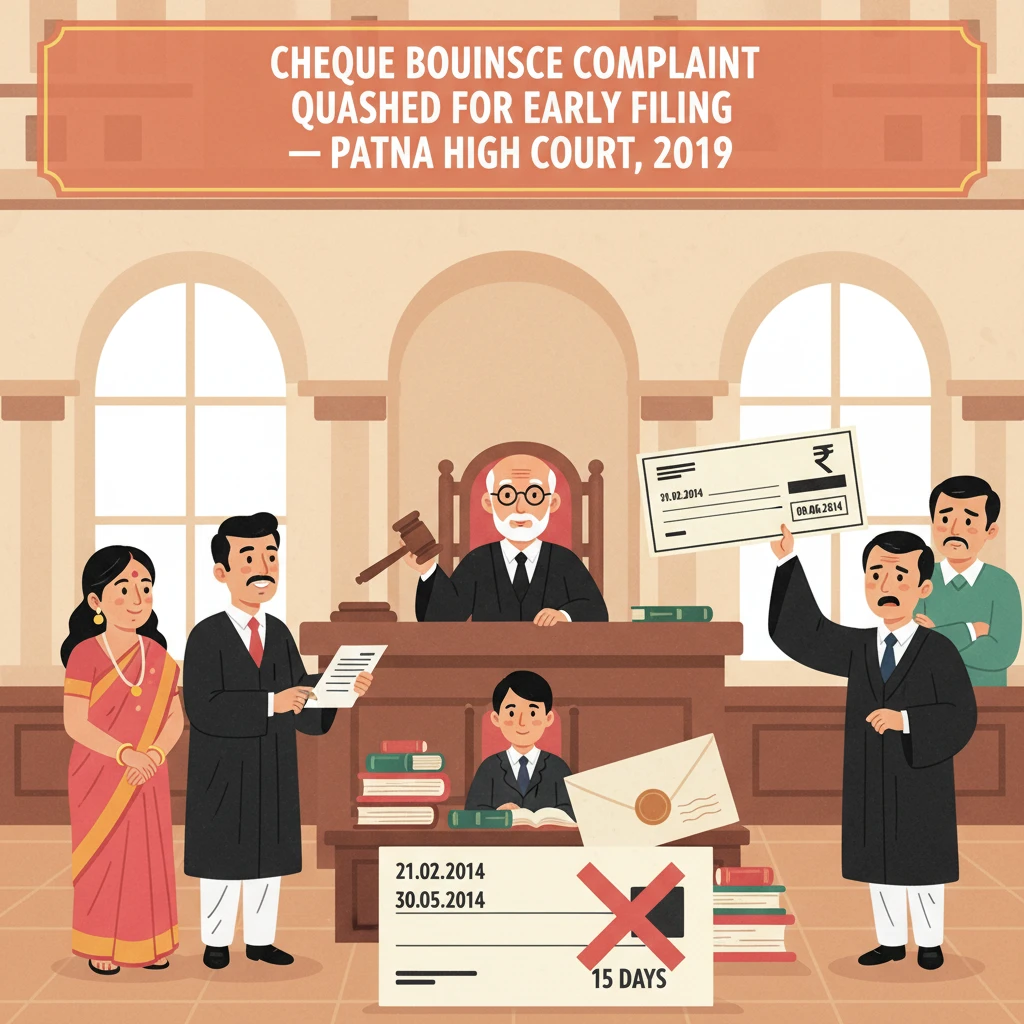
According to the complaint, they allegedly induced opposite party no. 2 to invest Rs. 11,00,000 in their business. For repayment, petitioner no. 1 issued a post-dated cheque of Rs. 11,00,000 dated 21.02.2014 in favour of opposite party no. 2.
When opposite party no. 2 presented this cheque in the bank, it was returned unpaid due to insufficient funds. A legal notice demanding payment was then sent to petitioner no. 1.
Opposite party no. 2 filed Complaint Case No. 852 of 2014 at Nawada, alleging offences under Sections 420 and 120B of the Indian Penal Code and Section 138 of the Negotiable Instruments Act, 1881.
After enquiry, the Chief Judicial Magistrate, Nawada, by order dated 30.06.2014, took cognizance only under Section 138 of the Negotiable Instruments Act and ordered issuance of summons against both petitioners.
The petitioners then approached the Patna High Court under Section 482 of the Code of Criminal Procedure, 1973, seeking to quash the cognizance order and the entire complaint, mainly on the ground that the complaint under Section 138 of the Negotiable Instruments Act was filed prematurely.
What the Court Examined and Decided
The Patna High Court, through Hon’ble Mr. Justice Ahsanuddin Amanullah, heard the petitioners, the State, and opposite party no. 2.
The core question before the Court was not whether the petitioners had actually taken money or whether they morally owed Rs. 11,00,000 to opposite party no. 2. Instead, the Court focused on a narrow but crucial technical point: whether the complaint under Section 138 of the Negotiable Instruments Act had been filed before the law allowed it.
Learned counsel for the petitioners did not dispute that a cheque for Rs. 11,00,000 dated 21.02.2014 was issued and bounced for insufficiency of funds. Their main argument was that, even if these facts were accepted, the complaint itself was filed too early and was, therefore, “non-est” in the eye of law.
The petitioners pointed out the key dates from the record. The cheque dated 21.02.2014 was returned by the bank on 21.05.2014. The legal notice demanding payment was dispatched on 26.05.2014. The postal endorsement showed that the petitioners received this notice on 30.05.2014.
Despite this, opposite party no. 2 filed the complaint on 09.06.2014.
Under Section 138 of the Negotiable Instruments Act, once the payee sends a legal notice after the cheque is dishonoured, the drawer of the cheque must be given 15 days’ time from the date of receipt of that notice to make the payment.
Only if the drawer fails to pay within those 15 days can a complaint under Section 138 be filed. If the complaint is filed before those 15 days are over, it is premature.
The petitioners argued that from 30.05.2014, the date of receipt of notice, the 15-day period would end only after 14 complete days had passed and the 15th day was over. Since the complaint was filed on 09.06.2014, it was filed before the expiry of 15 days from the date of receipt of notice.
Even if one counted from 26.05.2014, the date of the notice (which is more favourable to the complainant), the complaint was still filed on the 14th day, not after the 15 days as required by law.
To support this argument, the petitioners relied on the judgment of the Supreme Court in Yogendra Pratap Singh v. Savitri Pandey, reported in (2014) 10 SCC 713. In that case, the Supreme Court had clearly held that a complaint under Section 138 of the Negotiable Instruments Act filed before the expiry of the 15-day waiting period was not maintainable in law.
The learned A.P.P. for the State accepted that, although the conduct of the petitioners in not paying Rs. 11,00,000 to opposite party no. 2 appeared blameworthy, the strict legal requirements under Section 138 regarding notice and waiting period had not been followed in this case.
Counsel for opposite party no. 2 emphasised that the petitioners had taken a large sum of money and had failed to repay it even after the cheque bounced and a legal notice was sent. However, when confronted with the Supreme Court’s ruling in Yogendra Pratap Singh, he could not distinguish or counter it.
After considering the submissions and the admitted dates, the Patna High Court concluded that the matter turned on a purely technical but mandatory legal requirement.
The Court held that under the Negotiable Instruments Act, the drawer of the cheque must get a minimum period of 15 days from the date when he receives the legal notice to pay the cheque amount.
In this case, the complaint was filed before the completion of this minimum waiting period. Therefore, the complaint was premature and not maintainable.
The Court noted that the ratio of the Supreme Court in Yogendra Pratap Singh applied directly and squarely to the present case and supported the petitioners’ contention. On that basis, the Court held that the Chief Judicial Magistrate’s order taking cognizance under Section 138 and issuing summons could not stand.
Accordingly, the High Court quashed Complaint Case No. 852 of 2014 (C.R. No. 852/2014) and all subsequent proceedings and orders.
However, Hon’ble Justice Ahsanuddin Amanullah did not stop at simply quashing the case. Exercising the Court’s powers under Section 482 of the Code of Criminal Procedure, he considered the broader requirement to secure the “ends of justice”.
The Court highlighted that it was an admitted fact that petitioner no. 1 had issued a cheque in favour of opposite party no. 2, and that this cheque was not honoured. The Court also acknowledged that its interference was based on a technicality, even though this technicality was mandatory in law.
In other words, while the legal procedure had not been followed correctly, the underlying grievance of opposite party no. 2 about non-payment of a large amount could not be ignored.
The Court referred back to the Supreme Court’s judgment in Yogendra Pratap Singh, which itself recognised that, where an earlier complaint is dismissed as premature or defective, there is a remedy for the payee to file a fresh complaint for the same cause of action, subject to limitation rules under Section 142(b) of the Negotiable Instruments Act.
The High Court observed that if such a fresh complaint is filed beyond the normal limitation period, the complainant can seek benefit of the proviso to Section 142(b) by showing “sufficient cause” for the delay.
In the present case, the Court considered that opposite party no. 2 had been under a bona fide impression that his original complaint fulfilled all legal requirements. Only through the High Court’s decision had it become clear that the complaint was premature.
To ensure that this genuine misunderstanding did not completely defeat opposite party no. 2’s remedy, the Court gave a clear direction. It held that if opposite party no. 2 files a fresh complaint for the same cause of action within one month from the date of the High Court’s judgment, the concerned Magistrate must proceed with that complaint on merits and should not dismiss it on the ground of limitation.
Thus, while protecting the accused persons from a legally defective complaint, the Patna High Court also preserved the complainant’s right to pursue a fresh, legally valid cheque bounce case.
Why This Judgment Matters
This judgment is important for anyone involved in cheque bounce disputes under Section 138 of the Negotiable Instruments Act.
It shows that even if a cheque has clearly bounced and money is genuinely due, the criminal case can fail if the legal steps are not followed exactly.
The case makes clear that after sending a legal notice, the payee must wait for the full 15 days from the date the notice is received before filing a complaint. Filing even one day early can make the entire case illegal.
At the same time, the judgment offers reassurance to complainants. If they filed a case too early by mistake, they may still get another chance. The High Court recognised that a complainant acting under a bona fide belief should not lose his remedy entirely and allowed a fresh complaint within a fixed time.
For lawyers and litigants in Bihar, especially in cheque bounce matters in the Patna High Court and subordinate courts, this decision reinforces the need for careful calculation of dates and strict adherence to statutory requirements.
Legal Issues and Answers
- Issue: Whether a complaint under Section 138 of the Negotiable Instruments Act filed before completion of the mandatory 15-day period after receipt of legal notice is maintainable.
Answer: No. The Patna High Court, following the Supreme Court’s ruling in Yogendra Pratap Singh v. Savitri Pandey, held that such a complaint is premature and not maintainable in law. - Issue: Whether, after quashing a premature cheque bounce complaint, the complainant can be allowed to file a fresh complaint for the same cheque.
Answer: Yes. The Court held that opposite party no. 2 may file a fresh complaint for the same cause of action within one month, and the Magistrate must hear it on merits without dismissing it on limitation, subject to Section 142(b) and its proviso.
Cases Cited by the Court
- Yogendra Pratap Singh v. Savitri Pandey, (2014) 10 SCC 713
Case Details
Case Number: Criminal Miscellaneous No. 47204 of 2014; arising out of Complaint Case No. 852 of 2014 (C.R. No. 852/2014), District Nawada
Case Title: Rajesh Kumar Hembram and another v. The State of Bihar and another
Court: High Court of Judicature at Patna
Coram: Hon’ble Mr. Justice Ahsanuddin Amanullah
Date of Judgment: 26.02.2019
Citation: 2019 (3) PLJR 553
Advocates:
- For the Petitioners: Mr. Avanish Kumar Singh, Advocate
- For Opposite Party No. 2: Mr. Sunil Kumar and Mr. Navin Sharma, Advocates
- For the State: Mr. B. N. Pandey, A.P.P.
Nature of the Case: Petition under Section 482 of the Code of Criminal Procedure, 1973, seeking quashing of cognizance order under Section 138 of the Negotiable Instruments Act, 1881
Link to Judgment: View original judgment on Patna High Court website
If you found this explanation helpful and wish to stay informed about
how legal developments may affect your rights in Bihar,
you may consider following Samvida Law Associates for more updates.







