
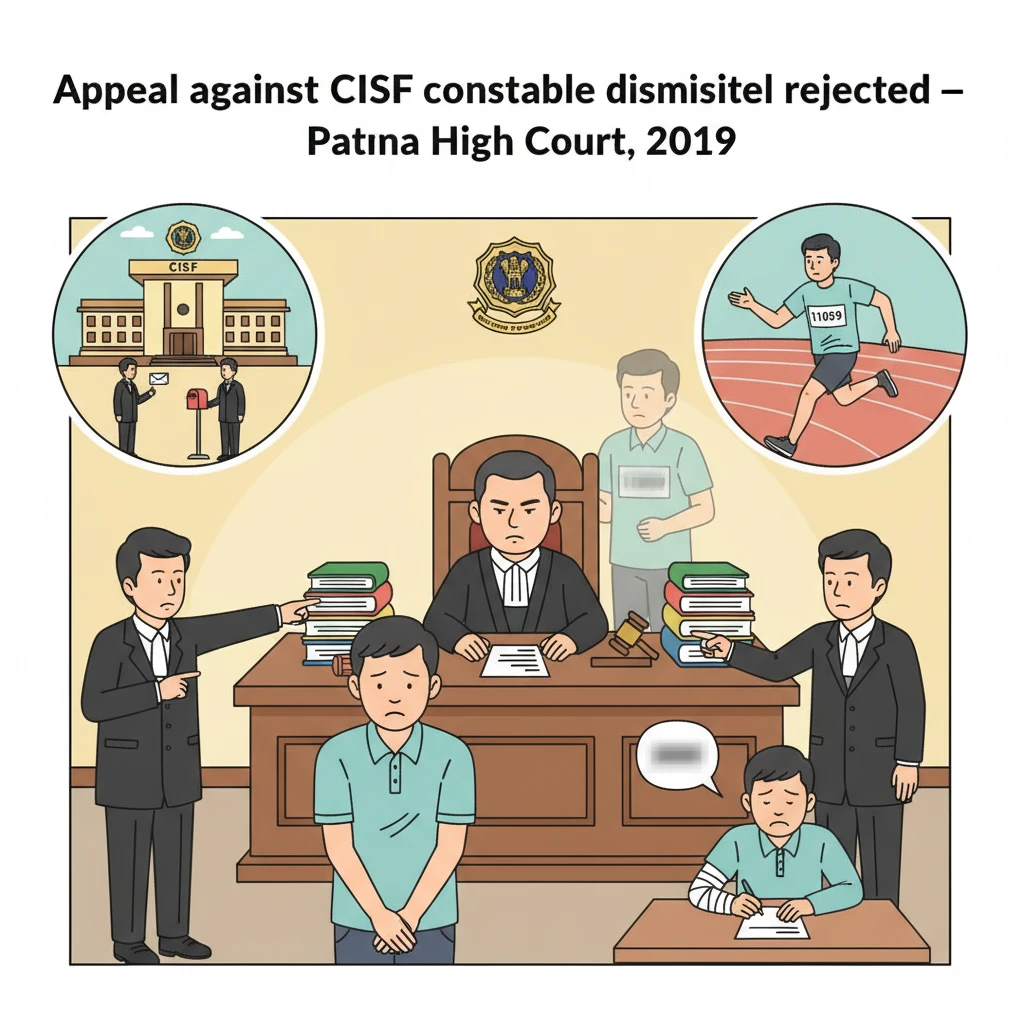
Case Background
The case arose out of recruitment to the post of Constable in the Central Industrial Security Force (CISF). The appellant, Rajiv Kumar, participated in the selection process and was selected. After his selection, he underwent training.
Almost seven months after the training, the CISF received an anonymous complaint in the name of one Mr. Pawan and Mr. Santosh. The complaint alleged serious irregularity in the appellant’s recruitment. Acting on this complaint, the CISF set an inquiry into motion.
The allegation was that during the Physical Evaluation Test, the appellant had not run himself. Instead, he had allegedly allowed another person, Sarvesh, to participate in his place. In other words, an impostor was said to have taken the physical test on behalf of the appellant.
Treating the appellant as a temporary engagee of the CISF, the authorities dispensed with his services. Against this termination, the appellant first approached the Patna High Court by filing Civil Writ Jurisdiction Case No. 11059 of 2011.
In that earlier writ petition, the High Court, by order dated 17 February 2014, set aside the termination. The Court, however, left it open to the CISF authorities to take appropriate action in accordance with law and under the Central Industrial Security Force Act, 1968 read with the Central Industrial Security Force Rules, 2001.
Following that order, the appellant was reinstated in service. At the same time, the departmental inquiry against him continued. It is the outcome of that inquiry, and the subsequent termination, which ultimately led to the present Letters Patent Appeal No. 201 of 2018 challenging the decision of a learned Single Judge.
What the Court Examined and Decided
The Division Bench, consisting of Hon’ble the Chief Justice and Hon’ble Justice Smt. Anjana Mishra, heard the appeal on 26 February 2019. The core question was whether the dismissal of the appellant from CISF service, after a departmental inquiry, was legally valid.
During the departmental inquiry, the appellant was called upon to have his statement recorded. He did appear and gave a detailed statement on 22 June 2010. He was also cross-examined. These proceedings were placed on record and discussed by the Disciplinary Authority in its order.
In his statement dated 22 June 2010, the appellant made a clear admission. He stated that when he appeared for the Physical Evaluation Test he did not run himself. Instead, he requested his friend Sarvesh Kumar to run in his place because he was suffering from an injury in his leg.
While being cross-examined during the inquiry, the appellant was specifically asked about the unlawfulness of his act. He categorically admitted that, due to unemployment and his poor financial condition, he tried to secure the job by adopting such means. This showed that he was aware that what he did was wrong, yet he still chose to do it.
The inquiry also examined documentary material. On a question regarding the allotted number of the candidate who took part in the Physical Evaluation Test, the appellant admitted that the number mentioned on the plate was his. However, he accepted that the photograph pasted in the document relating to the Physical Evaluation Test was not his photograph.
Thus, according to the materials considered by the Disciplinary Authority, two important facts emerged. First, an impostor, Sarvesh Kumar, had actually run the physical test. Second, the documents for the Physical Evaluation Test carried a photograph different from that of the appellant, though the candidate number was his.
After the inquiry concluded, the appellant tried to retract or weaken the effect of his earlier statement. He contended that during the inquiry he had been asked to sign certain documents and was forced to do so. On this basis, he argued that the statement recorded on 22 June 2010 should not be used as evidence against him.
The Disciplinary Authority examined this defence along with the entire record. It assessed the evidence and concluded that the charge against the appellant – that he had allowed someone else to run in the Physical Evaluation Test – stood proved. The allegation that his signatures on the statement had been taken forcefully was rejected as not correct.
On this basis, the Disciplinary Authority held that the appellant had gained entry into the CISF by dubious methods and terminated his services. The Appellate Authority later confirmed these findings after assessing the record.
Before the Division Bench in the Letters Patent Appeal, senior counsel for the appellant focused mainly on procedural grounds. He argued that the inquiry procedure had not been properly followed and that the principles of natural justice had been violated.
According to the appellant’s counsel, the authorities had not fixed any date specifically calling upon the appellant to produce further evidence in his defence. This, it was urged, violated Rule 36 of the Central Industrial Security Force Rules, 2001.
On the other side, the Additional Solicitor General representing the CISF referred the Court to the documents on record. He pointed out that the photographs were clearly different and that the appellant’s own admission during the inquiry was enough to corroborate the allegation of impersonation in the physical test.
The respondent’s counsel further argued that no mala fides had been alleged against the officials who conducted the selection process. The appellant had already been selected and was under training, and the inquiry was initiated only after an anonymous complaint reached the CISF almost seven months later. In this background, it was argued that the only manipulation was on the part of the appellant, in getting another person to run the Physical Evaluation Test.
The Patna High Court accepted the argument of the CISF regarding the absence of mala fides in the selection process. At the same time, the Court expressed concern about a serious lapse in the way the Physical Evaluation Test was conducted.
The Court noted that, as per the procedure for the Physical Evaluation Test, once a person entered the arena where the test was being held, he was not supposed to come out until the test was over. The appellant’s own version was that he had gone out to drink water and, during that time, another person entered and took the test in his place.
This raised a troubling question for the Court: how did the selection officials allow a different person to enter and run the test in place of the original candidate? The Bench observed that this lapse in the performance of duty by the selection team was questionable and called for an inquiry by the CISF itself.
However, the Court made it clear that this lapse on the part of the officials did not erase the evidence against the appellant. The material on record clearly showed that a different person had, in fact, participated in the Physical Efficiency Evaluation Test in place of the appellant.
In the absence of any evidence to contradict this, the appellant’s later bald denial of his statement during the inquiry did not inspire confidence. The Court held that there was no reason to take a different view from the Disciplinary and Appellate Authorities.
The Bench emphasised that the conclusions of the Disciplinary and Appellate Authorities were based on a proper assessment of the records. These findings showed that the appellant had secured entry into the CISF by dubious methods, and this required correction. Therefore, termination of his services on the strength of such evidence did not call for interference in the High Court’s extraordinary jurisdiction.
On the plea of violation of natural justice, the Court found no merit. The record showed that the appellant had been given an opportunity to participate in the inquiry and was also cross-examined. It was open to him to lead any evidence he considered important for his defence. He did not do so.
Because the appellant chose not to produce further evidence, he could not later convert this omission into a charge that the authorities had violated the principles of natural justice. The Court held that no perversity was found in the factual findings of either the Inquiry Officer or the Disciplinary Authority.
Finally, the Division Bench concluded that there was no error, much less a legal error, in the findings of the learned Single Judge or in the orders passed by the CISF authorities. The Letters Patent Appeal was therefore dismissed as lacking in merit.
Why This Judgment Matters
This judgment from the Patna High Court is important for candidates in police and paramilitary recruitment, and for serving personnel facing departmental inquiries.
First, it shows that impersonation or using an impostor in any part of the selection process is treated as a serious misconduct. Even if the candidate has already completed training and is working, such misconduct can lead to termination.
Second, the case highlights that an admission made by an employee during a departmental inquiry, combined with supporting documents like photographs and records, can be sufficient to prove charges. Later denials, without strong evidence, are unlikely to succeed.
Third, the Court clarified that where an employee has been called, has given statements, and has been cross-examined, the inquiry is not easily labelled as violating natural justice. The employee must actively use the opportunities given, including producing defence evidence.
At the same time, the judgment points out that recruitment authorities must also maintain strict discipline and fairness. The Court openly questioned how a different person was allowed to run in the physical test and suggested that the CISF should examine this lapse.
Legal Issues and Answers
- Issue: Whether the appellant’s dismissal from CISF service for allowing another person to take his Physical Evaluation Test was justified in law.
Answer: Yes. The Patna High Court held that the evidence, including the appellant’s own admission and differing photographs, proved the charge of impersonation. The termination did not warrant interference. - Issue: Whether the departmental inquiry violated Rule 36 of the Central Industrial Security Force Rules, 2001 and the principles of natural justice.
Answer: No. The Court held that the appellant had been given opportunity to participate in the inquiry, record his statement and be cross-examined, and he could have produced evidence of his choice. His failure to do so could not be turned into a claim of denial of natural justice. - Issue: Whether there was any perversity in the factual findings of the Inquiry Officer, Disciplinary Authority, or Appellate Authority warranting interference in writ or Letters Patent Appeal jurisdiction.
Answer: No. The Court found the findings to be based on evidence on record and refused to interfere, affirming the orders of the authorities and the learned Single Judge.
Cases Cited by the Court
- The judgment text does not record any specific case law citations relied upon by the Court.
Case Details
Case Number: Letters Patent Appeal No. 201 of 2018 in Civil Writ Jurisdiction Case No. 16824 of 2014; earlier related to C.W.J.C. No. 11059 of 2011
Case Title: Rajiv Kumar v. The Union of India & Ors.
Coram: Hon’ble the Chief Justice Amreshwar Pratap Sahi and Hon’ble Justice Smt. Anjana Mishra
Citation: 2019 (3) PLJR 551
Advocates: For the appellant – Mr. Yogesh Chandra Verma, Senior Advocate, with Mr. Javed Aslam, Advocate. For the respondents – Mr. S.D. Sanjay, Additional Solicitor General, with Mr. Rajesh Kumar Verma, Central Government Counsel.
Nature of the Case: Letters Patent Appeal against the judgment of a learned Single Judge in a civil writ petition concerning departmental inquiry and termination from service in CISF.
Link to Judgment: Click here to read the full judgment of the Patna High Court
If you found this explanation helpful and wish to stay informed about
how legal developments may affect your rights in Bihar,
you may consider following Samvida Law Associates for more updates.







