
Case Background
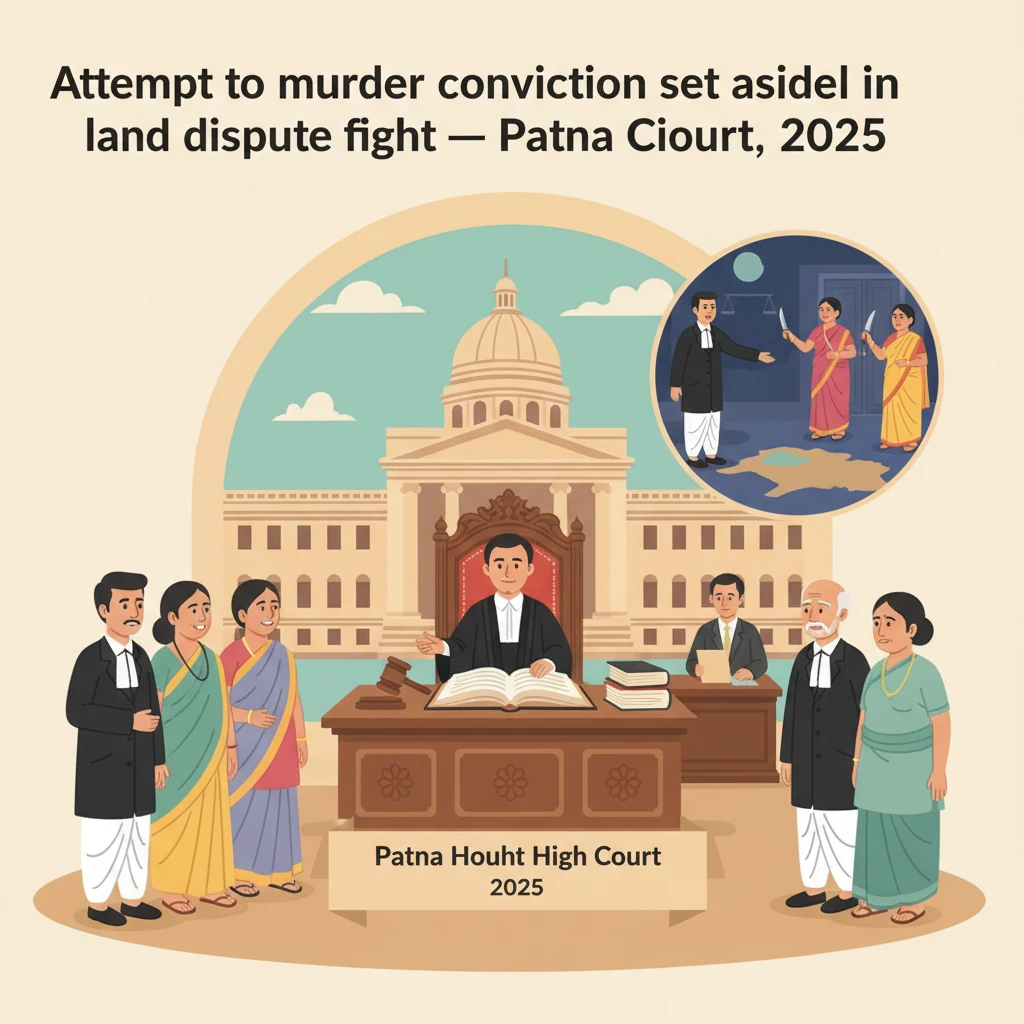
This case arose from a late-night incident in Village Mashrakh Dakshin Tola, District Saran, in October 1994. The informant, examined as PW-5, was sitting at his doorstep at about 2:00 a.m. on 18.10.1994 when the incident allegedly took place.
According to the written report given by the informant, three male accused, including two of the present appellants, arrived armed with lathi and knives. They allegedly abused him and then assaulted him when he protested. When his brother tried to intervene, he was also beaten. Soon after, three women, including appellant no. 2, allegedly joined and assaulted the informant and his brother with lathis.
The informant further alleged that a golden chain was snatched from the neck of PW-4, a woman relative. Villagers then came and pacified the matter. The informant stated that the background of the incident was a land dispute which, according to him, had been decided in his favour.
On this written report, Mashrakh P.S. Case No. 167 of 1994 was registered under sections 341, 323, 324, 307, 379, 447, 504/34 of the Indian Penal Code. After investigation, a charge-sheet was filed against all accused. Cognizance was taken and the case was committed to the Court of Session by the Chief Judicial Magistrate, Chapra, on 03.07.1995, becoming Sessions Trial No. 226 of 1995.
The trial court framed charges, which the accused denied, claiming innocence. The prosecution examined six witnesses, including the informant, his injured brother, another injured woman, two other witnesses, and the doctor (PW-6) who proved the injury reports. Certain documents, such as signatures on the fard-e-beyan and three injury reports, were exhibited.
After recording the statements of the accused under section 313 of the Code of Criminal Procedure, the 6th Additional Sessions Judge, Chapra (Siwan) convicted them. They were held guilty under section 307/34 IPC and sentenced to four years’ rigorous imprisonment. One appellant was additionally convicted under section 379 IPC and sentenced to one year’s rigorous imprisonment, with all sentences to run concurrently.
Aggrieved, the accused filed Criminal Appeal (SJ) No. 224 of 2004 before the Patna High Court under section 374(2) CrPC. During the pendency of the appeal, it abated against two appellants due to their death, by order dated 19.02.2025. The appeal, therefore, survived only for appellant nos. 2, 3 and 4.
What the Court Examined and Decided
The Patna High Court, through Hon’ble Mr. Justice Chandra Shekhar Jha, heard the appeal. When earlier appointed amicus curiae did not appear, the Court appointed Mr. Mukund Kumar as amicus curiae to assist on behalf of the appellants. The State was represented by the learned A.P.P.
The main conviction under challenge was for attempt to murder under section 307 IPC read with section 34 IPC, along with the theft charge under section 379 IPC against one appellant. The Court first referred to the text of section 307 IPC, which punishes acts done with such intention or knowledge, and under such circumstances, that if death had been caused, it would amount to murder.
The defence argued that the entire incident was a “free fight” arising from a land dispute, in which both sides received injuries. It was submitted that the informant’s side tried to dispossess the appellants from the land, and that merely because there were cut injuries, the trial court wrongly presumed an intention to kill and applied section 307 IPC. Reliance was placed on the Supreme Court decision in Jage Ram v. State of Haryana, (2015) 11 SCC 366, to underline that the nature and location of injuries and surrounding circumstances must show intention to kill for section 307 IPC to apply.
The amicus curiae also contended that the key witnesses were close family members and were interested in the outcome. Their testimonies, according to the defence, contained contradictions and could not be wholly relied upon. In this context, the decision in Namdeo v. State of Maharashtra, (2007) 14 SCC 150, was cited, which clarifies that while close relatives are natural witnesses, their evidence has to be carefully scrutinised for reliability.
A further serious objection was raised regarding the way the accused were examined under section 313 CrPC. The defence pointed out that the questions put by the trial court were cryptic and mechanical, not bringing the real incriminating circumstances to the notice of the accused. For this proposition, the defence relied on Sukhjit Singh v. State of Punjab, (2014) 10 SCC 270, where the Supreme Court emphasised that section 313 is not a mere formality and that failure to properly put incriminating material to the accused can vitiate the conviction.
It was also argued that the investigating officer (I.O.) was not examined in the trial. Because of this, contradictions in witness statements and important facts like the place of occurrence could not be properly tested, thereby harming the defence.
The State, on the other hand, supported the conviction by stressing that the injured witnesses — the informant (PW-5), his brother (PW-1) and the woman relative (PW-4) — consistently narrated the incident. According to the prosecution, the consistency of injured witnesses’ testimonies should inspire confidence and sustain the conviction.
The High Court closely examined the medical evidence. PW-1, the injured brother, had eight injuries. All were simple except injury no. 1, which was a “self-cut injury” on the front of the left shoulder measuring 2” x ½” x 1”. The rest were simple injuries on non-vital parts.
PW-5, the informant, had three injuries. Two were cut injuries — one behind the chin and one below the right knee — and the third was an abrasion below the right axilla of ½” x ¼”. The doctor found all of them simple, caused by a sharp-cutting substance.
PW-4, the woman relative, had two cut injuries, both simple. There was no evidence of any injury on vital organs, nor any indication that the injuries were life-threatening. The Court noted that most injuries were on non-vital parts, and except for one, all were simple.
The Court then considered whether these injuries, along with the surrounding facts, could prove the specific intention or knowledge required for attempt to murder. It held that, with such injuries on non-vital parts and in the background of a land dispute, it could not be safely concluded that the appellants had an intention to kill.
The High Court also pointed out contradictions in the oral evidence. PW-5 had stated that two appellants were armed with knives and one with lathi. But during his examination-in-chief he said that a person said to be armed with lathi had actually assaulted him with a knife on the cheek below his eye. There was no explanation how a person allegedly armed with lathi could have used a knife, and no evidence that any knife was passed to him. PW-5 also said that the same person assaulted PW-4 with lathi, creating further doubt about his version that he was attacked with knife by that accused.
The Court observed that such inconsistencies raised serious doubt about the prosecution narrative, especially when coupled with the simple nature and location of injuries. It also noted that the defence had shown that a counter-case was filed by the appellants’ side — Marhorwa P.S. Case No. 169 of 1994 — lodged by Chameli Devi, wife of one of the accused, on the basis of information given in Sadar Hospital on 18.10.1994 regarding an occurrence on 17.10.1994.
In that counter-case, the present informant and others were accused. Upon trial, three of them, including the informant (PW-5) and his brother (PW-1), were convicted under sections 341 and 323 IPC and were released under the Probation of Offenders Act after due admonition. The High Court highlighted that these convicted persons later appeared as prosecution witnesses in the present case, so their testimonies had to be scrutinised with extra care. Referring to the principle from Namdeo, the Court noted that while close relatives are not automatically disbelieved, their evidence must be “intrinsically reliable, inherently probable and wholly trustworthy,” which was not the situation here.
Turning to the section 313 CrPC issue, the High Court referred in detail to paragraphs 10 to 13 of Sukhjit Singh, which in turn relied on earlier landmark cases like Tara Singh v. State and Hate Singh Bhagat Singh v. State of Madhya Bharat. These judgments stress that each material circumstance against the accused must be put simply and separately so that even an illiterate or disturbed person can understand and offer an explanation. A conviction based on failure to explain something never properly put to the accused is bad in law.
Applying this law, the High Court found that the statements of the appellants were not recorded in line with these settled principles. The questions were cryptic and mechanical, failing to clearly draw their attention to the main incriminating circumstances. The Court held that this defect, by itself, made the trial court’s judgment “questionable.”
The non-examination of the investigating officer further weakened the prosecution case, as contradictions and important facts could not be properly tested. Taken together — the simple, non-vital injuries, the land dispute and counter-case, contradictions in the evidence, interested witnesses whose earlier conviction related to the same dispute, and defective section 313 examination — the High Court concluded that the prosecution had not proved its case beyond reasonable doubt.
Granting the benefit of doubt to the appellants, the Patna High Court set aside the judgment of conviction dated 01.04.2004 and the order of sentence dated 06.04.2004 in Sessions Trial No. 226 of 1995. The appeal was allowed. Appellant nos. 2, 3 and 4 were acquitted of all charges. As they were already on bail, they were discharged from their bail bonds, their sureties were discharged, and any fine paid was ordered to be returned.
The Court also directed that the lower court records be sent back and a copy of the judgment be transmitted to the trial court. Further, the Patna High Court Legal Services Committee was directed to pay Rs. 5,000 to the amicus curiae as consolidated fee for his professional assistance.
Why This Judgment Matters
This judgment is important for people involved in criminal cases arising out of village land disputes and group fights. It shows that not every assault with a sharp weapon will automatically be treated as attempt to murder.
The Patna High Court made it clear that courts must look at the intention behind the act, the part of the body where injuries are caused, and whether the injuries are simple or serious. When injuries are mostly simple and on non-vital parts, it becomes difficult to sustain a conviction under section 307 IPC.
The judgment also highlights that when both sides have lodged criminal cases and some witnesses have already been convicted in a counter-case, their evidence must be examined with great care. They are natural witnesses, but may also have reasons to exaggerate or twist events.
Another key lesson from this case is about the rights of accused persons during trial. Section 313 CrPC gives them a chance to explain the evidence against them. If this is done in a casual or mechanical way, the entire trial can be questioned.
For ordinary citizens, this decision underlines that courts will not blindly accept prosecution stories. Doubts in medical evidence, contradictions in statements, and procedural lapses can all help prevent wrongful convictions.
Legal Issues and Answers
- Issue: Did the injuries and circumstances of the case prove an intention or knowledge sufficient to sustain a conviction for attempt to murder under section 307 IPC?
Answer: No. The injuries were mostly simple and on non-vital parts, and the background was a land dispute with a counter-case. The Court held that intention to kill was not established beyond reasonable doubt. - Issue: Could the conviction stand when the statements of the accused under section 313 CrPC were recorded in a cryptic and mechanical manner?
Answer: No. Relying on Supreme Court precedents, the Court held that such defective examination under section 313 CrPC made the trial court judgment questionable and contributed to setting aside the conviction. - Issue: Were the testimonies of related and interested prosecution witnesses, already convicted in a counter-case, sufficient on their own to uphold the conviction?
Answer: No. Their evidence, when read with contradictions, simple injuries, non-examination of the I.O., and the counter-case, did not inspire the level of confidence needed for a conviction. The benefit of doubt went to the appellants.
Cases Cited by the Court
- Jage Ram v. State of Haryana, (2015) 11 SCC 366.
- Namdeo v. State of Maharashtra, (2007) 14 SCC 150.
- Sukhjit Singh v. State of Punjab, (2014) 10 SCC 270.
- Tara Singh v. State, 1951 SCC 903 : AIR 1951 SC 441 : (1951) 52 Cri LJ 1491.
- Hate Singh Bhagat Singh v. State of Madhya Bharat, 1951 SCC 1060 : AIR 1953 SC 468 : 1953 Cri LJ 1933.
- Ajay Singh v. State of Maharashtra, (2007) 12 SCC 341 : (2008) 1 SCC (Cri) 371.
- Ranvir Yadav v. State of Bihar, (2009) 6 SCC 595 : (2009) 3 SCC (Cri) 92 (referred in Sukhjit Singh extract).
Case Details
Case Number: Criminal Appeal (SJ) No. 224 of 2004; arising out of Mashrakh P.S. Case No. 167 of 1994.
Case Title: Janki Devi & Ors v. The State of Bihar.
Citation: 2026 (1) PLJR 218.
Coram: Hon’ble Mr. Justice Chandra Shekhar Jha.
Advocates: Mr. Mukund Kumar, Advocate, Amicus Curiae for the appellants; Mr. Satyendra Narayan Singh, APP for the State.
Date of High Court Judgment: 22.11.2025.
Trial Court Details: Judgment of conviction dated 01.04.2004 and order of sentence dated 06.04.2004 passed in Sessions Trial No. 226 of 1995 by the 6th Additional Sessions Judge, Chapra (Siwan).
Nature of the Case: Criminal appeal under section 374(2) of the Code of Criminal Procedure against conviction under sections 307/34 and 379 of the Indian Penal Code.
Link to Judgment: Full text of Patna High Court judgment.
If you found this explanation helpful and wish to stay informed about how legal developments may affect your rights in Bihar, you may consider following Samvida Law Associates for more updates.







