
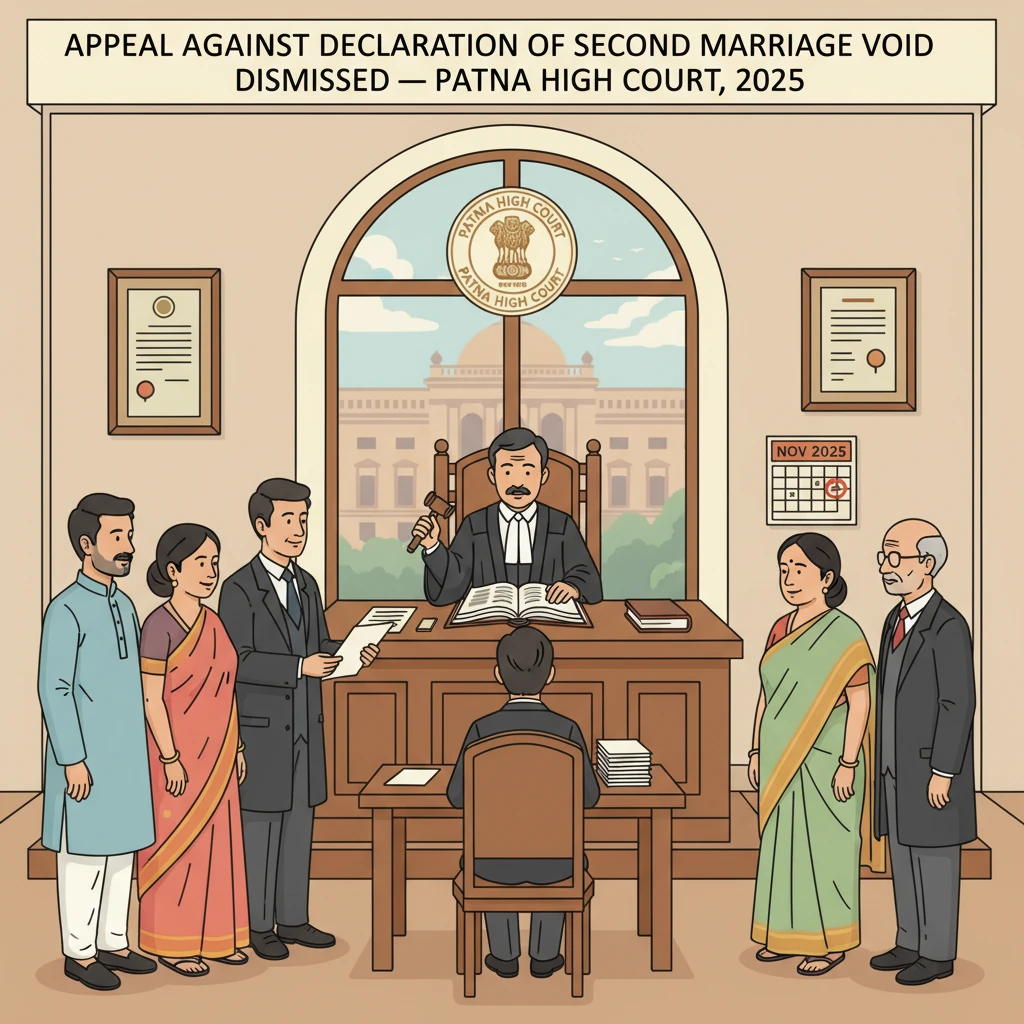
Case Background
The dispute started when the first wife filed Matrimonial Case No. 176 of 2010 before the Principal Judge, Family Court, Begusarai.
She sought a declaration that the marriage between her husband (Opposite Party No.1/appellant before the High Court) and another woman (Opposite Party No.2/respondent 2nd set) was null and void. The case was registered as Registration No. 1148 of 2013.
The Family Court framed four issues. It held that the case was maintainable, that a valid marriage had been solemnised between the first wife and the husband on 29.06.2001 at village Lakho, P.S. Muffasil, District Begusarai, that the husband had entered into another marriage during the subsistence of this marriage in violation of Section 5(i) of the Hindu Marriage Act, and that the first wife was entitled to relief under Section 11 of the Hindu Marriage Act.
On that basis, by judgment dated 29.09.2022 and decree dated 14.10.2022, the Family Court, Begusarai, declared the second marriage between Opposite Party No.1/appellant and Opposite Party No.2/respondent 2nd set to be null and void.
Aggrieved, the husband filed Miscellaneous Appeal No. 587 of 2022 before the Patna High Court under Section 19(1) of the Family Courts Act, 1984, challenging both the judgment and the decree of the Family Court.
What the Court Examined and Decided
The appeal came before a Division Bench of the Patna High Court comprising Hon’ble Mr. Justice Bibek Chaudhuri and Hon’ble Mr. Justice Dr. Anshuman. The judgment was authored by Hon’ble Mr. Justice Dr. Anshuman on 05.12.2025.
The husband, as appellant, raised two main grounds. First, he claimed that the Family Court failed to properly consider the oral evidence of PW 3, who is the father of the applicant/respondent 1st set (the first wife). He argued that if PW 3’s evidence had been correctly appreciated, the Family Court could not have decreed the suit.
Second, he argued that the very suit filed by the first wife before the Family Court was barred by Section 34 of the Specific Relief Act, 1963. According to him, since the first wife had not asked for restoration of conjugal rights or any further relief beyond a declaration, the suit was not maintainable. He relied on the proviso to Section 34, which says a court shall not make a declaration where the plaintiff, being able to seek further relief than a mere declaration, omits to do so.
Respondent No.1 (the first wife) was served with notice of the appeal through her father. The appellant filed a petition of jointness regarding service, which was accepted by the Court, and service upon her was treated as valid.
Respondent No.2 (the second woman) entered appearance through vakalatnama and, significantly, supported the stand of the appellant. Her counsel argued that the appeal was maintainable, that the Family Court suit was barred under Section 34 of the Specific Relief Act, and that the first wife, having not sought restitution of conjugal rights or any further relief, could not be granted a declaratory decree.
After hearing, the case was listed for consideration under Order XLI Rule 11 of the Code of Civil Procedure, and arguments were completed on 25.11.2025. The judgment was delivered on 05.12.2025.
The High Court then narrowed the controversy to two “points of determination”:
(i) Whether non-consideration (as alleged) of the oral evidence of PW 3 was so serious that it would demolish the entire judgment and decree of the Family Court.
(ii) Whether Section 34 of the Specific Relief Act barred the declaratory suit before the Family Court, and, if so, what would be the effect on the judgment and decree in Matrimonial Case No. 176 of 2010.
First point: role of PW 3’s evidence and standard of proof
On the first point, the Division Bench closely looked at the manner in which the Family Court had dealt with the evidence while deciding Issue No. II (about the marriage between the first wife and the appellant).
The High Court noted that the Family Court had not relied only on PW 3’s evidence. It had considered the evidence of PW 1, 15 photographs produced by PW 1 (Exhibits 6 to 6N), the document dated 21.04.2014 placed before the Mediation Centre, Begusarai (Exhibit 12), Exhibit 7, Exhibit 10A (in which the appellant had given an undertaking and made a statement on affidavit before the High Court), and Exhibits 9 and 11.
The Bench also pointed out that the Family Court had discussed the burden of proof and observed that the appellant had to stand on his own documents.
Importantly, the High Court reminded that this was a civil proceeding, and therefore the standard of proof is “preponderance of probability.” The Family Court had reached its conclusions on the basis of several oral and documentary pieces of evidence together, and had found the preponderance of probability in favour of the applicant/respondent 1st set.
In that backdrop, the High Court held that even if there were minor contradictions or alleged shortcomings in the oral evidence of PW 3, they would not help the appellant. Those alleged defects were not enough to overturn the entire judgment and decree based on a large body of evidence.
The Court therefore decided the first point of determination against the appellant, holding that there was no fatal error regarding PW 3’s evidence.
Second point: whether Section 34 of the Specific Relief Act bars the suit
On the second point, the Court examined whether Section 34 of the Specific Relief Act applies to matrimonial cases filed before Family Courts.
The Bench set out the text of Section 34, which provides that a person entitled to any legal character or right to any property may file a suit for a declaration, but the Court shall not grant such declaration where the plaintiff, being able to seek further relief than a mere declaration, omits to do so.
The Court then shifted focus to the Family Courts Act, 1984, because the matrimonial case had been filed and decided under this Act.
First, it referred to Section 7 of the Family Courts Act, particularly Section 7(1) Explanation (b). This provision clearly says that a suit or proceeding for a declaration as to the validity of a marriage or to matrimonial status of any person is maintainable before a Family Court.
Second, the Court referred to Section 10(1) of the Family Courts Act, which says that, subject to other provisions of the Act and the rules, the Code of Civil Procedure and other laws in force shall apply to suits before Family Courts, and the Family Court shall be deemed to be a Civil Court with all powers of such Court.
Third, and crucially, the Bench considered Section 20 of the Family Courts Act, which gives the Act an overriding effect. Section 20 provides that the provisions of the Family Courts Act shall have effect notwithstanding anything inconsistent therewith contained in any other law for the time being in force or in any instrument having effect by virtue of any law other than this Act.
On this basis, the Court reasoned that the principles in the Specific Relief Act, 1963, including Section 34, do not override or restrict suits filed under the Family Courts Act. The Family Courts Act came into force later, in 1984, while the Specific Relief Act is from 1963. Through Section 20, the later Act prevails over earlier inconsistent laws.
The Bench therefore held that even if the applicant/respondent 1st set did not pray for restoration of conjugal rights or any further relief, that omission would not bar her suit in the Family Court.
The judgment notes that, while deciding Issue No. 4, the Principal Judge, Family Court, had indicated this aspect and had restrained himself from granting any further relief under Section 11 of the Hindu Marriage Act beyond what was claimed. But this did not render the judgment and decree illegal.
Due to the overriding effect of Section 20, the non-demand of additional relief did not cast any doubt on the maintainability of the suit or on the legality of the decree.
The second point of determination was accordingly answered against the appellant, affirming that Section 34 of the Specific Relief Act did not bar the declaratory matrimonial suit.
Final outcome
After dealing with both points of determination, the High Court concluded that there was no illegality in the Family Court’s judgment and decree dated 29.09.2022 and 14.10.2022 in Matrimonial Case No. 176 of 2010.
Finding no reason to interfere, the Division Bench dismissed Miscellaneous Appeal No. 587 of 2022. The declaration that the marriage between Opposite Party No.1/appellant and Opposite Party No.2/respondent 2nd set is null and void, as granted by the Family Court, thus stands confirmed.
Why This Judgment Matters
This judgment matters for spouses who discover that their husband or wife has married another person while the first marriage is still valid.
The Patna High Court has made it clear that a person can approach the Family Court directly for a declaration about the validity of a marriage or their matrimonial status. Such a declaratory suit is maintainable even if no additional relief, like restitution of conjugal rights, is claimed.
The decision also shows that Family Courts, when deciding such cases, look at the overall material and decide on the basis of “preponderance of probability.” Minor inconsistencies in one witness’s testimony will not defeat a case that is otherwise supported by several documents, photographs and earlier statements.
For people facing similar situations, this judgment confirms that the Family Court has wide powers under the Family Courts Act, and that those powers are not cut down by the limitations found in the Specific Relief Act.
Legal Issues and Answers
- Issue: Did the Family Court commit a serious error by allegedly not properly considering the oral evidence of PW 3, the father of the first wife?
Answer: No. The High Court held that the Family Court had relied on multiple oral and documentary evidences and decided on the basis of preponderance of probability. Minor contradictions in PW 3’s evidence were not enough to overturn the decree. - Issue: Was the declaratory matrimonial suit before the Family Court barred by Section 34 of the Specific Relief Act because the first wife did not seek further relief like restitution of conjugal rights?
Answer: No. The High Court held that Section 7 and Section 20 of the Family Courts Act give specific and overriding jurisdiction to the Family Court to declare the validity of a marriage or matrimonial status. Therefore, Section 34 of the Specific Relief Act does not bar such a suit. - Issue: Should the High Court interfere with the Family Court’s decree declaring the second marriage null and void?
Answer: No. Finding no illegality in the reasoning or findings of the Family Court, the High Court dismissed the appeal and upheld the decree of nullity.
Cases Cited by the Court
- The judgment does not mention or rely upon any other reported case law. No external precedents are cited.
Case Details
Case Number: Miscellaneous Appeal No. 587 of 2022; arising out of Matrimonial Case No. 176 of 2010 (Registration No. 1148 of 2013) before the Family Court, Begusarai.
Case Title: Anjani Kumar @ Pappu Kumar v. Mamta Bharti & Rukmini @ Mansa
Coram: Hon’ble Mr. Justice Bibek Chaudhuri and Hon’ble Mr. Justice Dr. Anshuman
Citation: 2026 (1) PLJR 224
Advocates:
For the Appellant (Opposite Party No.1/husband): Mr. Jitendra Prasad Singh, Sr. Advocate; Mr. Varun Krishna Singh, Advocate; Mr. Vankatesh Kaushik, Advocate.
For the Respondents: Ms. Shripriya Sinha, Advocate; Mr. Rajeev Kumar, Advocate.
Nature of the Case: Miscellaneous Appeal under Section 19(1) of the Family Courts Act, 1984, against a decree in a matrimonial declaratory suit (declaration of second marriage as null and void).
Date of High Court Judgment: 05.12.2025
Impugned Judgment and Decree: Judgment dated 29.09.2022 and decree dated 14.10.2022 passed by Principal Judge, Family Court, Begusarai, in Matrimonial Case No. 176 of 2010.
Link to Judgment: Patna High Court Judgment in MA No. 587 of 2022
If you found this explanation helpful and wish to stay informed about
how legal developments may affect your rights in Bihar,
you may consider following Samvida Law Associates for more updates.







