
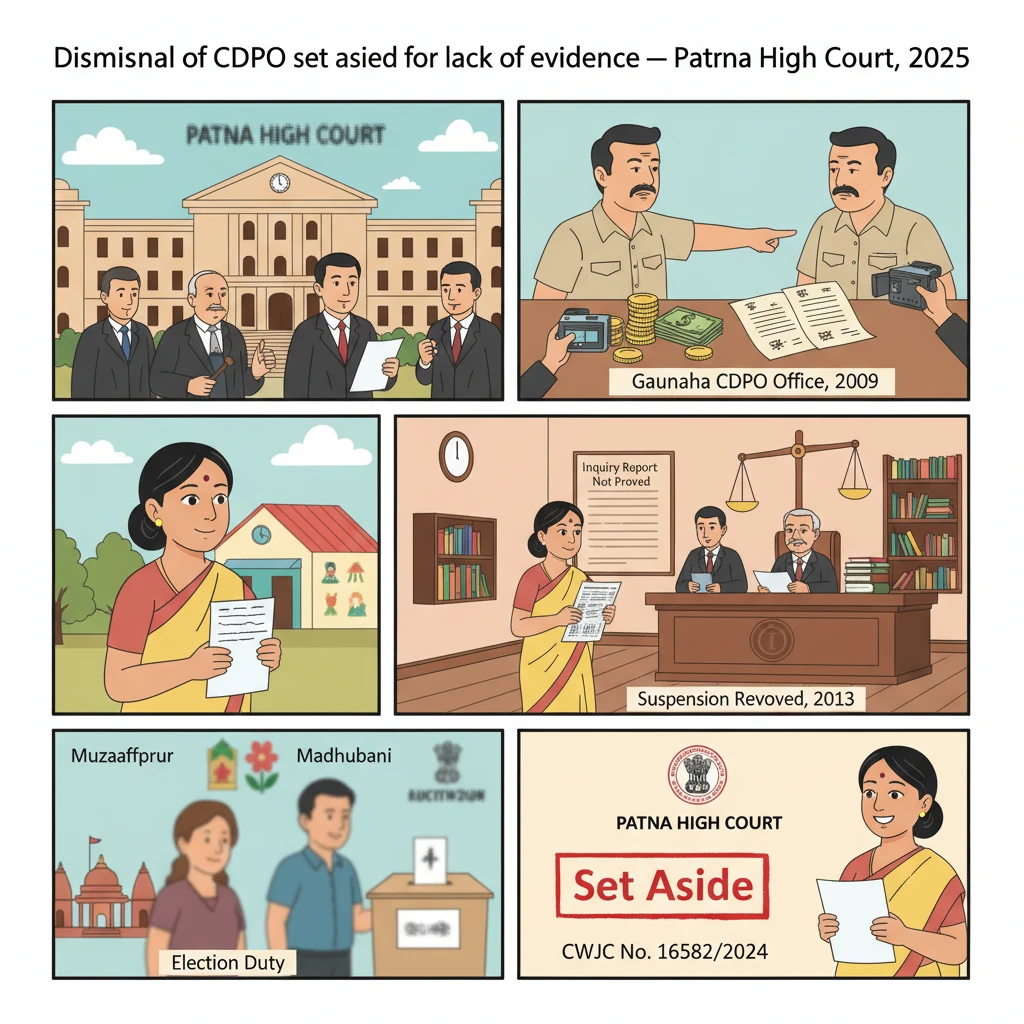
The Court found that no proper evidence was led in the departmental enquiry.
The dismissal order and review rejection were quashed.
The officer will now get back all service and monetary benefits as per law.
Case Background
The petitioner was appointed as a Child Development Project Officer (CDPO) on 19.05.2008. She was first posted at Bettiah and later given additional charge of CDPO, Gaunaha.
At Gaunaha, the then Block Development Officer (BDO), who was also holding charge of CDPO, did not initially hand over charge to the petitioner. After the District Magistrate and the District Programme Officer intervened, the petitioner finally took charge. According to the petitioner, this caused serious annoyance to the then BDO.
On 25.06.2009, the then BDO at Gaunaha reportedly received secret information that illegal collection of money was going on in the CDPO office at the instance of the petitioner, the head assistant and others. Acting on this, she went to the CDPO office, where she allegedly found Rs. 43,750/- and three pages showing amounts collected from 67 Anganwadi Sevikas. This incident was said to have been videographed.
On the statement of the then BDO, Gaunaha P.S. Case No. 23 of 2009 (Special Case No. 25 of 2009) was registered. The Court records show that even by the time of this judgment, the investigation in that criminal case was still pending and no charge sheet had been filed for about 15 years.
Following registration of the FIR, the petitioner was suspended by order dated 03.07.2009. A departmental proceeding was initiated on 06.07.2009. She appeared in that proceeding and filed a detailed show cause.
On 18.04.2011, the Enquiry Officer submitted his report in the first departmental enquiry. He found that the charges against the petitioner were not proved and recommended revocation of her suspension.
The disciplinary authority, however, disagreed with this report. By order dated 20.01.2012, it directed a fresh enquiry on the ground that the statements of the Anganwadi Sevikas (witnesses) had not been examined in the first enquiry.
During this period, the petitioner’s suspension was revoked. By Memo No. 608 dated 14.02.2013, she was asked to join at the office of the District Programme Officer. She was then posted as CDPO, Gayghat, Muzaffarpur and later, on 08.08.2015, as CDPO at Phulparas in Madhubani district.
What the Court Examined and Decided
During the second enquiry, the petitioner claimed she could not attend on certain dates because she was deployed on election duty. She later appeared, stated that she had already furnished all relevant documents in the earlier enquiry, and requested that the re-enquiry be concluded on that basis.
On 06.09.2013, she applied to the then CDPO, Gaunaha, asking for certified copies of the cash book for 25.03.2009 to July 2009, covering the period of the alleged illegal collection. On 05.03.2014, she wrote to the Enquiry Officer stating that she was engaged in Parliamentary Election 2014 duty and requested that the enquiry be stayed. According to her, the Enquiry Officer did not pass any order on this application and later remarked that she neither appeared nor produced any evidence of her election duty.
The petitioner alleged that in the second enquiry the Enquiry Officer treated the FIR allegations as true in a mechanical manner and submitted his report on 14.08.2014, holding the charge proved. She pointed out that the FIR case was still under investigation and no charge sheet had been filed, yet the Enquiry Officer relied upon it without independent evidence.
She also argued that in the earlier enquiry several Anganwadi Sevikas had been examined on 29.05.2012 by the Conducting Officer, but in the second enquiry report there was no discussion of their statements. She claimed that the Sevikas had not supported the charge of illegal collection and, therefore, their statements were deliberately ignored.
The petitioner further contended that the Enquiry Officer did not conclude that the charge was proved on the basis of any material. Instead, he concluded that she had no evidence or witnesses in her defence and had failed to disprove the allegations. According to her, this wrongly shifted the burden of proof from the department to the delinquent employee.
She also argued that, apart from the FIR in Gaunaha P.S. Case No. 23 of 2009, which was still under investigation, no other evidence was produced against her. She highlighted that the alleged search and seizure in her office was carried out by the then BDO-cum-Circle Officer, who was neither her superior officer nor a police officer, and that even the seizure list was not supplied to her. Although a video recording was said to exist, she pointed out that it was not produced during the departmental enquiry.
Relying on this enquiry report, the disciplinary authority issued a second show cause notice vide Letter No. 4117 dated 05.09.2014, but according to the petitioner, without enclosing the relevant documents. On 07.10.2014 she requested supply of those documents, yet they were not provided. She nonetheless filed a detailed reply, seeking exoneration.
On 26.03.2018, the Additional Secretary, Social Welfare Department, dismissed her from service through Memo No. 1851. The petitioner argued that the order simply recorded that her reply to the show cause was unsatisfactory, without giving any reasons or discussing the evidence, and that this violated the Bihar CCA Rules.
She also pointed out that the FIR was lodged against her and two others (the head assistant and another official), but departmental proceedings were initiated only against her, resulting in her dismissal alone.
The petitioner had approached the Patna High Court earlier in C.W.J.C. No. 8257 of 2018, challenging both the second enquiry report dated 22.08.2014 and the dismissal order dated 26.03.2018. A Coordinate Bench, by order dated 30.04.2024, directed her to avail the remedy of memorial / review under the CCA Rules.
Following this direction, she filed a review application. The Joint Secretary, Social Welfare Department, dismissed it by order dated 13.09.2024 (Memo No. 4513), holding that she had not raised any new fact and that the disciplinary authority had already considered her second show cause and found the charges proved.
The petitioner claimed that the revisional authority repeated the same reasoning as the disciplinary authority and failed to apply its own independent mind.
On behalf of the State, it was submitted that the orders were reasoned and speaking, and that the writ petition was devoid of merit. The State relied on the counter affidavit to support the departmental action.
Justice Sandeep Kumar examined the record carefully. He noted that the petitioner was suspended because of allegations that she and others were involved in illegal collection of money from Anganwadi Sevikas and that cash was kept in the office drawer. In the first enquiry, the Enquiry Officer had clearly held that the charges were not proved.
The disciplinary authority ordered a second enquiry only because Sevikas had not been examined earlier. However, when the Court looked at the second enquiry report, it found that the authorities still failed to adduce and appreciate any evidence or witness to establish the charges. Instead, they had “totally inverted the onus” and shifted it onto the petitioner to prove her own innocence.
To address this legal flaw, the Court relied on its earlier decision in Kumar Upendra Singh Parimar vs. B.S. Cooperative Land Development Bank Limited & Ors., 1999 SCC OnLine Pat 1075 : 2000 (3) PLJR 10. In that case, the Patna High Court had explained that in departmental enquiries, the department must prove the charges by producing and examining its own witnesses. Even if the employee does not attend, the department must still prove its case. No burden lies on the employee to prove his or her innocence.
The Court in that earlier judgment had also referred to the Constitution Bench decision of the Supreme Court in Union of India vs. H.C. Goel, AIR 1964 SC 364, which stressed that in disciplinary proceedings, like in criminal trials, care must be taken to ensure that innocent persons are not punished and that guilt must be established through evidence.
Applying these principles, Justice Sandeep Kumar held that in the petitioner’s case no evidence had been led in support of the memo of charge in the departmental proceeding. The FIR, which had not even reached the stage of charge sheet, had been treated as the sole basis for holding the petitioner guilty, without recording statements of witnesses.
The Court held that since the petitioner had denied the allegations, it was the duty of the department to prove the charges on the standard of “preponderance of possibilities” based on relevant materials. As the Enquiry Officer failed to adduce any supporting material, his finding of guilt was termed “totally perverse”.
The Court also found that the disciplinary authority failed to appreciate the material before concluding that the petitioner was guilty. Moreover, although the second enquiry was ordered specifically to examine the witnesses (Sevikas), the second enquiry report still did not consider their evidence. The conclusion of guilt was therefore based only on the existence of the FIR.
The Court further noted that even in the FIR, investigation had been pending for 15 years without a charge sheet, yet this alone had been used to justify a major penalty of dismissal from service.
In these circumstances, the Patna High Court held that the imposition of the major penalty of dismissal from service was unsustainable. It quashed the dismissal order dated 26.03.2018 and the revisional order dated 13.09.2024 rejecting the review application.
The Court directed that, since the dismissal order had been set aside, the petitioner would be entitled to all admissible consequential and monetary benefits in accordance with law.
Why This Judgment Matters
This judgment is important for government employees and contract workers facing departmental action based only on an FIR or suspicion, without proper evidence.
The Patna High Court has made it clear that an FIR alone, especially one in which investigation itself is incomplete for many years, cannot be the sole basis for throwing someone out of service. The department must bring real evidence and examine witnesses in the enquiry.
The decision also shows that higher authorities cannot simply disagree with an enquiry report that favours the employee and then conduct a second enquiry on the same weak material. If no fresh evidence is produced, a harsher conclusion in the second enquiry cannot stand.
For workers in schemes like ICDS and for Anganwadi functionaries, this judgment reinforces that disciplinary proceedings must be fair, reasoned and based on proof, not just on allegations or pressure.
Legal Issues and Answers
- Issue: Can a government employee be dismissed from service when, in the departmental enquiry, no witnesses are examined and the finding of guilt is based only on an FIR that has not resulted in a charge sheet for many years?
Answer: No. The Patna High Court held that the department must prove charges through evidence and witnesses. Reliance solely on an unfinalised FIR, without recording witness statements and while shifting the burden onto the employee, makes the enquiry report and dismissal order perverse and unsustainable. - Issue: Is a second departmental enquiry valid if ordered on the ground that witnesses were not examined earlier, but the second enquiry also fails to actually consider those witnesses?
Answer: The Court found such a process defective. Where the second enquiry again does not examine or consider the witnesses and still holds the employee guilty, the resulting findings and punishment cannot be sustained.
Cases Cited by the Court
- Kumar Upendra Singh Parimar vs. B.S. Cooperative Land Development Bank Limited & Ors., 1999 SCC OnLine Pat 1075 : 2000 (3) PLJR 10.
- Union of India vs. H.C. Goel, AIR 1964 SC 364 (referred to within the above Patna High Court decision).
- D.K. Jadav vs. J.M.A. Industries Ltd., (1993) 3 SCC 259 : 1994 (2) PLJR (SC) 55 (referred to within the above Patna High Court decision).
Case Details
Case Number: Civil Writ Jurisdiction Case No. 16582 of 2024
Case Title: Kusum Kumari v. The State of Bihar & Ors.
Citation: 2026 (1) PLJR 228
Coram: Hon’ble Mr. Justice Sandeep Kumar
Advocates:
- For the petitioner: Mr. Pratik, Advocate; Mr. Satish Kumar Sinha, Advocate; Mr. Nityanand, Advocate
- For the respondents: Mr. Kumar Alok, SC (7)
Nature of the Case: Writ petition challenging departmental dismissal order and rejection of review/memorial under service and disciplinary law.
Date of Judgment: 21.11.2025
Link to Judgment: View official Patna High Court judgment
If you found this explanation helpful and wish to stay informed about
how legal developments may affect your rights in Bihar,
you may consider following Samvida Law Associates for more updates.







