
Case Background
The case arose from the death of a government employee working as a Chaukidar at Sasaram Police Station in the district of Rohtas, Bihar.
The employee died in harness on 03.04.2016. After his death, one of his sons, the petitioner, applied for a government job on compassionate ground. He stated that he was a “madhyama” pass and claimed that he had the required educational qualification for such an appointment.
The petitioner submitted his application for compassionate appointment on 25.07.2016. His application was to be considered along with other applications filed by dependents of deceased Chaukidars and Dafadars of the district.
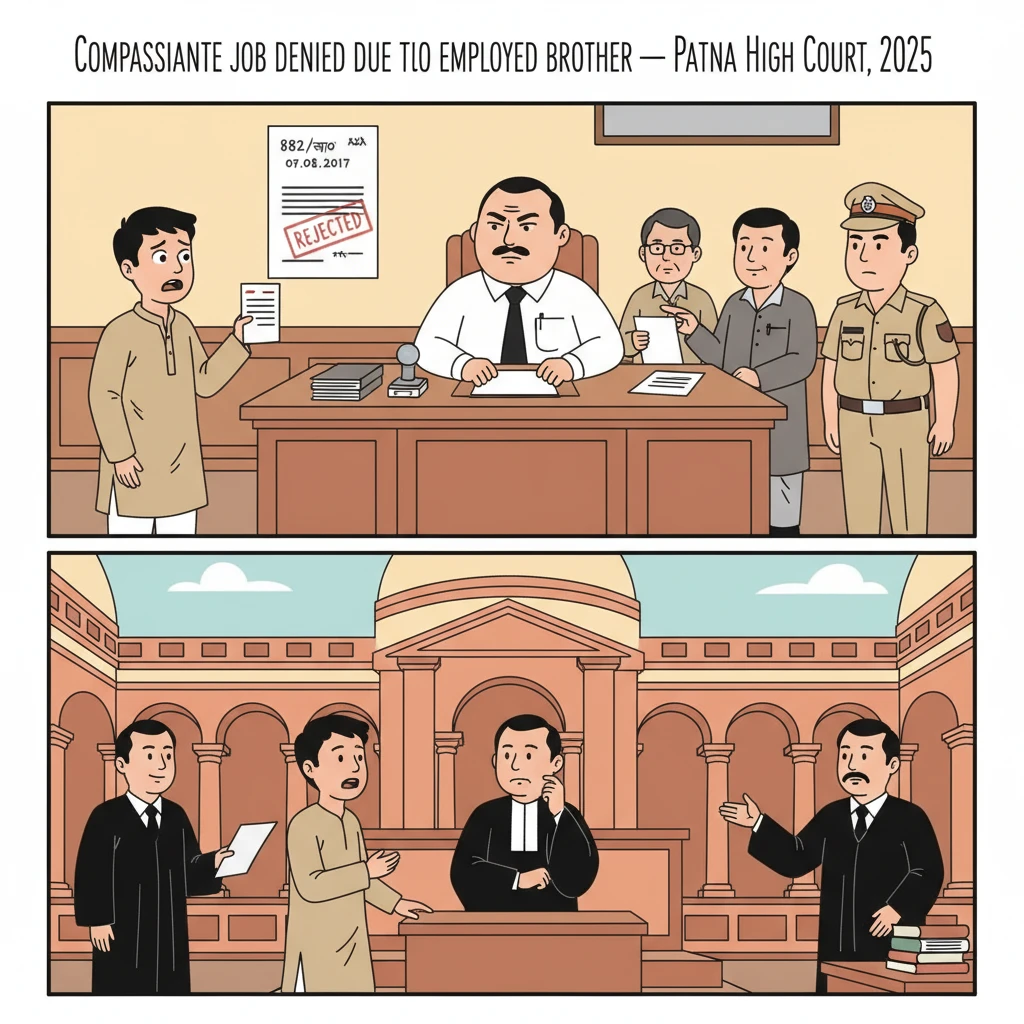
For this purpose, a Compassionate Committee under the District General Section of the Collectorate, Rohtas (Sasaram), presided over by the District Magistrate, was convened. The Committee held its meeting on 22.07.2017 to examine the pending applications.
In this meeting, the Committee rejected the petitioner’s application for compassionate appointment. The rejection was recorded against Serial No. 05 of Memo No. 882/सा0 dated 07.08.2017.
The sole reason given for the rejection was that the petitioner’s brother, Sudama Paswan, was already employed in the Bihar Police. Aggrieved by this decision, the petitioner approached the Patna High Court by filing a civil writ petition.
What the Court Examined and Decided
The petitioner invoked the writ jurisdiction of the Patna High Court in Civil Writ Jurisdiction Case No. 14475 of 2017. He sought to challenge the order of the Compassionate Committee and also requested a direction to be appointed on compassionate ground.
He asked for three main reliefs. First, he wanted the Court to quash the decision taken at Serial No. 05 of Memo No. 882/सा0 dated 07.08.2017, containing the proceedings of the meeting dated 22.07.2017 of the District General Section of the Collectorate, Rohtas (Sasaram). By that decision, his claim for compassionate appointment was rejected only because his brother was an employee of Bihar Police.
Second, he prayed for a mandamus to the authorities to issue him an appointment letter according to his educational qualification on compassionate ground, because his father had died in harness on 03.04.2016 while working as Chaukidar at Sasaram Police Station.
Third, he sought any other relief to which he might be found entitled.
On behalf of the petitioner, it was argued that the rejection of his application was unjust, arbitrary and discriminatory. The petitioner’s stand was simple: he had the necessary qualification, and mere employment of his brother in Bihar Police should not disentitle him from getting a compassionate appointment.
The respondents, representing the State of Bihar and the district authorities, opposed the writ petition. They submitted that the matter had been duly placed before the Compassionate Committee, which examined it in its meeting dated 22.07.2017. The Committee then rejected the petitioner’s application because his brother was already serving in the Bihar Police. According to the respondents, this rejection was in line with the applicable policy and legal principles on compassionate appointments.
The Court, presided over by Hon’ble Mr. Justice Partha Sarthy, heard both sides and examined the materials on record. The basic facts were not in dispute: the petitioner’s father was a Chaukidar at Sasaram Police Station; he died in harness on 03.04.2016; the petitioner applied on 25.07.2016; and the Committee rejected the application on 22.07.2017 because the petitioner’s brother, Sudama Paswan, was already employed in Bihar Police.
After noting these undisputed facts, the Court turned to the settled legal position on compassionate appointments. It first referred to the judgment of the Hon’ble Supreme Court in Indian Bank and Others vs. Promila and Another, (2020) 2 SCC 729.
Relying on this decision, the Court reiterated that compassionate appointment is not an alternative mode of regular government recruitment. There is no inherent or automatic right to seek such an appointment. Its only objective is to give immediate financial support and relief to the family of a government employee who dies while in service, and to help the family tide over the sudden crisis caused by the death.
The Court then discussed in detail the landmark Supreme Court judgment in Umesh Kumar Nagpal vs. State of Haryana and Others, (1994) 4 SCC 138. A long extract from this judgment was reproduced in the order.
In this extract, the Supreme Court had made it clear that as a general rule, public service appointments must be made strictly on merit and through open invitations for applications. Compassionate appointment is only a narrow exception to this rule, carved out to meet situations where the family of a deceased employee is left in penury and without any means of livelihood.
The Supreme Court had further held that the purpose of compassionate appointment is not to give a suitable government post as a matter of right, nor to match the status or post held by the deceased. Instead, it is only to give some employment, usually in the lowest categories (Class III or Class IV), so that the family can survive and come out of immediate financial distress.
Importantly, the Supreme Court had emphasised that before granting compassionate appointment, the Government must examine the financial condition of the family. Only if it finds that without such employment the family will not be able to overcome the crisis, a job may be offered to one eligible dependent. The Court also observed that many other families in society may be equally destitute, and hence this exception has to be applied strictly and narrowly.
After referring to this binding Supreme Court law, the Patna High Court turned to the specific policy in force in Bihar regarding compassionate appointments. The Court referred to a clarification issued by the General Administration Department, Government of Bihar, bearing No. 15783 dated 19.11.2014.
This clarification was later examined by a Full Bench of the Patna High Court in Niraj Kumar Mallick vs. The State of Bihar and Others, 2018 (2) PLJR 951. The clarification stated that if any one of the dependents of a deceased government servant is “gainfully employed”, then, regardless of whether that person lives jointly with the family or separately, no other dependent of that deceased employee will be entitled to compassionate appointment.
The Full Bench in Niraj Kumar Mallick upheld this clarification. It found that the clarification followed the principles earlier laid down by a Division Bench of the Patna High Court in Vishal Kumar vs. The State of Bihar and Others, 2004 (2) PLJR 453 and was consistent with the Supreme Court’s ruling in Umesh Kumar Nagpal.
In short, once one dependent is gainfully employed, the law in Bihar treats the family as not being in such financial distress as would justify another compassionate appointment.
Applying these legal principles to the petitioner’s case, the Patna High Court noted that the petitioner’s brother, Sudama Paswan, was already employed in Bihar Police. Therefore, as per the Government’s clarification and the binding Full Bench judgment, the petitioner could not claim compassionate appointment.
The Court observed that, in these circumstances, there was no error in the decision of the Compassionate Committee to reject the petitioner’s application on the ground of his brother’s employment in Bihar Police.
Finding no illegality or infirmity in the Committee’s decision, the Court refused to interfere. Consequently, the writ petition was dismissed and the petitioner’s prayer for compassionate appointment was rejected.
Why This Judgment Matters
This decision is significant for families of deceased government employees in Bihar who seek compassionate appointments.
The Patna High Court has clearly reaffirmed that the purpose of compassionate employment is only to help a family in real financial crisis immediately after the death of a government servant.
If any dependent is already gainfully employed, the family is presumed not to be in such extreme financial distress. In such a case, other family members cannot insist on a government job as a matter of right.
For dependents of Class III or Class IV employees like Chaukidars and Dafadars, this judgment shows that the authorities will strictly follow the State’s policy and the law laid down by higher courts.
People should understand that even if they have educational qualifications, they will not automatically get compassionate appointment if another member of the family already has a regular job.
Legal Issues and Answers
- Issue: Whether the petitioner, whose father died in harness as a Chaukidar, was entitled to compassionate appointment despite his brother being employed in Bihar Police.
Answer: No. The Court held that as one dependent (the petitioner’s brother) was already gainfully employed, the petitioner was not entitled to compassionate appointment under the State’s policy and the law on compassionate appointments. - Issue: Whether the Compassionate Committee’s decision dated 22.07.2017, recorded in Memo No. 882/सा0 dated 07.08.2017, rejecting the petitioner’s application was arbitrary or illegal.
Answer: No. The Court found no error in the Committee’s decision, as it was in line with the Government’s clarification and binding judicial precedents.
Cases Cited by the Court
- Indian Bank and Others vs. Promila and Another, (2020) 2 SCC 729
- Umesh Kumar Nagpal vs. State of Haryana and Others, (1994) 4 SCC 138
- Niraj Kumar Mallick vs. The State of Bihar and Others, 2018 (2) PLJR 951 (Full Bench, Patna High Court)
- Vishal Kumar vs. The State of Bihar and Others, 2004 (2) PLJR 453 (Division Bench, Patna High Court)
Case Details
Case Number: Civil Writ Jurisdiction Case No. 14475 of 2017
Case Title: Radhe Shyam Paswan vs. The State of Bihar & Others
Citation: 2026 (1) PLJR 273
Court: High Court of Judicature at Patna
Coram: Hon’ble Mr. Justice Partha Sarthy
Date of Judgment: 19.11.2025
Advocates for Petitioner: Mr. Waliur Rahman, Advocate; Mr. Manoj Kumar
Advocates for Respondents: Md. N. H. Khan, SC-1; Ms. Irshad, AC to SC-1
Nature of the Case: Writ petition (civil) challenging rejection of compassionate appointment
Impugned Decision: Decision at Serial No. 05 of Memo No. 882/सा0 dated 07.08.2017 recording proceedings of Compassionate Committee meeting held on 22.07.2017, rejecting petitioner’s claim for compassionate appointment
Final Outcome: Writ petition dismissed; rejection of compassionate appointment upheld
Link to Judgment: Patna High Court Judgment in CWJC No. 14475 of 2017
If you found this explanation helpful and wish to stay informed about how legal developments may affect your rights in Bihar, you may consider following Samvida Law Associates for more updates.







