
Case Background
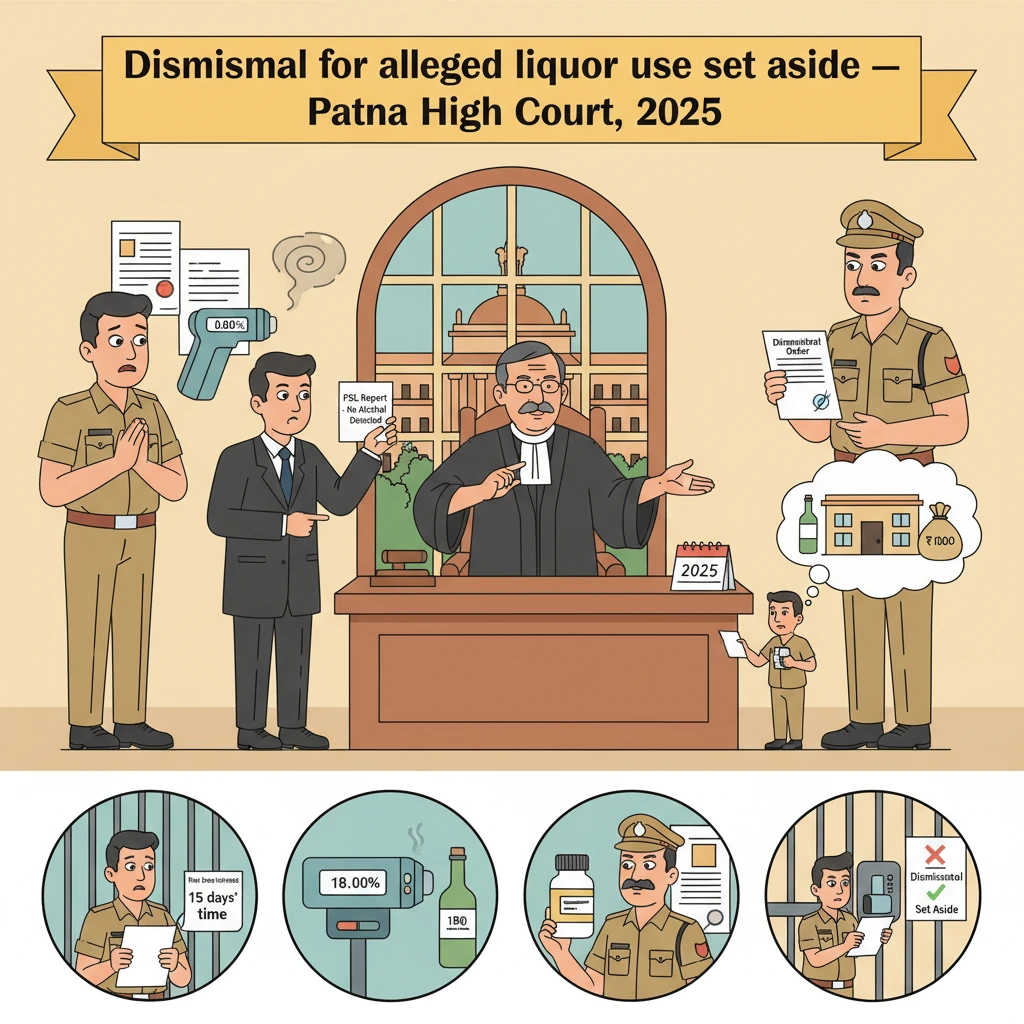
The petitioner was working as a Hawaldar at Hajipur Railway Station under the Railway Police. On 29.03.2019, an FIR was lodged against him as Rail Sonepur (Hajipur) P.S. Case No. 47 of 2019 under sections 37(b) and 37(c) of the Bihar Excise and Prohibition Act, 2016.
According to the FIR, he was creating nuisance in the police barrack. He was arrested and taken to Sadar Hospital. There, a breath analyser test was conducted and alcohol was allegedly detected in his blood, with smell of alcohol coming from his breath.
On the very same day, 29.03.2019, a departmental proceeding was started against him. The Superintendent of Police, Railway, Muzaffarpur issued Memo No. 691 dated 29.03.2019 serving article of charges through the Jail Superintendent, District Jail, Hajipur. He was asked to submit his explanation within 24 hours.
The charge-sheet stated that the breath analyser report showed 180 mg alcohol and that smell of alcohol was found in his breath. As he had been sent to judicial custody, the petitioner applied on 31.03.2019 seeking 15 days’ time to submit his explanation. This request went from the Jail Superintendent, Hajipur to the Senior Superintendent of Police, Railway, Muzaffarpur.
However, on the next day itself, the enquiry authority visited the jail and recorded the statements of witnesses inside the jail premises. After this, the petitioner was asked to file his last defence before the enquiry authority.
In his defence statement, the petitioner said he was a patient of chronic pain and used homoeopathic medicine. He claimed this might have caused alcohol to appear in the breath analyser test. He further alleged that the informant, the Sub Inspector-cum-PP In-charge, used to harass him and had demanded Rs. 1,000/- when he went to seek leave for his daughter’s marriage. On his refusal, there was a heated exchange.
The petitioner alleged that he had consumed homoeopathic medicine due to serious pain. On learning this, the informant, with the help of subordinates, arrested him and took him to Sadar Hospital, procured a fake report and then sent him to judicial custody.
What the Court Examined and Decided
Based on the witness statements recorded in jail, the enquiry authority held the petitioner guilty. The Superintendent of Police, Railway, Muzaffarpur passed District Order No. 468/2019 dated 08.04.2019, dismissing the petitioner from service.
The petitioner filed a departmental appeal on 24.04.2019. The appellate authority, the Additional Director General of Police, Railway, Bihar, Patna, rejected the appeal through Memo No. 796 dated 14.06.2019, without discussing in detail either the defence or the specific charges.
The petitioner then filed a memorial appeal before the Director General of Police, Bihar, Patna. He annexed all relevant documents, including a blood report dated 23.09.2019. The memorial appeal was dismissed by memo no. 77 dated 06.04.2022.
In the writ petition before the Patna High Court, the petitioner sought quashing of the dismissal order dated 08.04.2019, the appellate order dated 14.06.2019 and the memorial rejection dated 06.04.2022. He also prayed for reinstatement with all consequential benefits.
The main plank of his argument was that the breath analyser test could not be treated as conclusive proof of alcohol consumption, especially in light of his use of homoeopathic medicine. He relied on an internal instruction of the Police Headquarters—memo no. 294 dated 20.05.2022—which directed all disciplinary authorities not to hold any police personnel guilty solely on the basis of a breath analyser test.
Through a supplementary affidavit, the petitioner brought on record the complete Forensic Science Laboratory (FSL) report dated 31.08.2019. This report clearly stated that no ethyl alcohol was detected in his blood sample.
The State, through respondent no. 6 (Superintendent of Police, Railway, Muzaffarpur), filed a counter affidavit supporting the punishment. It was argued that as the petitioner was a member of a disciplined, uniformed force, the allegations could not be ignored.
Hon’ble Mr. Justice Sandeep Kumar heard both sides and examined the available material. The Court then turned to binding and persuasive precedents on how allegations of alcohol consumption should be assessed.
First, the Court referred to the three-judge bench decision of the Supreme Court in Bachubhai Hassanalli Karyani v. State of Maharashtra, (1971) 3 SCC 930. In that case, the Supreme Court held that one cannot conclusively say a person consumed alcohol merely because his breath smelt of alcohol, his gait was unsteady, his speech incoherent or his pupils dilated. The Court ruled that consumption of alcohol can be conclusively ascertained only by blood and urine tests. The doctor in that case had even admitted that a person could smell of alcohol without being under its influence.
Next, the Patna High Court referred to its own earlier judgment in Jawahar Kumar Singh v. State of Bihar through the Principal Secretary, Home Department & Ors., 2019 SCC OnLine Pat 3671 : (2019) 2 PLJR 156. There, a police constable was dismissed for allegedly creating a ruckus after consuming liquor. The Court noted that the punishment of dismissal was unduly harsh and that the charges were sought to be proved in a very rudimentary manner, solely by relying on the breath analyser report, which itself could be incorrect. The dismissal was set aside and the matter was sent back for reconsideration of appropriate punishment.
The Court then considered another coordinate bench decision in Manoj Kumar Thakur v. State of Bihar & Ors. (C.W.J.C. No. 4181 of 2021). In that case, the delinquent employee had been dismissed for alleged dereliction of duty and misconduct under the influence of liquor. Relying on the Supreme Court’s judgment in Munna Lal, the Court held that in the absence of any material to support consumption of liquor—especially in the absence of a medical report—such a serious penalty could not stand. The employee was directed to be reinstated with 50% back wages.
In Manoj Kumar Thakur, the Patna High Court also reiterated, with reference to Jawahar Kumar Singh, that relying solely on a breath analyser report to prove alcohol consumption is unsafe.
Further, the Court noted that in that case the impugned punishment order did not show proper application of mind to the defence put up by the delinquent, as required by Rule 17(14) of the Bihar Government Servants (Classification, Control and Appeal) Rules, 2005. Similarly, the appellate authority had also failed to perform its duty under Rule 27 of the same Rules.
The Court also referred to a recent judgment, Manju Devi v. State of Bihar through the Additional Chief Secretary and Others, reported as 2024 SCC OnLine PAT 2324. Relying on Bachubhai Hassanalli Karyani, that judgment held that mere smell of alcohol, or even a breath analyser report, cannot conclusively prove consumption of alcohol. Blood and urine tests are needed for a firm conclusion.
In Manju Devi, the Patna High Court held that the disciplinary authority had erred in basing punishment solely on the breath analyser report. As there was no allegation of unsteady gait, incoherent speech or dilated pupils, and as no blood or urine test was conducted, the Court set aside the order of punishment and the appellate order.
The present judgment also referred to another coordinate bench decision in Neeraj Kumar v. State of Bihar & Ors. (C.W.J.C. No. 9828 of 2022). There, the Court expressed shock that, despite a departmental order stating that no disciplinary proceeding should be based only on breath analyser results, such a proceeding had been conducted and the petitioner dismissed.
After reviewing these judgments, the Patna High Court in the present case summed up the legal position. It held that breath analyser test alone cannot be the sole basis to reach a firm finding that a person has consumed alcohol. Even though departmental proceedings are decided on a lower standard of proof—preponderance of probabilities, not “beyond reasonable doubt” as in criminal trials—complete reliance on breath analyser results does not meet even this lower standard.
The Court stressed that in the absence of any other supporting evidence, such a finding would be void. Here, the FSL report specifically supported the petitioner, saying that no ethyl alcohol was detected in his blood. This scientific report directly contradicted the breath analyser result.
Given this, the Court found that imposing the highest penalty of dismissal from service based solely on the breath analyser report, particularly when the FSL report favoured the petitioner, could not be sustained. The punishment orders were therefore vitiated.
Accordingly, the Court quashed and set aside the dismissal order dated 08.04.2019 passed by the Superintendent of Police, Railway, Muzaffarpur, and the appellate order dated 14.06.2019 passed by the Additional Director General of Police, Railway, Bihar, Patna. The Court directed the respondents to reinstate the petitioner forthwith with all consequential benefits in accordance with law.
With these directions, the writ petition was allowed.
Why This Judgment Matters
This judgment is important for all government employees, especially those in police and other uniformed services, who face allegations of alcohol consumption under the Bihar Excise and Prohibition Act, 2016.
The Patna High Court has clearly said that a breath analyser report by itself is not enough to dismiss a person from service. If there is no blood or urine test and no other strong evidence, such as medical findings of intoxication, a major penalty like dismissal cannot stand.
The ruling also reinforces earlier decisions and internal police instructions that disciplinary authorities must not rely blindly on breath analyser tests. They must look at all material, including FSL reports, and apply their mind properly to the employee’s defence.
For ordinary people and lower-rank officials, this means that if they are accused of drinking based only on a breath test, they have a clear ground to challenge harsh departmental punishment, particularly where later scientific reports show no alcohol in their blood.
Legal Issues and Answers
-
Issue: Can a government employee, particularly a police personnel, be dismissed from service solely on the basis of a breath analyser test showing presence of alcohol, when the FSL blood report later shows no ethyl alcohol?
Answer: No. The Patna High Court held that breath analyser results alone are not sufficient even for departmental proceedings. In the face of an FSL report showing no alcohol, a dismissal based solely on the breath analyser test is unsustainable and must be set aside. -
Issue: Did the disciplinary and appellate authorities act lawfully in upholding the petitioner’s dismissal in these circumstances?
Answer: No. The Court found that the authorities relied completely on the breath analyser report, ignored the FSL report and applicable judicial precedents, and thereby imposed a major penalty without cogent evidence. Their orders were quashed and the petitioner was directed to be reinstated with all consequential benefits.
Cases Cited by the Court
- Bachubhai Hassanalli Karyani v. State of Maharashtra, (1971) 3 SCC 930
- Jawahar Kumar Singh v. State of Bihar through the Principal Secretary, Home Department & Ors., 2019 SCC OnLine Pat 3671 : (2019) 2 PLJR 156
- Munna Lal (as referred to in Manoj Kumar Thakur v. State of Bihar & Ors., C.W.J.C. No. 4181 of 2021)
- Manoj Kumar Thakur v. State of Bihar & Ors., C.W.J.C. No. 4181 of 2021
- Manju Devi v. State of Bihar through the Additional Chief Secretary and Others, 2024 SCC OnLine PAT 2324
- Neeraj Kumar v. State of Bihar & Ors., C.W.J.C. No. 9828 of 2022
Case Details
Case Number: Civil Writ Jurisdiction Case No. 1270 of 2023
Case Title: Vikash Kumar Singh @ Vikash Kumar v. The State of Bihar & Ors.
Court: High Court of Judicature at Patna
Coram: Hon’ble Mr. Justice Sandeep Kumar
Date of Judgment: 20.11.2025
Citation: 2026(1) PLJR 148
Advocates:
- Mr. Vinay Ranjan, Advocate – for the petitioner
- Mr. Md. N.H. Khan, S.C.-1 – for the respondents/State
Nature of the Case: Writ petition (service matter) challenging dismissal from service and related departmental appellate and memorial orders arising out of alleged violation of the Bihar Excise and Prohibition Act, 2016.
Link to the Judgment: Official Patna High Court judgment
If you found this explanation helpful and wish to stay informed about
how legal developments may affect your rights in Bihar,
you may consider following Samvida Law Associates for more updates.







