
Case Background
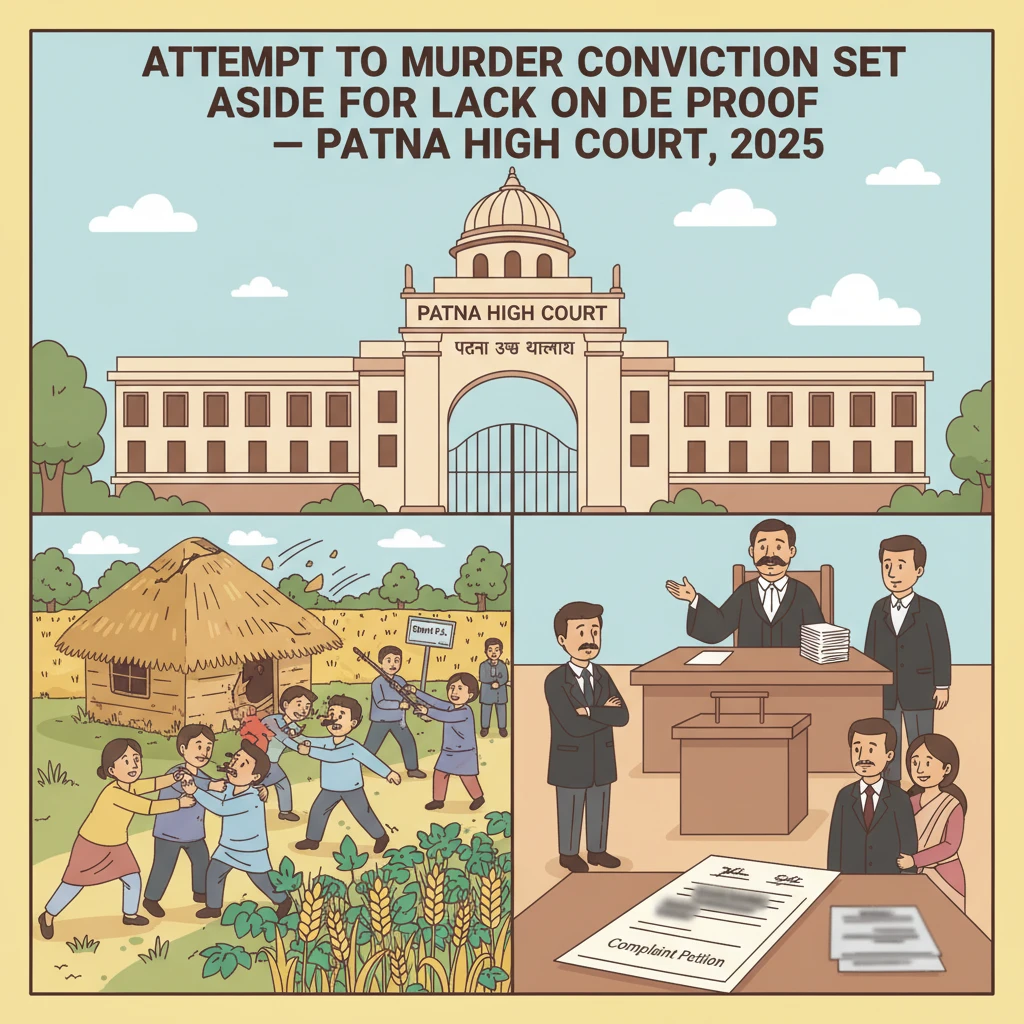
The criminal case started from a land and family dispute in district Saran, Bihar.
According to the complaint, the informant’s sister and her husband had returned from outside about two months earlier and had cultivated wheat and potato on land said to be in their share. A thatched house with asbestos (karkat) roofing was also said to be built on this share of land.
The informant stated that he went to his sister’s house to help in irrigating the crop. He and his brother‑in‑law were allegedly irrigating the wheat crop when they went back to the house for some time. There, he claimed, an altercation took place with the appellant and other family members of his brother‑in‑law.
The complaint alleged that the appellant and others had been threatening the informant over mobile phones earlier, and on the day of occurrence they were damaging the asbestos roof of the thatched house.
It was further alleged that when the informant questioned why his sister and brother‑in‑law were being assaulted, one co‑accused allegedly instigated the others to kill the informant and dispose of his body. The appellant was alleged to have then attacked the informant with a farsa, first on the neck, which actually hit the upper part of the head, and then on the shoulder. Other co‑accused were said to have used an iron rod, labda and danda, causing injuries on various parts of his body.
The informant claimed that villagers came and saved him. He further alleged that when he was being taken for treatment, the accused reached the nearby hospital and did not allow treatment. Thereafter, he was allegedly taken to Chapra Sadar Hospital where he claims to have been treated.
On this basis, Complaint Case No. 176 of 2013 was filed and later sent to the police station. It was then converted into Derni P.S. Case No. 103 of 2014 dated 01.09.2014, registered under Sections 341, 323, 324, 307, 427, 504, 506, 34 of the IPC.
After routine investigation, the police submitted charge‑sheet against the appellant and others. The Magistrate took cognizance and committed the case to the Court of Sessions. The trial court framed charges under Sections 307/34, 504, 341 and 427 of the IPC. The appellant pleaded not guilty and faced trial in Sessions Trial No. 349 of 2015 before the Additional Sessions Judge‑XIII, Saran at Chapra.
By judgment dated 16.07.2025, followed by order of sentence dated 21.07.2025, the trial court convicted the appellant under Section 307 IPC and sentenced him to three years’ rigorous imprisonment with fine of Rs. 20,000/‑ and three months’ simple imprisonment in default. Two co‑accused women, Indu Devi and Somari Devi, were acquitted on the same set of evidence.
The appellant challenged this conviction in Criminal Appeal (SJ) No. 3337 of 2025 before the Patna High Court.
What the Court Examined and Decided
The Patna High Court, presided over by Hon’ble Mr. Justice Alok Kumar Pandey, examined the entire trial record, arguments of both sides, and the legal question whether the offence under Section 307 IPC was made out on the evidence.
The prosecution examined six witnesses: PW‑1 Gorakh Singh, PW‑2 Riju Kumar (informant), PW‑3 Ganesh Singh, PW‑4 Baliram Singh, PW‑5 Laxmi Devi and PW‑6 Shiv Bachhan Rai. One document was exhibited, i.e., the informant’s signature on the complaint petition.
The defence examined one witness, DW‑1 Bhagwan Rai, and produced an amended deed (marked P1) executed between Ganesh Singh and the appellant, apparently relating to land.
The core defence was total denial. The appellant’s counsel argued that:
- Two co‑accused, Indu Devi and Somari Devi, were acquitted on the same evidence and same sections.
- PW‑1 and PW‑3 did not support the prosecution and were declared hostile.
- Though PW‑2 claimed to be an injured witness, the prosecution produced no injury report, no medical paper, and did not examine the doctor.
- The Investigating Officer (IO) was also not examined, so the place of occurrence was not properly proved.
- Important details like khata and khesra number and boundaries of the land were not clarified by the witnesses.
- There were contradictions regarding the number and location of injuries and the manner of assault among PW‑2, PW‑4, PW‑5 and PW‑6.
- Without medical evidence and without proof of the place of occurrence, the trial court erred in convicting under Section 307 IPC, and the appellant should get benefit of doubt.
The State, on the other hand, supported the trial court judgment, arguing that PW‑2, the informant and claimed victim, had supported the prosecution story, and other witnesses had broadly corroborated it. In their view, there was no reason for interference.
Assessment of Witness Testimonies
The High Court first noted that PW‑1 and PW‑3 did not support the prosecution and were declared hostile. Therefore, their evidence did not help the prosecution.
PW‑2 (informant) stated that the appellant and others were breaking the thatched house and that the appellant assaulted him twice with a farsa, first on the head and then on the right shoulder. He also said he had been treated at Sadar Hospital, Chapra. However, he was unable to point out the boundary of the field he was irrigating.
The Court emphasised that although PW‑2 spoke of treatment at hospital, no document, prescription, injury report or medical paper was produced. The doctor who allegedly treated him was also not examined. In these circumstances, the Court held that the accusation by PW‑2 remained a “bald statement” and could not be relied upon without supporting medical evidence.
PW‑4 (Baliram Singh), the brother‑in‑law of the informant, stated that the appellant assaulted PW‑2 with a farsa on the head and again on the upper part of the ear. He said PW‑2 had eight injuries and that there was blood on PW‑2’s clothes and on the ground, which he showed to the police officer. At the same time, he admitted he did not know the khata and khesra number of the land. He also stated he himself was not assaulted, which contradicted the original complaint version where the informant had claimed that his sister and brother‑in‑law were also being assaulted.
The High Court found PW‑4’s version inconsistent with the initial complaint. In the complaint, the second farsa blow was said to have hit the shoulder, not the upper part of the ear. The number of injuries stated by PW‑4 (eight) also conflicted with PW‑5.
PW‑5 (Laxmi Devi), the informant’s sister, stated that the first farsa blow landed on PW‑2’s right shoulder and the second on the upper part of the ear, and that he had six injuries. This again differed from both the complaint and PW‑4’s account, both in sequence and number of injuries.
PW‑6 (Shiv Bachhan Rai) stated that the appellant gave a single farsa blow on the head, and that a co‑accused assaulted PW‑2 with a rod on his back, causing him to fall. He also claimed that all the accused started pelting stones at PW‑2, a detail that did not appear in the original complaint or in any other witness’s testimony.
The Court observed that PW‑6’s version about stone‑pelting and the number of injuries was also at odds with the other witnesses and the complaint.
Non‑examination of Investigating Officer and Doctor
A crucial weakness in the prosecution case, according to the Court, was that the Investigating Officer was not examined. The IO is the key witness to prove the place of occurrence and to explain contradictions and omissions in the statements recorded during investigation.
The Court relied on the Supreme Court judgment in Behari Prasad v. State of Bihar, (1996) 2 SCC 317. It noted that while non‑examination of the IO is not automatically fatal in every case, where it causes prejudice to the accused it becomes a serious infirmity.
Applying this principle, the Court found that in this case the absence of the IO had in fact caused serious prejudice. There were several contradictions and omissions in the witnesses’ statements, and only the IO could have clarified them. Moreover, with no IO in the witness box, the place of occurrence had not been firmly established.
The Court further referred to the Supreme Court decision in Syed Ibrahim v. State of Andhra Pradesh, (2008) 10 SCC 601, which held that when the place of occurrence itself is not established, it would not be proper to accept the prosecution case.
Similarly, the doctor who allegedly treated the informant was not examined, and no injury report was brought on record. The Court highlighted that, especially for an offence under Section 307 IPC, the nature, number and location of injuries are important to infer intention to kill.
Requirements under Section 307 IPC
The judgment discussed how, under Section 307, intention to commit murder is inferred from several factors: the kind of weapon used, the part of body targeted, nature and severity of injuries, the force applied, and the surrounding circumstances.
The Court explained that even if death does not occur, a person can be convicted under Section 307 if the act, supported by these factors, shows an intention or knowledge to cause death. However, to assess this intention, courts need reliable evidence, including medical records.
In this case, though the informant and some witnesses spoke of a farsa blow on the head and other parts, there was no injury report to show whether the injuries were simple, grievous or dangerous to life. Without such proof, the Court held that it could not safely draw conclusions about intention to kill.
Overall Evaluation and Final Decision
The Court summed up the prosecution evidence as suffering from multiple “infirmities”:
- No IO examined; hence place of occurrence not proved.
- No doctor examined and no injury report produced.
- Contradictions among key witnesses about the manner of assault, the part of body hit, and the number of injuries.
- Differences between the complaint and oral evidence.
- On the same set of evidence, co‑accused Indu Devi and Somari Devi were acquitted, yet the trial court did not explain how the appellant’s case was different.
In these circumstances, the High Court held that the prosecution had failed to prove its case beyond reasonable doubt. It found that the trial court had erred in law and in appreciation of facts by convicting the appellant under Section 307 IPC.
Accordingly, the Patna High Court allowed the appeal, set aside the judgment of conviction dated 16.07.2025 and the order of sentence dated 21.07.2025, and discharged the appellant from the liabilities of his bail bonds. Any interlocutory applications were also disposed of. The Court directed that a copy of the judgment be sent to the concerned jail superintendent and that the trial court record be returned.
Why This Judgment Matters
This judgment from the Patna High Court is important for anyone facing serious criminal charges, especially for attempt to murder, and for those who may be complainants in such cases.
First, it shows that courts do not rely only on what is written in a complaint or what witnesses say in court. The prosecution must support allegations of serious injuries with proper medical evidence and by examining the doctor. Without an injury report, even a claim of attack with a dangerous weapon like a farsa may not be enough for conviction.
Second, it highlights the importance of the Investigating Officer’s evidence. When the IO is not examined, it becomes difficult to prove where exactly the incident took place and to clear up differences in witness statements. This can create reasonable doubt and result in acquittal.
Third, the judgment underlines that if co‑accused are acquitted on the same evidence, the court must carefully explain why one accused is treated differently. Otherwise, the conviction may not stand.
For ordinary readers, the message is that in criminal cases, especially where punishment is serious, the law requires strong and consistent evidence. For complainants, it signals the need to ensure medical examination and proper documentation at the earliest. For accused persons, it shows that contradictions in evidence and missing key witnesses can form the basis of a successful appeal.
Legal Issues and Answers
- Issue: Whether, on the evidence led, the offence of attempt to murder under Section 307 IPC was proved against the appellant beyond reasonable doubt.
Answer: No. The Patna High Court held that due to non‑examination of the Investigating Officer and doctor, absence of injury report, failure to establish the place of occurrence, and serious inconsistencies in witness testimonies, the prosecution failed to prove the charge under Section 307 IPC. The conviction and sentence were therefore set aside and the appellant was acquitted.
Cases Cited by the Court
- Behari Prasad v. State of Bihar, (1996) 2 SCC 317 – cited on the effect of non‑examination of the Investigating Officer.
- Syed Ibrahim v. State of Andhra Pradesh, (2008) 10 SCC 601 – cited on the importance of proving the place of occurrence.
Case Details
Case Number: Criminal Appeal (SJ) No. 3337 of 2025; arising out of Derni P.S. Case No. 103 of 2014; Sessions Trial No. 349 of 2015
Case Title: Satrughan Singh v. The State of Bihar & Anr.
Citation: 2026 (1) PLJR 29
Court: High Court of Judicature at Patna
Bench/Coram: Hon’ble Mr. Justice Alok Kumar Pandey
Date of Judgment: 25.11.2025 (uploaded and transmitted on 01.12.2025)
Advocates: For the appellant – Mr. Nawal Kishore Singh, Advocate; Mr. Kamlesh Kumar, Advocate. For the State – Mr. Mukeshwar Dayal, A.P.P.
Nature of Case: Criminal appeal (single judge) against judgment of conviction and order of sentence under Section 307 IPC passed by the Additional Sessions Judge‑XIII, Saran at Chapra.
Link to Judgment: View full judgment on Patna High Court website
If you found this explanation helpful and wish to stay informed about
how legal developments may affect your rights in Bihar,
you may consider following Samvida Law Associates for more updates.







