
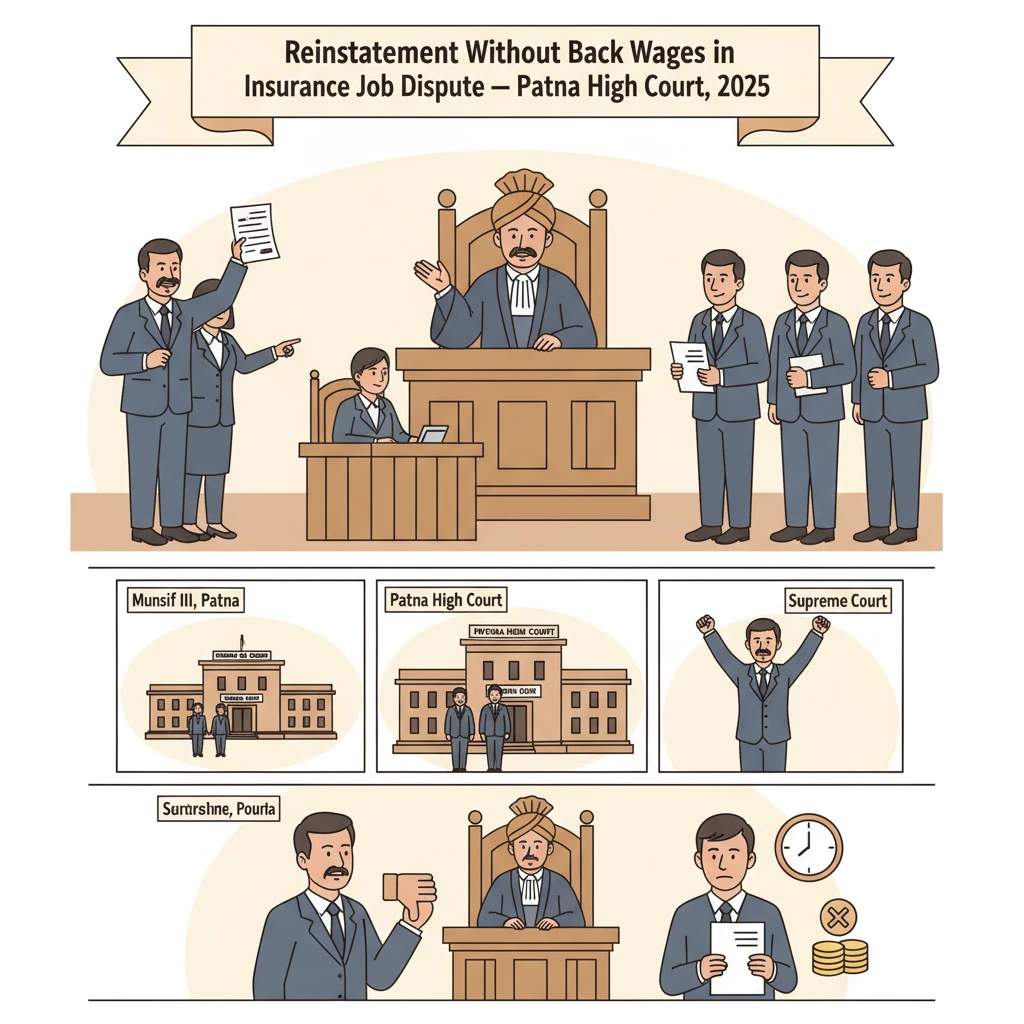
Case Background
The dispute arises from the dismissal of an employee of United India Fire and General Insurance Company Limited, posted at Exhibition Road, Patna. He was dismissed from service by an order dated 12.02.1976.
The employee (plaintiff) filed Title Suit No. 01 of 1979 before the Munsif III, Patna. He sought a declaration that the allegations and enquiry against him were malafide and that the dismissal order dated 12.02.1976 was illegal, malafide, void, and unconstitutional. He also asked for a mandatory injunction to reinstate him in his job, and for past and future damages in lieu of emoluments payable to him, along with costs and other reliefs.
On 15.09.1979, the Trial Court dismissed the suit as not maintainable. The plaintiff then filed Title Appeal No. 196 of 1979 / 35 of 1980. On 12.02.1981, this appeal was allowed.
The original defendants (the Union of India and the insurance company authorities) challenged this outcome. They filed Second Appeal No. 302 of 1981 and Miscellaneous Appeal No. 105 of 1981. Both matters were heard together and, by order dated 20.11.1986, the decisions went in favour of the defendants.
The plaintiff then approached the Hon’ble Supreme Court of India by filing S.L.P. No. 3186 of 1987. Leave was granted and the matter was registered as Civil Appeal No. 2499 of 1988. On 01.08.1988, the Supreme Court allowed the appeal, set aside the judgments of the Trial Court, First Appellate Court, and Second Appellate Court, and remitted the matter back to the Trial Court for fresh disposal on merits.
After remand, the Trial Court again decided Title Suit No. 01 of 1979 and, by order dated 20.07.1989, dismissed the suit. The plaintiff then filed Title Appeal No. 132 of 1989. On 08.06.1990, this appeal was allowed in part. It is from this stage that the present Second Appeal No. 306 of 1990 arose before the Patna High Court.
On 10.03.1992, the High Court framed the substantial question of law in this second appeal:
“Whether the Court below could refuse to grant decree for payment of salary when it set aside the order of dismissal?”
What the Court Examined and Decided
Both sides argued in detail on whether the employee was entitled to salary or back wages for the period he remained out of service under the dismissal order.
On behalf of the appellant (employee), it was submitted that he had been an employee of United India Fire and General Insurance Company Limited at Exhibition Road, Patna. Counsel argued that once the order of dismissal was set aside, he became entitled to salary for the period he was kept out of service.
The appellant’s counsel relied on several decisions of the Patna High Court. These included Md. Hassan Ansari v. The State of Bihar and Ors., reported in (2005) 3 PLJR 304. Relying on that decision, he argued that any deduction made from the appellant’s superannuation benefits should be repaid with interest at 9% per annum.
Counsel also cited Shashi Bhushan Pandey v. The State of Bihar and Ors., reported in (2005) 4 PLJR 575. He argued that the appellant did not remain without work by his own choice, but because he was not allowed to work and was not given a place of posting. In such a situation, according to him, the principle of “no work, no pay” should not apply.
He further relied on Ratan Kumar Sharma v. The State of Bihar, reported in (2006) 3 PLJR 365, to say that the appellant was entitled to salary for the period during which he was kept out of service. He also cited Rajendra Kumar Kindra v. Delhi Administration, AIR 1984 SC 1805, to argue that helping his father-in-law in a coal depot and living with him could not be treated as “gainful employment” so as to deny him back wages.
The appellant’s counsel further stressed that he had contested the dismissal from the Civil Court up to the Supreme Court. After the Supreme Court remanded the matter, the courts below allegedly ignored established principles in the above judgments. According to him, once the dismissal was set aside, a decree for payment of salary should follow, especially as the dismissal had already been declared invalid and substituted by a minor penalty.
On the other side, counsel for the respondents (Union of India and insurance authorities) did not dispute that the Supreme Court had remitted the matter. He pointed out that, after remand, Title Suit No. 01 of 1979 was dismissed again and the subsequent Title Appeal No. 132 of 1989 was only partly allowed on 08.06.1990.
Under this appellate judgment, the first order of dismissal was set aside on the ground that it was disproportionate to the charge. The appellate court directed that instead of dismissal, a minor penalty under Rule 23 of the United India Insurance Company (Conduct, Discipline and Appeal) Rules, 2014 should be imposed.
The rules referred to in the judgment came into force with immediate effect and replaced the General Insurance (Conduct, Discipline & Appeal) Rules, 1975. Rule 23 listed the minor penalties as:
(a) Censure.
(b) Withholding of one or more increments for a specified period.
(c) Recovery of whole or part of any pecuniary loss caused to the Company by negligence or breach of orders from pay or other amounts due.
(d) Reduction to a lower stage in the time scale for a period not exceeding three years with cumulative effect.
In this case, the appellate court’s order resulted in a minor penalty: the withholding of two increments. Counsel for the respondents submitted that the appellant had later retired as a Record Clerk on 31.05.2014 and that his pensionary benefits had already been granted to him in compliance with the appellate order.
For the point of back wages, the respondents relied on Supreme Court judgments. They cited Banshi Dhar v. State of Rajasthan and Anr., reported in (2007) 1 SCC 324, and P. Karupaiah v. General Manager, Thruuvalluvar Transport Corporation Limited, reported in (2018) 12 SCC 663.
From these decisions, counsel argued that grant of back wages is not automatic. An employee cannot claim back wages as a matter of right simply because an order of dismissal or removal is set aside. Unless the order of reinstatement specifically directs payment of back wages, no such right arises automatically.
The Patna High Court carefully examined the operative part of the first appellate court’s order, which had set aside the dismissal. The operative portion, reproduced in the judgment, clearly recorded that the punishment of dismissal was unjust, arbitrary, and shockingly disproportionate to the charge. It directed the competent authority to substitute the dismissal with a minor penalty under Rule 23 by mandatory injunction.
However, that same operative part contained a specific finding that the plaintiff-appellant could not claim any salary for the period during which he was not on duty on account of the dismissal order. It was clearly stated that he was not entitled to salary for that period.
The High Court noted that there were two sets of authorities cited: one from the Patna High Court and the other from the Supreme Court. The Court reiterated the settled principle that judgments of the Supreme Court are binding on all High Courts.
The Court then considered the relevant passages from Banshi Dhar. In that case, the Supreme Court had held that no hard-and-fast rule exists for back wages. Each case depends on facts, and grant of back wages is not automatic even where reinstatement is ordered. The Supreme Court pointed out that even where principles of natural justice are violated, courts may direct reinstatement but can still refuse or limit back wages.
The Patna High Court also examined P. Karupaiah. There, the Supreme Court again clarified that when a dismissal or removal order is set aside and reinstatement is directed, the employee does not automatically become entitled to back wages. The employee has to prove that he was not gainfully employed during the relevant period, and the employer can bring evidence to the contrary. Courts may grant full, partial, or no back wages, and often apply the “no work, no pay” principle, depending on the facts.
Against this legal background, the Patna High Court compared the facts of the present case. It found that when the appellate court earlier set aside the dismissal and converted it into a minor penalty, there was no direction whatsoever granting back wages or salary. On the contrary, there was a specific finding that the appellant would not be entitled to salary for the period he did not work due to dismissal.
The Court emphasised that, in light of the Supreme Court’s rulings, the grant of back wages is discretionary and not a natural or automatic consequence of reinstatement or substitution of punishment.
In conclusion, the Court held that, since there was an express finding against payment of salary for the non-working period and no express direction for back wages in the reinstatement order, the appellant could not claim salary for that period as a matter of right. The substantial question of law was therefore answered against the appellant and in favour of the respondents.
As a result, the Patna High Court dismissed Second Appeal No. 306 of 1990 on 25.11.2025.
Why This Judgment Matters
This judgment is important for employees, especially those in government or public sector companies, who challenge dismissal orders and hope to recover full back wages.
The Patna High Court has made it clear that simply winning a case where dismissal is set aside does not, by itself, guarantee payment of salary for the period of dismissal. There must be a clear order for back wages, or strong facts to support that claim.
For workers, this means that reinstatement and salary for the past are two different things. Courts may reinstate an employee but still deny back wages, particularly where an earlier order or judgment has specifically excluded such payment.
For employers, particularly insurance companies and other public bodies, the decision confirms that they can defend themselves against back wage claims where earlier court orders or rules provide for limited or substituted penalties.
Legal Issues and Answers
- Issue: Could the appellate court refuse to grant a decree for payment of salary when it had already set aside the employee’s dismissal and substituted a minor penalty?
Answer: Yes. The Patna High Court held that setting aside the dismissal did not automatically entitle the employee to back wages, especially where the earlier appellate order had clearly stated that he was not entitled to salary for the period he was not on duty, and where Supreme Court law establishes that back wages are not automatic.
Cases Cited by the Court
- Banshi Dhar v. State of Rajasthan and Anr., 2007 (1) SCC 324
- P. Karupaiah v. General Manager, Thruuvalluvar Transport Corporation Limited, 2018 (12) SCC 663
- Md. Hassan Ansari v. The State of Bihar and Ors., (2005) 3 PLJR 304
- Shashi Bhushan Pandey v. The State of Bihar and Ors., (2005) 4 PLJR 575
- Ratan Kumar Sharma v. The State of Bihar, (2006) 3 PLJR 365
- Rajendra Kumar Kindra v. Delhi Administration, AIR 1984 SC 1805
Case Details
Case Number: Second Appeal No. 306 of 1990
Case Title: Sarjug Prasad v. Union of India & Ors.
Citation: 2026 (1) PLJR 37
Coram: Hon’ble Mr. Justice Dr. Anshuman
Date of Judgment: 25.11.2025
Advocates:
For the Appellant: Mr. Brajesh Sharma, Advocate
For the Respondents: Mr. Rupak Kumar, Advocate; Mr. Subodh Kr. Jha, Sr. CGC; Mr. Ram Tujabh Singh, CGC
Nature of the Case: Second appeal arising from a title suit challenging dismissal from service and seeking declaration, reinstatement, and monetary relief.
Link to Judgment: View full judgment on Patna High Court website
If you found this explanation helpful and wish to stay informed about how legal developments may affect your rights in Bihar, you may consider following Samvida Law Associates for more updates.







