
Case Background
The case started with an FIR lodged at Phulparas Police Station, District Madhubani, in Phulparas P.S. Case No. 200 of 2021.
According to the FIR, the informant alleged that the present petitioner and five other accused persons assaulted him. The injuries were said to be on vital parts of the body, including a head injury. There was also a specific allegation that the petitioner snatched Rs. 20,000 from the pocket of the informant.
Based on these allegations, the FIR was registered under Sections 341, 323, 308, 379 and 504/34 of the Indian Penal Code.
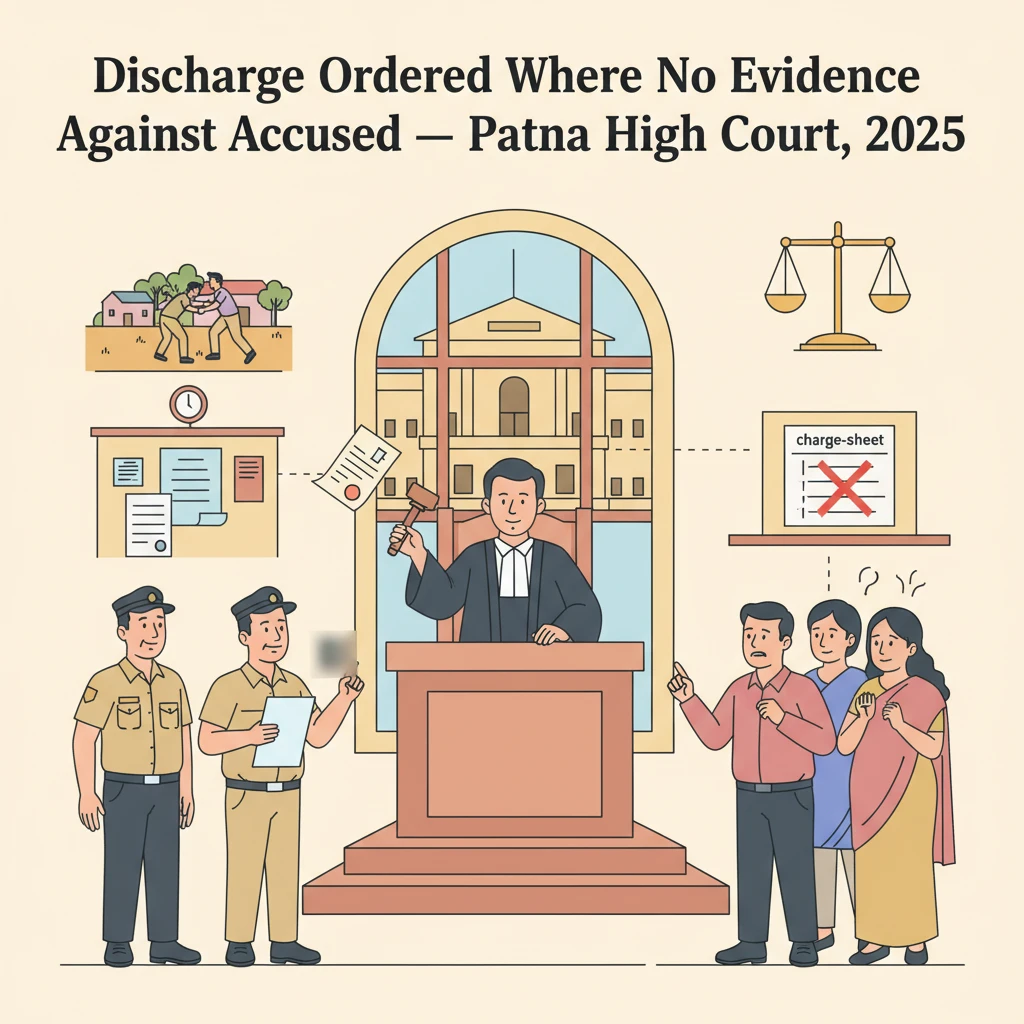
After investigation, the police submitted charge-sheet on 31.08.2021, but only under Sections 341, 323, 308 and 504/34 of the Indian Penal Code. The supervision and final form indicated that the allegation of theft under Section 379 IPC against the petitioner was found to be untrue, so that section was dropped.
The Magistrate, however, took cognizance of the offences under Sections 341, 323, 308 and 504/34 IPC and the case proceeded as a sessions case.
At the stage before trial, the petitioner filed an application under Section 227 of the Code of Criminal Procedure, seeking discharge from the case on the ground that there was no sufficient material to proceed against him.
On 19.12.2024, the learned Additional Sessions Judge-IV, Jhanjharpur, rejected this discharge application and ordered that the petitioner would have to face trial along with others.
Feeling aggrieved by this refusal to discharge, the petitioner approached the Patna High Court by filing Criminal Miscellaneous No. 18402 of 2025 under Section 528 of the Bharatiya Nagarik Suraksha Sanhita (BNSS), seeking quashing of the order dated 19.12.2024.
What the Court Examined and Decided
The oral judgment was delivered by Hon’ble Mr. Justice Purnendu Singh on 20.11.2025 after hearing counsel for the petitioner and the learned A.P.P. for the State of Bihar.
The petitioner’s main contention was focused on the lack of material against him.
He pointed out that the FIR made a very specific allegation that he had snatched Rs. 20,000 from the informant’s pocket. However, during police supervision and investigation, this allegation was found to be untrue. As a result, the police did not file charge-sheet under Section 379 IPC.
The petitioner emphasized that this aspect was clearly stated in paragraph 12 of his application before the High Court. He argued that when the very specific and serious allegation against him was not supported by any material, and was found false by the investigating agency itself, there remained no sufficient ground for compelling him to face a full criminal trial.
He also brought to the Court’s notice that he is an employee of Indian Railways. Because of what he described as malicious and vexatious allegations, if the trial was allowed to proceed without adequate material, he would be unnecessarily harassed and his service career could be adversely affected.
To support his case, learned counsel for the petitioner relied on Supreme Court decisions explaining how courts should exercise their power at the stage of discharge under Section 227 Cr.P.C. He cited:
State of Karnataka vs. L. Muniswamy & Ors., AIR 1977 SC 1489, and Dilawar Balu Kurane vs. State of Maharashtra, (2002) 2 SCC 135.
These judgments stress that if there is no sufficient ground for proceeding and the available material does not even raise a grave suspicion against the accused, the Court should discharge him rather than force a full trial.
On the other hand, the learned A.P.P. for the State argued that the District Court had considered all material on record and had rightly refused to discharge the petitioner. He submitted that interference by the High Court at this stage was not warranted and that the trial should be allowed to proceed.
After hearing both sides, the Patna High Court framed the key question for itself: whether there was sufficient ground for proceeding against the petitioner.
The Court first recorded the undisputed position from the record.
The FIR contained allegations under Sections 341, 323, 308, 379 and 504/34 IPC. However, after investigation, the police filed charge-sheet only under Sections 341, 323, 308 and 504/34 IPC because they found the allegation under Section 379 IPC to be not true so far as the petitioner was concerned.
The Magistrate thereafter took cognizance only of the offences mentioned in the charge-sheet. In that background, the High Court asked itself whether, in the interest of justice, the learned Magistrate and the Additional Sessions Judge were justified in compelling the petitioner to face trial despite there being no supporting material against him.
The Court then turned to the larger legal framework relating to quashing and discharge.
It discussed the Supreme Court’s decision in Asian Resurfacing of Road Agency Private Ltd. v. CBI, (2018) 16 SCC 299, particularly paragraphs 21 and 22. This judgment explains the interplay of powers under Section 482 Cr.P.C., Section 397(2) Cr.P.C., and Articles 226 and 227 of the Constitution. It reminds High Courts that interference with criminal proceedings, especially at the charge stage, should be exercised sparingly and generally in rarest of rare cases to prevent abuse of process or to secure the ends of justice.
Asian Resurfacing also affirms that while orders framing charge are often treated as interlocutory, the High Court’s powers under Article 227 remain wide, but must be used with “a high degree of judicial discipline” and not for minor or trifling matters.
After setting out that background, the Patna High Court closely examined the Supreme Court’s reasoning in State of Karnataka vs. L. Muniswamy & Ors. It reproduced paragraphs 7 to 11 from that judgment.
In those passages, the Supreme Court clarifies that under Section 227 Cr.P.C., a Sessions Court has the power to discharge an accused when, after considering the record and hearing both sides, it finds no sufficient ground for proceeding. The requirement to record reasons is precisely to enable higher courts to review whether the decision to proceed or discharge is justified.
The Supreme Court in L. Muniswamy also underlined that High Courts, using their inherent powers under Section 482 Cr.P.C., can quash proceedings where allowing them to continue would be an abuse of the process of the court or would not serve the ends of justice. It warned that court proceedings must not become weapons of harassment or persecution.
The passages emphasized that at the stage of framing charge, the court is not a mere mouthpiece of the prosecution. It must apply its judicial mind to see whether, if the material remains unrebutted, a conviction can reasonably be said to be possible. If not, continuing the prosecution would be a waste of public time and money.
The Patna High Court then referred to the Supreme Court’s decision in Dilawar Balu Kurane. It quoted paragraph 12 where the Apex Court held that while deciding discharge under Section 227, the judge may sift and weigh the evidence to see if there is a prima facie case or grave suspicion against the accused. If only some suspicion, and not grave suspicion, arises, and two views are equally possible, the accused should be discharged.
Importantly, Dilawar Balu Kurane states that the judge cannot act merely as a post office for the prosecution; he must consider broad probabilities and the total effect of the evidence, though without conducting a full-fledged trial at this stage.
Applying these principles to the facts before it, the Patna High Court assessed whether there was any material at all against the petitioner.
The Court found that the core specific allegation against the petitioner in the FIR was the snatching of Rs. 20,000. This allegation had been expressly found untrue in the police supervision and final form. The charge-sheet, accordingly, did not include Section 379 IPC against him.
There was no discussion in the judgment of any other independent material collected in investigation that would directly connect the petitioner with the alleged offences.
In that situation, the High Court held that if the trial court was allowed to proceed against the petitioner, it would amount to blindly accepting the decision of the prosecution, rather than independently applying judicial mind as required under Section 227 Cr.P.C.
Considering the facts and the law laid down by the Supreme Court, the Court concluded that in the absence of any material against the petitioner, there was no sufficient ground for proceeding against him.
Therefore, the Patna High Court quashed and set aside the impugned order dated 19.12.2024 passed by the learned Additional Sessions Judge-IV, Jhanjharpur.
With this, the criminal miscellaneous application was disposed of, effectively granting relief to the petitioner and shielding him from an unnecessary criminal trial in Phulparas P.S. Case No. 200 of 2021.
Why This Judgment Matters
This judgment is important for anyone who faces criminal charges based only on bare allegations in the FIR, without supporting evidence after investigation.
The Patna High Court has shown that a trial court cannot simply push every accused to trial just because an FIR exists. The court must see whether there is actual material that, if left unrebutted, could reasonably lead to a conviction.
For government employees and others whose careers and reputations are at stake, this decision reinforces that higher courts can intervene when lower courts ignore the lack of evidence and refuse discharge without proper reasons.
The judgment also spreads awareness among lay persons that, where investigation itself finds serious allegations to be false and the charge-sheet does not support those allegations, the accused can legitimately seek discharge under Section 227 Cr.P.C., and, if wrongly refused, approach the High Court.
Legal Issues and Answers
-
Issue: Whether there was sufficient ground to proceed with the criminal trial against the petitioner when investigation found key allegations against him to be untrue and no material supported his involvement.
Answer: No. The Patna High Court held that in the absence of any material against the petitioner, compelling him to face trial would amount to blindly accepting the prosecution’s stand. The discharge application should have been allowed, and the order rejecting it was quashed. -
Issue: Whether the Sessions Court properly exercised its power under Section 227 Cr.P.C. while rejecting the petitioner’s discharge application.
Answer: No. Relying on Supreme Court decisions such as L. Muniswamy and Dilawar Balu Kurane, the High Court held that the trial court failed to apply its judicial mind to see if the record disclosed sufficient ground or grave suspicion. Its refusal to discharge, despite absence of material, was unsustainable.
Cases Cited by the Court
- Asian Resurfacing of Road Agency Private Ltd. v. CBI, (2018) 16 SCC 299
- State of Karnataka v. L. Muniswamy & Ors., AIR 1977 SC 1489
- Dilawar Balu Kurane v. State of Maharashtra, (2002) 2 SCC 135
- Union of India v. Prafulla Kumar Samal, (1979) 3 SCC 4 (referred to within quoted passage)
- Other earlier Supreme Court decisions (R.P. Kapur, Vadilal Panchal, Century Spinning & Manufacturing Co.) are mentioned in the extracted quotation from L. Muniswamy.
Case Details
Case Number: Criminal Miscellaneous No. 18402 of 2025, arising out of Phulparas P.S. Case No. 200 of 2021, District Madhubani.
Case Title: Nikesh Jha v. The State of Bihar & Anr.
Coram: Hon’ble Mr. Justice Purnendu Singh
Date of Judgment: 20.11.2025 (Uploaded on 24.11.2025)
Citation: 2026(1) PLJR 76
Nature of the Case: Criminal miscellaneous application under Section 528 BNSS for quashing the order rejecting discharge under Section 227 Cr.P.C. in a sessions trial arising from an FIR under Sections 341, 323, 308, 379 and 504/34 IPC.
Advocates:
- For the Petitioner: Mr. Rajesh Sinha, Advocate; Mr. Aarsh Kumar, Advocate; Mr. Chandan Kumar Singh, Advocate; Mr. Ravi Kant Tiwari, Advocate
- For the State: Mr. Ajit Kumar, A.P.P.
Link to Judgment: Click here to view the official Patna High Court judgment
If you found this explanation helpful and wish to stay informed about
how legal developments may affect your rights in Bihar,
you may consider following Samvida Law Associates for more updates.







