
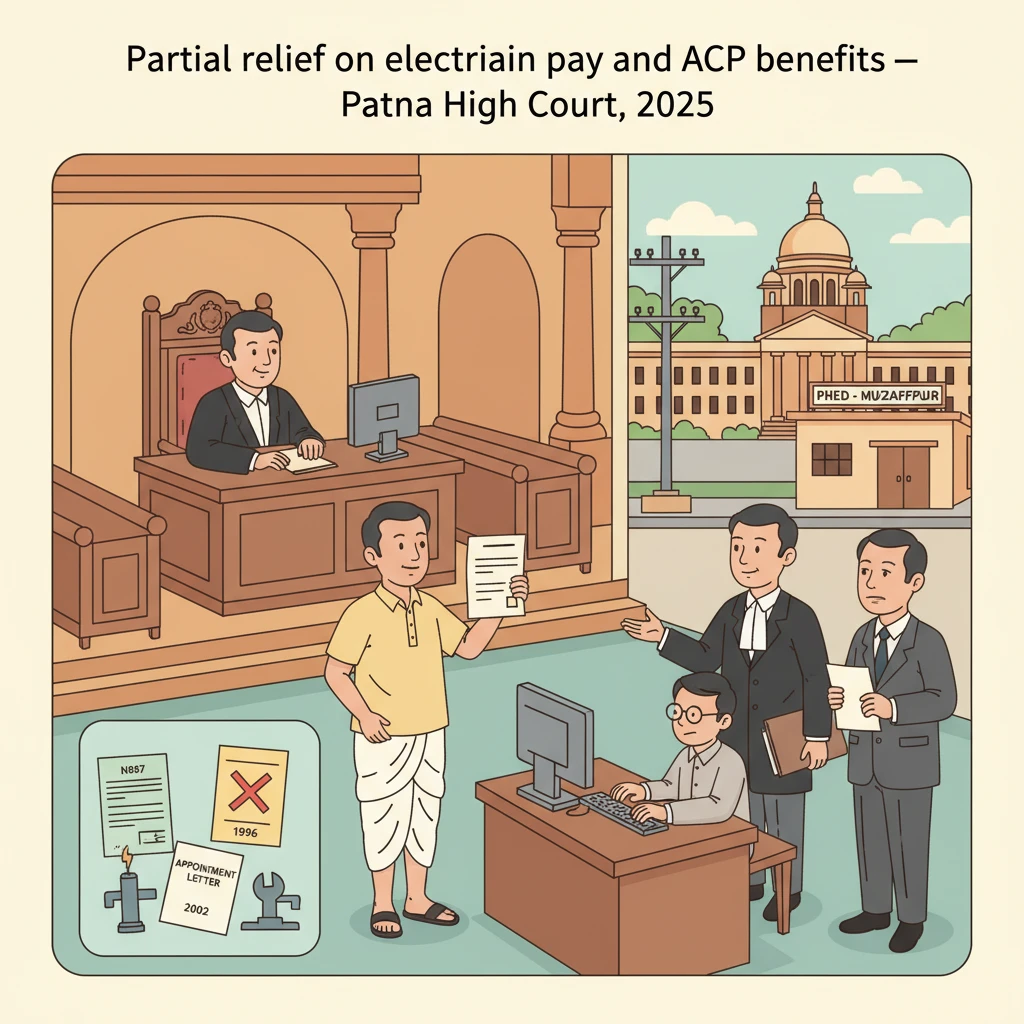
Case Background
The petitioner started working with the Public Health Engineering Department (PHED), Government of Bihar, on 1.6.1980. He was taken as a daily wage worker on the post of Pump Khalasi in Muzaffarpur.
On 14.3.1988, he was absorbed into the work charge establishment as Pump Khalasi with effect from 13.1.1988. Later, based on a decision of the Establishment Committee in its meeting on 17.12.1996 and Finance Department letter no. 5548 dated 20.10.1995, the department decided that Pump Khalasis having a two-year I.T.I. Electrical trade and work experience would be appointed as Electricians.
Accordingly, by order dated 31.12.1996, the petitioner, then described as Pump Khalasi, PHED, Muzaffarpur, was appointed on the sanctioned post of Electrician in the pay scale of Rs. 1200-30-1800 and posted at Pupri in Sitamarhi district. From then onwards, he worked as an Electrician.
On 13.4.2002, the department issued a show cause notice asking why he should not be reverted from work charge establishment to daily wage. The petitioner challenged this notice before the Patna High Court in CWJC No. 6370 of 2002. On 22.5.2002, the Court granted interim protection, directing that no coercive action be taken against him in the meantime.
Despite this, on 22.8.2002, the department passed an order reverting him to daily wage with effect from 1.6.2002. Later, on 30.11.2006, the Executive Engineer, PHED, Muzaffarpur, issued an order absorbing/regularising him on the post of Pump Operator in the pay scale of Rs. 2,650-4,000. This order specifically recorded that he would continue to perform the same work he had been doing earlier.
The petitioner maintained that he had been working as an Electrician since 1996 and that the 2006 regularisation as Pump Operator was wrong. He therefore filed CWJC No. 6004 of 2007, challenging this manner of regularisation on a lower post.
On 20.12.2011, in CWJC No. 6004 of 2007, a learned Single Judge of the Patna High Court directed the Chief Engineer, PHED, to consider the petitioner’s case for regularisation in the light of submissions made by the then Additional Advocate General-II before a Division Bench on 10.5.2006 in a batch of cases (later decided as Ram Tapeshwar Sah vs. State of Bihar; 2010 (3) PLJR 459). The Court also granted him limited benefits of difference of salary for the period the earlier interim order was in force, subject to parity with similarly situated employees.
Pursuant to that direction, the petitioner filed a representation. The Principal Secretary, PHED, then passed the impugned order dated 8.10.2012 rejecting his claim for absorption/regularisation on the post of Electrician on the ground of non-availability of a post. Aggrieved, the petitioner approached the Patna High Court again in this writ petition.
What the Court Examined and Decided
The writ petition sought two main reliefs: quashing of the order dated 8.10.2012 by the Principal Secretary, PHED, and a direction to regularise/absorb the petitioner as Electrician with effect from 30.11.2006 with benefit of Assured Career Progression (ACP), similar to other employees including juniors.
The petitioner’s counsel argued that from the inception of his service in 1980, he effectively worked as an Electrician, and this was formally recognised through the 31.12.1996 order following the Establishment Committee’s meeting of 17.12.1996. He submitted that even though the 30.11.2006 order described him as Pump Operator, it specifically mentioned that he would continue to discharge the work as before, i.e., that of an Electrician.
He stressed that the High Court in CWJC No. 6004 of 2007 had itself directed that his case be considered in line with the submissions recorded in paragraph 8 of the order dated 13.7.2006 in the Ram Tapeshwar Sah batch, especially paragraph 8(c), which recorded a statement from the then Additional Advocate General-II that inter se seniority would be fixed on the basis of initial entry into work/service.
Relying on a list of 130 employees obtained from the Executive Engineer, Muzaffarpur (Annexure-6), he pointed out that his name appeared at serial number 45, while one Hari Kumar Patel appeared at serial number 66. On this basis he pleaded that he was senior and should have been considered for absorption as Electrician before Hari Kumar Patel.
On the other side, the Additional Advocate General-3 for the State did not dispute that the petitioner was initially appointed on daily wages and later brought into the work charge establishment as Pump Khalasi by order dated 14.3.1988, and that he was regularised as Pump Operator by order dated 30.11.2006.
However, the State relied heavily on the Government policy decision dated 16.3.2006, which was considered in the judgment in Ram Tapeshwar Sah (2010 (3) PLJR 459). Paragraph 8 of that judgment recorded three submissions by the Additional Advocate General-II: (a) regarding regularisation of Class IV daily wagers who had completed 240 days of work prior to 11.12.1990, (b) inclusion of reverted work charge employees, and (c) that the cases of eligible employees would be considered by 30.9.2006 and inter se seniority would be fixed on the basis of initial entry into work/service.
The State produced the text of the Government resolution dated 16.3.2006 (Annexure-R/1 to the supplementary counter affidavit). Clause 3(i) of this resolution specifically provided that the inter se seniority of daily wage employees was to be fixed on the basis of age, not the date of initial entry into service.
The Additional Advocate General-3 therefore submitted that any statement recorded in paragraph 8(c) of Ram Tapeshwar Sah, to the effect that inter se seniority would be determined by initial entry into service, was contrary to the written Government policy dated 16.3.2006 and could not bind the State. He argued that the impugned order dated 8.10.2012 correctly applied the Government’s policy and could not be faulted.
The Court examined this contention in detail. It noted that the Government resolution of 16.3.2006 was not under challenge in the present writ petition. Clause 3(i) of that policy clearly mandated that seniority of daily wage employees was to be arranged according to age.
The Court also took note of the Supreme Court’s judgment in Himalayan Cooperative Group Housing Society v. Balwan Singh and others; (2015) 7 SCC 373. In paragraphs 31 and 32 of that judgment, the Supreme Court emphasised that:
- Advocates have a solemn duty not to exceed the authority given by their client.
- Clients are not bound by statements or concessions by counsel which affect substantial legal rights unless properly authorised.
- Admissions of law or concessions contrary to policy or law are not binding on the client or the court.
Relying on this principle, the Patna High Court held that even if the Additional Advocate General-II had made a statement as recorded in paragraph 8(c) of Ram Tapeshwar Sah, such a statement could not override or amend the clear terms of the Government’s written policy dated 16.3.2006. Therefore, the State was not legally bound to follow initial entry into service as the basis for seniority when its own policy mandated age as the criterion.
The Court further noted that the petitioner had not challenged the validity of the 16.3.2006 policy. It also recorded that, as per the documents annexed by the petitioner himself, the comparative dates of birth were not in his favour. The date of birth of Hari Kumar Patel was 1.12.1961, while that of the petitioner was 12.1.1962. Thus, under the policy that fixed seniority on the basis of age, Hari Kumar Patel was elder and therefore senior.
Additionally, Hari Kumar Patel had not been made a party to this writ petition. Any attempt to disturb his position by granting the petitioner seniority or absorption over him would affect his rights without hearing him, which the Court could not do.
In these circumstances, the Court concluded that the petitioner’s prayer for absorption as Electrician over and above Hari Kumar Patel could not be accepted. The rejection of his claim by the Principal Secretary in order dated 8.10.2012, to that extent, suffered from no illegality and was upheld.
Having addressed the seniority and absorption issue, the Court then turned to the undisputed factual position regarding the nature of work actually performed by the petitioner.
The Court noted that:
- By order dated 31.12.1996, following the Establishment Committee’s decision, the petitioner was appointed as Electrician on a sanctioned post.
- The 30.11.2006 absorption order, although regularising him as Pump Operator, expressly stated that he would continue to do the same work as before.
- The petitioner consistently claimed, and the State did not deny, that he performed the duties of an Electrician from 31.12.1996 till his retirement in 2022.
The Court then referred to the Finance Department resolution in memo no. 10710 dated 17.10.2013 (Annexure-12 to the petitioner’s rejoinder). Clause 4(vi) of this resolution clarified that if no post was available in the regular establishment, then while converting a work charge employee into the regular establishment, the work charge post itself would be converted into a regular post. Such a post, however, would not be treated as a sanctioned cadre post and would automatically stand abolished upon the concerned employee’s superannuation or death in service.
The Court also relied on the Division Bench judgment in LPA No. 1686 of 2010 (Pramila Devi vs. State of Bihar & Ors.), decided on 22.4.2016. In that case, the Court held that where a person, who is qualified and competent to hold a higher post, is made to officiate on that higher post with higher responsibilities for a considerable period and not as a stop-gap arrangement, he cannot be denied the full remuneration of that higher post. A condition limiting him only to deputation allowance was held to be arbitrary, discriminatory, and against public policy and Article 14 of the Constitution.
Applying these principles to the present case, the Court held that while the petitioner could not be granted notional absorption over a senior colleague, he could not be denied the financial benefits corresponding to the higher work he actually performed as Electrician for a long period.
Accordingly, the Court directed that:
- The petitioner is entitled to financial benefits accruing from having discharged the duties of an Electrician from 31.12.1996 till the date of his retirement.
- The respondents must calculate the pay and allowances of the petitioner on the basis of the Electrician’s post for that period, deduct what has already been paid, and release the difference within four months.
- The petitioner is also entitled to submit a representation for grant of ACP benefits. The respondents must decide this representation within four months. If he is found eligible, ACP benefits must be granted within the same period; if not, a reasoned order must be communicated to him.
Thus, the writ petition was partly allowed: the challenge to non-absorption over Hari Kumar Patel failed, but the claim for financial benefits and consideration under the ACP scheme succeeded.
Why This Judgment Matters
This judgment is important for many workers in Bihar who have been made to work for years on higher posts without being given the matching pay or formal designation.
The Patna High Court made it clear that even if the State refuses to adjust cadre positions or seniority due to an existing policy, it cannot take advantage of an employee by taking work of a higher post for long periods and paying only lower scale wages.
For daily wagers, work charge employees, and others in the Public Health Engineering Department and similar departments, this decision shows two things. First, government policy on regularisation and seniority, if not challenged, will bind the Court. Second, even under such policies, the Court can still direct that a worker must receive the financial benefits of the higher post whose duties he actually performed.
The judgment also reinforces that statements made by government counsel in court cannot override a valid written policy. Employees cannot base their rights only on such statements if they go against the Government’s formal resolutions.
Practically, the case offers a route for long-serving skilled workers to claim arrears of higher pay and to seek ACP benefits, even if they are denied seniority against another person due to age-based policies.
Legal Issues and Answers
-
Issue: Can the petitioner claim absorption/regularisation as Electrician over a colleague on the basis of earlier entry into service and a statement by State counsel, despite a Government policy fixing seniority by age?
Answer: No. The Court held that the Government policy dated 16.3.2006, which fixes seniority by age, governs. Any contrary statement recorded in an earlier case is not binding on the State and cannot displace the policy. The petitioner, being younger than the colleague and having not challenged the policy, could not claim absorption over him. -
Issue: Is a worker who has actually discharged the duties of a higher post (Electrician) for a long period entitled to the financial benefits of that higher post, even if formally shown on a lower post (Pump Operator)?
Answer: Yes. Relying on Pramila Devi and the Finance Department resolution dated 17.10.2013, the Court held that the petitioner is entitled to financial benefits of the Electrician’s post from 31.12.1996 till his retirement, and directed payment of the differential amount. -
Issue: Is the petitioner entitled to consideration for ACP benefits on the basis of his long service and nature of duties performed?
Answer: Yes, to consideration. The Court directed that he may represent for ACP benefits, and the department must decide his claim within four months, granting benefits if found eligible or passing a reasoned rejection order otherwise.
Cases Cited by the Court
- Ram Tapeshwar Sah vs. State of Bihar; 2010 (3) PLJR 459 – referred for Government policy dated 16.3.2006 and submissions of the Additional Advocate General-II regarding regularisation of daily wage and work charge employees.
- Himalayan Cooperative Group Housing Society v. Balwan Singh and others; (2015) 7 SCC 373 – cited to clarify that concessions or statements by counsel contrary to law or policy are not binding on the client (here, the State) unless properly authorised.
- LPA No. 1686 of 2010, Pramila Devi vs. State of Bihar & Ors., judgment dated 22.4.2016 – relied upon to hold that an employee made to officiate on a higher post with higher responsibilities for a long period is entitled to the full remuneration of that higher post.
Case Details
Case Number: Civil Writ Jurisdiction Case No. 16357 of 2013
Case Title: Awadhesh Kumar vs. The State of Bihar & Ors.
Court: High Court of Judicature at Patna
Coram: Hon’ble Mr. Justice Partha Sarthy
Date of Judgment: 08-10-2025
Citation: 2025(4) PLJR 575
Advocates:
- For the Petitioner: Mr. Shiv Kumar, Advocate; Ms. Sweta Burnwal, Advocate
- For the Respondents (State of Bihar/PHED): Mr. P.K. Verma, Additional Advocate General-3; Ms. Divya Verma, AC to AAG-3
Respondents: State of Bihar through the Principal Secretary, Public Health Engineering Department, and departmental officers including Engineer-in-Chief-cum-Special Secretary, Chief Engineer, Superintendent Engineer, and Executive Engineer, PHED, Muzaffarpur
Nature of the Case: Writ petition under Article 226 of the Constitution seeking quashing of departmental order dated 8.10.2012, direction for absorption/regularisation on the post of Electrician with effect from 30.11.2006, and grant of ACP and related financial benefits.
Link to Judgment: Click here to view the full judgment of the Patna High Court
If you found this explanation helpful and wish to stay informed about
how legal developments may affect your rights in Bihar,
you may consider following Samvida Law Associates for more updates.







