
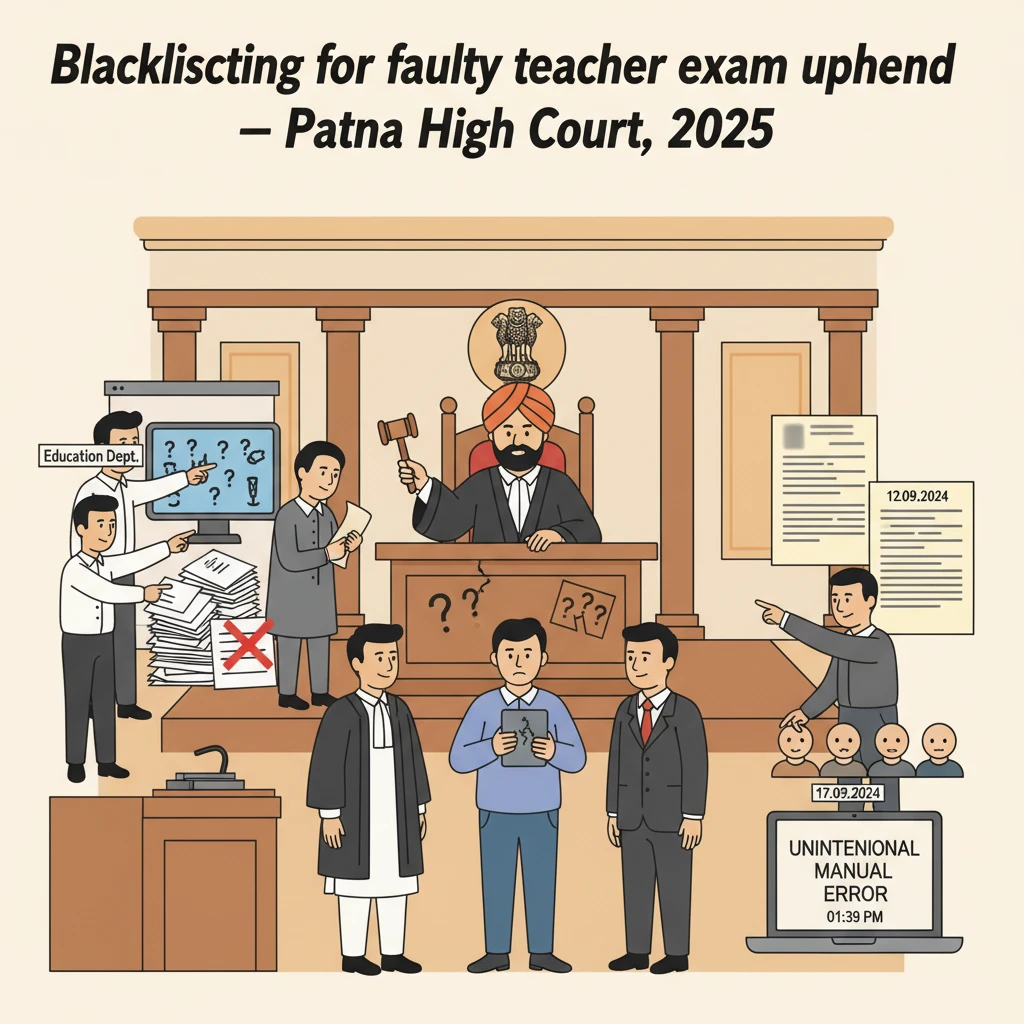
Case Background
The Education Department, Government of Bihar, issued a Request for Proposal on 22.09.2023 to select an agency for setting up an online examination system and conducting computer-based tests for various exams.
The petitioner, SIFY Digital Services Limited, became the lowest bidder (L1) and received a Letter of Intent on 20.12.2023. A formal agreement was then signed on 13.03.2024 for a five-year period, extendable by two years, at the rate of ₹170 per candidate, excluding GST. The petitioner furnished a performance bank guarantee of ₹10 lakhs.
Under Clause 12 of this agreement, the Education Department could terminate the contract and blacklist the vendor if serious defects, poor quality, or non-compliance were proved, after giving notice and an opportunity to explain.
The petitioner conducted several large examinations, including BSSTET 2023, CTT-1 2024, D.El.Ed 2024, Simultala Residential School entrance 2024, and STET 2024, covering more than 15 lakh candidates.
The dispute arose from the Competency Test for Local Body Teacher–II (CTT-2) held between 23.08.2024 and 26.08.2024. On the last day, 26.08.2024, serious irregularities were reported in multiple subjects, including repetition of questions and formatting issues.
A six-member committee was set up by Bihar School Examination Board (BSEB) on 17.09.2024. It examined the issue and submitted its report on 08.10.2024, holding the petitioner responsible for major lapses in the exam.
Initially, an order dated 31.12.2024 terminated the contract and blacklisted the petitioner indefinitely. That earlier order was challenged in CWJC No. 1292 of 2025. On 16.04.2025, the Patna High Court set aside the indefinite blacklisting and remanded the matter back to the Education Department for fresh decision after proper hearing.
After remand, the Department issued a fresh show cause notice on 30.06.2025. The petitioner filed written replies on 02.07.2025 and 08.07.2025 and was heard through video conference by the Secretary, Education Department.
After considering the materials, the Department passed a fresh order on 22.07.2025, blacklisting the petitioner from participating in tenders of the Education Department up to 31.03.2026 and affirming termination of the contract. This second order became the subject of the present writ petition, CWJC No.13538 of 2025.
What the Court Examined and Decided
The Patna High Court examined in detail both sides’ versions: the petitioner’s claim of procedural and legal violations in blacklisting, and the respondents’ stand that serious failures justified the action.
The petitioner argued that the core problem on 26.08.2024 was repetition of questions in six subjects, affecting about 749 out of 85,252 candidates. According to the petitioner, this happened because SCERT supplied question content very late, sometimes on the same day of the exam, leaving insufficient time to properly curate and verify the questions through the online authoring tool.
The petitioner highlighted that a re-examination of seven subjects for 823 candidates was conducted on 13.11.2024 at its own cost, and results were published without further complaint. It relied on the six-member committee’s recommendation of a 25% penalty and a warning instead of blacklisting.
The petitioner also contended that the earlier show cause notices of November 2024 mentioned only two points: repetition of questions in six subjects on 26.08.2024 and answer keys appearing in 50 questions of Home Science (Class XI–XII). It complained that the impugned order of 22.07.2025 brought in new grounds like issues in BSTET and delay in result publication, allegedly not part of the original show cause.
It further argued that Clause 12 of the contract required a 30-day termination notice and 15 days’ notice before blacklisting, which it said was not followed. According to the petitioner, the order was non-speaking, relied on extraneous material, ignored court directions in CWJC No.1292 of 2025, and violated natural justice.
The State and BSEB presented a very different picture. They submitted that the tender and contract were clear about quality standards and about the Department’s power to terminate and blacklist in case of serious discrepancy or poor service.
They relied on SCERT’s letter dated 12.09.2024, which flagged severe defects during CTT-2: repetition of questions across seven subjects, missing images where required, wrong display of percentage and ratio symbols, misaligned bilingual questions, and mixing of English option letters within Hindi text. These errors were described as grave, not minor, and affecting the integrity of a large examination.
The six-member committee constituted on 17.09.2024 examined the data and found identical question IDs repeating in multiple sets. It concluded that there were serious discrepancies attributable to the vendor’s lapse. Crucially, the committee relied on the petitioner’s own email dated 21.09.2024 sent at 01:39 PM, where the company admitted that question repetition happened due to oversight during data processing.
SCERT, through letter dated 03.12.2024, and BSEB, through letter dated 16.12.2024, both opined that the petitioner was primarily at fault and responsible for flawed conduct of the examination. These were placed before the decision-making authority.
After the earlier blacklisting order of 31.12.2024 was set aside in CWJC No.1292 of 2025, the Department followed the High Court’s direction and issued a fresh show cause on 30.06.2025, received the petitioner’s detailed replies on 02.07.2025 and 08.07.2025, and heard it again.
The Court noted that even in the representation dated 08.07.2025, the petitioner repeated its admission that in the last exam (CTT-2) question repetition occurred due to lack of time and “unintentional manual error”, along with an assurance that such mistakes would not recur.
On this factual basis, the Bench considered five key issues: (1) natural justice and arbitrariness, (2) nature and seriousness of the lapses, (3) effect of the petitioner’s admissions, (4) proportionality of the blacklisting period, and (5) compliance with Clause 12 and the earlier remand order.
On natural justice, the Court held that after remand, the Department had complied with the requirement of notice, reply and hearing. A show cause dated 30.06.2025 was issued, the petitioner responded in writing twice and was heard via video conference. The final order took into account the inquiry report, opinions of SCERT and BSEB, and the petitioner’s own admissions. In these circumstances, the Court found no breach of natural justice, mala fides, or lack of material evidence.
On the nature of lapses, the Court rejected the argument that the defects were minor or technical. It relied on SCERT’s letter and the inquiry report to hold that repeated questions, missing images, wrong symbols, misaligned bilingual text, and confused answer options across several subjects constituted serious operational failures. These led to cancellation and re-conduct of seven subject exams, causing delay, burden, and undermining exam integrity. Such failures, the Court said, “struck at the very foundation of the examination system”.
Regarding admissions, the Court treated the email dated 21.09.2024 and the 08.07.2025 representation as clear voluntary acknowledgements of fault. In law, such admission by a party is strong evidence against the maker. The petitioner had not retracted these admissions with any credible explanation. Hence, the respondents were justified in relying on them to impose disciplinary action under Clause 12.
On proportionality, the Court noted that the earlier order had blacklisted the petitioner indefinitely, but after the High Court’s earlier judgment, the Department reconsidered and limited the blacklisting period till 31.03.2026. This showed conscious application of mind and a reduction of severity. Considering the scale of disruption and seriousness of the lapses, temporary blacklisting was held to be a balanced and reasonable response, not excessive.
On compliance with Clause 12 and the earlier remand order, the Court found that the conditions for termination and blacklisting—material breach, failure to provide quality services, serious discrepancies affecting departmental functioning, and failure to meet lawful expectations—were clearly made out. The procedure of issuing a fresh notice, considering the replies, and passing a reasoned order aligned with both the contract and the directions in CWJC No.1292 of 2025.
In the final analysis, the Court concluded that the Education Department had acted within its contractual powers, followed due process, and passed a speaking order based on evidence and admissions. It therefore refused to interfere.
The writ petition was dismissed, and the blacklisting of the petitioner up to 31.03.2026, along with termination of the contract, was upheld. No order as to costs was made.
Why This Judgment Matters
This judgment is significant for all private agencies involved in online examinations for government departments in Bihar and beyond. It shows that even one examination marred by serious errors can lead to termination and temporary blacklisting.
The Patna High Court has made it clear that question repetition, wrong formatting, and technical glitches that disturb fairness of exams are treated as serious failures, not small mistakes, especially where thousands of candidates are affected and re-exams are needed.
The decision also underlines that emails and letters written by service providers, admitting mistakes, can be decisive evidence. Once such admissions exist, it becomes difficult to later argue that the authority acted without basis.
For government departments, the judgment supports their right to enforce contract clauses relating to quality and integrity of public exams, provided they follow proper notice and hearing procedures and record clear reasons.
Legal Issues and Answers
- Issue: Was the 22.07.2025 blacklisting order passed without fair hearing or in an arbitrary manner?
Answer: No. The Court held that fresh notice was issued, replies were considered, a hearing was given, and the decision was based on inquiry reports, expert opinions, and admitted facts. - Issue: Were the lapses in CTT-2 minor technical errors or serious failures affecting the exam?
Answer: The Court held they were serious operational failures—widespread repetition of questions and technical defects that led to cancellation and re-examination of seven subjects. - Issue: Was blacklisting till 31.03.2026 disproportionate to the defaults committed?
Answer: No. The Court found the limited-period blacklisting to be a measured and proportionate response, especially considering that an earlier indefinite blacklisting had been replaced after reconsideration. - Issue: Did the impugned order comply with Clause 12 of the agreement and the earlier High Court remand order?
Answer: Yes. The Court held that the conditions under Clause 12 were met, proper notice and opportunity were given, and the authority followed the directions issued in CWJC No.1292 of 2025.
Cases Cited by the Court
- The petitioner relied on Gorkha Security Services v. Govt. (NCT of Delhi), (2014) 9 SCC 105, regarding requirements of show cause notice. The High Court’s reasoning, however, turned on the specific facts, the fresh notice after remand, and the petitioner’s clear admissions.
Case Details
Case Number: Civil Writ Jurisdiction Case No.13538 of 2025
Case Title: SIFY Digital Services Limited v. State of Bihar & Ors.
Citation: 2025 (4) PLJR 623
Court: High Court of Judicature at Patna
Coram: Hon’ble the Chief Justice P. B. Bajanthri, Hon’ble Mr. Justice Alok Kumar Sinha
Date of Judgment: 14.10.2025
Nature of Case: Civil writ petition challenging termination of contract and order of blacklisting/debarment
Advocates for Petitioner: Mr. Chitranjan Sinha, Senior Advocate; Mr. P.N. Shahi, Senior Advocate; Mr. Sriram Krishna, Advocate
Advocates for State (Respondent No.1): Mr. P.K. Shahi, Advocate General; Mr. P.K. Verma, Senior Advocate, AAG-3; Mr. Sanjay Kumar Ghosarvasy, AC to AAG-3
Advocates for Respondent BSEB: Mr. Satyabir Bharti, Senior Advocate
Impugned Administrative Order: Memo No. 391 dated 22.07.2025 issued by Education Department, Government of Bihar, blacklisting the petitioner till 31.03.2026 and affirming termination of agreement dated 13.03.2024
Earlier Related Case: CWJC No.1292 of 2025, in which the order dated 31.12.2024 was set aside and matter remanded
Link to Judgment: Click here to read the full judgment of Patna High Court
If you found this explanation helpful and wish to stay informed about how legal developments may affect your rights in Bihar, you may consider following Samvida Law Associates for more updates.







