
Case Background
The petitioner is the son of a deceased Class IV employee of the Civil Court, Aurangabad. His father, who worked as a Daftary, died in harness on 8.2.2014.
The deceased employee left behind the petitioner (son) and a daughter. His wife, the petitioner’s mother, had already died before him. Because the widow had predeceased the employee, there was no question of family pension being paid.
According to the judgment, the family was left with no source of income after the father’s death. In this situation, the petitioner applied for a job under the compassionate appointment scheme.
On 9.7.2014, the petitioner submitted an application before the District and Sessions Judge, Aurangabad (respondent no.3), seeking compassionate appointment in the Civil Court, Aurangabad. The matter was placed before the Compassionate Appointment Committee of the Civil Court.
The petitioner appeared before the Committee on the date fixed, carrying all his original documents for verification. The Committee examined his case along with others.
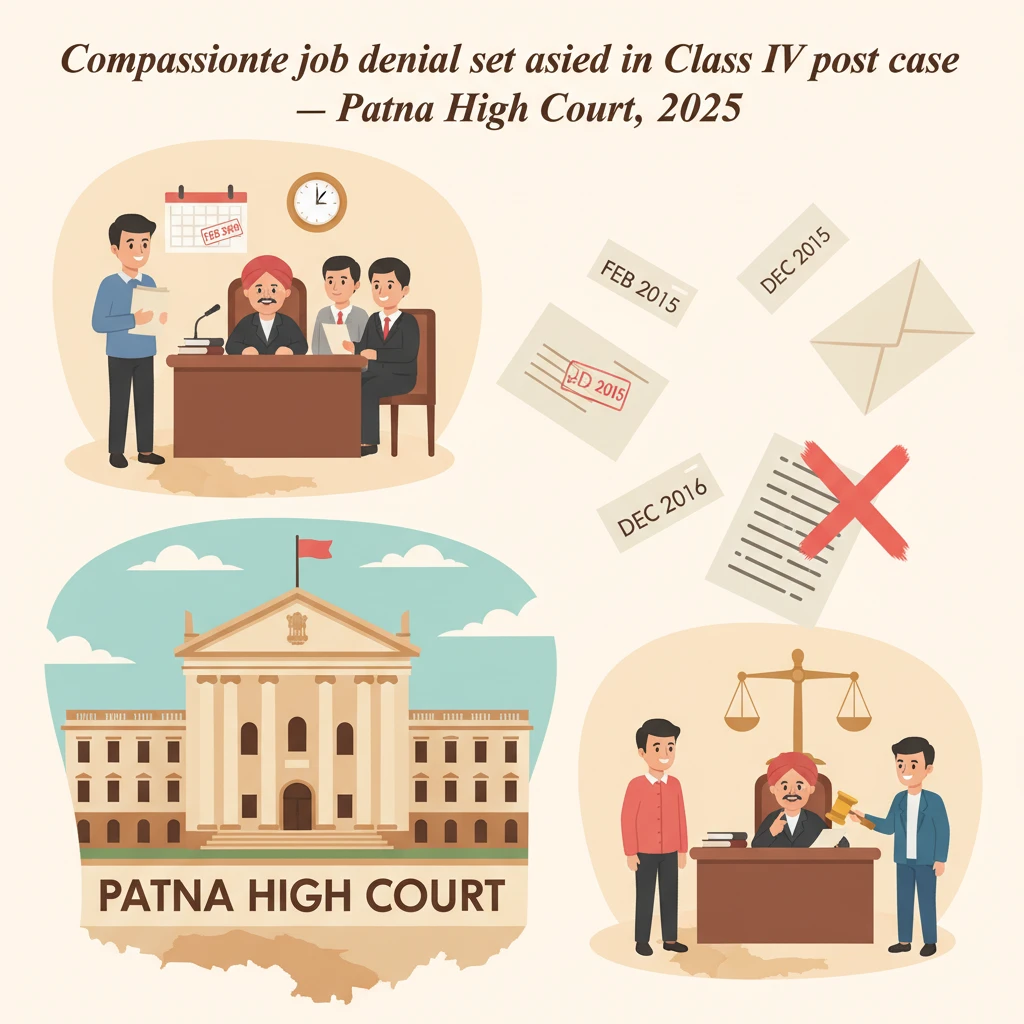
In its meeting held on 9.2.2015, the Appointment Committee of the Civil Court, Aurangabad passed a resolution to appoint the petitioner on compassionate ground on the post of Daftary in Class IV. This decision, however, was expressly made “subject to the approval of the Patna High Court”.
The recommendation was forwarded by letter dated 19.2.2015 to the Registrar (Administration), Patna High Court (respondent no.2) seeking approval.
As time passed and no appointment letter was issued, the petitioner submitted a representation to the District and Sessions Judge (respondent no.3), seeking information and action on his appointment.
In response, by letter dated 16.6.2016, the petitioner was informed that the Patna High Court had not approved his appointment and that the recommendation had been sent back on 15.12.2015 for reconsideration.
What the Court Examined and Decided
The Patna High Court examined in detail how and why the petitioner’s compassionate appointment was first recommended and then effectively denied.
The Court noted that by letter dated 15.12.2015, the High Court administration had returned the recommendation of the Appointment Committee and requested reconsideration of the petitioner’s case and two others. The reconsideration was to be done in light of the Supreme Court judgment in Umesh Kumar Nagpal vs. State of Haryana & Ors.; (1994) 4 SCC 138 and after properly assessing the financial condition of each applicant.
In the meantime, an important administrative decision was taken. By letter dated 4.1.2016, the Registrar (Administration), Patna High Court wrote to all District and Sessions Judges in Bihar, including Aurangabad. This letter stated that, after consideration, the Patna High Court had directed that appointments on compassionate ground must be restricted so that the total strength of compassionate appointees does not exceed 3% of the sanctioned strength of the cadre concerned.
Another letter dated 5.4.2016 was also issued from the Patna High Court in the same context, reinforcing this 3% cap.
Following the High Court’s earlier direction for reconsideration, the Appointment Committee of the Civil Court, Aurangabad met again on 3.8.2016. The minutes of this meeting were specifically examined by the Patna High Court in the writ proceedings.
Regarding the petitioner, the Committee recorded that he was the son of late Baijnath Prajapati, Daftary, and that the deceased employee had left behind the petitioner and a married daughter. It also noted that the petitioner’s mother had already died.
The Committee further recorded that the petitioner’s sister had also claimed her share in the death-cum-retiral benefits of their father. Since no competent authority had yet decided their shares, no retiral benefit had been paid to the petitioner.
The minutes describe the petitioner as being in a “hand to mouth condition” and unemployed, and state that his family was in a “penurious condition”. The Committee acknowledged that he had earlier been recommended for appointment as Daftary and, as per the “Hon’ble court direction”, it suggested that he could be recommended for the lowest Class IV post.
Despite these findings, the Committee, facing the new 3% ceiling communicated by the High Court through the letters dated 4.1.2016 and 5.4.2016, again sought further guidelines from the Patna High Court.
By letter dated 19.9.2016, the Registrar (Administration), Patna High Court (respondent no.2) informed the District and Sessions Judge, Aurangabad (respondent no.3) that the case of the petitioner and others had “not been considered favourably”.
The reason, as recorded in the judgment, was that ten staff members in the judgeship of Aurangabad had already been appointed in the Class IV cadre on compassionate grounds, which was much more than 3% of the sanctioned strength of that cadre. Therefore, in view of the 4.1.2016 decision, no further appointment could be granted.
In Court, the respondents relied on this 3% limit and the fact of prior compassionate appointments in Aurangabad to justify refusal of the petitioner’s appointment. They argued that the High Court’s policy decision bound them and that, in the circumstances, the writ petition should be dismissed.
The petitioner’s side stressed that his father had died in service, leaving the family with no income, and that his application was made in time. The Appointment Committee had already found his financial condition to be extremely poor and had initially recommended him for a Class IV post. His grievance was that a later administrative cap was being used to defeat his already processed claim.
The Patna High Court then considered the applicable law on compassionate appointment, with special reference to the Supreme Court’s decision in Indian Bank & Ors. vs. Promila & Anr; (2020) 2 SCC 729.
The Supreme Court in Indian Bank vs. Promila, relying on Canara Bank v. M. Mahesh Kumar; (2015) 7 SCC 412, had clarified that the scheme applicable for compassionate appointment is the one in force on the date of death of the employee. A claim under an existing scheme cannot be decided on the basis of a later scheme which came into force much after the death.
The Supreme Court also reiterated that compassionate appointment is not an alternative to regular recruitment and that there is no inherent right to such employment. Its object is to provide immediate relief to the family at the time when the employee dies. However, the Court in Promila emphasized that the cut-off date for applying a scheme is the date of the employee’s death, and that subsequent schemes cannot be made applicable to earlier deaths in a way that takes away a vested or processed right.
It was also noted in Promila that family pension and terminal benefits cannot be treated as a substitute for compassionate appointment, and that the actual terms of the scheme at the relevant time must be examined.
Applying these principles, the Patna High Court turned to the facts of the present case. Here, the deceased employee died on 8.2.2014. The petitioner filed his application on 9.7.2014. The Appointment Committee considered his application favourably in its meeting on 9.2.2015 and forwarded its recommendation for approval on 19.2.2015.
The High Court observed that the 3% ceiling on compassionate appointments was introduced only on 4.1.2016, much later than the death of the petitioner’s father and even later than the Committee’s first favourable recommendation.
On this basis, the Court held that the 3% cap introduced on 4.1.2016 could not be applied to the petitioner’s case. It treated the later administrative restriction as inapplicable to an earlier claim that had already been considered under the existing framework before that date.
The Court also took note of the Appointment Committee’s own description of the petitioner’s financial condition as “penurious” and “hand to mouth”, and the fact that no retiral benefits had been paid due to pending division of shares.
In view of these circumstances and the binding principles laid down by the Supreme Court, the Patna High Court concluded that the petitioner’s writ application deserved to be allowed.
The Court therefore set aside the effect of the earlier non-approval and directed the respondents to appoint the petitioner on compassionate ground on a Class IV post in the Civil Court, Aurangabad.
The Court also fixed a time-frame for compliance, directing that the appointment be made “at the earliest”, preferably within three months from the date of receipt or service of a copy of the order.
Why This Judgment Matters
This judgment is important for families of government and court employees in Bihar who seek compassionate appointment after the death of the earning member.
First, the Patna High Court has made it clear that authorities cannot use a new policy or restriction that comes into force later to deny a claim which arose, and was processed, under an earlier policy existing on the date of death.
Here, the 3% ceiling on compassionate appointments, introduced on 4.1.2016, could not be used to block the petitioner’s claim that arose from a death in 2014, especially when his case had already been recommended in 2015.
Second, the decision underlines that the real test in compassionate appointment is the financial hardship of the family at the time of the employee’s death. The Court took serious note of the Appointment Committee’s own finding that the petitioner’s family was in a penurious, hand-to-mouth condition.
Third, the judgment sends a message to administrative authorities and Appointment Committees that they must apply the law and schemes fairly, keeping in mind Supreme Court guidance, and cannot simply rely on later circulars to avoid genuine claims.
For similarly placed dependents of deceased employees, this decision offers a legal basis to challenge rejections that are based purely on later policy changes rather than the rules in force when their loved one died.
Legal Issues and Answers
- Issue: Can a later administrative decision imposing a 3% cap on compassionate appointments be applied to reject a claim arising from a death that occurred earlier, where the claim was already considered favourably?
Answer: No. The Patna High Court held that the 3% restriction, introduced on 4.1.2016, could not apply to the petitioner’s case, as the deceased had died on 8.2.2014 and the petitioner’s application had already been favourably considered by the Appointment Committee in 2015, before the new cap came into force. - Issue: What is the relevant date for determining which compassionate appointment scheme or policy applies to a claim?
Answer: The relevant date is the date of death of the employee. Relying on the Supreme Court’s decision in Indian Bank & Ors. vs. Promila & Anr; (2020) 2 SCC 729, the Court affirmed that a claim under a scheme applicable on the date of death cannot be decided on the basis of a later scheme. - Issue: Whether the petitioner was entitled to compassionate appointment on the facts of this case?
Answer: Yes. Considering the petitioner’s dire financial condition, the earlier favourable recommendation of the Appointment Committee, and the inapplicability of the later 3% cap, the Court allowed the writ and directed the respondents to appoint the petitioner on a Class IV post in the Civil Court, Aurangabad, preferably within three months.
Cases Cited by the Court
- Umesh Kumar Nagpal vs. State of Haryana & Ors.; (1994) 4 SCC 138 (referred to in the High Court’s earlier direction for reconsideration).
- Indian Bank & Ors. vs. Promila & Anr; (2020) 2 SCC 729 (relied upon for the principle that the applicable scheme is the one in force on the date of death; also referring to Canara Bank v. M. Mahesh Kumar; (2015) 7 SCC 412).
Case Details
Case Number: Civil Writ Jurisdiction Case No. 2983 of 2017
Case Title: Ramesh Prajapati vs. The State of Bihar & Ors.
Citation: 2025 (4) PLJR 521
Court: High Court of Judicature at Patna
Coram: Hon’ble Mr. Justice Partha Sarthy
Date of Judgment: 07.10.2025
Appearing Advocates:
- For the Petitioner: Mr. Arbind Kumar Singh, Advocate; Mr. Ranjit Kumar, Advocate
- For the State (Respondent no.1): Mr. Prabhakar Jha, GP-27
- For Respondent nos. 2 to 4: Ms. Anukriti Jaipuriyar, Advocate
Respondents: State of Bihar through Chief Secretary; Registrar (Administration), Patna High Court; District and Sessions Judge, Aurangabad, cum-Chairman of Compassionate Appointment Committee; Registrar, Civil Court, Aurangabad.
Nature of the Case: Writ petition (civil) seeking direction for compassionate appointment on Class IV post in Civil Court, Aurangabad, following death in harness of a Daftary.
Link to Judgment: file:///C:/Users/Adity/OneDrive/Documents/Vaktrita%20Final/case%201263.pdf
If you found this explanation helpful and wish to stay informed about how legal developments may affect your rights in Bihar, you may consider following Samvida Law Associates for more updates.







