
Case Background
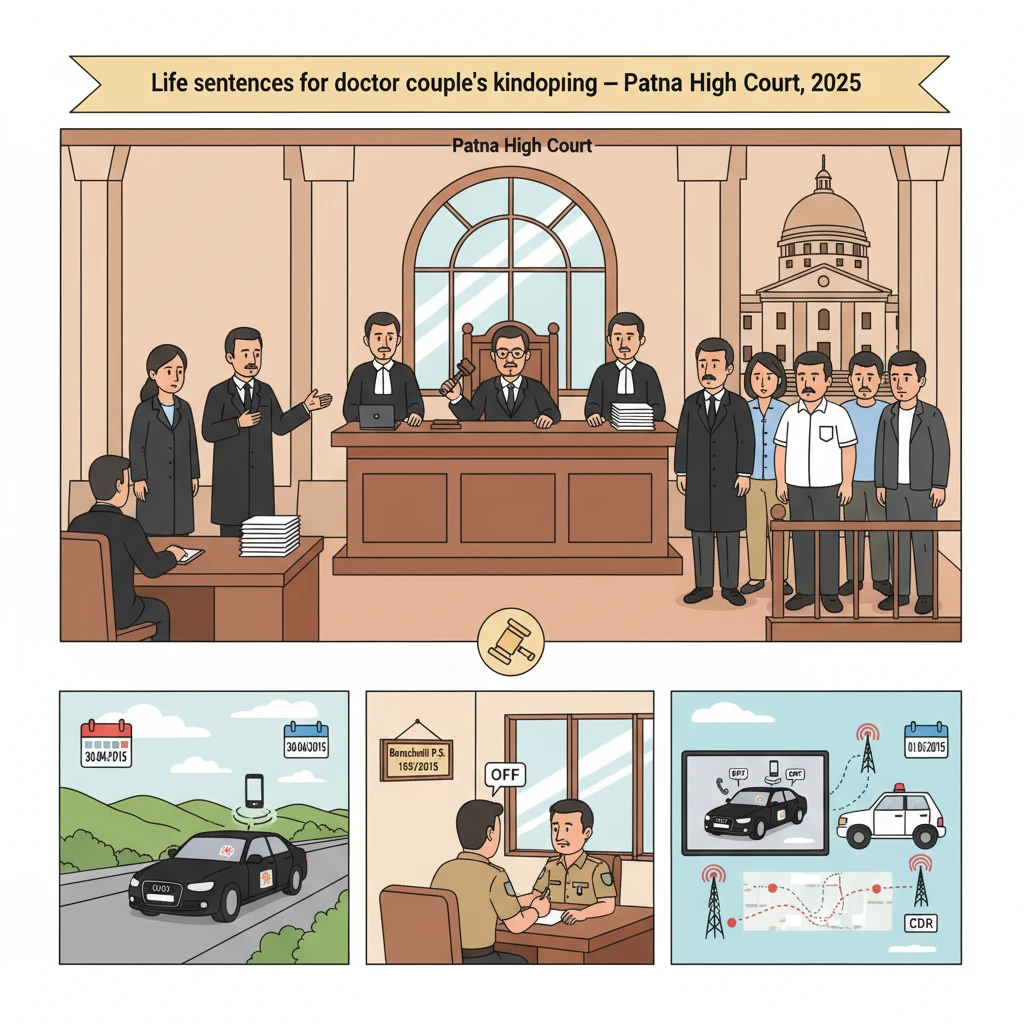
The case arises from Barachatti P.S. Case No. 155 of 2015, Gaya. On 30.04.2015, a doctor, Dr. Pankaj Kumar Gupta (PW-16), and his wife Subhra Gupta (PW-20) left Gaya in their black Audi car (Registration No. JH01AB-7698) to attend a marriage at Giridih.
On 01.05.2015, they started their return journey from Giridih at about 10:00 a.m. Their family in Gaya remained in contact with them by mobile phone until around 12:30 p.m., when they were told that the couple would reach Gaya within an hour.
By 4:00 p.m., when Neeraj Kumar Gupta (PW-3), brother of the doctor, tried to call both the doctor and his wife, their phones were switched off. Fearing that his brother, sister-in-law, and the Audi car had been kidnapped on GT Road in the Barachatti area, he submitted a written application on 01.05.2015 to the Officer-in-Charge, Barachatti Police Station.
On this written application, Barachatti P.S. Case No. 155/2015 was registered on 01.05.2015 under Section 364 IPC. Investigation followed, including analysis of call detail records and search operations across several toll plazas and locations.
On completion of investigation, police submitted charge sheet No. 168/2015 dated 10.08.2015 against the accused. Cognizance for offences under Sections 364A, 395 and 412 IPC was taken on 31.03.2016. The case was committed to the Sessions Court, and on 03.11.2016 charges under Sections 364A, 395 and 412 IPC were framed against the appellants, who pleaded not guilty.
The trial court (Additional District and Sessions Judge-I, Gaya, in Sessions Trial No. 190 of 2016 (S.J.)/419 of 2016) convicted all the accused on 20.02.2018 and sentenced them on 27.02.2018. Multiple criminal appeals were filed before the Patna High Court seeking to set aside both conviction and sentence.
What the Court Examined and Decided
The Patna High Court (Division Bench) examined whether the conviction of the appellants for kidnapping for ransom (Section 364A IPC), dacoity (Section 395 IPC), and dishonestly receiving stolen property obtained in dacoity (Section 412 IPC) was justified on the evidence.
The Court began with the prosecution’s basic story: the doctor couple set off from Giridih in their Audi on 01.05.2015; contact was lost by about 4:00 p.m.; and the family suspected kidnapping on GT Road near Barachatti.
The driver (PW-1) and compounder (PW-2) supported the background. PW-1, who normally accompanied the doctor, testified that on 01.05.2015 the doctor drove himself. At about 12:00 noon, PW-1 received a call from the doctor’s wife, who said they would arrive within an hour. When they could not be contacted later, PW-1 and PW-2 went searching up to Barhi border and then joined PW-3 at Barachatti P.S., where the FIR was lodged. PW-1 later learnt that the doctor had been kidnapped by persons using a Fortuner with red beacon and wearing uniforms.
PW-3, the informant and brother of the doctor, confirmed he last spoke with his brother at about 11:30 a.m. and with the sister-in-law at about 12:30 p.m. After phones went off, he alerted district officials and the police, and the FIR was registered around 7:00 p.m. The Senior Superintendent of Police (SSP) reached Barachatti P.S. that night and recorded statements of PW-1, PW-2, and PW-3.
The heart of the case lay in the testimony of the victims themselves. Dr. Pankaj Kumar Gupta (PW-16) stated that while driving on GT Road before Barachatti, a white Fortuner with “Government of India” written on it and a Delhi registration approached with siren. Thinking it was a VIP vehicle, he stopped his Audi to the side.
Four to five persons in commando-type uniform got down from the Fortuner, came to his car, and asked him to lower the window for “search”. As soon as he did, they dragged him and his wife out, put black cloth caps over their heads, handcuffed them, and forced them into the backseat. Initially told they were being taken to “headquarters,” they were then bluntly informed that they were kidnapped and would not be released without payment of money.
PW-16 described being driven for hours, transferred into another vehicle, taken up by a lift, and confined in a room where they stayed until the night between 05.05.2015 and 06.05.2015. During confinement they were given food, but whenever food was served they were made to wear caps and face the wall. Their personal belongings – Audi car, phone, jewellery, clothes, shaving kit, and his wife’s make-up items – were not returned.
On the night of 05/06.05.2015, they were told they would be freed. With their faces covered, they were driven some distance, dropped, and instructed not to look back. When they walked ahead, they realised they were at Allahabad Railway Station. They boarded a train going to Gaya, reached Dehri-on-Sone, borrowed a passenger’s phone, and called the doctor’s brother-in-law. Eventually they were received at Gaya and taken to the doctor’s in-laws’ house, where police soon met them and recorded their ordeal.
PW-16 candidly admitted he could not identify the accused in Court because events unfolded very quickly and he was kept blindfolded or facing the wall throughout. His wife, PW-20, gave a consistent account of the abduction, confinement, and release, and similarly explained her inability to identify any accused in the dock, though she added that at the very beginning the accused had not concealed their faces. The High Court held that, given the short duration of that initial encounter and the trauma and constant hooding thereafter, failure to identify the accused in Court did not weaken the case when other strong circumstantial evidence existed.
The main link to the accused was through the joint operation of Bihar and Uttar Pradesh police at Sharda Apartment, Gomti Nagar, Lucknow. Technical cell officer Ram Chand Bhanu (PW-4) and another officer, Gaurav Sindhu (PW-5), both posted with the SSP, Gaya, described how call records and GPS led the investigation to Lucknow. With assistance from the Uttar Pradesh STF and senior officers (D.G., I.G., D.I.G., S.S.P.), multiple raiding teams were formed.
PW-4 and PW-5 both testified that on 06.05.2015, a raid was conducted at Sharda Apartment. They described that in the parking area, a black Audi, a white Fortuner, and an Innova were found. Four persons were in the Audi, three in the Fortuner, and two in the Innova. Ajay Singh, identified by them in Court, was in the Audi; according to PW-4, he attempted to fire from the Audi but was overpowered by the I.G. Arms were recovered from the vehicles, and all nine accused were arrested there.
On interrogation, Ajay Singh disclosed that he resided on the ninth floor of Sharda Apartment and that the doctor couple’s belongings were kept in a flat there. He took out a key hidden in a flower pot near the door of Flat No. 906, opened it, and inside were found red and white bags and suitcases containing items that he said belonged to the doctor’s wife: ladies’ clothing, undergarments, jewellery, personal care and make-up products; as well as police and paramilitary style uniforms, belts, shoes, beacon lights, number plates, and monograms resembling official symbols.
The Uttar Pradesh investigation (Gomti Nagar P.S. Case Nos. 299–302 of 2015) was handled by PW-12, a Senior Police Inspector, who confirmed that nine accused were arrested from Sharda Apartment and that the Audi, Fortuner, and Innova, along with articles belonging to the doctor couple, were seized from the parking and Flat No. 906. A detailed seizure-cum-arrest memo (fard-giraftari) prepared by STF Lucknow was produced as Exhibit 33, bearing signatures of the raiding officers from both states and of all nine accused.
PW-9, the Block Development Officer, Barachatti, conducted a Test Identification Parade (TIP) of seized articles on 05.06.2015 on the Magistrate’s order. He stated that 46 articles – including a red ladies’ bag, ladies’ purse, yellow metal chain, ear-tops, handbags, perfume bottle, shaving kit, clothing, and personal items – were mixed with similar items and shown to PW-16 and PW-20, who identified them as theirs. He prepared and proved the TIP chart (Exhibit 11). The Court found his evidence credible and noted no contradiction in cross-examination sufficient to discredit the TIP, even though two independent TIP witnesses were not examined.
House owners in Lucknow also linked Ajay Singh to the premises. PW-10, landlord at 3/210 Vishwas Khand, deposed that Ajay Singh took his house on rent from November 2012 to May 2015 under the name “Neeraj Pratap Singh,” after seeing an advertisement, and that police later informed him that this tenant was in fact Ajay Singh involved in the doctor’s kidnapping. PW-22, mother of the owner of Flat No. 906, Sharda Apartment, testified that the flat was given on rent in December 2014 to “Rajeev Shekhar,” later revealed by the DGP/IG STF to be Ajay Singh. She had approached senior police officers herself after seeing news of the kidnapping on television.
PW-6 proved multiple bank account statements and identity documents (Exhibits 3 series and 4 series), showing that Ajay Singh used different names – Neeraj Pratap Singh, Narendra Pratap Singh, and Rajiv Pratap Singh – with the same photograph. PW-7 and PW-8 from the CID connected the modus operandi in this case with an earlier Barachatti case (Case No. 37 of 2015) involving kidnapping of a businessman and use of a Fortuner. PW-8 also stated that Rajasthan police informed him that Ajay Singh was a life convict in a Jaipur kidnapping case who had absconded while on parole, though the High Court treated this more as background and noted that defence had not seriously disputed it in cross-examination.
The defence raised several objections: there was no Test Identification Parade (TIP) of the accused persons; victims did not identify anyone in Court; key senior officers like D.G., I.G., and S.S.P. Lucknow were not examined; seizure lists were allegedly not proved; there were contradictions about whether accused were arrested from the parking lot or flat; CCTV CDs were not proved under Section 65B of the Evidence Act; there was delay in examining some witnesses; and Section 313 CrPC was allegedly not properly complied with.
The High Court systematically rejected these contentions. It held that:
- Non-identification of the accused by the victims was reasonably explained and did not break the chain of circumstantial evidence.
- PW-4 and PW-5, though not the highest-ranking officers, were credible eye-witnesses to the raid and arrest, and their presence with the STF team was corroborated by PW-12 and Exhibit 33.
- Even if the CCTV CDs were ignored, the victim’s own testimony and other evidence sufficiently established the movement of the Audi and Fortuner on the relevant route.
- The TIP of articles conducted by PW-9, together with consistent identification by PW-16 and PW-20, strongly linked the seized goods to the victims.
- Contradictions about exact timing or precise arrest location (parking vs. flat) were minor and did not undermine the core prosecution case.
- The accused gave no explanation in their Section 313 CrPC statements for their possession of the Audi, Fortuner, Innova, and the victims’ belongings found in Flat No. 906.
The Court emphasised that the totality of the prosecution evidence – the consistent accounts of the victims, the recovery of the doctor’s Audi and personal articles from the Lucknow premises, the proof that Ajay Singh rented the houses under false names, and the coordinated raid by Bihar and UP police – established the offences beyond reasonable doubt. Referring to the principle in Gopal Singh v. State of Bihar (1993 (1) PLJR 236), the Bench held that minor discrepancies could not defeat a strong, coherent prosecution case.
In the result, the Patna High Court upheld the conviction of all appellants under Sections 364A, 395 and 412 IPC. It confirmed the life sentence awarded to main accused Ajay Singh for all three offences, and the life sentence under Section 364A and ten-year terms under Sections 395 and 412 IPC for the other appellants, along with the fines imposed by the trial court.
The appeals were dismissed. Appellants who were on bail were directed to surrender before the trial court within two weeks; failing that, coercive steps were to be taken to secure their custody. Ajay Singh and Amit Singh, already in jail, were ordered to continue serving their remaining sentences.
Why This Judgment Matters
This Patna High Court judgment is significant for several practical reasons.
First, it shows that even when abducted victims cannot identify their kidnappers in Court, convictions can still be upheld if other evidence clearly proves the crime. Here, the Court relied heavily on recovery of the victims’ Audi car and personal belongings from a specific flat in Lucknow, and on credible police testimony about the raid and seizure.
Second, the decision underlines that gangs using fake official uniforms, beacon lights, and government-style number plates to stop vehicles on highways can still be successfully prosecuted. The discovery of police and paramilitary uniforms and fake symbols in the flat was treated as a crucial link, showing how the gang disguised themselves as authorities to trap victims.
Third, the judgment reinforces that technical objections – such as non-examination of some senior officers, or minor inconsistencies in timings – will not automatically result in acquittal where the overall story is coherent and supported by multiple independent witnesses and documents.
For ordinary people who travel long distances by road, especially doctors, businesspersons or others perceived to be wealthy, this case is a reminder of the dangers of gangs masquerading as officials, and of the legal system’s willingness to impose strict punishment – including life imprisonment – on kidnappers for ransom.
Legal Issues and Answers
- Issue: Did the prosecution prove beyond reasonable doubt that the appellants kidnapped the doctor couple for ransom and committed dacoity by taking away their car and belongings?
Answer: Yes. The Court held that the consistent testimony of the victims, recovery of the Audi and personal articles from Flat No. 906, the evidence of police officers involved in the raid, and the rental and identity records linking Ajay Singh to the Lucknow premises together proved kidnapping for ransom and dacoity under Sections 364A and 395 IPC. - Issue: Was the offence under Section 412 IPC (dishonestly receiving property obtained in dacoity) made out against the appellants?
Answer: Yes. The Court found that the appellants were arrested in possession of the Audi car and the doctor couple’s stolen articles soon after the kidnapping, with no lawful explanation. This established that they had retained property knowing or having reason to believe it was obtained in dacoity, satisfying Section 412 IPC. - Issue: Did procedural lapses regarding identification, seizure, and Section 313 CrPC examination make the conviction unsustainable?
Answer: No. The Court held that the absence of TIP of the accused, non-identification by the victims, and non-examination of some officers were not fatal because the overall circumstantial evidence was strong and consistent. The Court also found that the essential incriminating circumstances were put to the accused under Section 313 CrPC, and no prejudice was shown.
Cases Cited by the Court
- The Court referred to Gopal Singh and Others v. State of Bihar, 1993 (1) PLJR 236, to emphasise that minor discrepancies do not justify rejecting otherwise reliable evidence.
- The defence cited Anvar P.V. v. P.K. Basheer (2014) 10 SCC 473 on proof of electronic records, and Prakash v. State of Karnataka (2014) 12 SCC 133 on Section 313 CrPC, but the High Court found that even without disputed electronic records, the prosecution case stood proved.
Case Details
Case Numbers:
Criminal Appeal (DB) No. 144 of 2022
Criminal Appeal (DB) No. 403 of 2018
Criminal Appeal (DB) No. 428 of 2018
Criminal Appeal (DB) No. 539 of 2018
Criminal Appeal (DB) No. 714 of 2018
Criminal Appeal (DB) No. 1010 of 2018
Criminal Appeal (DB) No. 1038 of 2018
Criminal Appeal (DB) No. 923 of 2019
Trial Court Case:
Sessions Trial No. 190 of 2016 (S.J.) / 419 of 2016 arising out of Barachatti P.S. Case No. 155/2015, District Gaya
Case Title (one example, as per record):
Amit Singh v. The State of Bihar
(Other connected appeals are titled with the respective named appellants v. The State of Bihar.)
Citation:
2025 (4) PLJR 508
Court and Coram:
Patna High Court (Division Bench)
Hon’ble Mr. Justice Rajeev Ranjan Prasad
Hon’ble Mr. Justice S. B. Pd. Singh
Date of Judgment:
16.05.2025
Advocates:
For appellants (in different appeals):
Mr. Ansul, Sr. Advocate (appeared in multiple appeals)
Mr. Sanjay Kumar, Advocate
Mr. Javed Aslam, Advocate
Mr. Ravindra Kumar Sinha, Advocate
Mr. Anil Singh, Advocate (Amicus Curiae in Cr. Appeal (DB) No. 539 of 2018)
Mr. Bindhyachal Singh, Sr. Advocate
Mr. Vipin Kumar Singh, Advocate
Mr. Kumar Awnish Ankit, Advocate
Dr. Rajesh Kumar Singh, Advocate
Mr. Ajay Kumar Thakur, Advocate
Mr. Bhaskar Shankar, Advocate
For the State of Bihar (respondent):
Ms. Shashi Bala Verma, APP
Mr. Abhimanyu Sharma, APP
Mr. Shivesh Chandra Mishra, APP
Mr. Dilip Kumar Sinha, APP
Mr. Shiwesh Chandra Mishra, APP
Nature of the Case:
Criminal appeals (Division Bench) against conviction and sentence in a sessions trial for kidnapping for ransom, dacoity, and receiving stolen property (Sections 364A, 395, 412 IPC).
Link to Full Judgment:
Patna High Court Judgment – Criminal Appeal (DB) No. 144 of 2022 & connected matters
If you found this explanation helpful and wish to stay informed about
how legal developments may affect your rights in Bihar,
you may consider following Samvida Law Associates for more updates.







