
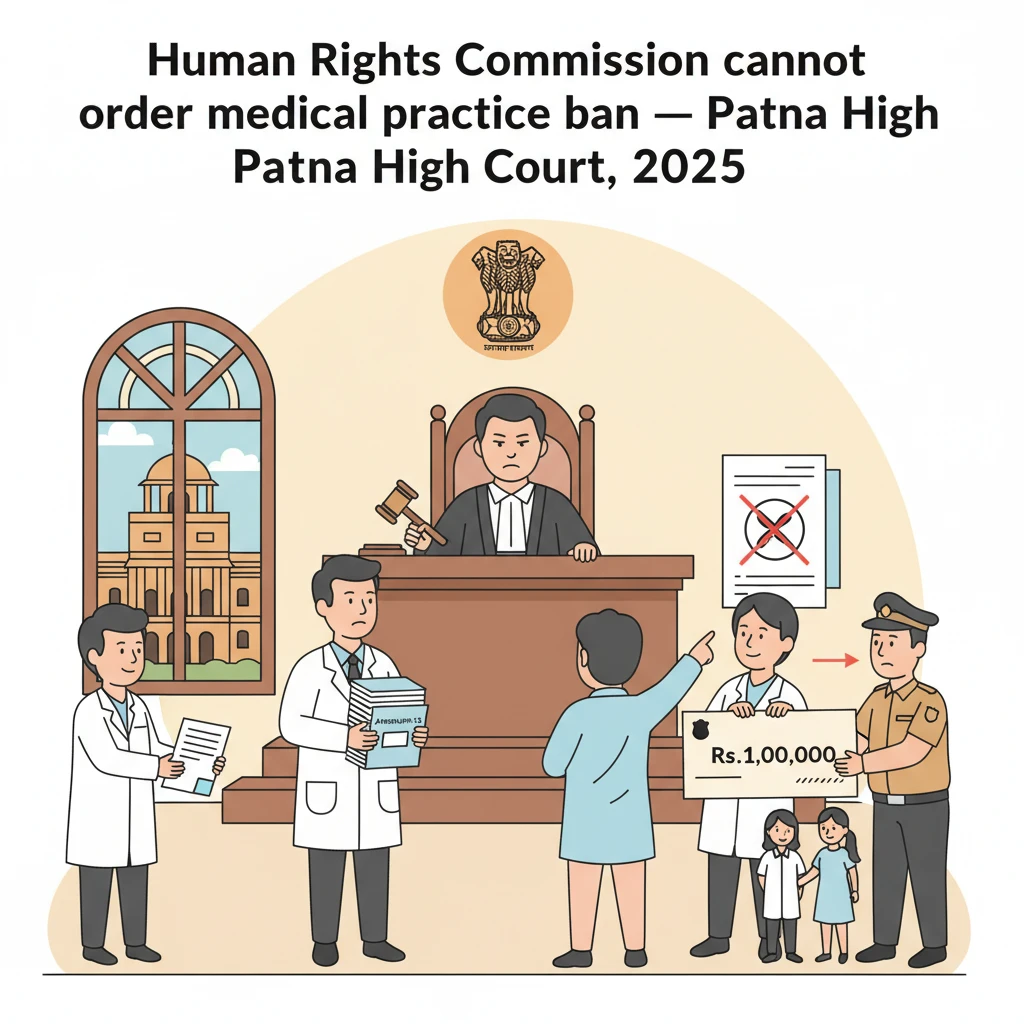
Case Background
The writ petition was filed in Civil Writ Jurisdiction Case No.18177 of 2014 before the Patna High Court by a medical practitioner, Dr. Ranjit Kumar. The petitioner runs Sakshi Surgery Centre at Sirhi Ghat Lane, under Bakhtiyarpur Police Station in Patna district.
Proceedings had earlier taken place before the Bihar Human Rights Commission, Patna, in File No. BHRC/Comp.676/12 titled “Ram Narayan Singh vs. Dr. Ranjit Kumar”. The complaint related to alleged serious criminal medical negligence, and an Expert Committee set up by the Health Department examined the matter.
On 02.06.2014, the Commission directed the Health Department to send a response to its proposal to award compensation to the victim. The Department was asked to respond by 02.07.2014, after which final orders were to be passed. The Commission also directed the petitioner doctor to submit his defence, which he did.
On 25.07.2014, the Commission passed an order in BHRC/Comp.676/12. The operative portion directed payment of compensation to the victim by the Health Department, recovery of the amount from the doctor, communication of action regarding termination of the doctor’s services, and transmission of the Expert Committee report to authorities for various follow-up steps. One specific clause, paragraph 5(c), stated that a copy of the Expert Committee report was being sent to the Chairman, Bihar Council of Medical Education, “for effecting ban on the Gynaecological practice and surgery by the Doctor”, and required action taken to be communicated to the Commission within three months.
The petitioner approached the Patna High Court challenging the Commission’s order dated 25.07.2014. At the stage of arguments, however, his counsel narrowed the challenge only to paragraph 5(c) of that order, relating to the ban on his gynaecological practice and surgery.
What the Court Examined and Decided
Justice Alok Kumar Sinha heard the matter and noted that, although the writ petition had originally sought to quash the entire order dated 25.07.2014, the learned counsel for the petitioner confined the challenge to paragraph 5(c).
The petitioner raised two main objections:
First, he argued that the Commission had passed the direction in paragraph 5(c) without properly considering his detailed reply (Annexure-12) filed in BHRC/Comp.676/12. In that reply, he had tried to explain why the findings and recommendations of the Expert Committee dated 23.05.2014 (Annexure-10) were incorrect. He contended that the Commission simply recorded that he had “miserably failed to rebut the charges” without giving any reasoning, and then proceeded to act on the Expert Committee report to direct a ban on his gynaecological practice.
Second, and more fundamentally, he argued that the Bihar Human Rights Commission had exceeded its legal powers by issuing a “direction” instead of a “recommendation”. He placed heavy reliance on Section 18 of the Protection of Human Rights Act, 1993, and on a coordinate Bench judgment of the Patna High Court in Dr. Lalit Mohan Sharma vs. Bihar Human Rights Commission & Anr., CWJC No.13188 of 2012, decided on 06.03.2024.
In that earlier case, the coordinate Bench had examined Section 18 and held that the Human Rights Commission is only empowered to make recommendations and cannot adjudicate and pass an enforceable order for payment of compensation. It was described as a recommendatory body, whose powers are codified in Section 18. The State Government and authorities are obliged to consider its recommendations in accordance with law, but the Commission itself cannot directly order payment of compensation. The order of the Bihar Human Rights Commission granting compensation in that case had been quashed.
The petitioner also relied on a judgment of the Chhattisgarh High Court in Chhattisgarh State Electricity Board vs. Chhattisgarh State Human Rights Commission & Ors., reported in AIR 2018 CHH 53. There too, it was held that the Human Rights Commission is a recommendatory body which can only make recommendations to the concerned Government or authority, and has no jurisdiction to pass an order directing payment of compensation.
To support his argument, the petitioner drew attention to the text of Section 18 of the Protection of Human Rights Act, 1993. The provision states that during or after an inquiry, where violation of human rights, negligence in prevention, or abetment by a public servant is disclosed, the Commission “may recommend” to the concerned Government or authority to:
(i) make payment of compensation or damages,
(ii) initiate prosecution or other suitable action,
(iii) take such further action as it may think fit.
Section 18 further provides for approaching the Supreme Court or High Court for directions, recommending interim relief, sending copies of inquiry reports, and requiring the concerned Government or authority to send comments and report action taken on the recommendations.
On this statutory basis, the petitioner argued that the Commission cannot go beyond recommendations and cannot issue binding directions such as ordering a ban on a doctor’s right to practice in a particular field.
On the other side, learned counsel for respondent no.3 (the complainant) defended the Commission’s order. He submitted that paragraph 5(c) did not amount to a direction, but was merely a step asking the Chairman, Bihar Council of Medical Education, to act on the Expert Committee’s recommendation to ban the gynaecological practice and surgery of the petitioner. According to him, there was no illegality in the Commission’s action and no need for interference.
Learned counsel for the State also supported the Commission’s order, particularly paragraph 5(c). The State relied on a decision of the Allahabad High Court reported in MANU/UP/1239/2016, where the Court discussed whether the word “recommend” in Section 18(a) is to be treated as a mere opinion that the State can ignore. The Allahabad High Court held that such a construction would dilute the efficacy of the Commission and defeat the object of the statute. It concluded that the State Government cannot ignore the Commission’s recommendations at its discretion, and is duty-bound to comply unless the order is set aside in judicial review.
The State also cited a Madras High Court (Madurai Bench) decision reported in MANU/TN/0767/2021, where a Full Bench had held that recommendations under Section 18 are binding and enforceable, and that the Commission can order recovery of compensation paid by the State to victims of human rights violations from officers found responsible, subject to issuance of show-cause notice and appropriate procedural safeguards.
The Patna High Court carefully considered these authorities. On the Allahabad High Court decision, it found that the issue in that case was different from the one arising here. That case dealt with whether recommendations can be ignored by the Government, whereas the present dispute is whether the Commission can issue a “direction” at all. Therefore, the Allahabad judgment was held to be of no assistance to the State in the present context.
On the Madras High Court decision, the Patna High Court noted that it emphasized the binding and enforceable nature of the Commission’s recommendations on the State and permitted recovery of compensation from officers. The Court stated that there was no quarrel with that proposition. However, it underlined that the central question in the current case was different: not the importance or binding nature of the Commission’s recommendations, but whether the Commission can give a binding direction instead of a recommendation.
Reiterating the statutory language of Section 18 and relying on the earlier coordinate Bench judgment in Dr. Lalit Mohan Sharma and the Chhattisgarh High Court decision, Justice Sinha held that the Human Rights Commission is a recommendatory body. It can recommend actions to the Government or authorities, but cannot itself direct them to do specific acts which have the character of binding orders.
The Court acknowledged that the Expert Committee had indeed recommended a ban on the petitioner’s gynaecological practice and surgery. But it framed the decisive question as whether the Commission could “direct” the Chairman, Bihar Council of Medical Education, to implement that recommendation.
The Court held that, given the mandate of Section 18 and the precedents cited, no such direction could have been issued. The Commission could have recommended that the Council consider the Expert Committee’s report and take appropriate action. However, by using language “for effecting ban” and requiring the Chairman to report action taken within a time frame, the Commission had crossed the line from recommendation to direction.
Justice Sinha concluded that the direction given by the Commission in paragraph 5(c) was completely illegal, without jurisdiction, and contrary to Section 18 of the Protection of Human Rights Act, 1993.
Accordingly, the Patna High Court quashed and set aside the impugned order dated 25.07.2014 of the Bihar Human Rights Commission in BHRC/Comp.676/12 to the extent that it directed the Chairman, Bihar Council of Medical Education, to effect a ban on the gynaecological practice and surgery by the petitioner.
The writ application was allowed only to that limited extent. All pending interlocutory applications were deemed disposed of.
Why This Judgment Matters
This judgment is important because it draws a clear line around the powers of the Bihar Human Rights Commission and similar bodies under the Protection of Human Rights Act, 1993.
For doctors and other professionals facing complaints before human rights commissions, it clarifies that such commissions can recommend action, but cannot directly order bans on professional practice or pass binding punitive directions. Any such decisions must be taken by the competent statutory or regulatory authorities, after following due process.
For the Government and regulatory bodies like medical councils, the judgment confirms that they must consider and act on the Commission’s recommendations seriously, but the Commission cannot legally dictate the exact outcome in the form of binding directions.
For victims alleging human rights violations in medical or other contexts, the decision explains the role of the Commission: it can support them by investigating, making findings, and recommending compensation or action, but the ultimate enforcement lies with the Government and other authorities, subject to judicial review.
Legal Issues and Answers
-
Issue: Can a State Human Rights Commission, under Section 18 of the Protection of Human Rights Act, 1993, issue a binding direction to a regulatory authority to ban a doctor’s gynaecological practice and surgery?
Answer: No. The Patna High Court held that the Commission is only a recommendatory body. It cannot issue binding directions; it may only recommend action to the concerned Government or authority. The direction in paragraph 5(c) of the Commission’s order was therefore illegal and without jurisdiction. -
Issue: Was paragraph 5(c) of the Bihar Human Rights Commission’s order dated 25.07.2014, directing the Chairman, Bihar Council of Medical Education, to effect a ban on the petitioner’s gynaecological practice and surgery, sustainable in law?
Answer: No. The Court quashed paragraph 5(c) of the order in BHRC/Comp.676/12, holding that such a direction went beyond the powers granted to the Commission under Section 18 of the Protection of Human Rights Act, 1993.
Cases Cited by the Court
- Dr. Lalit Mohan Sharma vs. Bihar Human Rights Commission & Anr., CWJC No.13188 of 2012, Patna High Court, judgment dated 06.03.2024.
- Chhattisgarh State Electricity Board vs. Chhattisgarh State Human Rights Commission & Ors., AIR 2018 CHH 53, Chhattisgarh High Court.
- Allahabad High Court decision reported in MANU/UP/1239/2016 (relied on by the State; distinguished by the Patna High Court).
- Madras High Court (Madurai Bench) Full Bench decision reported in MANU/TN/0767/2021 (relied on by the State; held not directly on the point in issue).
Case Details
Case Number: Civil Writ Jurisdiction Case No.18177 of 2014
Case Title: Dr. Ranjit Kumar vs. The State of Bihar & Ors.
Coram: Hon’ble Mr. Justice Alok Kumar Sinha
Citation: 2025 (4) PLJR 293
Date of Judgment: 28.07.2025
Advocates:
- For the Petitioner: Mr. Saket Tiwary, Advocate; Mr. Tarun, Advocate; Mr. Animesh Gupta, Advocate; Mr. Shivam Gupta, Advocate.
- For the State: Mr. Vivek Prasad, GP-7; Mr. Aman Priyadarshi, Advocate.
- For Respondent No.3: Mr. Sanjeev Kumar, Advocate.
Nature of the Case: Writ petition (civil) challenging part of an order of the Bihar Human Rights Commission under Article 226 of the Constitution of India.
Impugned Order: Order dated 25.07.2014 passed by the Bihar Human Rights Commission, Patna, in File No. BHRC/Comp.676/12 (Ram Narayan Singh vs. Dr. Ranjit Kumar), specifically paragraph 5(c) directing the Chairman, Bihar Council of Medical Education, to effect a ban on the petitioner’s gynaecological practice and surgery.
Link to Judgment: Patna High Court Judgment – CWJC No.18177 of 2014
If you found this explanation helpful and wish to stay informed about
how legal developments may affect your rights in Bihar,
you may consider following Samvida Law Associates for more updates.







