
Case Background
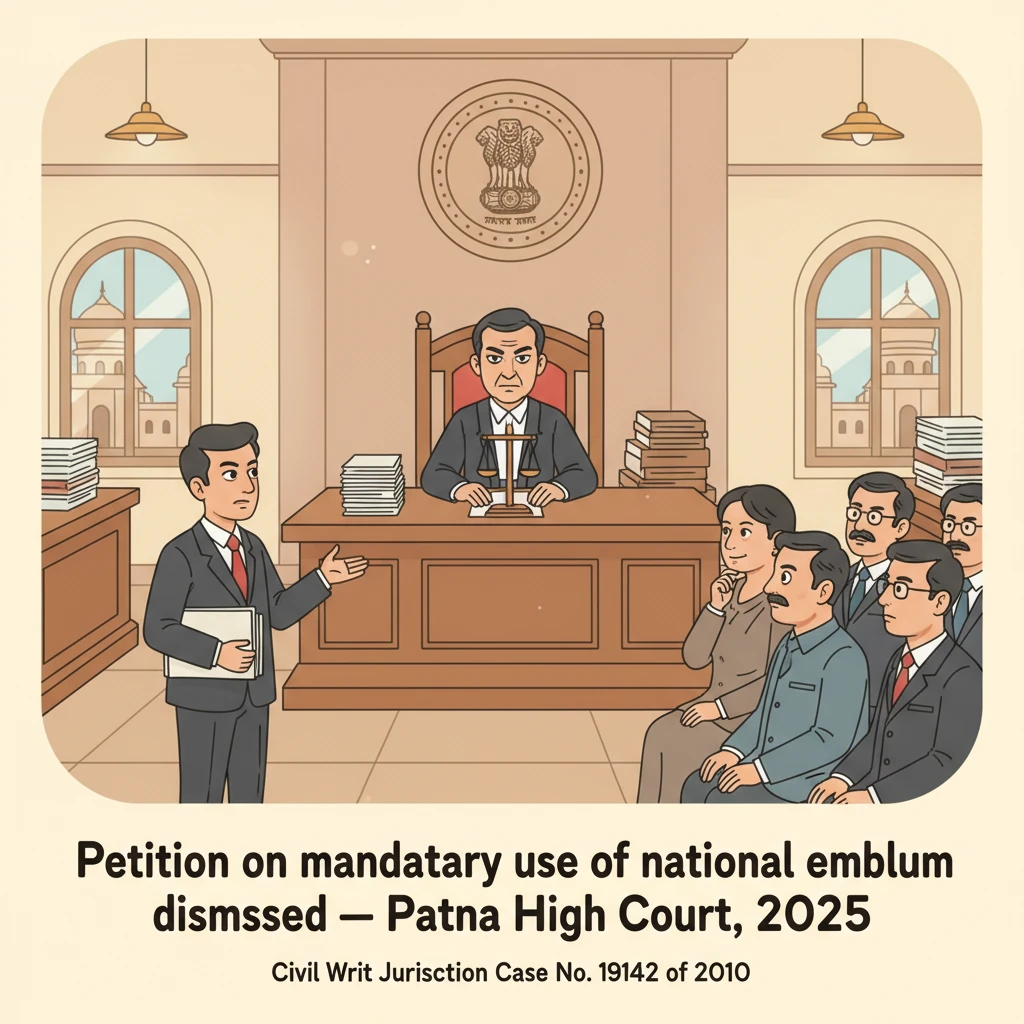
The petitioner, a practising advocate of the Patna High Court, filed this writ petition in Civil Writ Jurisdiction Case No.19142 of 2010. He appeared in person and described himself as an advocate and the son of a freedom fighter.
The writ petition was directed against the State of Bihar, various Principal Secretaries and Secretaries of different departments, senior officers of the State, the Union of India through the Ministry of Home Affairs and other ministries, as well as officers of the Patna High Court and the Bihar Legislature.
From Order No. 2 dated 24.11.2010, the Court recorded that the petitioner had a grievance against the State of Bihar and its officers for not using the National Emblem on official stationery and for coining a separate State emblem. At that stage, the Court observed that the matter could hardly be a matter of concern for the public in general and directed that the matter be listed before a learned Single Judge dealing with miscellaneous writ petitions. The petitioner was also directed to amend the cause title accordingly.
Subsequently, by Order No. 4 dated 10.01.2019, the Court recorded that the matter was heard, the writ petition was admitted, and since the parties had already entered appearance, no fresh notice was required to be issued.
The oral judgment was ultimately delivered on 19.08.2025 by Hon’ble Mr. Justice Dr. Anshuman, after hearing the petitioner in person, counsel for Respondent Nos. 17 and 18 (Patna High Court), and learned counsel for the State of Bihar. No one appeared on behalf of the Union of India at the time of final hearing.
What the Court Examined and Decided
The core grievance of the petitioner was that various authorities in the State of Bihar, including Principal Secretaries, Secretaries, Heads of Departments, Commissioners, District Magistrates-cum-Collectors, and officers holding constitutional posts, were not using the national emblem as per law on their official stationery and seals.
The petitioner sought a writ of mandamus directing these authorities to strictly use the State Emblem of India for all official purposes, as per the Emblems and Names (Prevention of Improper Use) Act, 1950, the State Emblem of India (Prohibition of Improper Use) Act, 2005, and the State Emblem of India (Regulation of Use) Rules, 2007.
He pointed out that the Rules of 2007 were notified in the Gazette of India on 4 October 2007 under Section 11 of the 2005 Act. According to him, these Rules regulate the use of the State Emblem of India in official seals, stationery, and design. The petitioner emphasized that Schedule 1 of the Rules lists the functionaries authorised to use the emblem and argued that such authorities, whose names appear in the Schedule, should not use any other symbol.
On this basis, the petitioner requested the Court to issue a mandamus compelling the State of Bihar and its officials to comply with these statutes and rules and to stop using any separate or distinct State emblem if they fall within the categories specified in the Rules of 2007.
On behalf of Respondent Nos. 17 and 18 (the Patna High Court authorities), learned counsel contested the maintainability and substance of the writ petition. Two main lines of argument were advanced.
First, counsel pointed out that the petitioner had founded his claim on two separate Central Acts—the Emblems and Names (Prevention of Improper Use) Act, 1950 (Act No. 12 of 1950) and the State Emblem of India (Prohibition of Improper Use) Act, 2005 (Act No. 50 of 2005)—along with the 2007 Rules framed under the latter Act. Both Acts, counsel stressed, were aimed at preventing improper or abusive use of emblems and names, especially for professional and commercial purposes.
The 1950 Act, as noted by counsel, was enacted “to prevent the improper use of certain emblems and names for professional and commercial purposes.” The 2005 Act was enacted “to prohibit the improper use of the State Emblem of India for professional and commercial purpose and for matters connected therewith or incidental thereto.” Thus, both Acts were essentially prohibitory and protective in nature, rather than mandating any compulsory use in the way the petitioner was suggesting.
Counsel for the High Court authorities underlined that, while the petitioner referred to the same legal framework, he was seeking something very different: a direction to the State of Bihar and its officials to mandatorily use the national emblem on official stationery and to refrain from coining or using a separate State emblem. This, counsel argued, did not flow from the scheme of these Acts, which were crafted to stop improper and unauthorised uses, not to compel or standardise the adoption of particular emblems by States.
Second, and more critically for the decision, counsel drew the Court’s attention to Rule 4 of the State Emblem of India (Regulation of Use) Rules, 2007. According to the respondents, this Rule directly answered the petitioner’s doubts and clearly dealt with whether the national emblem must necessarily be adopted by State Governments or whether they can have their own symbols.
To resolve the issue, the Court considered it necessary to reproduce and examine Rule 4 of the 2007 Rules in full. Rule 4, titled “Adoption by States or Union territories,” provides that a State Government may adopt the State Emblem of India as the official emblem of the State or Union territory without the prior approval of the Central Government. However, if a State Government proposes to incorporate the national emblem or any part of it into its own State emblem, it must obtain prior approval and get the design and layout sanctioned by the Central Government.
Importantly, the proviso to Rule 4 states that where a State Government had already incorporated the emblem or a part thereof in the emblem of that State or Union territory prior to the coming into force of these Rules, it may, subject to the other provisions of the Rules, continue to use such emblem.
After reproducing this Rule, the Court carried out a “bare reading” and reached a clear conclusion about its meaning. The Court held that Rule 4 shows that adoption of the national emblem by a State is not mandatory. The wording “may adopt” used in Rule 4(1) indicates discretion and choice, not compulsion.
The Court further noted that the Rule expressly permits States to continue using an emblem they had already been using before the Rules came into force, even if that emblem incorporates the State Emblem of India or part of it, subject to compliance with the other provisions. This reinforces that there is no automatic or compulsory replacement of pre-existing State emblems by the national emblem.
Thus, in the Court’s view, the petitioner’s basic assumption—that the law compelled all State authorities and constitutional functionaries to use the State Emblem of India and no other symbol—was incorrect. The legal framework, properly read, allows for the possibility of adoption but does not impose it as a binding precedent or mandatory rule upon the State.
On this reasoning, the Court concluded that there was no legal basis for issuing the writ of mandamus sought by the petitioner. Since the adoption of the State Emblem of India as the official emblem of a State is a matter of the State’s prerogative under Rule 4 of the 2007 Rules, the Court could not force the State to change its emblem or its official stationery in the manner demanded.
The Court therefore held that the writ petition lacked merit. Finding no enforceable legal duty that had been breached by the State, and no statutory compulsion that could justify a mandamus, the Court disposed of the writ petition without granting any relief.
Why This Judgment Matters
This judgment is important for citizens who may believe that the State is legally obliged to use only the national emblem on all its documents and symbols. The Patna High Court has clarified that, under the 2007 Rules, adoption of the State Emblem of India by a State Government is optional, not compulsory.
People who might want to challenge a State’s separate emblem, logo or symbol must understand that the law, as applied here, does not force a State to abandon its own emblem unless some express legal prohibition is shown. The Acts and Rules relied upon in this case mainly deal with preventing improper or commercial misuse of the emblem, not dictating what emblem a State must adopt.
The judgment also underlines a broader principle: a writ of mandamus cannot be used to compel the State to exercise a discretionary power in a particular way, when the statute itself leaves that choice to the State. Courts will look closely at the actual wording of the law—such as “may adopt”—before issuing directions that can affect how governments design and use their official emblems.
Legal Issues and Answers
-
Issue: Whether the State of Bihar and its officials are legally bound to use the State Emblem of India on official stationery and cannot coin or use a separate State emblem under the 1950 Act, the 2005 Act, and the 2007 Rules.
Answer: No. The Patna High Court held that Rule 4 of the 2007 Rules makes adoption of the State Emblem of India by a State Government optional, not mandatory. It is the State’s prerogative to adopt or not adopt the emblem, and existing State emblems may continue, subject to the Rules. Therefore, no mandamus could be issued compelling the State to use only the national emblem.
Cases Cited by the Court
- No prior judicial decisions or case law have been cited or relied upon in the text of this judgment.
Case Details
Case Number: Civil Writ Jurisdiction Case No.19142 of 2010
Case Title: Harendra Pratap Singh vs. The State of Bihar & Ors.
Coram: Hon’ble Mr. Justice Dr. Anshuman
Citation: 2025(4) PLJR 273
Advocates:
For the petitioner: Mr. Harendra Pratap Singh (in person)
For the State of Bihar: Mr. AAG-9
For Respondent Nos. 17 & 18 (Patna High Court): Mrs. Anukrit Jaipuriyar, Advocate
Nature of the case: Writ petition under civil writ jurisdiction seeking mandamus directing mandatory use of the State Emblem of India by State authorities and challenging the use of a separate State emblem.
Date of Judgment: 19-08-2025
Link to the Judgment: Patna High Court Judgment in CWJC No.19142 of 2010
If you found this explanation helpful and wish to stay informed about
how legal developments may affect your rights in Bihar,
you may consider following Samvida Law Associates for more updates.







