
Case Background
This case arose from a family dispute over a house in Peoples Co-Operative Colony, Kankarbagh, Patna. The complainant is an elderly man (respondent no. 5), a senior citizen, who claimed rights over the residential property in question.
The appellants are his nephews, five brothers, all sons of Late Santosh Prasad, residing in the same colony and occupying the disputed premises. A dispute developed when the senior citizen sought protection of his residence and possession, alleging unlawful or unauthorized occupation by the nephews.
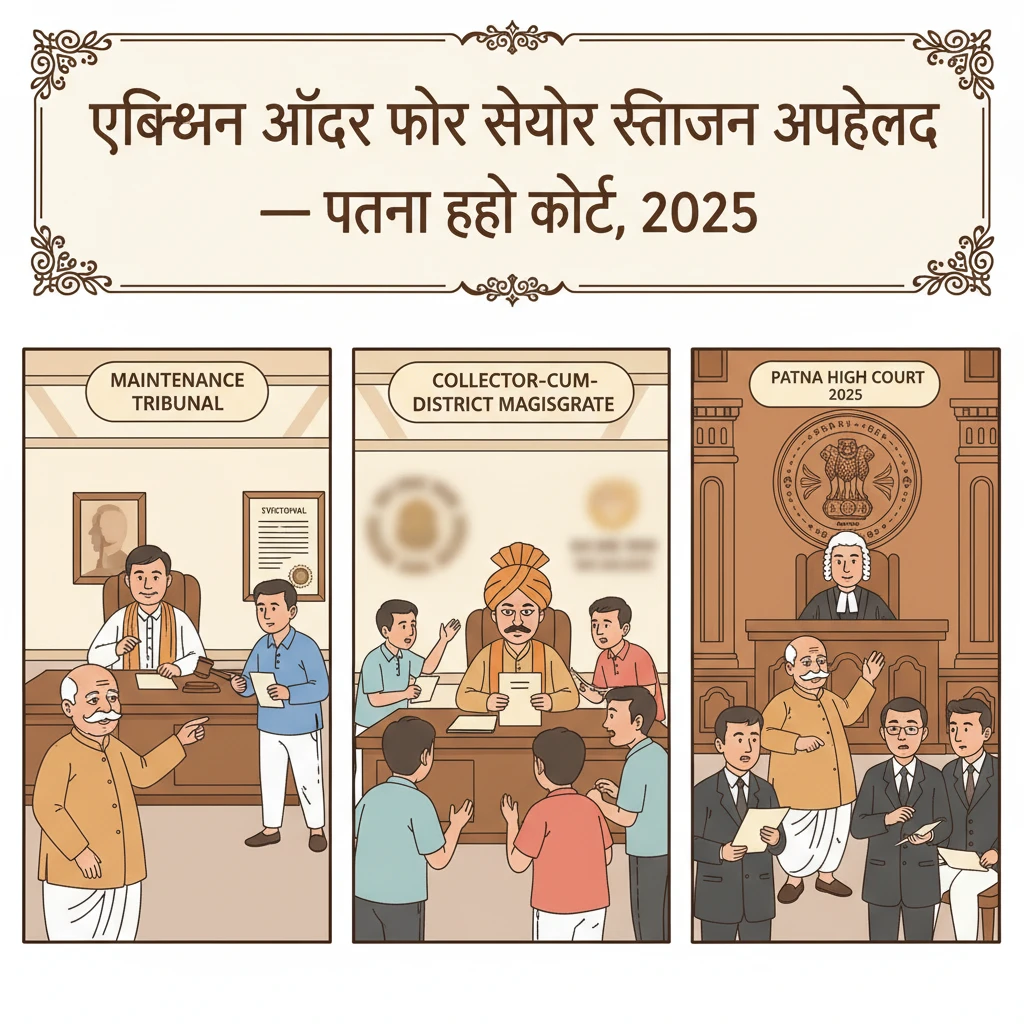
The senior citizen moved the Maintenance Tribunal under the Maintenance and Welfare of Parents and Senior Citizens Act, 2007 (“the 2007 Act”). The Tribunal passed an order on 14.03.2020 directing eviction of the nephews from the premises and protecting the senior citizen’s possession.
The nephews filed an appeal before the Collector-cum-District Magistrate, Patna in Senior Citizen Appeal No. 01/2020–21. On 10.06.2022, the Collector dismissed the appeal and affirmed the Tribunal’s order.
The nephews then approached the Patna High Court by filing CWJC No. 10426 of 2022, challenging both the Tribunal’s and the Collector’s orders. A learned Single Judge of the Patna High Court dismissed the writ petition on 29.01.2024, upholding the eviction and other directions.
Aggrieved by the Single Judge’s decision, the nephews filed the present Letters Patent Appeal (LPA) No. 167 of 2024. This LPA was heard by a Division Bench consisting of Hon’ble the Chief Justice and Hon’ble Mr. Justice Alok Kumar Sinha, who delivered the present CAV judgment on 09.10.2025.
What the Court Examined and Decided
The Division Bench framed four clear issues: whether there was violation of natural justice, whether the Tribunal exceeded its powers under Section 23 of the 2007 Act by ordering eviction, whether the nephews’ claims of independent rights could be decided in such summary proceedings, and whether the beneficial purpose of the Act supported sustaining the eviction order.
First, the nephews argued that the very initiation of proceedings under the 2007 Act was wrong because they were not “children” within the meaning of Section 4 of the Act, but only nephews of the senior citizen. They said the Act is meant mainly for parents against their children, not wider relatives. They also contended that the disputed property was joint family property, and questions of ownership and partition were already pending before a civil court.
They claimed that the Maintenance Tribunal, in a summary proceeding under Section 23, could not decide questions of title and possession. They alleged that their written reply, a registered family settlement deed, and revenue receipts showing their possession were ignored, and that they were wrongly treated as licensees or permissive occupants.
They also pressed that the Tribunal acted in haste, without giving them adequate opportunity, and that the Single Judge failed to appreciate these alleged procedural defects and the pending civil dispute.
On the other hand, the respondents, including the State and the senior citizen, maintained that the Tribunal had full jurisdiction under the 2007 Act to protect the senior citizen’s property and residence. They argued that the nephews were in permissive occupation without independent title. The Tribunal, after notice and hearing, had found the senior citizen entitled to recover possession and rent.
The respondents contended that the so-called family settlement and the revenue receipts had no legal sanctity and did not confer title. They stressed that the Tribunal’s focus is the protection of senior citizens, not resolution of complicated civil suits, and that the appeal and writ were merely attempts by the nephews to stall eviction and continue occupation.
On the issue of natural justice, the Division Bench examined the record and found that notices were served on the nephews, they appeared before the Maintenance Tribunal, filed written replies with annexures, and participated in the proceedings. The Tribunal considered their submissions and then passed a reasoned eviction order on 14.03.2020.
Later, the Collector-cum-District Magistrate, Patna heard both sides in the senior citizen appeal and affirmed the Tribunal’s order on 10.06.2022. Thereafter, the learned Single Judge independently examined the case and dismissed the writ petition on 29.01.2024.
The Bench referred to Supreme Court decisions in Union of India v. W.N. Chadha and Dharampal Satyapal Ltd. v. Dy. Commissioner of Central Excise. These decisions state that natural justice is about fairness, not rigid technicalities, and that once a fair opportunity is given, a party cannot complain of violation.
Applying these principles, the Bench held that the nephews were heard at all stages. Their claim of denial of opportunity was contradicted by their own participation and submissions. Therefore, no breach of natural justice was made out.
On the second issue, the nephews argued that Section 23 of the 2007 Act is limited to declaring a transfer void when a transferee fails to maintain a senior citizen; it does not authorize eviction. They also emphasized that civil suits for title and partition were pending and that the Tribunal should not have ventured into these areas.
The Bench examined this argument with reference to binding Supreme Court precedents. It noted that in Samtola Devi v. State of Uttar Pradesh (SLP No. 26651 of 2023), the Supreme Court clarified that though the Senior Citizens Act does not explicitly mention eviction, the Tribunal may order eviction if necessary and expedient to protect the senior citizen, following the earlier decision in S. Vanitha v. Commissioner, Bengaluru Urban District.
The Supreme Court’s decision in Urmila Dixit (Civil Appeal No. 10927 of 2024) was also cited, where it was held that Tribunals under the 2007 Act are competent to direct eviction as an incident of enforcing statutory protection. Similarly, in Kamalakant Mishra v. Additional Collector & Ors., the Supreme Court reiterated that eviction may be directed where required to give meaningful relief under the Act.
Relying on these authorities, the Division Bench held that the Tribunal’s jurisdiction under Section 23, properly understood, includes the power to order eviction when such action is essential to protect a senior citizen’s right to live with dignity and security. The Tribunal had not decided title or partition; it had only ordered eviction to restore possession and protect the senior citizen’s residence. Therefore, no jurisdictional error existed.
On the third issue, the nephews pressed heavily on a family settlement deed and revenue receipts, claiming these showed their independent ownership rights. They argued that these materials should have been considered and that their status was not that of mere permissive occupants.
The Bench, however, accepted the respondents’ stand that proceedings under the 2007 Act are summary and protective in nature. They are not meant to settle complex disputes of title, partition, or co-ownership. Such issues must be decided by the competent civil court.
The Court emphasized that the nephews, as nephews and not “children” under Section 4, could not expand the scope of the Tribunal’s jurisdiction into a full-fledged civil trial. The Tribunal rightly refused to adjudicate their title claims based on family arrangement and revenue entries. The Single Judge had also correctly held that the nephews were attempting to convert the proceedings into a substitute for civil litigation.
On the fourth issue, the Division Bench considered the overall purpose of the 2007 Act. It referred again to Supreme Court decisions such as S. Vanitha, Sudesh Chhikara v. Ramti Devi, Urmila Dixit, and Kamalakant Mishra, which collectively stress that the Act is a welfare legislation intended to provide real and effective protection to senior citizens, including safeguarding their residence and property from neglect and exploitation.
The Court noted that Section 23 allows the Tribunal to declare certain transfers void and, by necessary implication, to restore possession and evict occupants where their continued stay frustrates the rights of senior citizens. Interpreting the Act purposively, the Bench found that eviction in this case was a necessary and lawful step to protect the senior citizen’s right to peaceful possession of his house.
The Court also underlined that the nephews, being nephews and not statutory “children,” had no special standing under the Act to resist such protective orders. Their alleged co-ownership claims would remain open before the civil court, but could not be used to stop or delay relief under the 2007 Act.
In conclusion, the Division Bench held that there was no violation of natural justice, no overstepping of jurisdiction by the Tribunal, and no error in refusing to decide title disputes within the Tribunal’s limited scope. The beneficial object and mandate of the 2007 Act fully supported the eviction order.
Accordingly, the Letters Patent Appeal was dismissed. The concurrent findings of the Maintenance Tribunal (order dated 14.03.2020), the Collector-cum-District Magistrate in Senior Citizen Appeal No. 01/2020–21 (order dated 10.06.2022), and the learned Single Judge in CWJC No. 10426 of 2022 (judgment dated 29.01.2024) were affirmed. No order as to costs was made.
Why This Judgment Matters
This judgment is important for senior citizens living in Bihar and beyond, especially those facing pressure from relatives occupying their houses. The Patna High Court clearly confirms that Maintenance Tribunals under the 2007 Act can order eviction where it is necessary to protect a senior citizen’s residence and dignity.
It also clarifies that relatives cannot use pending civil suits, family settlements, or revenue entries as a shield to block or delay relief under the Senior Citizens Act. While genuine title disputes can and must go to the civil court, they do not prevent the Tribunal from securing immediate protection for the senior citizen.
The decision sends a strong message that the 2007 Act is not just about money (maintenance) but also about ensuring that elderly persons are not forced out of their own homes or made to suffer in their own property due to unauthorized occupation by family members.
Legal Issues and Answers
- Issue: Was there a violation of natural justice in the proceedings before the Maintenance Tribunal, the Collector, or the Single Judge?
Answer: No. The Court held that notices were served, the appellants appeared, filed replies with documents, and were heard at all stages. Hence, no breach of natural justice was made out. - Issue: Did the Maintenance Tribunal exceed its powers under Section 23 of the 2007 Act by ordering eviction?
Answer: No. Relying on Supreme Court precedents, the Court held that Tribunals can order eviction where necessary to protect senior citizens’ rights, without deciding complex title disputes. - Issue: Can claimed rights based on family settlement, partition, and revenue records be adjudicated by the Maintenance Tribunal in such proceedings?
Answer: No. The Court held that such claims must be decided by civil courts. The Tribunal’s jurisdiction is summary and protective, not for resolving civil title or partition disputes.
Cases Cited by the Court
- Union of India v. W.N. Chadha, 1993 Supp (4) SCC 260
- Dharampal Satyapal Ltd. v. Dy. Commissioner of Central Excise, (2015) 8 SCC 519
- S. Vanitha v. Deputy Commissioner, Bengaluru Urban District, (2021) 15 SCC 730
- Sudesh Chhikara v. Ramti Devi, (2022) 1 SCC 705
- Samtola Devi v. State of Uttar Pradesh, SLP No. 26651 of 2023
- Urmila Dixit, Civil Appeal No. 10927 of 2024
- Kamalakant Mishra v. Additional Collector & Ors., SLP (Civil) D No. 42786 of 2025
Case Details
Case Number: Letters Patent Appeal No. 167 of 2024 in Civil Writ Jurisdiction Case No. 10426 of 2022
Case Title: Shailesh Kumar @ Azad & Ors. v. The State of Bihar & Ors.
Coram: Hon’ble the Chief Justice; Hon’ble Mr. Justice Alok Kumar Sinha
Date of Judgment: 09.10.2025
Citation: 2025 (4) PLJR 498
Advocates:
For the appellants: Mr. Siya Ram Shahi, Advocate; Mr. Anirudh Kumar Sinha
For respondent no. 5 (senior citizen): Mr. J.S. Arora, Senior Advocate; Mr. Ritesh Kumar, Advocate; Mr. Pramod Kumar, Advocate
For the State: Mr. Amit Prakash, GA-13
Nature of the case: Letters Patent Appeal (intra-court appeal) against dismissal of writ petition challenging orders of Maintenance Tribunal and Appellate Authority under the Maintenance and Welfare of Parents and Senior Citizens Act, 2007.
Link to judgment: file:///C:/Users/Adity/OneDarive/Documents/Vaktrita%20Final/case%201258.pdf
If you found this explanation helpful and wish to stay informed about
how legal developments may affect your rights in Bihar,
you may consider following Samvida Law Associates for more updates.







