
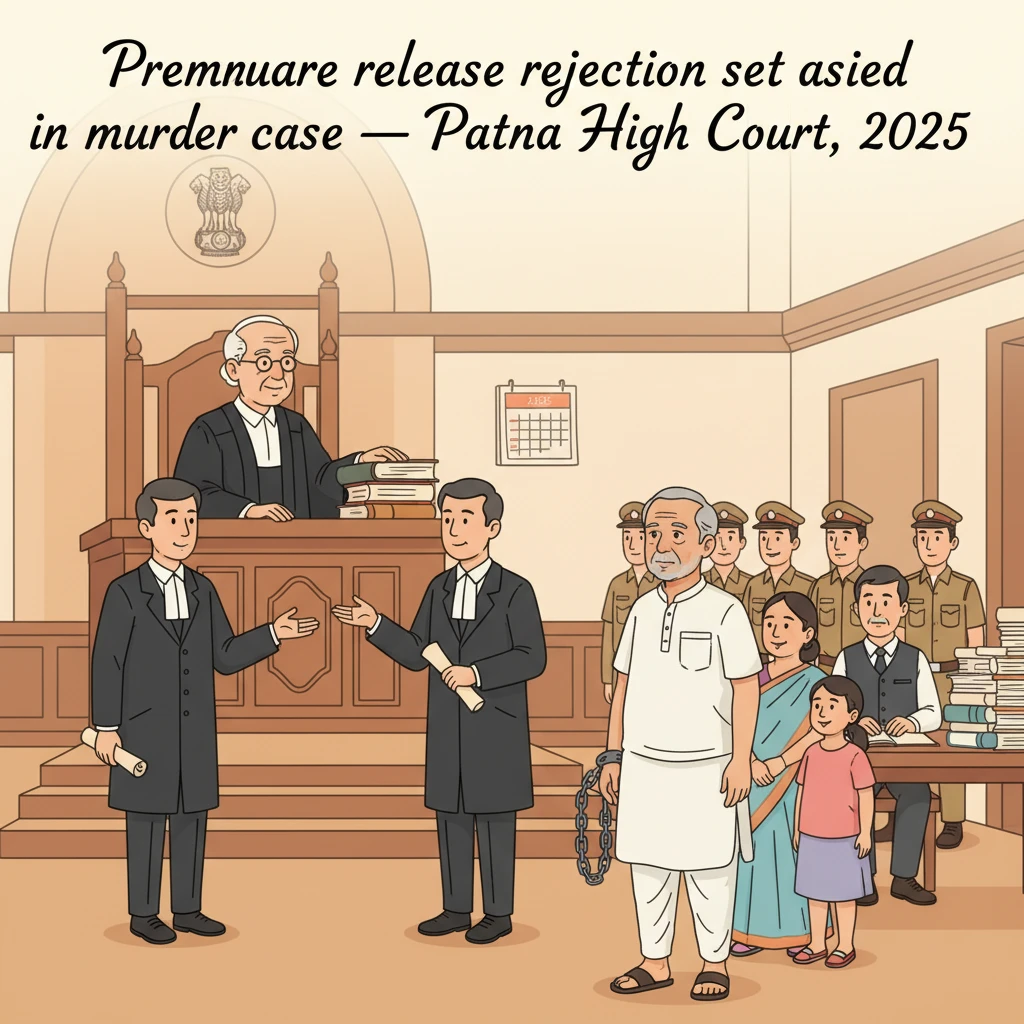
Case Background
The petitioner is a life convict in connection with Banka P.S. Case No. 341 of 2006. The case was registered under Sections 302/34 of the Indian Penal Code and Section 3/4 of the Explosive Substances Act.
He was tried in Sessions Trial No. 975 of 2007 before the Fast Track Court No. II, Banka. By judgment dated 16.06.2009, he was convicted under Sections 302/34 IPC and Section 3/4 of the Explosive Substances Act. On 19.06.2009, he was sentenced to rigorous imprisonment for life.
The petitioner filed Criminal Appeal (DB) No. 590 of 2009 before the Patna High Court. On 22.06.2015, the High Court upheld the trial court’s conviction and sentence. He then approached the Supreme Court by way of SLP No. 2542 of 2016. The Supreme Court dismissed the SLP, thereby confirming the conviction and sentence.
According to the writ petition, the petitioner has been in jail since 14.11.2006, except for a period of provisional bail from 11.02.2010 to 18.10.2010. With remission, he claimed to have completed more than 22 years in custody by the time of consideration of his case.
The State Remission Board (also referred to as the Bihar Remission Board) considered his case for premature release and, by its decision dated 27.11.2023, rejected the proposal. This rejection was communicated through letter no. 1397 dated 15.02.2024 issued by the Deputy Inspector General of Prison and Reform Services, Bihar, Patna.
Aggrieved, the petitioner filed Criminal Writ Jurisdiction Case No. 876 of 2024 before the Patna High Court. He initially challenged the communication and sought directions for fresh consideration of remission and his release. Through an interlocutory application (I.A. No. 01 of 2025), he also specifically challenged the Board’s resolution/decision dated 27.11.2023, and the Court allowed this amendment, treating the new averments as part of the main writ petition.
What the Court Examined and Decided
The core dispute before the Patna High Court was whether the Bihar Remission Board had lawfully rejected the petitioner’s proposal for premature release, and whether it had properly applied its mind to all relevant materials, as required by law and binding Supreme Court judgments.
The petitioner’s senior counsel argued that the Board had decided in a routine and mechanical manner. According to the writ petition and arguments recorded in the judgment, the Board relied mainly, if not entirely, on an adverse report given by the Superintendent of Police, Banka.
The Superintendent of Police’s report, based on the report of the local SHO, stated that if released, the petitioner could indulge again in murder and dacoity. The petitioner’s side contended that this report was “ex parte”, that neither the Superintendent of Police nor the SHO visited the village, made any local inquiry, or served notice on family members, and that no independent inquiry was held. It was described as “table work”, groundless and without foundation.
On the other hand, it was submitted that the Probation Officer’s report was in favour of the petitioner, and that other statutory authorities had recommended his premature release. The grievance was that, despite supportive recommendations from these authorities, the Board focused only on the adverse police report and rejected the proposal.
The petitioner’s counsel argued that by ignoring other reports and simply following the Superintendent of Police’s view, the Board failed to exercise its own independent judgment. He submitted that such a mechanical approach violated the principles laid down by the Supreme Court on how remission and premature release cases must be considered. He relied on the Patna High Court decision in Md. Azimuddin @ Ajimuddin vs. State of Bihar (Cr.W.J.C. No. 146 of 2022), which in turn relied on Supreme Court decisions in:
- Rajo @ Rajwa @ Rajendra Mandal v. State of Bihar & Ors., 2023 SCC OnLine SC 1068
- Ram Chander v. State of Chhattisgarh & Anr., (2022) 12 SCC 52
The State’s counsel defended the Board’s decision. He submitted that the Board had rejected the proposal due to the adverse report of the Superintendent of Police, Banka, and by following the Supreme Court’s guidelines in Laxman Naskar v. Union of India, (2000) 2 SCC 595. According to the State, this approach was legally sustainable.
The State’s counsel further pointed to Rule VI(d) of Notification No. 3106 dated 10.12.2002, which says that rejection of a case for premature release by the Board on one or more occasions is not a bar to reconsideration. However, reconsideration can be done only after one year from the last consideration. He submitted that the petitioner could apply afresh for premature release and that the Board would reconsider such prayer in accordance with law.
After hearing both sides, the Court examined whether the Board’s reliance on the Superintendent of Police’s report, while rejecting the petitioner’s premature release, was in line with law and Supreme Court guidelines.
The Court first discussed the Supreme Court judgment in Rajo @ Rajwa @ Rajendra Mandal. The Supreme Court had emphasised that overemphasis on one authority’s opinion—there, the presiding judge—while ignoring others, makes a remission decision unsustainable. The Supreme Court held that the appropriate government must take a holistic view of all opinions received and cannot mechanically follow just one input that focuses only on the crime, while ignoring the person’s reformation and present circumstances.
The Patna High Court noted that although those observations were made in the context of giving primacy to the presiding judge’s opinion, the same principle applied here with respect to the Superintendent of Police’s report. The Board could not lawfully rely on one authority’s adverse report while ignoring other favourable reports.
The Court then referred to the Supreme Court judgment in Ram Chander, which explained the law under Section 432 Cr.P.C. and made it clear that the procedure under Section 432(2) is mandatory. The Constitution Bench decision in V. Sriharan had held that the government’s decision on remission should be guided by the presiding judge’s opinion, obtained through the statutory procedure, and that suo motu remission is not permissible.
The Patna High Court highlighted from Ram Chander and Sriharan that:
- The power of remission under Section 432(1) Cr.P.C. must be exercised with great care and caution and in public interest.
- The procedure in Section 432(2), including obtaining the presiding judge’s opinion, is mandatory and a safeguard.
- Decisions on remission and premature release have to be based on complete materials regarding the nature of the crime, the convict’s record, background, and other relevant factors.
The Court then turned to the Bihar Prison Manual, specifically Rules 478 and 481. Rule 478 requires the Board, while considering premature release, to keep in view general principles of remission laid down by the State or by courts, earlier precedents, and above all, the welfare of society at large. Importantly, it says the Board shall not ordinarily decline premature release merely because the police have not recommended it. It mandates that the Board consider:
- Circumstances of the offence
- Whether the prisoner is likely to commit similar or other offences again
- Socio-economic condition of the convict’s family
- Possibility of further violence on release
- Progress in victim reconciliation programmes
- Chances of reclaiming the convict as a useful member of society
Rule 481 lays down categories of prisoners eligible to be considered for premature release, including those undergoing life imprisonment and covered by Section 433A Cr.P.C., and the conditions and exclusions for such consideration. It also sets out when male and female prisoners can be considered and clarifies that certain categories of convicts (such as those convicted for specified serious offences or whose death sentence has been commuted) are not entitled to premature release even after 20 years including remission, and that in cases where the court has specified no remission or a fixed minimum term, remission cannot be granted contrary to that direction.
Applying these principles, the Court found that, in the petitioner’s case, the Board had not properly applied its mind. The impugned order showed that the Board had relied heavily on the adverse report of the Superintendent of Police, Banka, without truly considering the other authorities’ reports and the required parameters under law and the Bihar Prison Manual.
The Court held that the Board had acted mechanically, contrary to the Supreme Court’s guidance in Rajo @ Rajwa @ Rajendra Mandal and Ram Chander. It emphasised that remission and premature release are part of a reformatory approach. For a prisoner who had remained incarcerated for more than 22 years with remission, the Board needed to examine his age, health, family bonding, possibility of reintegration into society, and any contemporary assessment (for example, from a psychiatrist), rather than only relying on police apprehensions.
The Court noted that the Supreme Court in Rajo @ Rajwa @ Rajendra Mandal had also observed that the Board should not entirely rely either on the presiding judge’s view or on police reports, and that a report prepared contemporaneously by a qualified psychiatrist after interviewing the convict could help in making a fair decision. In the petitioner’s case, no attempt had been made to examine such aspects.
On this reasoning, the Patna High Court concluded that the Board’s decision dated 27.11.2023, so far as it concerned the petitioner, was unsustainable and contrary to binding legal principles.
The Court therefore allowed the writ petition. It quashed the Board’s decision dated 27.11.2023 in respect of the petitioner.
At the same time, the Court recognised the rule that a rejected case may be reconsidered after one year. It noted that more than one year had passed since the Board’s rejection. Therefore, it directed the petitioner to file a fresh application for premature release before the Inspector General of Prison, Bihar, Patna (respondent no. 4).
The Court further directed that, if such an application is filed, the Inspector General of Prison must refer the petitioner’s case to the Remission Board within one month. The Board is then required to obtain fresh reports from all concerned authorities within one month on all relevant parameters identified by the Supreme Court in Rajo @ Rajwa @ Rajendra Mandal. Thereafter, the Board must take an appropriate decision in accordance with law, and keeping in mind the observations and findings recorded in this writ judgment, within a further period of one month.
Why This Judgment Matters
This judgment is important for life convicts in Bihar and their families who seek premature release. It confirms that the Bihar Remission Board cannot simply rely on an adverse police report and ignore other favourable reports and legal criteria.
The Patna High Court made it clear that under the Bihar Prison Manual and Supreme Court decisions, the Board must look at the convict as a person, not just the crime. It must consider age, health, family situation, conduct, risk of reoffending, and chances of rehabilitation. Police opinion is relevant but not the final word.
Practically, this helps prisoners who have spent long years in jail and have otherwise good records, but whose cases are rejected only on the basis of a generic or “table work” police report. It gives them a legal basis to demand a fresh, fair, and reasoned consideration.
The judgment also reminds authorities that remission and premature release are part of a reformatory justice system. The Board’s decisions must be in line with Supreme Court law and prison rules. Mechanical or one-sided decisions are open to challenge before the Patna High Court.
Legal Issues and Answers
- Issue: Whether the Bihar Remission Board could lawfully reject the petitioner’s proposal for premature release solely on the basis of an adverse report from the Superintendent of Police, Banka, without properly considering other reports and mandatory legal parameters.
Answer: No. The Patna High Court held that the Board acted mechanically by heavily relying on the Superintendent of Police’s report and not applying its independent mind to all relevant factors and reports. This approach was contrary to Supreme Court judgments and the Bihar Prison Manual, so the Board’s decision dated 27.11.2023 was quashed and the matter directed to be reconsidered afresh.
Cases Cited by the Court
- Rajo @ Rajwa @ Rajendra Mandal v. State of Bihar & Ors., 2023 SCC OnLine SC 1068
- Ram Chander v. State of Chhattisgarh & Anr., (2022) 12 SCC 52
- Union of India v. V. Sriharan, (2016) 7 SCC 1 : (2016) 2 SCC (Cri) 695 (referred within Ram Chander extract)
- Sangeet v. State of Haryana, (2013) 2 SCC 452 : (2013) 2 SCC (Cri) 611 (referred within Ram Chander extract)
- Laxman Naskar v. Union of India, (2000) 2 SCC 595 (cited by State)
- Md. Azimuddin @ Ajimuddin v. State of Bihar, Cr.W.J.C. No. 146 of 2022 (Patna High Court, 20.03.2024)
Case Details
Case Number: Criminal Writ Jurisdiction Case No. 876 of 2024; arising out of PS Case No. 341 of 2006, Thana Banka, District Banka
Case Title: Gokul Yadav v. The State of Bihar & Ors.
Coram: Hon’ble Mr. Justice Arun Kumar Jha
Citation: 2025 (4) PLJR 482
Date of Judgment: 15.09.2025 (oral judgment)
Advocates:
- For the petitioner: Mr. Y.C. Verma, Senior Advocate; Mr. Brij Nandan Prasad, Advocate
- For the respondents/State: Mr. Raju Patel, AC to AG
Nature of the case: Criminal writ petition challenging the State Remission Board’s decision rejecting premature release and seeking directions for fresh consideration of remission and release.
Link to judgment: Patna High Court Judgment in Cr.W.J.C. No. 876 of 2024
If you found this explanation helpful and wish to stay informed about how legal developments may affect your rights in Bihar, you may consider following Samvida Law Associates for more updates.







