
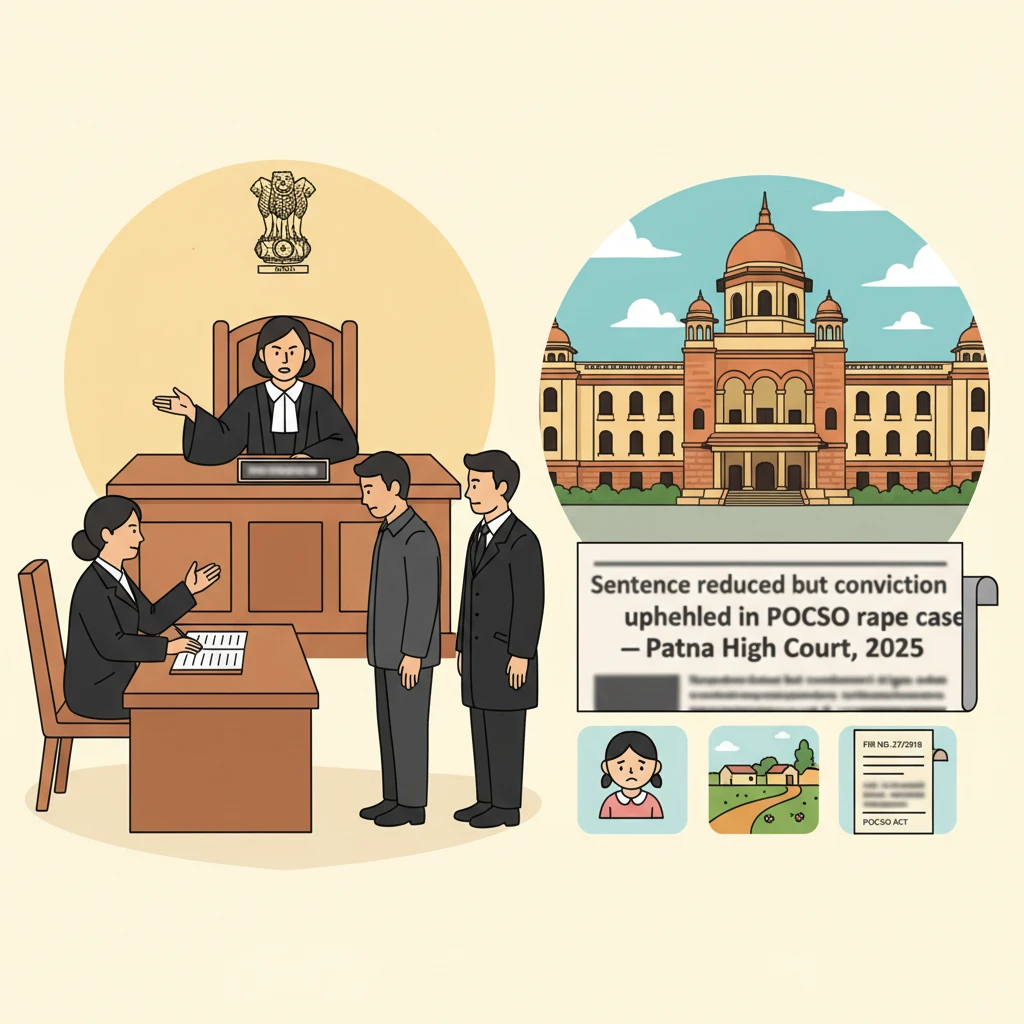
Case Background
This criminal appeal was filed through the Patna High Court Legal Services Committee against the judgment of conviction dated 20.08.2019 and the order of sentence dated 27.08.2019 passed by the 1st Additional Sessions Judge-cum-Special Judge (POCSO Act), Madhubani, in POCSO G.R. Case No. 16 of 2018 arising out of Benipatti P.S. Case No. 27 of 2018.
The prosecution case began with a written application submitted by the father of the victim (PW-3). On 03.03.2018 at about 3:00 PM, his 8-year-old daughter (PW-2) had gone about 200 meters away from their house to a garden (referred to as “gachi”) to collect leaves. According to him, the appellant, a co-villager named in the FIR, allegedly caught hold of the child in that area and committed rape on her.
The child returned home crying, took the name of the appellant, alleged that he had done a “wrong act” with her, and then fell unconscious. The family and others took her for primary treatment to Benipatti. On the basis of the written application (Exhibit 1), Benipatti P.S. Case No. 27 of 2018 was registered on 03.03.2018 under Section 376 IPC and Sections 4 and 6 of the POCSO Act.
After investigation, the police submitted charge-sheet No. 103 of 2018 dated 31.03.2018 under Sections 376 and 307 IPC and Sections 4 and 6 of the POCSO Act. By order dated 25.04.2018, the trial court took cognizance under Sections 376 and 307 IPC and Sections 3 and 4 of the POCSO Act. On 24.07.2018, charges were framed under Sections 376 and 307 IPC and Sections 4 and 6 of the POCSO Act. The appellant pleaded not guilty and claimed trial.
During the trial, the prosecution examined eight witnesses and proved two documents:
- PW-1: Mother of the victim
- PW-2: Victim
- PW-3: Informant/father of the victim
- PW-4: Cousin brother of the victim’s father
- PW-5: Dilip Das (co-villager)
- PW-6: Dr. Rama Jha
- PW-7: Dr. S.C. Roy
- PW-8: Ravindra Kumar Singh (Investigating Officer)
The prosecution exhibited the written application as Exhibit 1 and the medical report of the victim as Exhibit 2. The appellant’s statement was recorded under Section 313 CrPC; he claimed innocence and did not lead any defence evidence.
The trial court convicted him under Section 376 IPC and Sections 4 and 6 of the POCSO Act. It imposed life imprisonment and Rs. 1,00,000 fine under Section 376 IPC (with one year further imprisonment in default), and twenty years’ rigorous imprisonment with Rs. 10,000 fine each under Sections 4 and 6 of POCSO (and six months further imprisonment in default for each).
Aggrieved, the appellant approached the Patna High Court in Criminal Appeal (DB) No. 318 of 2023. The appeal was argued by counsel appointed through the Legal Services Committee. The State and the informant contested the appeal.
What the Court Examined and Decided
The Division Bench of Hon’ble Mr. Justice Rajeev Ranjan Prasad and Hon’ble Mr. Justice Sourendra Pandey heard counsel for the appellant, the Additional Public Prosecutor, and counsel for the informant. The Court considered two broad aspects: (1) whether the conviction based on the evidence was sustainable, and (2) whether the sentence awarded by the trial court was legally correct.
Challenge to the conviction
On conviction, the appellant’s counsel mainly argued that the trial court wrongly relied on the testimony of a child witness (PW-2) without first properly examining her competence to depose. He relied on the Supreme Court decision in P. Ramesh v. State Representing by Inspector of Police, (2019) 20 SCC 593, to say that without testing the child’s ability to understand and speak the truth, her sole testimony could not safely sustain conviction.
He further argued that the core supporting witnesses — the mother (PW-1), father (PW-3) and cousin (PW-4) — were all related and hence “interested”. PW-5, a co-villager, allegedly did not remember the date, day or exact boundary of the occurrence and only knew the appellant to be a married man with children engaged in agricultural work. Counsel also tried to weaken the medical evidence by pointing out that the doctors (PW-6 and PW-7) stated in cross-examination that the injuries to the victim’s private parts “may be” caused by a fall and that there were no external marks of violence.
The State, on the other hand, argued that although PW-2 was a child witness, the trial court had recorded that she was competent to depose. The fact that specific preliminary questions were not written down in the deposition did not, by itself, discredit her evidence. The State further submitted that the victim’s account was fully supported by the medical evidence (Exhibit 2) and that PW-5 was an independent co-villager who reached the informant’s courtyard within 15–20 minutes of the incident and found the child unconscious before she was taken for treatment.
The High Court then examined the entire evidence on record. From the deposition of PW-3 (father), the Court noted that the victim was about 8 years old, the youngest of his five children, and had gone alone to collect leaves. He described the place of occurrence by boundaries with neighbouring landowners and confirmed that the appellant lived only 50 feet away and was related as a maternal grandfather. He stated that his daughter returned weeping around 4:00 PM and remained unconscious for about 1 to 1½ hours.
The Court placed particular weight on the testimony of PW-2, the victim. She identified the appellant in court and stated that he came to her, asked her father’s name, lifted her in his lap, took her to a “Dhaniya” field, removed her undergarment, gagged her mouth, pressed her neck and then committed a “wrong act” with her. The Court found that her cross-examination did not produce any material to shake her version or cast doubt on her credibility.
The mother (PW-1), PW-4 and PW-5 corroborated the immediate aftermath of the incident. PW-5, a co-villager, deposed that he had good relationship with both the informant and the appellant, reached the courtyard of the informant 15–20 minutes after hearing the hulla, and found the victim unconscious, who was then taken for treatment at Benipatti. The Court treated PW-5 as an independent witness. No suggestion of prior enmity or motive to falsely implicate the appellant was put to any of these witnesses by the defence.
On medical evidence, PW-6 (Dr. Rama Jha) proved Exhibit 2. She found a tear of the hymen posteriorly and also a tear of the posterior vaginal wall of ¼ inch length with lacerated margins, red in colour, with no active bleeding and age of injury within 24 hours. PW-7 (Dr. S.C. Roy) supported this. The Court held that these findings clearly suggested sexual assault on the minor girl. Though defence suggested that such injuries could be due to a fall, the Court held that this bare suggestion could not erase the clear evidentiary value of the medical report.
The Investigating Officer, PW-8 (Ravinder Kumar Singh), deposed that he visited the place of occurrence, found the Dhaniya field trampled, and confirmed the same boundary description as given by PW-3. The Court treated this as circumstantial support for the prosecution version.
In his Section 313 CrPC statement, the appellant merely claimed innocence and did not allege any prior dispute or reason for false implication.
Considering the consistent testimony of the child victim, the corroboration from close family and an independent co-villager, the medical evidence, and the investigation details, the High Court held that the trial court had correctly appreciated the evidence. It found no reason to interfere with the finding that the prosecution had proved the case beyond reasonable doubt. The conviction under Section 376 IPC and Sections 4 and 6 of the POCSO Act was therefore affirmed.
Error in sentencing and reduction of term
The High Court then turned to the order of sentence. The appellant’s counsel argued that the trial court wrongly applied later, more stringent amendments to Section 376 IPC and Sections 4 and 6 of the POCSO Act that came into force after the date of offence (03.03.2018).
He pointed out that, at the time of occurrence, Section 376 IPC provided for a minimum sentence of seven years up to life imprisonment and fine. The provision was substituted with effect from 21.04.2018 by Act 22 of 2018, enhancing the minimum to ten years. Similarly, Section 4 POCSO, as it stood on 03.03.2018, prescribed minimum seven years up to life imprisonment. Sub-section (2) of Section 4, providing a minimum of 20 years for penetrative sexual assault on a child below 16 years, was inserted only with effect from 16.08.2019 by Act 25 of 2019. Section 6 POCSO, prior to its substitution on 16.08.2019, provided a minimum of ten years up to life imprisonment; the 20-year minimum came only after substitution.
The Additional Public Prosecutor fairly conceded that, since the occurrence took place on 03.03.2018, the substituted, harsher provisions could not be applied retrospectively. He agreed that the trial court appeared to have mistakenly applied the later-amended provisions of Section 4 and Section 6 POCSO while awarding the sentence.
The High Court accepted this position and held that the trial court had committed a grave error in awarding sentence under the amended regime. It therefore set aside the entire order of sentence while maintaining the conviction.
On the question of what sentence to impose afresh, the Court heard both sides. It noted that the appellant was about 29 years old at the time of the offence, married with two dependent children, working as a labourer in the field along with the informant, and so poor that he could not file an appeal for nearly four years, ultimately doing so only through the Legal Services Committee.
The Court referred to the Supreme Court’s guidelines in Gurmukh Singh v. State of Haryana, (2009) 15 SCC 635, especially paragraph 23, which lists various factors for determining appropriate sentence, such as motive, suddenness of incident, nature and gravity of injury, age and health of the accused, criminal background, and conduct after the incident. It noted that these factors are illustrative and each case must be viewed in its own perspective.
After discussing with the Additional Public Prosecutor and considering the overall circumstances and parameters, the High Court considered it just and proper to award a sentence of 12 years’ rigorous imprisonment to the appellant. It also reduced the fine substantially, directing that he would pay Rs. 10,000, keeping in view his poor financial condition.
In conclusion, the Court partly allowed the appeal: the conviction was upheld, the earlier sentence was set aside, and a fresh sentence of 12 years’ rigorous imprisonment with Rs. 10,000 fine was imposed.
The Court further directed that the trial court records along with a copy of the judgment be sent back, and specifically asked the Patna High Court Legal Services Committee to take appropriate steps to provide legal assistance to the appellant in sending his records to the Supreme Court Legal Services Committee.
Why This Judgment Matters
This judgment is important for two main reasons. First, it shows that the Patna High Court treats the testimony of child victims of sexual assault with seriousness when their statements are consistent and supported by medical and other evidence. The Court did not discard the child’s account merely because she was young.
Second, it reinforces a crucial protection in criminal law: no one can be punished under a harsher law that came into force after the incident. The trial court had mistakenly used later amendments that increased minimum punishments under Section 376 IPC and POCSO provisions. The High Court corrected this, applied the law as it stood on the date of offence, and then fixed a sentence it considered appropriate within that legal framework.
For accused persons and their families, the decision shows that appeals can succeed at least on sentencing even if the conviction is maintained, especially where the trial court misapplies the punishment provisions. For victims and their families, it underlines that convictions in POCSO cases will be upheld when there is clear testimony, medical support, and no sign of false implication.
The judgment also highlights the role of Legal Services Committees in ensuring access to justice for poor litigants who cannot afford private lawyers, at both the High Court and Supreme Court levels.
Legal Issues and Answers
- Issue: Was the conviction of the appellant for rape and penetrative sexual assault on a minor under Section 376 IPC and Sections 4 and 6 POCSO sustainable on the evidence of a child witness and supporting material?
Answer: Yes. The Patna High Court held that the victim’s testimony was credible and consistent, corroborated by medical evidence, family witnesses, an independent co-villager, and the IO’s findings. There was no material to suggest false implication, so the conviction was affirmed. - Issue: Did the trial court correctly apply the law relating to punishment under Section 376 IPC and Sections 4 and 6 of the POCSO Act as it stood on the date of occurrence?
Answer: No. The Court found that the trial court had applied later, amended provisions increasing minimum punishment, which came into force after 03.03.2018. Since the offence occurred earlier, the harsher amendments could not be applied. The High Court therefore set aside the sentence and re-sentenced the appellant under the pre-amendment provisions. - Issue: What is the appropriate sentence in this case, consistent with the law applicable on the date of offence and guided by Supreme Court sentencing principles?
Answer: Considering the gravity of the offence against an 8-year-old child, the circumstances, and the appellant’s age, family responsibilities, and poverty, the High Court imposed 12 years’ rigorous imprisonment and a fine of Rs. 10,000, partly allowing the appeal.
Cases Cited by the Court
- P. Ramesh v. State Representing by Inspector of Police, (2019) 20 SCC 593 – cited by the appellant’s counsel on the competence of a child witness (referred to in argument, not as a basis for allowing the appeal).
- Gurmukh Singh v. State of Haryana, (2009) 15 SCC 635 – relied upon by the Patna High Court for guiding principles on sentencing, particularly paragraph 23.
Case Details
Case Number: Criminal Appeal (DB) No. 318 of 2023; arising out of Benipatti P.S. Case No. 27 of 2018; POCSO G.R. Case No. 16 of 2018
Case Title: Chhedi Das v. The State of Bihar & Anr.
Citation: 2025 (4) PLJR 440
Court: High Court of Judicature at Patna
Coram: Hon’ble Mr. Justice Rajeev Ranjan Prasad; Hon’ble Mr. Justice Sourendra Pandey
Date of Judgment: 15.09.2025
Advocates:
For the Appellant: Mr. Rajesh Kumar, Advocate
For the Informant: Mr. Gagandeo Yadav, Advocate; Mr. Udeshya Kumar Yadav, Advocate
For the State: Mr. Ajay Mishra, Additional Public Prosecutor
Nature of the Case: Criminal appeal (division bench) against judgment of conviction and order of sentence passed by Special POCSO Court
Offences Involved: Section 376 and 307 of the Indian Penal Code; Sections 3, 4 and 6 of the Protection of Children from Sexual Offences Act, 2012
Link to Judgment: Click here to access the full Patna High Court judgment
If you found this explanation helpful and wish to stay informed about
how legal developments may affect your rights in Bihar,
you may consider following Samvida Law Associates for more updates.







