
Case Background
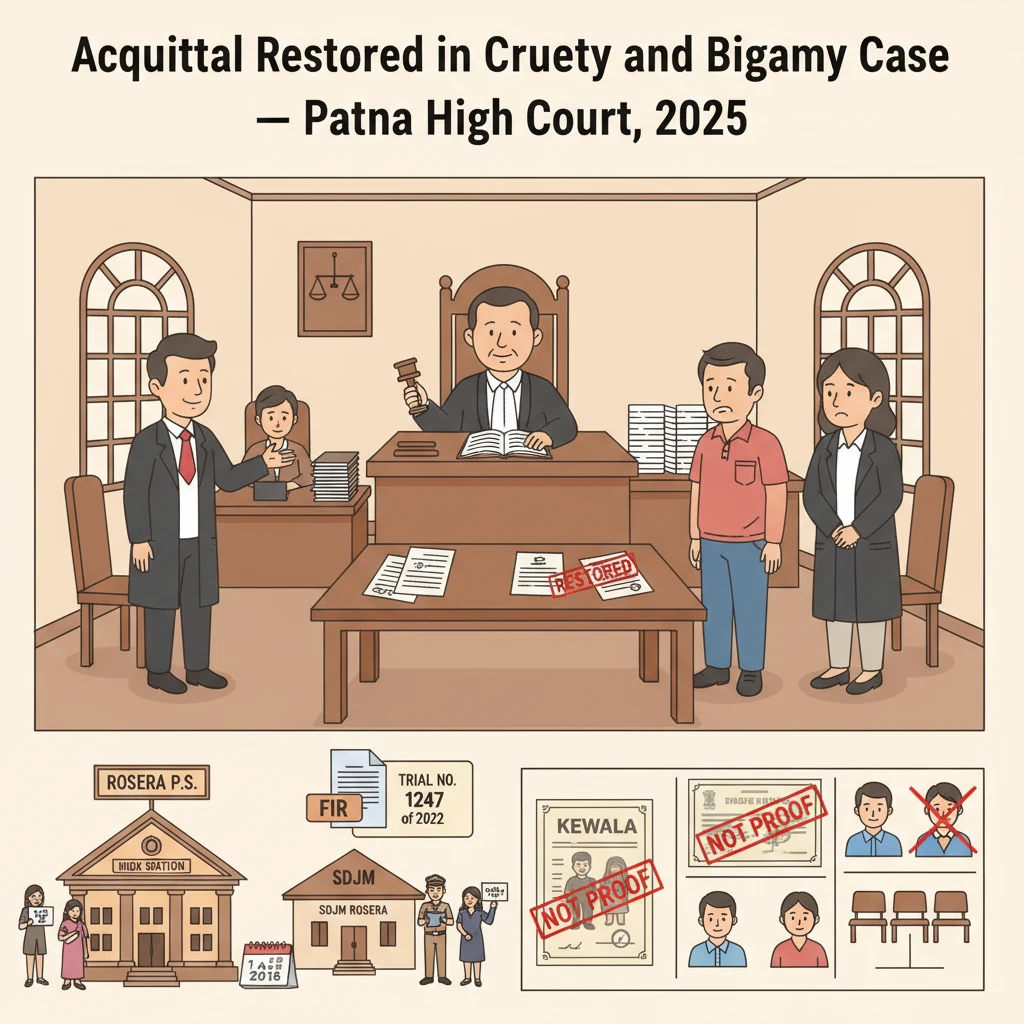
This case comes from a marital dispute between a husband and wife from Rosera, District Samastipur. The wife lodged a written complaint on 1 April 2018 at Rosera Police Station. On that basis, Rosera P.S. Case No. 103 of 2018 was registered.
The complainant, Nutan Devi, stated that she married Anil Kumar on 16 April 2004 as per Hindu rites and customs. Over time, she alleged that the relationship turned sour. She claimed that during the subsistence of the marriage, she was subjected to cruelty and driven out of the matrimonial home.
She further alleged that without taking any divorce, her husband married another woman named Kanti Kumari. She said that even after an interim maintenance order in Maintenance Case No. 111 of 2016, she was not paid maintenance and was also threatened, which forced her to go to the police.
On these allegations, the police registered an FIR under Sections 498-A and 494 of the Indian Penal Code. After investigation, the police filed a charge-sheet, and the husband was put on trial before the Sub-Divisional Judicial Magistrate (SDJM), Rosera, in Trial No. 1247 of 2022.
During trial, the prosecution examined seven witnesses, including the wife and the Investigating Officer. The defence examined three witnesses. After hearing both sides and considering all evidence, the SDJM, by judgment dated 30 November 2022, acquitted the husband of all charges, giving him the benefit of doubt.
Against this acquittal, the wife filed Criminal Appeal No. 02 of 2023 before the 1st Additional Sessions Judge, Samastipur. On 5 September 2024, the appellate court reversed the acquittal, convicted the husband under Sections 498-A and 494 IPC, and sentenced him to three years’ rigorous imprisonment and fine of Rs. 10,000/- under each section, with default imprisonment of one year each, to run concurrently.
Aggrieved by this reversal of acquittal, the husband approached the Patna High Court in Criminal Revision No. 856 of 2024 under Sections 397 and 401 of the Code of Criminal Procedure. The revision challenged the legality, correctness, and propriety of the conviction and sentence imposed by the appellate court.
What the Court Examined and Decided
The Patna High Court, through Hon’ble Mr. Justice Bibek Chaudhuri, examined the entire record of the trial court and the appellate court. The main question was whether the appellate court was justified in overturning a detailed acquittal and convicting the husband for cruelty and bigamy.
First, the High Court noted the key findings of the SDJM, Rosera, in the 2022 acquittal. Among the seven prosecution witnesses, three (PWs 1, 3, and 4) either denied knowledge of any cruelty or turned hostile. PW 2, who was shown as an independent witness, admitted in cross-examination that he had not seen any torture. The wife (PW 5) stated she had been living separately for around three years, but she could not give specific dates or clear instances of cruelty.
Regarding the allegation of second marriage with Kanti Kumari, the wife did not produce any marriage certificate, photograph, priest, or witness to support her claim. The prosecution relied mainly on sale deeds (Kewalas) where Kanti Kumari was described as the wife of Anil Kumar. The trial court held that such property documents, without proof of an actual marriage ceremony, could not establish a valid second marriage under Section 494 IPC.
The Investigating Officer (PW 6) admitted that he had not recorded statements of the wife’s parents or neighbours and had failed to properly verify the identity of the alleged second wife. He also did not find or examine anyone who attended or witnessed the supposed second marriage.
Three defence witnesses consistently stated that the wife had voluntarily left the matrimonial home and was in a relationship with one Vikash Kumar. No suggestion of bias was put to these witnesses, and their evidence remained unshaken. The trial court found the prosecution story inconsistent and unsupported by reliable independent evidence, and therefore gave the husband benefit of doubt.
The appellate court, however, took a different approach. It placed heavy reliance on the testimony of PW 5 (the wife) and held it to be credible even without independent corroboration. It treated the Kewalas (Exhibits 3, 4, and 5) as strong proof that the husband had a marital relationship with Kanti Kumari. These documents were read as supporting the charge of bigamy under Section 494 IPC.
For cruelty under Section 498-A, the appellate court noted that the wife was forced out of the matrimonial home, lived in rented accommodation, and that the husband failed to pay interim maintenance ordered in Maintenance Case No. 111 of 2016. It considered this as mental cruelty. The appellate court also relied on documents from Matrimonial Case No. 25 of 2016 (Exhibit 8) and property-related records to infer that the husband intended to sever ties with the wife and maintain a parallel matrimonial life with Kanti Kumari. It concluded that the trial court had ignored material documents and wrongly granted benefit of doubt.
Before the High Court, counsel for the husband attacked the appellate judgment on both factual and legal grounds. It was argued that the appellate court had no proper reason to interfere with a well-reasoned acquittal. The trial court had carefully evaluated all evidence and rightly found that the prosecution failed to prove the case beyond reasonable doubt.
On Section 494 IPC (bigamy), the defence stressed that the law requires strict proof of a second valid marriage, including proof of performance of essential ceremonies as per personal law. In this case, there was no marriage certificate, no priest, no photographs, no invitation card, and no witness who had seen the alleged second marriage. Merely mentioning a woman as “wife” in property documents could not, in law, amount to proof of marriage.
On Section 498-A IPC (cruelty), the defence pointed out that the wife’s allegations were vague and uncorroborated. PWs 1 to 4 did not support her case. The Investigating Officer had conducted a weak investigation and had not examined key witnesses like the wife’s parents or neighbours. There was also evidence from defence witnesses and from proceedings under Section 125 CrPC suggesting that the wife had voluntarily left and had even stated she did not wish to claim maintenance.
The High Court accepted these submissions. It first clarified the limited scope of revisional jurisdiction under Sections 397 and 401 CrPC. Normally, a revisional court does not re-assess all evidence like an appellate court. But it can interfere where there is a clear misapplication of law, perversity in findings, or gross miscarriage of justice.
The Court held that the SDJM’s acquittal was a reasoned judgment based on full appreciation of facts and evidence. When an appellate court reverses such an acquittal, it must show that the trial court’s view was clearly wrong, illegal, or perverse. In this case, the appellate court had not done so.
On Section 498-A, the High Court reiterated that the prosecution must prove cruelty of such a nature that it is linked to dowry demand or is so serious as to drive the woman to suicide or cause grave injury to her life, limb, or health. In this case, PW 5’s version was not backed by any other witness, there was no medical evidence, and no specific dated incidents were proved. PWs 1, 2, 3, and 4 did not support the cruelty claim. The IO admitted that no family or local witness was examined. The Court observed that vague allegations without corroboration cannot sustain a conviction under Section 498-A.
On Section 494, the Court underlined that to prove bigamy, it is not enough to show that a man lived with another woman or referred to her as “wife”. The prosecution must prove that a second marriage was actually solemnized, with proper ceremonies, during the subsistence of the first marriage. Here, no priest, photographs, invitation card, certificate, or eyewitness to any marriage ceremony had been produced. The Kewalas only showed joint property transactions with Kanti Kumari. They did not prove the solemnization of a valid second marriage.
The Court also noted that the Supreme Court has consistently held that mere cohabitation or calling someone “wife” is not legal proof of marriage unless the marriage itself is proved. The appellate court had misread the property documents and had not dealt with the trial court’s detailed findings about gaps and contradictions in the prosecution case.
The High Court stressed that when an acquittal is reversed, the appellate court must act with greater care and give strong reasons. In this case, such compelling reasons were missing. The High Court found that the appellate findings were contrary to settled legal principles and amounted to misreading of evidence, leading to miscarriage of justice.
In the end, the High Court held that the essential ingredients of Sections 498-A and 494 IPC had not been proved beyond reasonable doubt. The prosecution had mainly relied on the uncorroborated statement of the wife and property documents that did not legally prove marriage. The investigation was perfunctory, and important evidence that should have been available was not presented.
Therefore, the Patna High Court allowed the criminal revision, set aside the conviction and sentence dated 05.09.2024 passed by the 1st Additional Sessions Judge, Samastipur in Criminal Appeal No. 02 of 2023, and restored the acquittal judgment dated 30.11.2022 of the SDJM, Rosera in Trial No. 1247 of 2022. The petitioner was discharged from all liabilities under the bail bond, and the surety was also discharged.
Why This Judgment Matters
This judgment is important for both accused persons and complainants in matrimonial criminal cases. The Patna High Court clearly says that criminal conviction for cruelty and bigamy cannot be based only on suspicion, weak investigation, or vague statements.
For those facing such allegations, the ruling shows that courts will insist on strict proof of a second marriage and clear, specific evidence of serious cruelty. Property papers or mere cohabitation are not enough to prove bigamy.
For complainants, the judgment makes it clear that timely, detailed, and supported evidence is crucial. Neighbours, family members, and other witnesses should be examined, and documents like marriage proof, medical records, or independent testimony should be collected. Otherwise, even genuine grievances may not meet the strict criminal standard of “beyond reasonable doubt”.
The judgment also reinforces that higher courts should be careful while overturning an acquittal. If a trial court has given a reasoned view based on evidence, an appellate court must give very strong and legally sound reasons before reversing that view. This protects individuals from wrongful convictions and upholds fair trial standards.
Legal Issues and Answers
-
Issue: Could the appellate court validly reverse a detailed acquittal and convict the husband for cruelty and bigamy on the given evidence?
Answer: No. The Patna High Court held that the trial court’s acquittal was based on proper appreciation of evidence, and the appellate court failed to show any perversity, illegality, or clear error justifying reversal. -
Issue: Was there sufficient legal proof to convict the husband under Section 498-A IPC for cruelty?
Answer: No. The Court found the allegations vague and uncorroborated, with no supporting medical or independent witness evidence, and held that the essential ingredients of Section 498-A were not proved beyond reasonable doubt. -
Issue: Was there sufficient legal proof of a second valid marriage to convict under Section 494 IPC for bigamy?
Answer: No. The Court held that no ceremony of marriage was proved, and property sale deeds mentioning another woman as “wife” could not, in law, establish the solemnization of a second marriage.
Cases Cited by the Court
- No specific case names or citations are mentioned in the judgment, though the Court refers to settled Supreme Court principles on proof of marriage and standards under Sections 498-A and 494 IPC.
Case Details
Case Number: Criminal Revision No. 856 of 2024; arising out of Rosera P.S. Case No. 103 of 2018; Trial No. 1247 of 2022; Criminal Appeal No. 02 of 2023
Case Title: Anil Kumar vs. The State of Bihar & Anr.
Coram: Hon’ble Mr. Justice Bibek Chaudhuri
Citation: 2025(4) PLJR 350
Advocates:
- For the Petitioner (husband): Mr. Gautam Kr. Yadav, Advocate; Mr. Ranjeet Kumar, Advocate
- For the State (Respondent No. 1): Mr. Akshay Lal Pandit, APP
Nature of the Case: Criminal revision under Sections 397 and 401 CrPC against appellate conviction for offences under Sections 498-A and 494 IPC, challenging reversal of an earlier acquittal.
Link to Judgment: Read full judgment on Patna High Court website
If you found this explanation helpful and wish to stay informed about
how legal developments may affect your rights in Bihar,
you may consider following Samvida Law Associates for more updates.







