
Case Background
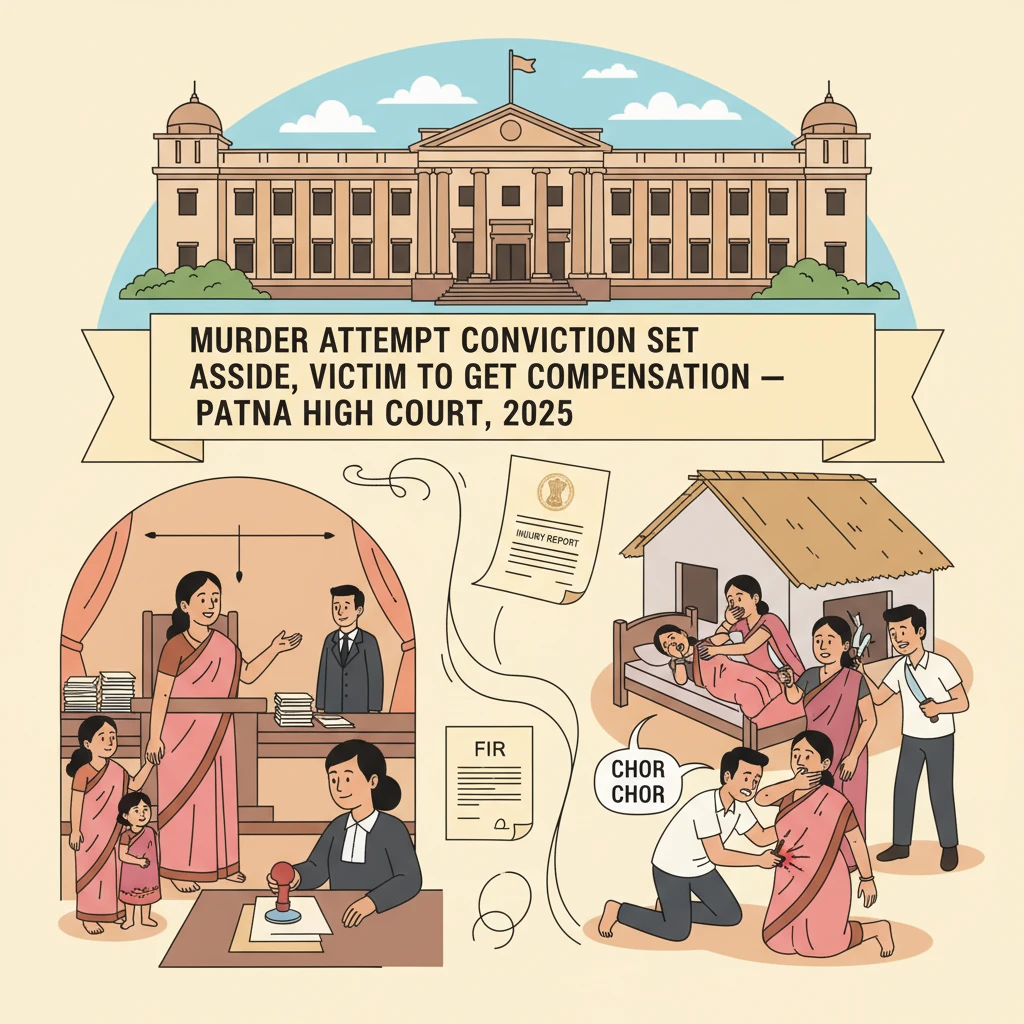
This criminal appeal arose from Musahari P.S. Case No. 71 of 2008, lodged on 29.07.2008. The case was based on the fardbeyan of a woman, Meera Devi, recorded by Sub-Inspector B.K. Sharma at 9:15 a.m. on 29.07.2008 at Dr. Rajesh Kumar’s Clinic, Muzaffarpur.
She alleged that on the night of 27.07.2008, at about 9 p.m., she was at home in village Chhapra Megh with only her seven-year-old daughter, while her husband and son were away from the village. She stated that while she was about to sleep, four co-villagers entered and assaulted her inside her house.
On her version, one male accused sat on her chest, pressing her with his knees; his wife pressed her neck and mouth; and two other men stood nearby with knives. On exhortation by the female accused and one male accused, another male accused allegedly stabbed her on the left side of her stomach with a knife, causing heavy bleeding. Thinking she was dead, the assailants allegedly left the room and fled.
She claimed she then somehow came out of the house in an unconscious, semi-conscious state, raising alarm and shouting “chor chor”, but no one came immediately. About half an hour later, her gotini, Rangila Sharma (wife of her brother-in-law), allegedly came to the door, helped her and informed others through mobile number 9470307783.
The informant also stated that the accused were co-villagers and that the attack happened due to earlier litigation between her husband and one of the male accused, which was pending in the courts of Ranchi and Muzaffarpur.
After investigation, the case went to trial as Sessions Trial No. 790 of 2009 before the Additional Sessions Judge, Fast Track Court No.1. On 06.10.2010, the Trial Court convicted the appellants under Sections 452, 324, 326 and 307 read with Section 34 of the Indian Penal Code. On 07.10.2010, it sentenced them to rigorous imprisonment for ten years with fine of Rs. 5,000 each under Section 307 IPC and five years with fine of Rs. 2,000 each under Section 452 IPC. No separate sentence was passed under Sections 324 and 326 IPC. In default of fine, they were to undergo an additional one year of rigorous imprisonment, with all sentences to run concurrently.
The appellants challenged this judgment and sentence before the Patna High Court in Criminal Appeal (SJ) No. 1070 of 2010. During the pendency of the appeal, Appellant No.1, Braj Kishore Sharma, died. The Court recorded that his son, already a co-appellant, continued the appeal on his behalf.
What the Court Examined and Decided
Justice Jitendra Kumar of the Patna High Court closely examined the entire record, including oral evidence of twelve prosecution witnesses and documentary exhibits such as the injury report, fardbeyan, seizure lists and signatures.
The prosecution examined nine private witnesses and three official witnesses. Among the private witnesses, the informant (P.W.9) and her minor daughter, Nishu Rani (P.W.7), were projected as eye-witnesses. The others, including the husband, son, sister, nanad and gotini of the informant, as well as two co-villagers, were all hearsay witnesses.
The defence argued that the conviction was unsustainable because:
- The earliest statement of the minor daughter, recorded soon after the incident, was suppressed and not produced on record.
- Names of the accused were not disclosed to close family members immediately after the incident.
- The fardbeyan was recorded after two days, allegedly after consultation with the husband and others, in a situation of admitted previous enmity.
- The competency test of the child witness under Section 118 of the Evidence Act was not conducted.
The State and the informant’s counsel supported the conviction, asserting that the eye-witness account of the informant and her daughter, corroborated by the injury report and seizure lists, proved the case beyond reasonable doubt. They also pressed for compensation for the victim under the Bihar Victim Compensation Scheme, 2014.
The Court first considered the status of the eye-witnesses. It noted that only the informant and her minor daughter were eye-witnesses and that all other private witnesses were either close family members or co-villagers who came to know about the incident later. This made it crucial to test the reliability and completeness of the earliest versions of the incident.
The Court then focused on the missing earliest statement of the child witness. The first Investigating Officer (P.W.12), who was the then Station House Officer, clearly deposed that he recorded the statement of seven-year-old Nishu Rani about six hours after the incident, in the night of 27.07.2008 itself, around 3:00 a.m. This was supported by the child witness herself (P.W.7) and by the second Investigating Officer, Surendra Mandal (P.W.11).
P.W.12 stated that he handed over that statement to P.W.11 when the investigation was transferred. However, P.W.11 admitted that this statement was not available on the record. Justice Jitendra Kumar noted that this meant the first version of the prosecution case, recorded closest to the time of occurrence from a key eye-witness, had been withheld.
This withholding became more serious when seen together with the evidence about what was told to family members. P.W.2, the gotini of the informant, was the first to reach the scene on hearing the informant’s cries. She informed the informant’s husband (P.W.8) and sister (P.W.4) about the incident. However, both P.W.8 and P.W.4 stated that they were only told that the informant had been injured by a knife. They were not told the names of any assailants.
P.W.4, the sister of the informant, further deposed that she received information the next morning that her sister had been grievously injured by “someone” with a knife. The Court reasoned that if the informant or her daughter had known the assailants by name from the start, it was natural and expected that such names would be disclosed immediately to the husband and other close relatives. The fact that this did not happen raised a serious doubt.
The Court also examined the testimony of P.W.3, Mukesh Kumar, a co-villager. He claimed in court that when he reached the house on hearing the informant’s screams, she named the appellants as the culprits. But the second Investigating Officer (P.W.11) stated that P.W.3 did not say this in his statement under Section 161 Cr.P.C. This inconsistency further weakened the prosecution case on identification of the assailants.
The admitted existence of previous enmity also played a role in the Court’s assessment. In her own fardbeyan, the informant stated that ongoing litigation between her husband and one of the accused in the courts at Ranchi and Muzaffarpur was the background for the occurrence. This showed there was a strong motive to falsely implicate the appellants if there was any doubt about the identity of the real culprits.
Another factor was the timing and context of the fardbeyan itself. The fardbeyan was recorded on 29.07.2008, two days after the incident, at the clinic and in the presence of the informant’s husband. The defence highlighted that by this time the family had time for consultation and deliberation. The Court accepted this as an additional circumstance that required caution when relying on the later version naming the appellants, particularly when the first child statement and immediate disclosures were missing or silent about names.
After considering the cumulative effect of all these circumstances, Justice Jitendra Kumar concluded that there was a serious doubt about the involvement of the appellants in the crime, even though it was clear that the informant had suffered a grievous knife injury. The Court held that the prosecution had failed to prove the guilt of the appellants beyond reasonable doubt. In criminal law, when such serious doubt exists, the benefit must go to the accused.
Accordingly, the Patna High Court held that it would be a travesty of justice to uphold the conviction and sentence. The appeal was allowed, the judgment of conviction and order of sentence were set aside, and the appellants were acquitted of all charges, receiving the benefit of doubt. As they were already on bail, they were discharged from their bail bonds.
The Court then turned to the issue of victim compensation. It noted that despite the acquittal, the evidence clearly proved that Meera Devi had suffered a grievous injury by a sharp-edged weapon and thus was a victim of the crime. Referring to its earlier Division Bench judgment in Sunil Kumar Jha v. State of Bihar, 2024 SCC OnLine PAT 960, the Court reiterated that trial, appellate and revisional courts are duty-bound to consider compensation to victims under Sections 357 and 357A Cr.P.C., irrespective of conviction, acquittal or discharge.
The Court quoted key paragraphs from the Division Bench decision, emphasising:
- Courts must pass a reasoned order regarding compensation at the conclusion of a criminal trial.
- Compensation can be directed even when the victim has not applied.
- In case of acquittal, the court should resort to Section 357A Cr.P.C. and recommend payment from the State Victim Compensation Fund.
Applying these principles, Justice Jitendra Kumar recommended that the Bihar State Legal Services Authority pay compensation to Meera Devi under the Bihar Victim Compensation Scheme, 2014, within two months from receipt of the order. The office was directed to send a copy of the judgment to the Secretary of the Authority for necessary action. The Lower Court Records were ordered to be returned with a copy of the judgment, and all pending applications were disposed of.
Why This Judgment Matters
This judgment is significant for two main reasons.
First, it reinforces that in criminal cases, the Patna High Court will not uphold convictions if there is serious doubt about the identity or involvement of the accused. Missing early statements, late naming of accused and previous enmity are all treated as important warning signs. For accused persons, this shows that benefit of doubt still operates strongly in their favour.
Second, and equally important, the decision shows that even when accused are acquitted, a genuine victim is not left without support. The Court clearly separated the question of guilt from the question of harm to the victim. It recognised that Meera Devi was grievously injured and directed that she be compensated from the State’s Victim Compensation Scheme.
For ordinary people, especially victims of violence in Bihar, this means that even if a case ends in acquittal due to lack of proof against specific persons, the courts can still ensure some financial relief and support through the Legal Services Authorities and victim compensation schemes.
Legal Issues and Answers
- Issue: Did the prosecution prove beyond reasonable doubt that the appellants were the persons who attacked and grievously injured the informant?
Answer: No. The Patna High Court found serious doubts due to suppression of the child’s earliest statement, non-disclosure of names to close relatives immediately after the incident, contradictions in witness statements, and admitted prior enmity. The appellants were acquitted, receiving the benefit of doubt. - Issue: Can a victim be granted compensation under the Bihar Victim Compensation Scheme, 2014, even when the accused are acquitted?
Answer: Yes. Relying on earlier precedent, the Court held that compensation under Section 357A Cr.P.C. and the State scheme can be recommended even in case of acquittal, and directed the Bihar State Legal Services Authority to pay compensation to the victim.
Cases Cited by the Court
- Sunil Kumar Jha v. State of Bihar, 2024 SCC OnLine PAT 960 – Division Bench judgment of the Patna High Court on the duty of courts to consider and award victim compensation under Sections 357 and 357A Cr.P.C. and under the State Victim Compensation Scheme.
Case Details
Case Number: Criminal Appeal (SJ) No. 1070 of 2010
Case Title: Braj Kishore Sharma & Ors. v. State of Bihar
Citation: 2025 (4) PLJR 401
Court: High Court of Judicature at Patna
Coram: Hon’ble Mr. Justice Jitendra Kumar
Date of Judgment: 11-09-2025
Trial Court Details: Additional Sessions Judge, Fast Track Court No. 1, in Sessions Trial No. 790 of 2009
Offences Alleged: Sections 452, 324, 326, 307, 120-B read with Section 34 of the Indian Penal Code
Result in Trial Court: Conviction under Sections 452, 324, 326 and 307/34 IPC; sentences of 10 years R.I. with fine under Section 307 IPC and 5 years R.I. with fine under Section 452 IPC; no separate sentence under Sections 324 and 326 IPC; sentences to run concurrently.
Result in Patna High Court: Appeal allowed; conviction and sentence set aside; appellants acquitted of all charges on benefit of doubt; bail bonds discharged; recommendation for victim compensation under Bihar Victim Compensation Scheme, 2014.
Advocates:
For the Appellants: Mr. A.K. Thakur, Advocate.
For the State: Ms. Anita Kumari, APP.
For the Informant: Mr. Prafull Chandra Jha, Advocate; Mr. Apurva Kumar, Advocate.
Nature of the Case: Criminal appeal (against conviction and sentence) arising from a sessions trial for house-trespass, hurt and attempt to murder, with a connected question of victim compensation.
Link to Judgment: Full text of Patna High Court judgment
If you found this explanation helpful and wish to stay informed about
how legal developments may affect your rights in Bihar,
you may consider following Samvida Law Associates for more updates.







