
Case Background
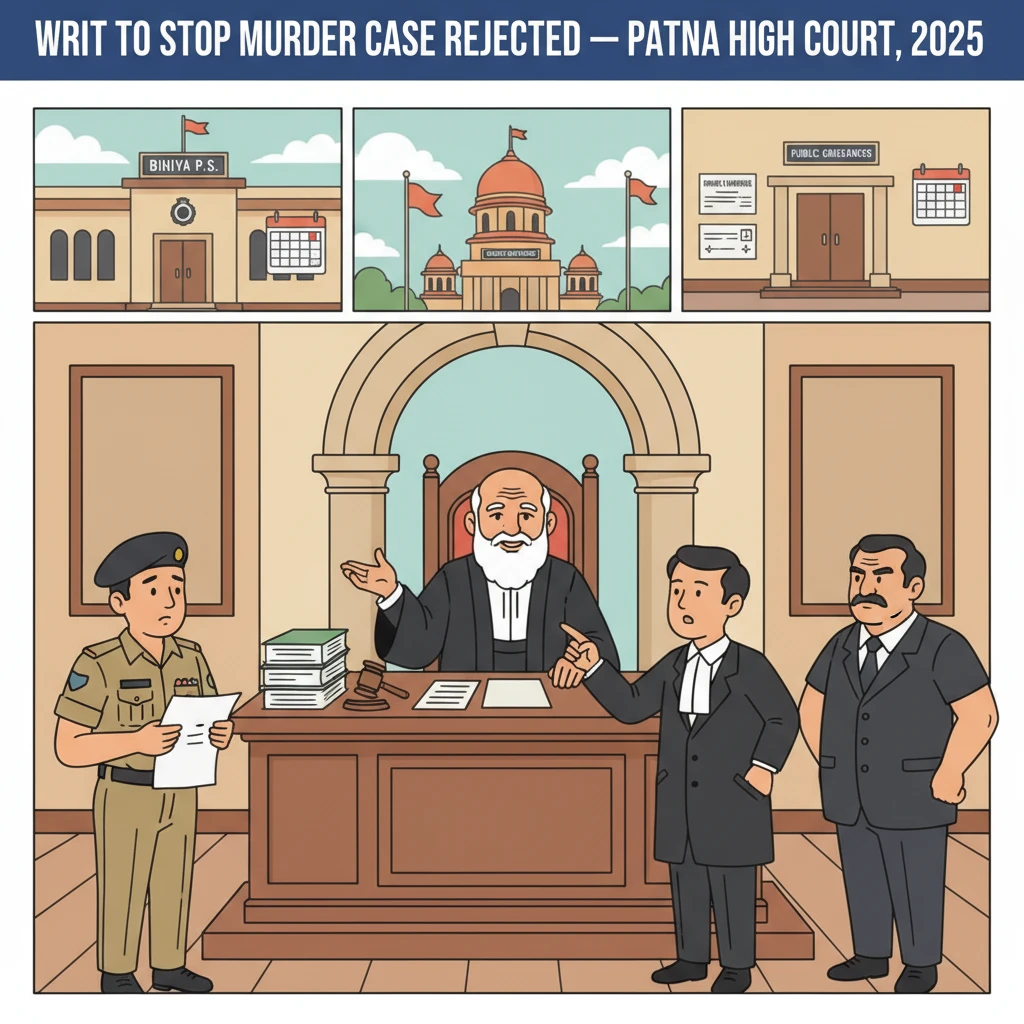
This case arises from Bihiya P.S. Case No. 257 of 2023, District Bhojpur. In that FIR, the petitioner in Criminal Writ Jurisdiction Case No. 281 of 2025 is named as an accused for the offence of murder and allied offences.
The FIR alleges commission of offences under Sections 302/34 of the Indian Penal Code and Section 27 of the Arms Act. After investigation, the police submitted a charge sheet in this case, in which the petitioner has been shown as an absconder.
Feeling aggrieved, the petitioner, who is serving as a constable with the Central Industrial Security Force (CISF), approached the Patna High Court under its criminal writ jurisdiction. He sought quashing of the entire criminal case and protection from coercive steps by the police.
Alongside this matter, another connected writ petition, Criminal Writ Jurisdiction Case No. 197 of 2025, was also listed. In that second writ, the other private party from the same locality approached the Court against various authorities, including Union of India, CISF authorities, State of Bihar and the present petitioner as a respondent. However, that second writ petition was ultimately withdrawn on the petitioner’s request.
What the Court Examined and Decided
In Criminal Writ Jurisdiction Case No. 281 of 2025, the Patna High Court, through Hon’ble Mr. Justice Arun Kumar Jha, heard counsel for the petitioner, the State, and the informant (arrayed as respondent no. 8).
The petitioner’s main request was threefold: first, to quash Bihiya P.S. Case No. 257 of 2023 registered under Sections 302/34 IPC and Section 27 of the Arms Act so far as it relates to him; second, to restrain the police from taking any coercive action against him during the pendency of the writ; and third, to grant any other appropriate relief under law.
Counter affidavits were filed on behalf of the State authorities (including respondent no. 2) and on behalf of respondent no. 8, opposing the writ petition.
Petitioner’s narrative and grounds
The petitioner’s counsel argued that the investigation in Bihiya P.S. Case No. 257 of 2023 was conducted in a completely perfunctory and faulty manner. According to him, the Investigating Officer had collected material during investigation which, in his view, showed the petitioner’s innocence. However, while submitting the charge sheet, that material was allegedly ignored and not reflected.
The petitioner relied on a judgment of a Coordinate Bench of the Patna High Court in Surendra Singh & Ors. vs. State of Bihar (Cr.W.J.C. No. 153 of 2017 and analogous cases), decided on 09.09.2022. In that case, the Court had issued directions aimed at ensuring fair and proper investigation. The petitioner’s counsel said that those directions were not complied with in the present case by the Investigating Officer.
The petitioner further alleged that the informant and his brother are “notorious criminals” whose names are on the district’s criminal register. He claimed that a vexatious and frivolous prosecution had been launched against him and his family members due to their enmity.
To support his claim of mala fide, he referred to an information from the Sub-Divisional Public Grievances Redressal Officer in Complaint Case No. 999940102072409135, dated 02.07.2024. In that communication, it is stated that the informant in Bihiya P.S. Case No. 257/2023 and four others had formed a criminal group for extortion. The petitioner relied on this to say that the complainant side itself is involved in criminal activities.
The petitioner also tried to show that he was not present at the place of occurrence. He stated that he is a CISF constable posted at Delhi. He had come to his native village on leave and was supposed to return to duty on the day of occurrence. However, due to a rail accident, his reservation was cancelled. He alleged that the informant misused this situation and falsely implicated him, taking advantage of the fact that he was still in the village.
On these grounds, the petitioner pleaded that the entire prosecution against him is false, frivolous, and should not be allowed to continue. He argued that the FIR and subsequent proceedings deserve to be quashed by the Patna High Court.
State and informant’s stand
The State and respondent no. 8 strongly opposed the writ. They contended that the criminal writ petition itself is not maintainable in these circumstances, especially after submission of the charge sheet.
It was pointed out that the charge sheet has been filed showing the petitioner as an absconder. The respondents also placed on record that the petitioner had been granted leave by his employer, CISF, to enable him to surrender before the jurisdictional criminal court.
According to the respondents, the petitioner was given 30 days’ leave from 04.01.2025 to 03.02.2025, which was further extended up to 28.02.2025 specifically so that he could surrender in the criminal case. Despite enjoying this leave, the petitioner did not surrender before the concerned court.
The respondents further submitted that the case has been found “true” during investigation. From a bare reading of the FIR and the collected material, according to them, a prima facie offence is clearly made out against the petitioner. In such a situation, they argued, there is no question of quashing the FIR at the writ stage. They also asserted that, after filing of the charge sheet, the prayer for quashing the FIR has become infructuous.
Application of Bhajan Lal principles
The Court then examined the legal position on when criminal proceedings can be quashed, relying on the landmark Supreme Court judgment in State of Haryana and Others vs. Bhajan Lal and Others, AIR 1992 SC 604. The Bhajan Lal case lays down illustrative categories where power to quash an FIR or criminal proceedings may be exercised.
The Patna High Court reproduced the seven broad guidelines from Bhajan Lal. These include, among others, situations where: even if allegations in the FIR are taken at face value, they do not constitute any offence; where no cognizable offence is disclosed; where allegations are absurd or inherently improbable; where there is an express legal bar to continuation of proceedings; or where proceedings are manifestly mala fide or maliciously instituted.
After setting out these categories, the Court examined whether the petitioner’s case fit into any of them.
The Court noted that it is an admitted fact that a charge sheet has been filed against the petitioner in Bihiya P.S. Case No. 257 of 2023, and he has been shown as an absconder. It is also clear from the FIR itself that the petitioner is a named accused for offences punishable under Sections 302/34 IPC and Section 27 of the Arms Act.
The Court found that, on the face of the allegations, a cognizable offence is disclosed and a prima facie case exists. The petitioner did not bring before the Court cogent materials to show that the FIR is absurd, inherently improbable, or barred in law, nor that the proceedings are clearly malicious as per the strict test in Bhajan Lal.
The Court specifically held that the case of the petitioner is not covered under any of the Bhajan Lal categories. It further recorded that the petitioner has failed to demonstrate mala fide on the part of the informant or to establish that the prosecution is maliciously instituted.
Faulty investigation and remedy suggested
The Court acknowledged that the petitioner is more aggrieved by what he calls “faulty investigation” and non-compliance of the directions in Surendra Singh & Ors. vs. State of Bihar (judgment dated 09.09.2022 in Cr.W.J.C. No. 153 of 2017 and analogous cases).
The Court made it clear that if the petitioner’s complaint is about improper or unfair investigation, he is at liberty to move before the concerned court seeking appropriate relief in the light of the directions in the Surendra Singh judgment. He can also rely on the Supreme Court’s decision in Sakiri Vasu vs. State of Uttar Pradesh and Ors., (2008) 2 SCC 409, which deals with remedies before the Magistrate in case of defective investigation.
The Court also reminded the respondent authorities of their duty to comply with the directions issued in Surendra Singh regarding fair investigation.
Outcome of both writ petitions
In view of these findings, the Court concluded that there was no merit in Criminal Writ Jurisdiction Case No. 281 of 2025. Accordingly, it dismissed that writ petition.
At the same time, in Criminal Writ Jurisdiction Case No. 197 of 2025, the learned counsel for the petitioner sought permission to withdraw the petition. The Court allowed this request and dismissed that writ petition as withdrawn.
However, while dismissing Cr.W.J.C. No. 281 of 2025, the Court clarified that it is always open for the petitioner to take recourse to law in appropriate proceedings before the appropriate forum for redressal of his grievance, including grievance regarding investigation.
Why This Judgment Matters
This judgment is important for anyone facing serious criminal charges who is thinking of directly approaching the Patna High Court to cancel an FIR or charge sheet.
The Court clearly reiterates that the extraordinary power to quash criminal proceedings is used only in rare and clear-cut situations, as laid down in the Bhajan Lal case. If the FIR shows a prima facie offence, and the investigation has resulted in a charge sheet, the High Court will normally not stop the case at the writ stage.
The decision also sends a message that complaints about faulty or unfair investigation should first be raised before the Magistrate or the court dealing with the criminal case, using remedies indicated in decisions like Surendra Singh and Sakiri Vasu, instead of coming straight to the High Court for quashing.
For serving personnel like CISF constables or others in uniformed services, the judgment underlines that being on leave and not surrendering despite opportunity may be seen negatively when asking the Court for extraordinary relief.
Legal Issues and Answers
- Issue: Can the Patna High Court, in a criminal writ, quash an FIR and charge sheet for murder and Arms Act offences where the accused is a named person and has been charge-sheeted as an absconder?
Answer: No. The Court held that the case does not fall under any of the Bhajan Lal categories for quashing. A prima facie case is made out from the FIR and investigation, so the writ petition seeking quashing was dismissed. - Issue: What is the proper remedy if an accused alleges faulty or unfair investigation and non-compliance with prior High Court directions on investigation?
Answer: The Court held that such grievance should be taken before the competent court or forum, in light of the directions in Surendra Singh and the Supreme Court’s ruling in Sakiri Vasu, rather than seeking quashing in writ jurisdiction.
Cases Cited by the Court
- State of Haryana and Others vs. Bhajan Lal and Others, AIR 1992 SC 604.
- Surendra Singh & Ors. vs. State of Bihar, Cr.W.J.C. No. 153 of 2017 and analogous cases, judgment dated 09.09.2022 (Patna High Court).
- Sakiri Vasu vs. State of Uttar Pradesh and Ors., (2008) 2 SCC 409.
Case Details
Case Number: Criminal Writ Jurisdiction Case No. 281 of 2025; with Criminal Writ Jurisdiction Case No. 197 of 2025
Case Title (Cr.W.J.C. No. 281 of 2025): Bipin Kumar Sinha vs. The State of Bihar & Ors.
Case Title (Cr.W.J.C. No. 197 of 2025): Dushyant Kumar @ Deepak Lal vs. Union of India & Ors.
Citation: 2025 (4) PLJR 395
Coram: Hon’ble Mr. Justice Arun Kumar Jha
Date of Judgment: 19-09-2025
Advocates (Cr.W.J.C. No. 281 of 2025):
- For the petitioner: Mr. Uma Shankar, Advocate; Mr. Rajesh Kumar, Advocate; Mr. Sumit Kumar Yadav, Advocate; Mr. Jitendra Sagar, Advocate
- For the State: Mr. Subhash Chandra Mishra, SC-16; Mr. Pramod Kumar Singh, AC to SC-16
- For respondent no. 8: Mr. Kumar Gautam, Advocate
Advocates (Cr.W.J.C. No. 197 of 2025):
- For the petitioner: Mr. Kumar Goutam, Advocate
- For the Union of India: Dr. Iti Suman, CGC
- For the State of Bihar: Mr. Nagendra Pd. Yadav, SC-23
Nature of the Case: Criminal writ petition seeking quashing of FIR and criminal proceedings (Cr.W.J.C. No. 281 of 2025); connected criminal writ petition later withdrawn (Cr.W.J.C. No. 197 of 2025).
Link to Judgment: View full judgment on Patna High Court website
If you found this explanation helpful and wish to stay informed about
how legal developments may affect your rights in Bihar,
you may consider following Samvida Law Associates for more updates.







