
Case Background
This case arose from an allegation that a man from village Golakhpur in district Jehanabad was carrying an illegal firearm. On that basis, he was prosecuted under the Arms Act and finally convicted by the Trial Court and the Appellate Court.
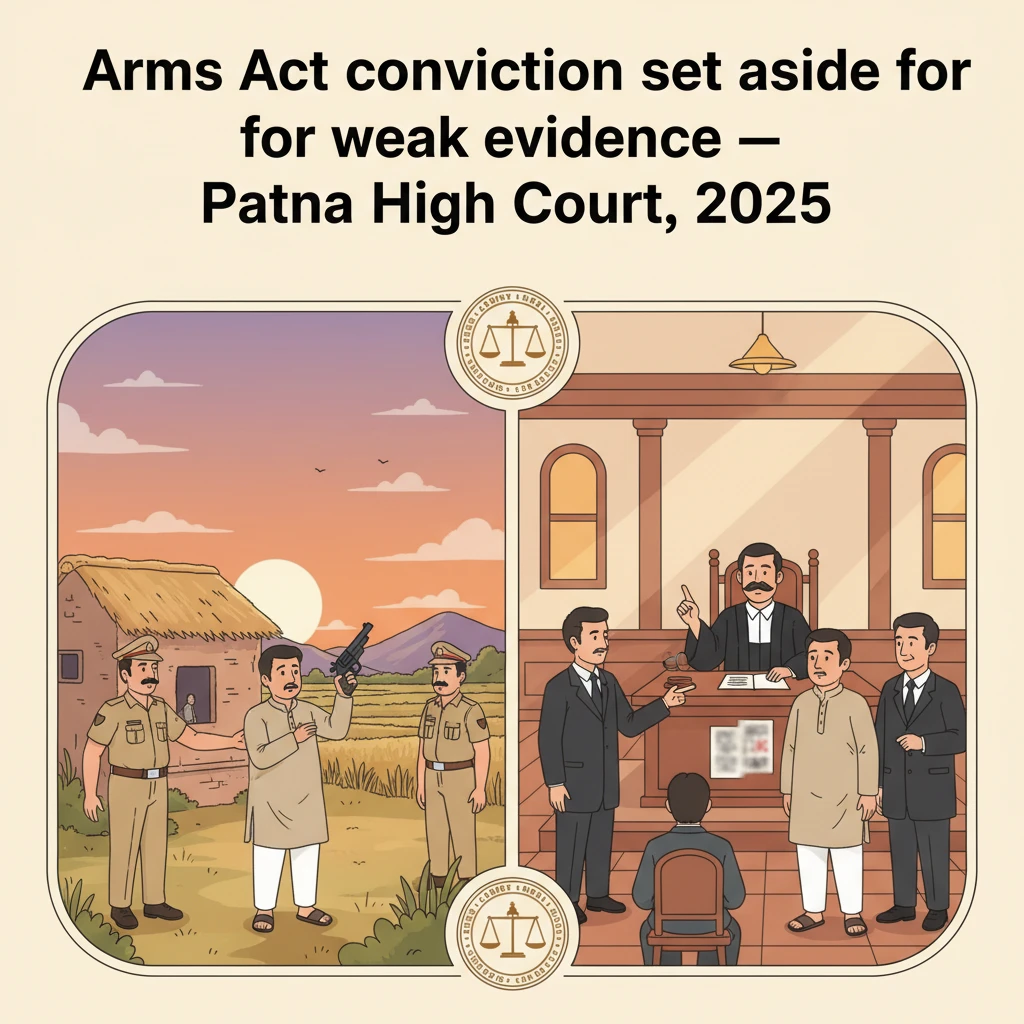
According to the record, on 06.07.2013 at about 5:15 p.m., the Station House Officer (SHO) of Pali Police Station, along with other police personnel, was on evening patrolling duty. At about 5:40 p.m., when the police party reached near Serthu village, the SHO allegedly received secret information.
The information was that one Upendra Yadav @ Barhu Yadav was carrying illegal firearms to commit some offence in or around a government irrigation cabin standing on his land in village Golakhpur. The SHO informed his senior officers about this input, and then proceeded with the patrolling team to the spot.
At around 6:30 p.m., the police party reached near the said cabin, which was situated on the eastern side of village Golakhpur. The prosecution story is that on seeing the police, one person started fleeing. The police party, along with the local chowkidar, searched the cabin area.
The police claim that during this search they recovered one black coloured country-made pistol, already loaded, along with a live cartridge of .315 bore from the waist of the person who was apprehended. Upon being questioned, this person disclosed his identity as Upendra Yadav @ Barhu Yadav.
The police seized the country-made pistol and live cartridges at the spot in the presence of chowkidars and arrested the accused. On the basis of this incident, the SHO lodged a suo motu complaint at Pali Police Station, which led to registration of Pali P.S. Case No. 85 of 2023 under Sections 25(1-B)(a) and 26 of the Arms Act.
After investigation, the police submitted a charge-sheet against the accused under the above provisions. The accused appeared before the Judicial Magistrate, 1st Class, Jehanabad. Charges were framed, read over and explained to him. He pleaded not guilty and claimed to be tried.
In the trial (G.R. No. 774/2023, Trial No. 1266/2024), the prosecution examined seven witnesses. PW-1 was the informant, SHO Balvir Kumar Singh. PW-2 to PW-6 were other police personnel. PW-7 was an arms expert, who gave his report on the working condition of the firearm and cartridges.
On the basis of this evidence, the Trial Court convicted the accused under Sections 25(1-B)(a) and 26 of the Arms Act. He was sentenced to rigorous imprisonment for three years for the offence under Section 25(1-B)(a), and imprisonment for two years and a fine of Rs. 10,000/- for the offence under Section 26. The substantive sentences were directed to run concurrently.
The accused filed Criminal Appeal No. 11 of 2024 before the District and Sessions Judge, Jehanabad. The Appellate Court dismissed the appeal on 09.07.2024, affirming the conviction and sentence. Aggrieved by this, the accused approached the Patna High Court in Criminal Revision No. 700 of 2024.
What the Court Examined and Decided
The criminal revision came up before Hon’ble Mr. Justice Bibek Chaudhuri. The core question was whether the conviction under Sections 25(1-B)(a) and 26 of the Arms Act could stand in light of the contradictions and gaps in the prosecution evidence.
The counsel for the petitioner first pointed out that the accused had already been in custody for about two years. However, the main attack was not on sentence, but on the reliability of the prosecution story itself.
The defence focused on the seizure list, marked as Exhibit P-2. In paragraph 3 of the seizure list, it is written that the firearm and live cartridges were recovered from the land of the accused, beside a cabin in village Golakhpur. The Hindi portion mentioned that the recovery was from the accused’s field near the cabin.
From this, the defence argued that the seizure list itself did not show that the firearm was recovered from the waist of the accused, as claimed in oral evidence. Instead, it suggested recovery from a place near the cabin.
This, according to the petitioner’s counsel, made the prosecution story of “recovery from the waist” false and contradicted by its own document. If the firearm and cartridges were lying beside a cabin, the question arose whether they were in the actual or exclusive possession of the accused at all.
The second major contradiction related to the nature of the cartridges. The seizure list notes that police recovered a country-made firearm loaded with two live cartridges engraved “8mm KF”. In contrast, during trial, witnesses including PW-1 and PW-4 stated that they had recovered two live cartridges of .315 bore.
The suo motu FIR lodged by the SHO also talks about recovery of .315 bore cartridges. Thus, between the seizure list, the FIR and the witnesses, there were conflicting descriptions about the type of ammunition allegedly seized.
When the arms expert (PW-7) examined the seized articles, he certified that the live cartridges were of 8mm KF. The High Court noted that this matched the seizure list, but did not match the oral testimony of the police witnesses and the FIR version, which had described the cartridges as .315 bore.
The Court observed that it is not believable or desirable that police officers, who are familiar with firearms and ammunition, and whose own department uses .315 bore cartridges, would not know the difference between .315 bore and 8mm KF cartridges. The discrepancy on such a basic point raised a serious doubt about what exactly was recovered, if at all.
The High Court then went back to the seizure location issue. If the seizure list is accepted as correct, it shows the firearm and ammunition were recovered from a place beside the cabin in the accused’s field, and not from his person.
The Court noted that there was absolutely no evidence that the very place from where the firearm and cartridges were allegedly recovered was under the exclusive possession of the accused. Mere mention of his field or a cabin near it, without more, was not enough to establish his constructive possession beyond reasonable doubt.
Another point raised by the defence was about the manner of apprehension. PW-1, the informant, stated that on seeing the police party, the accused fled away. However, there was no clear evidence as to when and where the accused was subsequently apprehended. This gap, in the Court’s view, cast a doubt as to whether he was actually caught in the manner alleged at all.
The Court emphasised that offences under Sections 25 and 26 of the Arms Act relate to illegal possession of firearms. Therefore, the prosecution has the primary obligation to prove that the firearm and cartridges were recovered from the actual or constructive possession of the accused.
On an overall reading of the evidence, the High Court found that the prosecution case did not stand on a firm and true foundation. The contradictions in the documents and statements, especially about the place of seizure and the type of cartridges, went to the root of the case.
Ordinarily, while exercising revisional jurisdiction, a High Court does not re-appreciate evidence unless the findings of the lower courts are perverse. Here, the Court found that the appreciation of evidence by both the Trial Court and the Appellate Court was indeed perverse.
The perversity lay in their failure to consider the contradictions between the seizure list, the FIR, the oral testimony of PW-1 and PW-4, and the expert report. The lower courts had mechanically accepted the prosecution story without resolving these serious inconsistencies.
In paragraph 16 of the judgment, the High Court clearly recorded that the discrepancy regarding the nature and “neck” of the cartridges remained unexplained. This undermined the prosecution’s version of a clean and reliable recovery of arms and ammunition.
In view of these reasons, the High Court held that the prosecution had failed to bring home the charge against the accused under Sections 25(1-B)(a) and 26 of the Arms Act. The finding of guilt recorded by the Trial Court, and affirmed by the Appellate Court, could not be sustained.
The Court therefore refused to concur with the affirmation of conviction and sentence. The criminal revision was allowed on contest. There was no order as to costs.
The High Court directed that the accused be acquitted of the charges, set at liberty and released from his bail bond at once. A plain copy of the order was to be handed over to the petitioner’s advocate free of cost, and the Trial Court was directed to act on the basis of this plain copy.
Finally, the Court ordered that the seized material (the firearm and cartridges) be destroyed after the expiry of the period of limitation for filing Special Leave to Appeal. The lower court records were directed to be returned.
Why This Judgment Matters
This Patna High Court judgment is important for people facing Arms Act cases, particularly in rural areas where “secret information” and roadside seizures are common. It shows that mere recovery of a weapon somewhere near a person’s land is not enough to secure a lawful conviction.
The Court has made it clear that the prosecution must prove actual or constructive possession with solid, consistent evidence. Police papers like the seizure list, the FIR, and witness statements must all tell the same basic story.
If there are serious contradictions about where the weapon was found or what exactly was seized, courts must treat the case with caution. Simply relying on the word of police officials without checking their documents can lead to wrongful convictions.
For lawyers and accused persons, this decision underlines the value of closely scrutinising seizure lists, expert reports, and oral testimony. For police and prosecutors, it is a reminder that accurate documentation and consistent evidence are essential in Arms Act cases.
Legal Issues and Answers
- Issue: Whether the prosecution proved beyond reasonable doubt that the firearm and cartridges were in the actual or constructive possession of the accused, justifying conviction under Sections 25(1-B)(a) and 26 of the Arms Act.
Answer: No. Due to contradictions about the place of recovery and the type of cartridges, and absence of proof of exclusive possession, the prosecution failed to establish illegal possession, and the conviction was set aside. - Issue: Whether the appreciation of evidence by the Trial Court and Appellate Court was so perverse as to justify interference in revisional jurisdiction.
Answer: Yes. The lower courts ignored material contradictions between the seizure list, witness statements and expert report, amounting to perverse appreciation of evidence, warranting High Court interference.
Cases Cited by the Court
- No prior cases or precedents are cited or relied upon in the judgment.
Case Details
Case Number: Criminal Revision No. 700 of 2024; arising out of P.S. Case No. 85 of 2023, Pali Police Station, District Jehanabad; Trial: G.R. No. 774/2023, Trial No. 1266/2024; Criminal Appeal No. 11 of 2024.
Case Title: Upendra Yadav @ Barhu Yadav vs. The State of Bihar
Coram: Hon’ble Mr. Justice Bibek Chaudhuri
Citation: 2025(3) PLJR 936
Advocates: For the petitioner: Mr. Umesh Kumar, Advocate; Mr. Abhishek Anand, Advocate; Mr. Roy Birendra, Advocate; Mr. Prashant Kumar, Advocate. For the State/Respondent: Mr. Umeshanand Pandit, APP.
Nature of the Case: Criminal revision challenging concurrent conviction and sentence under Sections 25(1-B)(a) and 26 of the Arms Act, 1959.
Date of High Court Judgment: 22.07.2025 (CAV judgment; CAV date 14.07.2025; Uploading and Transmission Date 22.07.2025).
Link to Judgment: View full judgment on Patna High Court website
If you found this explanation helpful and wish to stay informed about
how legal developments may affect your rights in Bihar,
you may consider following Samvida Law Associates for more updates.







