
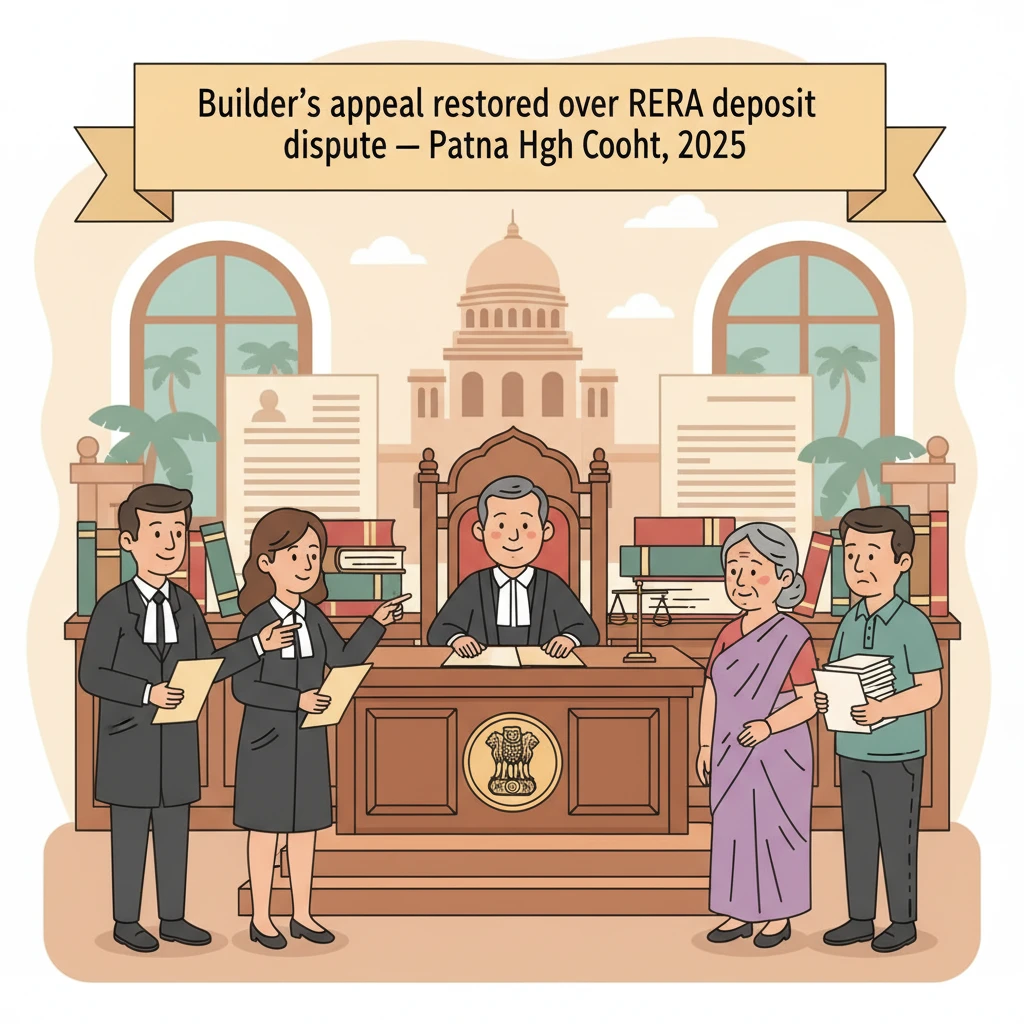
The Patna High Court held that only 30% deposit was needed in this dispute.
The Tribunal’s dismissal order was modified and the builder’s appeals were restored.
Now, the Tribunal must hear the case on merits within a reasonable time.
Case Background
The dispute arises from a development agreement between a land promoter, M/s Nesh India Infrastructure Pvt. Ltd. (the appellant), and two landowners, later arrayed as respondent nos. 4 and 5.
Respondent nos. 4 and 5 are the owners of the land. The appellant is the developer or land promoter. Under the agreement, the appellant was to construct a building originally up to five floors.
Later, the number of floors was increased from five to seven. Because of this change, respondent nos. 4 and 5 demanded additional benefits, including more flats, as well as compensation for delayed completion of the project.
Feeling aggrieved by delayed work and other issues, respondent nos. 4 and 5 approached the Adjudicating Authority under the Real Estate (Regulation and Development) Act, 2016 (RERA). The Adjudicating Authority ordered the appellant to pay compensation, interest and litigation costs in favour of the landowners.
The appellant challenged this order before the Bihar Real Estate Appellate Tribunal (BREAT). At first, the Tribunal directed the appellant to deposit 30% of the awarded amount as pre-deposit under Section 43(5) of the RERA Act.
On a review petition filed by the landowners, the Tribunal changed its stand on 10.08.2021. It ordered that the appellant must deposit 100% of the compensation, interest and litigation costs, failing which the appeal would not be entertained.
When the appellant sought review of this 10.08.2021 order, the Tribunal dismissed the review on 10.09.2021 and made it clear that if full deposit was not made within a fortnight, both appeals would stand dismissed without further reference to the Bench.
Challenging these Tribunal orders and the requirement of 100% pre-deposit, the appellant filed Civil Writ Jurisdiction Case No. 15444 of 2021 before the Patna High Court. On 28.08.2024, a learned Single Judge upheld the Tribunal’s direction of 100% deposit.
The appellant then preferred Letters Patent Appeal (LPA) No. 932 of 2024 before a Division Bench of the Patna High Court against the Single Judge’s order.
What the Court Examined and Decided
The core question before the Patna High Court was narrow but very important: under Section 43(5) of the RERA Act, in what kind of case is a promoter required to deposit 30% of the amount, and in what kind of case is a 100% deposit necessary before an appeal can be heard?
The appellant argued that the Bihar Real Estate Appellate Tribunal had misunderstood Section 43(5), and that the case at hand was not one where the promoter was required to return any amount taken from an allottee. Instead, it was a dispute about compensation to landowners for delay and for not giving them the agreed number of flats.
To support this, the appellant relied on a judgment of the Hon’ble Supreme Court in its own case, Civil Appeal Nos. 6745–6749 of 2021, arising out of SLP (Civil) Nos. 3711–3715 of 2021. The Patna High Court specifically quoted paragraphs 121 and 122 of that Supreme Court decision.
Paragraph 121 of the Supreme Court judgment set out the text of Section 43(5) of the RERA Act. The section provides that any person aggrieved by any order of the Authority or Adjudicating Officer may file an appeal before the Appellate Tribunal.
The proviso to Section 43(5) states that when a promoter files an appeal, it will not be entertained unless the promoter first deposits at least 30% of the penalty or such higher percentage as the Tribunal may decide, or the total amount to be paid to the allottee, including interest and compensation, as the case may be.
In paragraph 122, the Supreme Court clarified how this proviso should work. The Supreme Court said that:
- Where the appeal is against imposition of penalty, the promoter must deposit at least 30% of the penalty amount, or a higher amount if the Tribunal so directs.
- Where the appeal is against any other order which involves return of the amount to the allottee, the promoter must deposit the total amount to be paid to the allottee, including interest and compensation, before the appeal is instituted.
The Patna High Court noted that the crucial distinction drawn by the Supreme Court is between “penalty” cases and cases involving “return of the amount to the allottee”. It is only in the latter category that a 100% deposit of the amount payable to the allottee is required.
The Court then examined the facts of this case. It observed that there was no question of returning any amount to an allottee. Respondent nos. 4 and 5 are landowners who had given their land to the promoter in exchange for a share of the constructed flats and related benefits.
The grievance of respondent nos. 4 and 5 before the Adjudicating Authority was about delayed completion and failure to provide certain agreed flats and benefits. They claimed compensation, interest and other benefits. There was no claim that they had paid money to the promoter which had to be refunded.
The Division Bench made this point clear by stating that the case was “in respect of payment of compensation and not return of the amount to the allottee.” On this basis, it held that the Tribunal and the learned Single Judge had wrongly treated this case as if it involved refund to an allottee.
The Court also took note that the Tribunal, in its 10.08.2021 order, had itself recorded that the Adjudicating Officer had awarded compensation, interest and litigation cost, and had not imposed any penalty. Still, relying on decisions of other High Courts and Tribunals, BREAT had concluded that 100% of the awarded amount must be deposited.
However, the Patna High Court held that, in light of the Supreme Court’s interpretation in the appellant’s own case, 100% deposit is required only when the appeal involves refund of money to an allottee. Since this case was about compensation to landowners, the statutory requirement was satisfied by a 30% deposit.
The Court therefore came to the conclusion that “appellant need not deposit 100%” and that “tenor of Section 43(5) read with the Hon’ble Supreme Court decision cited (supra) in particularly paras 121 & 122” had not been properly appreciated by either the Appellate Tribunal or the Single Judge.
Accordingly, the Division Bench modified the orders. It held that the appellant is “liable to deposit only 30%”. It also recorded that the appellant had already deposited 30% pursuant to the earlier order of the Appellate Authority. Therefore, the later orders dated 10.08.2021 and 10.09.2021, which insisted on 100% deposit and led to dismissal of the appeals for non-compliance, stood modified to that extent.
As a result, the Court ordered that REAT Appeal Nos. 28 and 29 of 2021 filed by the appellant before BREAT “stand restored on the file of the Real Estate Appellate Tribunal, Bihar”.
Finally, the Patna High Court requested the Appellate Tribunal to decide these appeals on merits, after giving “ample opportunity of hearing to the respective parties”, and to dispose of them within a reasonable period of six months from the date of receipt of the High Court’s order. It also directed the parties to cooperate with the Tribunal in early disposal.
The Letters Patent Appeal No. 932 of 2024 was thus allowed in part: the pre-deposit requirement was scaled down, and the appeals were revived, but the original compensation order itself was not decided by the High Court, and remains to be examined by BREAT.
Why This Judgment Matters
This judgment is important for property developers, landowners, and flat purchasers dealing with RERA disputes in Bihar.
First, it clarifies that under Section 43(5) of the RERA Act, promoters are not always required to deposit 100% of the awarded amount before their appeal can be heard. The higher deposit applies only where the order involves refund of money taken from an allottee.
In disputes like this one, where landowners seek compensation and interest for delay or for not getting the agreed share of flats, the promoter’s obligation is to deposit at least 30% of the awarded amount, unless a specific penalty is in issue.
Second, the ruling protects the right of appeal. If promoters are wrongly forced to deposit 100% in compensation-only matters, many appeals may get dismissed for non-deposit, without examination on merits. The Patna High Court has ensured that such appeals are heard, provided the statutory 30% is deposited.
Third, for landowners and allottees, the judgment gives a realistic picture of the procedural steps in RERA litigation. Even if compensation is awarded by the Adjudicating Authority, the promoter may be allowed to challenge it before the Appellate Tribunal with a limited pre-deposit, rather than the full amount.
Overall, the decision brings Bihar practice in line with the Supreme Court’s interpretation of Section 43(5), providing clearer guidance for future RERA appeals before the Patna High Court and the Bihar Real Estate Appellate Tribunal.
Legal Issues and Answers
-
Issue: In a RERA dispute involving only compensation and interest to landowners, and not refund of money to an allottee, must a promoter deposit 100% of the awarded amount as a pre-condition to filing an appeal under Section 43(5) of the RERA Act?
Answer: No. The Patna High Court held that in such cases the promoter is required to deposit only 30% of the amount (or such higher percentage as may be determined in penalty cases), since 100% deposit is mandated only where the appeal involves return of the amount to the allottee. -
Issue: Were the Bihar Real Estate Appellate Tribunal and the learned Single Judge right in insisting on 100% deposit and dismissing the appeals when the builder did not comply?
Answer: No. The Court held that both had misapplied Section 43(5) in light of the Supreme Court’s decision in the appellant’s own case. Their orders were modified, and the builder’s appeals before BREAT were restored.
Cases Cited by the Court
- Civil Appeal No(s). 6745–6749 of 2021 arising out of SLP (Civil) Nos. 3711–3715 of 2021 (Supreme Court) – relied upon for interpretation of Section 43(5) of the RERA Act, particularly paragraphs 121 and 122.
Case Details
Case Number: Letters Patent Appeal No. 932 of 2024 in Civil Writ Jurisdiction Case No. 15444 of 2021
Case Title: M/S Nesh India Infrastructure Pvt. Ltd. v. The State of Bihar & Ors.
Citation: 2025(4) PLJR 129
Court: High Court of Judicature at Patna
Coram: Hon’ble The Acting Chief Justice P. B. Bajanthri; Hon’ble Mr. Justice Alok Kumar Sinha
Date of Judgment: 02.09.2025
Advocates:
- For the Appellant: Mr. Abhinav Shrivastava, Senior Advocate; Mr. Raushan, Advocate; Mr. Pushkar Bhardwaj, Advocate; Mr. Krishna Murari, Advocate; Mr. Sahil Kumar, Advocate.
- For the Respondents: Mr. D. K. Sinha, Senior Advocate; Mr. Ram Babu Sah, Advocate.
Nature of the Case: Letters Patent Appeal against a Single Judge order in a writ petition challenging pre-deposit conditions imposed by the Bihar Real Estate Appellate Tribunal under Section 43(5) of the RERA Act.
Link to Judgment: Click here to read the full judgment of the Patna High Court
If you found this explanation helpful and wish to stay informed about
how legal developments may affect your rights in Bihar,
you may consider following Samvida Law Associates for more updates.







