
Case Background
This case arises from long-standing disputes over control of cricket administration in Bihar.
The writ case was filed by the Secretary of the Cricket Association of Bihar (CAB) in 2021 before the Patna High Court. CAB is a society registered under the Societies Registration Act, 1860. It said it works for development of cricket in Bihar but that the Board of Control for Cricket in India (BCCI) had failed to properly develop cricket in the State.
Bihar Cricket Association (BCA) is the body recognised by BCCI as the State Cricket Association for Bihar. BCCI itself is registered under the Tamil Nadu Societies Registration Act, 1975.
The writ petitioner alleged serious corruption, maladministration and mismanagement in BCA. CAB sought directions to BCCI to derecognise BCA, to recognise CAB instead, and to appoint an ad hoc body to run cricket in Bihar. Later, the petitioner did not press the prayers about derecognition of BCA and recognition of CAB, but continued to seek an independent enquiry into BCA’s functioning and appointment of an ad hoc management committee.
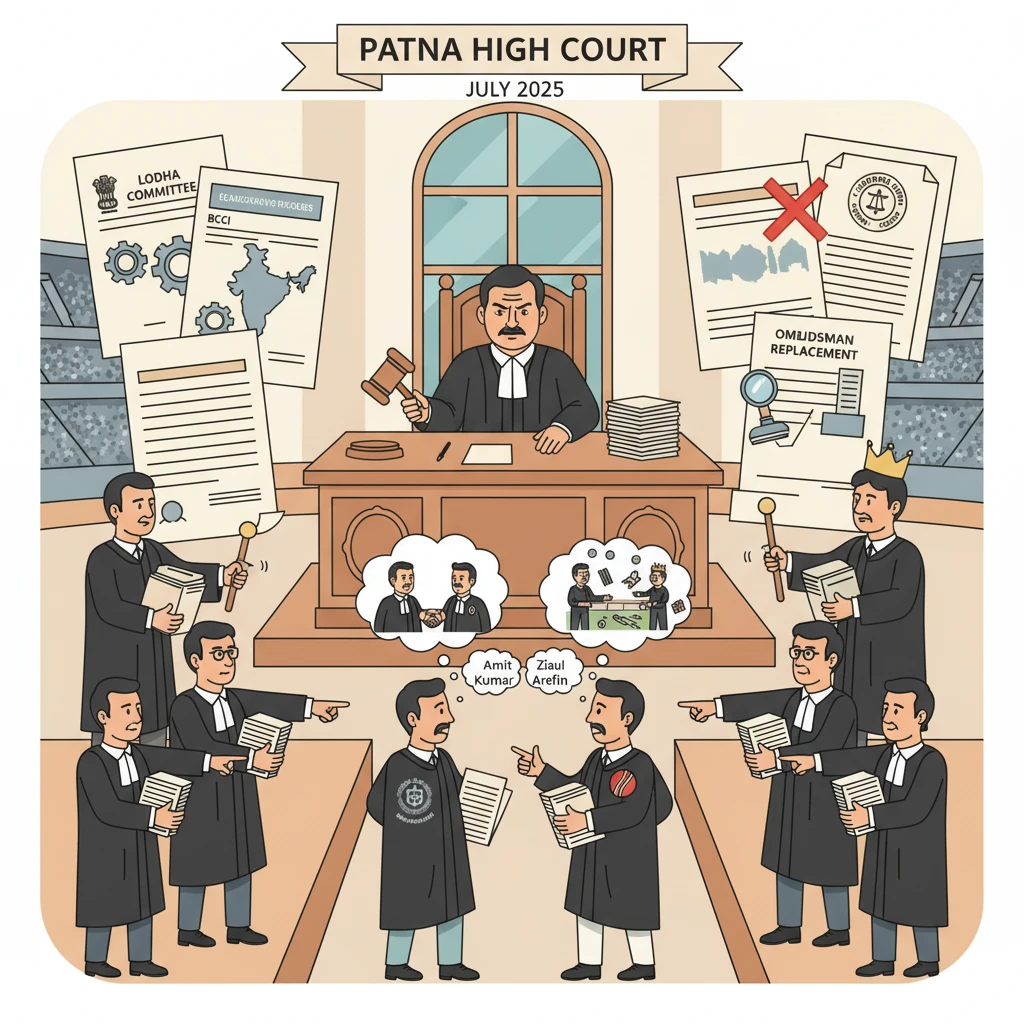
During the writ proceedings, serious internal disputes within BCA came on record. Two different persons claimed to be Secretary of BCA at different points—Amit Kumar (erstwhile Secretary) and Ziaul Arefin (present Secretary). Both filed affidavits in the writ case, taking opposite stands. There were also disputes over who was the valid Ombudsman of BCA: retired District Judge Nawal Kishore Singh or retired District Judge Paras Nath Roy.
Meanwhile, a Title Suit No. 75 of 2023 was filed in the court of Sub Judge-I, Patna, by BCA through Secretary Amit Kumar against the BCA President and others, challenging the President’s power to convene meetings and resolutions passed there. That suit is still pending.
Separately, CAB had previously approached the Bombay High Court for recognition as full member of BCCI, lost in 2010, and then filed Civil Appeal No. 7645 of 2011 in the Supreme Court, which is pending. CAB also filed an Interlocutory Application (IA No. 223712 of 2023) in Civil Appeal No. 4235 of 2014 before the Supreme Court seeking directions on alleged corruption and mismanagement in BCA.
In the writ case CWJC No. 13405 of 2021, the learned Single Judge, by judgment dated 5.8.2024, held that the then functioning Ombudsman (retired District Judge Nawal Kishore Singh) had been illegally appointed by the Committee of Management of BCA in breach of BCA rules. The Single Judge restrained both retired District Judges (Nawal Kishore Singh and Paras Nath Roy) from functioning as Ombudsman and appointed a retired Judge of the Patna High Court, Hon’ble Shailesh Kumar Sinha, J. (retired), as Ombudsman.
The Single Judge directed that the new Ombudsman should decide all complaints against office bearers of BCA in accordance with its by-laws, examine other complaints noted in the judgment, and receive an honorarium of Rs. 2.5 lakhs per month.
Against this order, two Letters Patent Appeals were filed: LPA No. 840 of 2024 by retired District Judge Nawal Kishore Singh, and LPA No. 906 of 2024 by BCA through its Secretary, Ziaul Arefin.
What the Court Examined and Decided
The Division Bench (Hon’ble the Acting Chief Justice and Hon’ble Mr. Justice Partha Sarthy) heard detailed arguments from all sides: BCA, the former Ombudsman, CAB (writ petitioner), BCCI, the State of Bihar and interveners.
First, the Bench considered whether a writ under Article 226 of the Constitution was maintainable against BCCI. It referred to Zee Telefilms Ltd. v. Union of India, (2005) 4 SCC 649, where the Supreme Court held that BCCI is not “State” under Article 12. It then relied on Board of Control for Cricket in India v. Cricket Association of Bihar, (2015) 3 SCC 251 (“BCCI vs CAB”), where the Supreme Court clarified that although BCCI is not “State”, it is still amenable to the High Court’s writ jurisdiction under Article 226. On this basis, the Bench held that a writ petition can be maintained against BCCI.
However, maintainability against BCCI was only one part of the matter. The Bench carefully traced the Supreme Court’s role in restructuring BCCI and its State bodies.
In Civil Appeal No. 4235 of 2014, the Supreme Court had appointed a Committee of Administrators (CoA) on 2.1.2017 to supervise BCCI, prepare a draft constitution in line with BCCI vs CAB (2015) 3 SCC 251, and get it registered. On 9.8.2018, the Supreme Court approved that draft constitution and directed that BCCI’s constitution be registered in Tamil Nadu and that each State Association register its constitution on similar lines within 30 days. If any State Association failed, earlier orders dated 7.10.2016 and 21.10.2016 on withholding funds were to revive.
By order dated 4.1.2018 in Civil Appeal No. 7644 of 2011 (Cricket Association of Jharkhand, Jamshedpur & Anr. v. BCCI) with Civil Appeal No. 7645 of 2011, the Supreme Court had directed that the State of Bihar would be eligible to participate in the Ranji Trophy and similar competitions, and that the “incumbent Bihar Cricket Association, which has been elected by virtue of the order passed… in SLP (C) No. 35160 of 2013, shall be in charge of the same.” The CoA’s final report of 14.10.2019 also recognised BCA as a full member of BCCI representing Bihar.
Thus, in the eyes of law, BCA is the recognised State Cricket Association for Bihar under BCCI. CAB’s earlier challenge to this position was already part of the Supreme Court proceedings.
The Division Bench then looked closely at the actual reliefs in the writ petition CWJC No. 13405 of 2021. Originally, CAB had asked:
- for derecognition and disaffiliation of BCA by BCCI;
- for BCCI to recognise and affiliate CAB;
- for an enquiry into alleged corruption, maladministration and mismanagement of BCA; and
- for BCCI to constitute an ad hoc committee to take over management of cricket in Bihar.
During arguments before the Division Bench, counsel for CAB stated that prayers (i) and (iii) (derecognising BCA and recognising CAB) would not be pressed. But CAB continued to seek an enquiry into BCA and appointment of an ad hoc body to manage cricket in Bihar.
The Bench observed that the ongoing disputes were of two types:
First, a rivalry between CAB and BCA, where CAB wanted BCA derecognised and itself recognised. This issue, the Bench noted, was already covered by the Supreme Court’s 4.1.2018 order in Civil Appeal Nos. 7644 and 7645 of 2011, which made BCA in charge of Bihar’s participation in major tournaments.
Second, deep internal disputes within BCA itself, especially between Amit Kumar (erstwhile Secretary) on one side and BCA President Rakesh Kumar Tiwari and current Secretary Ziaul Arefin on the other. These disputes concerned:
- who was the legitimate Secretary;
- who could convene meetings;
- who could operate bank accounts;
- whether the President unlawfully concentrated power in himself; and
- who was the validly appointed Ombudsman.
The Single Judge had gone into great detail about alleged breaches of BCA’s own Rules and Regulations, especially on removal of Secretaries, appointment of Ombudsman and operation of bank accounts. The Single Judge had listed a series of complaints (paragraph 62 of the Single Judge’s judgment) about alleged misuse of power by the BCA President, violation of specific BCA rules and conflict of interest in selection of players.
The Division Bench, however, took a step back and asked a basic question: who is raising these internal disputes, and what is their legal standing?
The Bench noted that the writ petition was filed by CAB, which is not an official or office bearer of BCA. CAB is a separate association, rival to BCA. The Court held that CAB had no locus standi to raise internal, inter se disputes between BCA officials—such as who is Secretary, who is Ombudsman, or how the President exercises power under BCA’s internal rules.
Moreover, disputes between BCA office bearers were already the subject of Title Suit No. 75 of 2023 before the Sub Judge-I, Patna. That civil suit is the proper place to decide such contested questions of fact concerning internal governance.
The Bench also recorded that CAB had already approached the Supreme Court through IA No. 223712 of 2023 in Civil Appeal No. 4235 of 2014, making similar allegations of large-scale corruption and mismanagement in BCA and seeking a court-appointed committee to manage BCA. That IA is pending before the Supreme Court.
Further, the Division Bench highlighted Rule 44 of the BCA Regulations, which provides for an Ombudsman as an independent dispute resolution mechanism. The Bench found that CAB could and should approach the BCA Ombudsman for its complaints about mismanagement and financial irregularities. If any question arises as to who is the proper Ombudsman, CAB can approach BCCI, which may, if needed, appoint an independent Ombudsman to determine that dispute and to hear complaints.
On the specific grievance of retired District Judge Nawal Kishore Singh, the Division Bench found that he was not a party to the original writ petition, yet the Single Judge had restrained him from functioning as Ombudsman and replaced him with a retired High Court Judge. Passing such an adverse order against a non-party without hearing him was contrary to principles of natural justice.
Putting all this together, the Division Bench concluded that the Single Judge should not have:
- decided or interfered with internal BCA disputes in a writ petition filed by CAB;
- replaced the BCA Ombudsman and installed a new Ombudsman; or
- fixed an honorarium and assigned wide powers to the court-appointed Ombudsman in this proceeding.
Instead, the correct course was to direct CAB to use existing mechanisms: BCA’s own Ombudsman under Rule 44, BCCI’s oversight where necessary, and the pending civil suit for internal BCA disputes.
Accordingly, the Division Bench set aside the Single Judge’s judgment dated 5.8.2024 and allowed both LPAs, while laying down the route CAB should take for its complaints.
Why This Judgment Matters
This judgment is important for anyone dealing with disputes in sports associations, especially cricket bodies in Bihar.
First, the Patna High Court makes it clear that while BCCI can be brought under writ jurisdiction, not every internal dispute of a State Cricket Association can be settled through such writ petitions. Rival associations cannot use a writ case to fight internal elections, appointments or bank signatory issues of the recognised State body.
Second, the Court reinforces that when by-laws of an association provide a clear remedy—such as an Ombudsman under Rule 44—complainants must first go there. High Courts will not jump in and run the association’s day-to-day affairs, especially when the Supreme Court is already supervising the broader reforms.
Third, the judgment protects the principle that no adverse order should be passed against a person without making them a party and hearing them. Retired District Judge Nawal Kishore Singh could not be restrained from functioning as Ombudsman without being heard.
For players, club officials and other stakeholders in Bihar, the judgment indicates that allegations of corruption or mismanagement in BCA should be raised before the BCA Ombudsman or BCCI, and, where necessary, through proper civil suits—not only through writ petitions by rival bodies.
Legal Issues and Answers
- Issue: Can a writ petition under Article 226 be maintained against BCCI and used by a rival association (CAB) to attack BCA’s recognition and internal functioning?
Answer: A writ is maintainable against BCCI (BCCI vs CAB, (2015) 3 SCC 251), but CAB cannot use it to challenge BCA’s recognition already settled by the Supreme Court, nor to litigate internal disputes between BCA officials where CAB has no locus standi. - Issue: Could the Single Judge, in a writ by CAB, remove the existing BCA Ombudsman and appoint a new Ombudsman (a retired High Court Judge) with fixed honorarium and wide powers?
Answer: No. The Division Bench held that, since the writ was not filed by BCA officials, the question of who is BCA’s Ombudsman should not have been decided in this case. Orders could not be passed against the then Ombudsman, Nawal Kishore Singh, who was not a party, and CAB must instead be directed to approach the Ombudsman/BCCI as per Rule 44. - Issue: What is the proper forum for CAB’s allegations of corruption, maladministration and mismanagement in BCA?
Answer: CAB should move an appropriate application before the BCA Ombudsman under Rule 44. If there is any dispute about who is the Ombudsman, CAB may approach BCCI, which can, if required, appoint an independent Ombudsman to decide. Internal disputes between BCA officials are for the civil court (Title Suit No. 75 of 2023) and not for decision in this writ.
Cases Cited by the Court
- Board of Control for Cricket in India v. Cricket Association of Bihar, (2015) 3 SCC 251
- Zee Telefilms Ltd. & Anr. v. Union of India & Ors., (2005) 4 SCC 649
- Civil Appeal No. 7644 of 2011 (Cricket Association of Jharkhand, Jamshedpur & Anr. v. BCCI) with Civil Appeal No. 7645 of 2011 – order dated 4.1.2018
- Civil Appeal No. 4235 of 2014 – orders including 2.1.2017, 9.8.2018 and 9.12.2020
- CWJC No. 2809 of 2022 (DB) (Kumar Arvind v. Bihar State Cricket Association & Ors.) – relied upon by BCCI on maintainability
Case Details
Case Numbers: Letters Patent Appeal No. 840 of 2024 and Letters Patent Appeal No. 906 of 2024, arising out of Civil Writ Jurisdiction Case No. 13405 of 2021.
Case Titles:
LPA No. 840 of 2024: Nawal Kishore Singh v. State of Bihar & Ors.
LPA No. 906 of 2024: Bihar Cricket Association v. Aditya Prakash Verma & Ors.
Citation: 2025(3) PLJR 641
Coram: Hon’ble the Acting Chief Justice; Hon’ble Mr. Justice Partha Sarthy (CAV Judgment per Hon’ble Mr. Justice Partha Sarthy; Hon’ble the Acting Chief Justice Ashutosh Kumar agreeing).
Date of Judgment: 14-07-2025
Advocates (LPA No. 840 of 2024):
- For the appellant (Nawal Kishore Singh): Mr. Sanjay Sinha, Advocate; Mr. Satish Kumar Pandey, Advocate
- For the State of Bihar: Mr. P.K. Shahi, Advocate General
- For Respondent No. 9: Mr. Kumar Kaushik, Advocate; Ms. Namrata Dubey, Advocate; Mr. Vikash Kumar Jha, Advocate
- For Respondent No. 10: Mr. Hridyal Kumar, Advocate; Mr. Pratik Kumar, Advocate
- For Respondent No. 11 (writ petitioner/CAB): Mr. Abhinav Shrivastava, Sr. Advocate; Mr. Raushan, Advocate; Mr. Pushkar Bharadwaj, Advocate; Mr. Shubham Priyadarshi, Advocate; Ms. Shreyashi Raj, Advocate
- For BCA: Mr. Raju Giri, Sr. Advocate; Mr. Harsh Vardhan, Advocate
- For BCCI: Mr. Bindhyachal Singh, Sr. Advocate; Mr. Parijat Saurav, Advocate
Advocates (LPA No. 906 of 2024):
- For the appellant (BCA): Mr. Raju Giri, Sr. Advocate; Mr. Harsh Vardhan, Advocate
- For BCCI: Mr. Bindhyachal Singh, Sr. Advocate; Mr. Parijat Saurav, Advocate
- For the State of Bihar: Mr. P.K. Shahi, Advocate General
- For Respondent No. 1 (writ petitioner/CAB): Mr. Abhinav Shrivastava, Sr. Advocate; Mr. Raushan, Advocate; Mr. Pushkar Bharadwaj, Advocate; Mr. Shubham Priyadarshi, Advocate; Ms. Shreyashi Raj, Advocate
- For Respondent No. 9: Mr. Ashhar Mustafa, Advocate; Mr. Vikash Kumar Jha, Advocate; Mr. Ashish Kr. Ranjan, Advocate; Mr. Abu Nasar, Advocate; Ms. Anita Kumari, Advocate
- For Respondent No. 10: Mr. Hridyal Kumar, Advocate; Mr. Pratik Kumar, Advocate
Nature of the Case: Letters Patent Appeals against a Single Judge’s order in a writ petition under Article 226 of the Constitution concerning recognition of a State cricket association, allegations of corruption and maladministration in Bihar Cricket Association, and appointment/replacement of its Ombudsman.
Link to Judgment: Click here to view the official Patna High Court judgment
If you found this explanation helpful and wish to stay informed about how legal developments may affect your rights in Bihar, you may consider following Samvida Law Associates for more updates.







