
Case Background
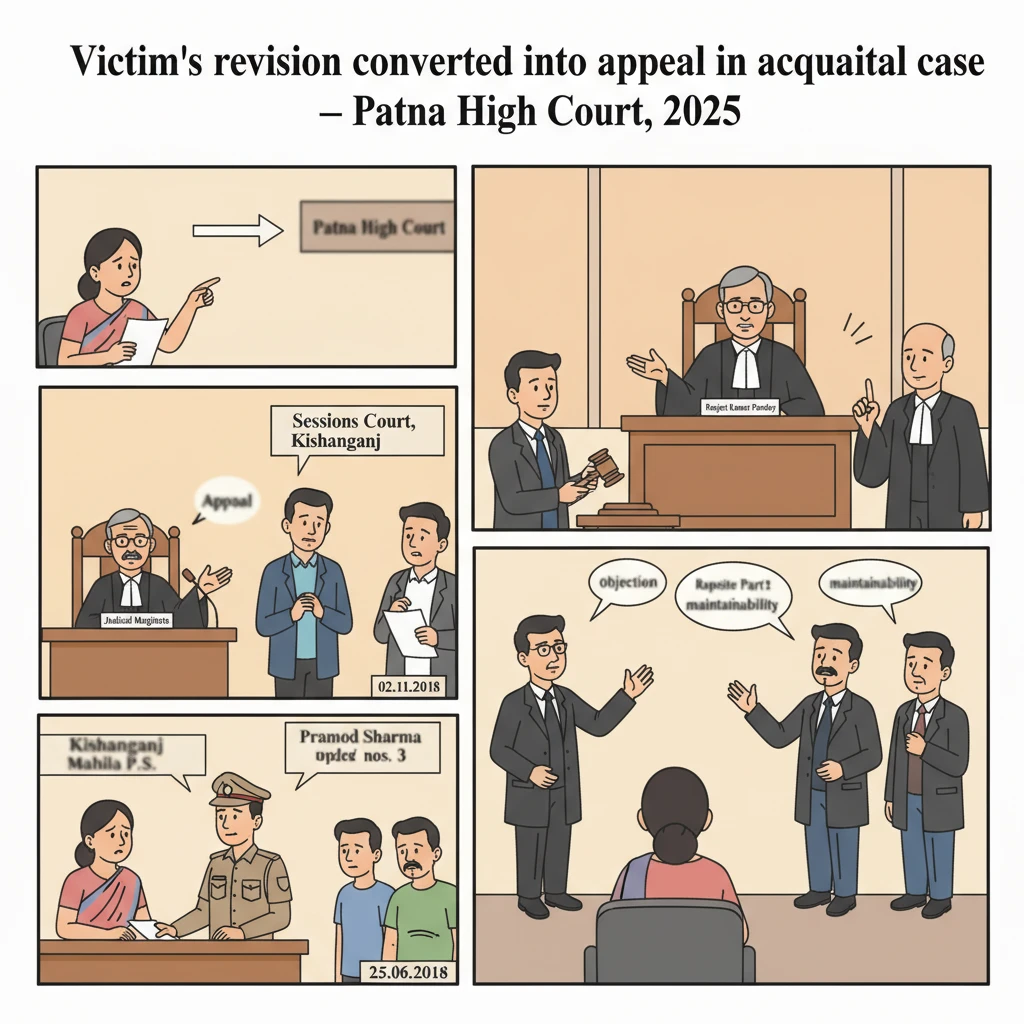
The case started with a written report given by the victim, Rekha Devi, who is the informant and petitioner. On the basis of her written report, Kishanganj Mahila P.S. Case No. 49 of 2012 was registered on 28.10.2012.
The case was registered against three accused persons, including opposite party nos. 2 and 3 and one Pramod Sharma. The allegation was that the victim was subjected to assault by the accused persons.
After investigation, charge-sheet was submitted. Cognizance was taken and charges were framed. The trial then commenced in G.R. Case No. 1270 of 2012 corresponding to Kishanganj Mahila P.S. Case No. 49 of 2012.
The learned Judicial Magistrate 1st Class, Kishanganj, Shri Punit Kumar Tiwary, by judgment dated 25.06.2018, found opposite party nos. 2 and 3 and Pramod Sharma guilty. The trial court convicted opposite party nos. 2 and 3 under Sections 341, 323, 504 read with Section 34 of the Indian Penal Code and passed an order of sentence.
Opposite party nos. 2 and 3 challenged this conviction by filing Criminal Appeal No. 16 of 2018 before the Sessions Judge, Kishanganj. By judgment dated 02.11.2018, the learned Sessions Judge allowed the appeal. The appellate court set aside the judgment of conviction and the order of sentence and acquitted opposite party nos. 2 and 3 of all charges.
Feeling aggrieved by this appellate judgment of acquittal, the victim–informant, Rekha Devi, filed Criminal Revision No. 105 of 2019 before the Patna High Court.
What the Court Examined and Decided
When the criminal revision came up for hearing before the Patna High Court, the learned counsel for the petitioner was not present. On request of the Court, Mr. Ranjeet Kumar Pandey, Advocate, agreed to assist as Amicus Curiae for the petitioner.
At the very outset, before going into the facts of the assault or the evidence, a preliminary objection was raised by the learned APP for the State and by the learned counsel for opposite party nos. 2 and 3. They argued that the criminal revision petition itself was not maintainable.
The State and opposite party nos. 2 and 3 submitted that, in view of the proviso to Section 372 read with Section 378 of the Code of Criminal Procedure, the petitioner, being a victim, should have filed a criminal appeal against the acquittal after obtaining leave of the High Court. They also argued that the present criminal revision was barred by Section 401(4) Cr.P.C., which restricts revision where an appeal remedy is available but not used.
On the other hand, the learned Amicus Curiae for the petitioner opposed this objection. He submitted that since opposite party nos. 2 and 3 had already been acquitted by the lower appellate court in Criminal Appeal No. 16 of 2018, no further appeal could lie against the appellate judgment. According to him, the only remedy left with the victim was to approach the High Court in revision, and therefore the criminal revision was rightly filed.
Hon’ble Mr. Justice Jitendra Kumar considered the rival submissions and examined the statutory scheme of appeals and revisions under the Code of Criminal Procedure.
The central question framed by the Court was: what is the correct legal remedy for the victim–petitioner against an appellate judgment of acquittal? Specifically, whether the victim was right in filing a criminal revision, or whether a criminal appeal was the proper remedy, with or without leave of the Court.
The Court first referred to Section 378 Cr.P.C., which deals with appeals in case of acquittal. The provision was quoted and examined. Sub-sections (1), (2) and (3) deal with appeals in police cases, enabling the District Magistrate or the State Government (or the Central Government in certain cases) to direct the Public Prosecutor to present an appeal, subject to leave of the High Court. Sub-section (4) governs appeals by a complainant in complaint cases, again subject to special leave by the High Court. Sub-section (5) prescribes limitation, and sub-section (6) bars further appeals if special leave is refused.
The Court then examined Section 372 Cr.P.C., which states that no appeal lies from a criminal court’s judgment or order except as provided by the Code or other law. Importantly, the Court noted that, prior to the insertion of the proviso to Section 372 in 2009, a victim had no independent right to appeal except under Section 378(4) as a complainant in a complaint case, and even then only with special leave.
The proviso to Section 372 now grants a special and independent right to the victim to file an appeal against:
- an order of acquittal, or
- conviction for a lesser offence, or
- imposition of inadequate compensation,
and clarifies that such appeal lies to the court to which an appeal ordinarily lies against the order of conviction of such court.
The Court noted that there had historically been two views across courts on whether a victim appealing under the proviso to Section 372 needed leave or special leave like in Section 378(3) and 378(4). One view said the victim’s right was absolute and required no leave. The other view said the victim must still seek leave or special leave, to balance the accused’s rights and the presumption of innocence after acquittal.
This controversy, the Court explained, was settled by the three-Judge Bench decision of the Supreme Court in Mallikarjun Kodagali v. State of Karnataka, (2019) 2 SCC 752. Quoting and summarising that judgment, the High Court noted that:
- The Supreme Court recognised that under the proviso to Section 372 Cr.P.C., a victim, as defined in Section 2(wa), has a right to file an appeal against an order of acquittal.
- This right must be understood in a liberal, progressive and beneficial manner in favour of the victim.
- The Supreme Court held that the victim’s appeal filed under the proviso to Section 372 was maintainable and should have been heard on merits.
- The Supreme Court made a clear distinction between a “complaint” case under Section 2(d) Cr.P.C. and a case arising from an FIR, and held that the special leave requirement of Section 378(4) applies only to complaint cases instituted before a Magistrate.
The Patna High Court also referred to the minority view in Mallikarjun Kodagali, which argued that the proviso to Section 372 must be read together with Section 378(3) and (4), and that leave should be required to maintain a balance with the accused’s strengthened presumption of innocence after acquittal. However, the High Court treated the majority view as authoritative and binding.
The Court then discussed another Supreme Court decision, Joseph Stephen v. Santhanasamy, (2022) 13 SCC 115. In that case, the victim had filed a criminal revision before the High Court against a first appellate court’s acquittal, even though the proviso to Section 372 gave him a right of appeal. The Supreme Court considered three issues, including whether a revision is maintainable when a statutory appeal lies and is not availed.
By quoting paragraphs 13, 13.1 and 13.2 of Joseph Stephen, the Patna High Court highlighted that:
- Section 401(4) Cr.P.C. clearly bars revision at the instance of a party who could have appealed but did not.
- After the 2009 amendment, a victim has a statutory right of appeal against acquittal under the proviso to Section 372, and therefore a revision should not be entertained in such a situation.
- The victim should be relegated to the remedy of appeal, which also gives wider powers to the appellate court than a revisional court.
- The Supreme Court reaffirmed that a victim’s right of appeal under the proviso to Section 372 is an absolute right and does not depend on any special leave, unlike a complainant’s appeal under Section 378(4).
On that basis, the Patna High Court concluded that, in light of Mallikarjun Kodagali and Joseph Stephen, the law is now settled:
- A victim’s right to file an appeal under the proviso to Section 372 Cr.P.C. is absolute and no leave or special leave is required.
- This applies both to police cases and complaint cases so far as the victim is concerned, because the proviso does not distinguish between the two.
- However, in complaint cases, a complainant who is not a “victim” must still seek special leave under Section 378(4).
The Court then dealt with the petitioner’s argument that no appeal can lie against an appellate judgment. It rejected this argument. Referring to Section 372 and Section 393 Cr.P.C., the Court explained that:
- A right of appeal is purely statutory. It can exist only where the Code or some other law expressly provides it.
- While Section 393 generally provides for finality of appellate judgments, it is itself subject to exceptions under Sections 377, 378 and 384 Cr.P.C., which allow appeals even against appellate judgments.
- The proviso to Section 372 does not restrict victims’ appeals only to trial court judgments; there is no such limitation in the text.
The Court then turned to Section 401 Cr.P.C., which governs revisional powers of the High Court. Sub-section (4) states that where an appeal lies and no appeal is brought, no revision at the instance of a party who could have appealed shall be entertained. However, sub-section (5) allows the High Court, in the interests of justice and where a person has mistakenly filed a revision instead of an appeal, to treat the revision as a petition of appeal and deal with it accordingly.
The Court quoted Section 401 in full and again relied on Joseph Stephen, where the Supreme Court had directed a High Court to treat a revision filed by a victim as an appeal under the proviso to Section 372 Cr.P.C. The Supreme Court had clarified that the High Court must pass a judicial order to convert a revision into an appeal under Section 401(5) Cr.P.C., and that such conversion serves the interests of both victims and accused because of the wider scope of appellate jurisdiction.
The Patna High Court also referred to a Jharkhand High Court decision in Renu Mishra v. State of Jharkhand and Anr. (Criminal Revision No. 520 of 2019, decided on 18.04.2024). In that case, a revision against a first appellate court’s acquittal was held non-maintainable in light of Joseph Stephen, and the victim was given liberty to take appropriate steps in accordance with law.
Applying this legal framework to the present case, the Patna High Court found that:
- The petitioner is a victim in a police case arising out of Kishanganj Mahila P.S. Case No. 49 of 2012.
- The trial court convicted the accused, but the first appellate court acquitted them in Criminal Appeal No. 16 of 2018.
- Against this appellate judgment of acquittal, the victim–petitioner had an effective and absolute statutory remedy to file a criminal appeal before the High Court under the proviso to Section 372 Cr.P.C., without needing leave or special leave.
- Because this appeal remedy was available but not invoked, the present criminal revision was hit by Section 401(4) Cr.P.C. and, strictly speaking, not maintainable as a revision.
However, instead of dismissing the case on a technical ground, the Court decided to exercise its power under Section 401(5) Cr.P.C. It held that it was appropriate, in the interests of justice, to convert the criminal revision into a criminal appeal and to direct that it be dealt with accordingly.
In its operative order, the Court directed that Criminal Revision No. 105 of 2019 be treated as a criminal appeal. The office was instructed to make the necessary corrections in the case records and to list the appeal before the appropriate Bench with the permission of Hon’ble the Chief Justice.
Why This Judgment Matters
This judgment is important for victims of crime in Bihar and elsewhere who are dissatisfied with an acquittal, including acquittals given in appeal. It clearly explains that a victim has a direct and independent right to file a criminal appeal under the proviso to Section 372 Cr.P.C. against an order of acquittal, even when the acquittal is by a first appellate court.
The judgment also explains that a victim should not file a criminal revision in such a situation, because Section 401(4) Cr.P.C. bars revision when an appeal remedy exists but is not used. This saves victims from wasting time and money on a wrong remedy and reduces the risk of their challenge being rejected on technical grounds.
At the same time, the Patna High Court demonstrates a victim-friendly approach by not throwing out the case. Instead, it uses Section 401(5) Cr.P.C. to convert the wrongly filed revision into a criminal appeal, ensuring that the victim’s challenge to the acquittal will still be heard on merits.
For lawyers and laypersons alike, this judgment reinforces the Supreme Court’s view that a victim’s right of appeal under the proviso to Section 372 is an absolute statutory right that does not require prior permission from the High Court. It also shows that the Patna High Court aligns its approach with leading Supreme Court precedents like Mallikarjun Kodagali and Joseph Stephen.
Legal Issues and Answers
- Issue: Whether a victim can maintain a criminal revision before the High Court against a first appellate court’s judgment of acquittal when a statutory right of appeal exists under the proviso to Section 372 Cr.P.C.
Answer: No. When a victim has a statutory right to appeal against an acquittal under the proviso to Section 372 Cr.P.C., a criminal revision at the instance of that victim is barred by Section 401(4) Cr.P.C. - Issue: Does a victim need leave or special leave of the High Court to file an appeal under the proviso to Section 372 Cr.P.C., particularly against an appellate court’s acquittal?
Answer: No. Following Mallikarjun Kodagali and Joseph Stephen, the Court held that a victim’s right to appeal under the proviso to Section 372 Cr.P.C. is absolute and does not require leave or special leave, and this right extends to challenging appellate judgments of acquittal. - Issue: What can the High Court do if a victim mistakenly files a criminal revision instead of a statutory appeal against acquittal?
Answer: The High Court may, under Section 401(5) Cr.P.C., pass a judicial order treating the criminal revision as a criminal appeal and then deal with it as an appeal in accordance with law.
Cases Cited by the Court
- Mallikarjun Kodagali v. State of Karnataka, (2019) 2 SCC 752
- Joseph Stephen v. Santhanasamy, (2022) 13 SCC 115
- Renu Mishra v. State of Jharkhand and Anr., Criminal Revision No. 520 of 2019, High Court of Jharkhand, decided on 18.04.2024
Case Details
Case Number: Criminal Revision No. 105 of 2019 (now converted into Criminal Appeal; new appeal number not specified in the judgment)
Trial Case Reference: G.R. Case No. 1270 of 2012 arising out of Kishanganj Mahila P.S. Case No. 49 of 2012
Appellate Case Reference: Criminal Appeal No. 16 of 2018 (Sessions Judge, Kishanganj)
Case Title: Rekha Devi v. The State of Bihar & Ors.
Coram: Hon’ble Mr. Justice Jitendra Kumar
Date of Patna High Court Judgment: 04.04.2025
Citation: 2025(3) PLJR 366
Advocates:
- For the petitioner/victim–informant: Mr. Ranjeet Kumar Pandey, Amicus Curiae
- For the State: Mr. Upendra Kumar, APP
- For opposite party nos. 2 and 3: Mr. Rohit Kumar, Advocate
Nature of the Case: Criminal revision under Sections 397/401 Cr.P.C. challenging a first appellate court’s acquittal in a police case, subsequently converted into a criminal appeal under the proviso to Section 372 Cr.P.C.
Relevant Penal Provisions at Trial: Sections 341, 323, 504 read with Section 34 of the Indian Penal Code
Relevant Procedural Provisions Discussed: Sections 372, 378, 393, 397, 401 Cr.P.C.
Link to Judgment: Click here to read the full Patna High Court judgment
If you found this explanation helpful and wish to stay informed about
how legal developments may affect your rights in Bihar,
you may consider following Samvida Law Associates for more updates.







