
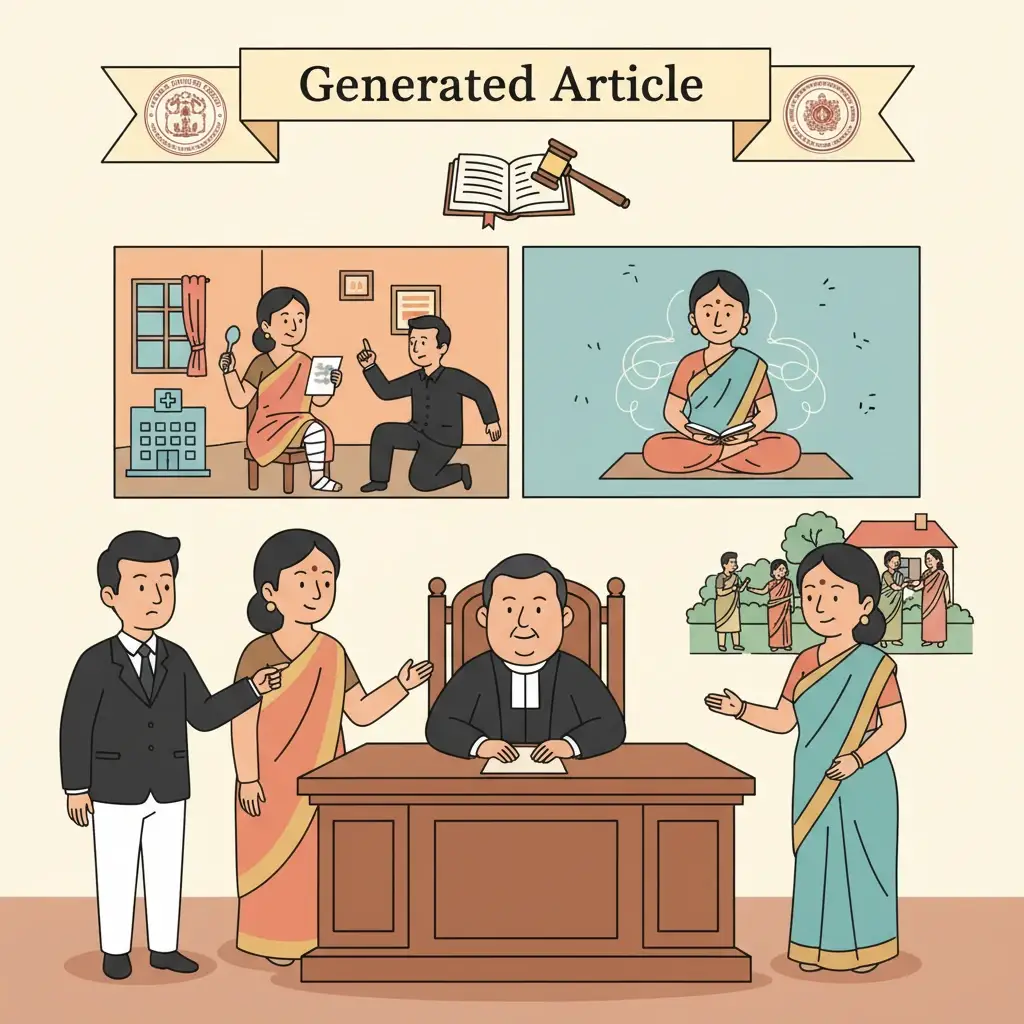
Case Background
The case arose from a matrimonial dispute between a husband and wife who married on 21.05.2005 at Akbarpur, District Nawada, according to Hindu rites and ceremonies.
After marriage, the couple started living together in a rented house in Kolkata. According to the husband, they lived together for about one year and eleven months.
The husband later filed Matrimonial Case No. 52 of 2010 before the District and Sessions Judge, Alipore (West Bengal), seeking a decree of divorce under Section 13(1)(ia) and (ib) of the Hindu Marriage Act, 1955, mainly on the grounds of mental disorder (schizophrenia), physical disability and desertion by the wife.
The Hon’ble Supreme Court, by order dated 02.10.2012 in Transfer Petition (Civil) No. 278 of 2011, transferred the matrimonial case from Alipore to the Family Court, Nawada.
After trial, the Principal Judge, Family Court, Nawada dismissed the husband’s divorce suit by judgment dated 22.11.2018 and decree dated 04.12.2018 in Matrimonial Case No. 52 of 2010 (15 of 2013). The Family Court held that the husband failed to prove cruelty, desertion, mental illness or leg disability on the part of the wife.
Aggrieved by this dismissal, the husband filed Miscellaneous Appeal No. 1152 of 2018 before the Patna High Court under Section 19 of the Family Courts Act, 1984.
On 15.10.2019, a Coordinate Bench of the Patna High Court gave both parties an opportunity to attempt an amicable settlement through mediation. However, mediation failed, as no mutual agreement could be reached.
The appeal was heard and decided by a Division Bench of Hon’ble Mr. Justice P. B. Bajanthri and Hon’ble Mr. Justice Sunil Dutta Mishra, with the C.A.V. judgment delivered on 07.04.2025.
What the Court Examined and Decided
The Patna High Court closely examined the husband’s grounds for divorce, the wife’s defence, the evidence led before the Family Court, and the legal requirements under Section 13(1)(ia), (ib) and (iii) of the Hindu Marriage Act, 1955.
According to the husband, soon after marriage he noticed “abnormal behavior” in his wife’s attitude and movement. He claimed she was treated in the psychiatric department of Ramkrishna Mission Seva Pratisthan at Kolkata and was diagnosed with schizophrenia, a mental disorder. He further alleged that she had a permanent disability in her leg, could not move properly, and had physically attacked him several times without any reason.
The husband also alleged that the wife’s parents had concealed her mental disease and physical disability at the time of marriage. He claimed that the parties never lived together as normal husband and wife, and that the wife realised the “mistake” of her family, agreed to dissolve the marriage, and wrote two handwritten documents expressing her willingness to end the matrimonial tie.
He stated that on 26.11.2006, the wife’s mother and two relatives took the wife away from the matrimonial home along with all her belongings, and that since then she had been living at her parental home, having withdrawn from his society and deserted him with mala fide intention.
The wife, in her written statement, completely denied these allegations. She stated that the husband’s family had seen her twice before marriage—once at Akbarpur and again at Kolkata—and only then the marriage was solemnised. She specifically denied any mental illness or schizophrenia, or any aggressive behaviour towards the husband.
She described herself as a spiritual lady, denied ever using any knife, spoon or other weapon to harm the husband, and strongly refuted having executed any document relating to dissolution of marriage. She also denied having ever been counselled by a psychiatrist in connection with such documents and asserted that any such writing, if produced, would be false and fabricated.
The wife asserted that she had no disease, had lived with the husband as wife, and that there was no valid ground for the husband’s suit, which deserved dismissal with costs.
Before the Family Court, the husband examined two witnesses: his uncle, Nathun Shaw (P.W. 1), and himself, Sanjay Kumar Shaw (P.W. 2). The wife examined three witnesses: herself, Anjali Shaw (O.P.W. 1), her father, Bhola Prasad (O.P.W. 2), and one Shyam Sundar Shaw (O.P.W. 3). No documentary evidence was exhibited by either side—most crucially, no medical records or doctors’ evidence were produced by the husband.
The Family Court framed issues regarding maintainability, cause of action, cruelty, desertion, the wife’s right to refuse divorce, and the husband’s entitlement to relief. After appreciating the pleadings and evidence, the Family Court held that:
• the husband had failed to prove cruelty by the wife;
• there was no evidence of desertion by the wife;
• instead, it was the husband who had committed dowry torture and abandoned the wife; and
• no evidence showed schizophrenia, mental disorder, or leg disability.
Accordingly, the divorce petition was dismissed.
In appeal, counsel for the husband argued before the Patna High Court that the Family Court had failed to properly consider the oral statements of the wife and her father, and the fact that the couple had been living separately for about 12 years (later emphasised as more than 18 years since marriage in 2005), which, according to him, showed desertion and a marriage beyond repair.
He also complained that no specific issue had been framed regarding the alleged schizophrenia and that the impugned judgment was passed without exhibiting documents. He pressed that continued separation itself amounted to mental cruelty, and that there was concealment of the wife’s mental condition at the time of marriage.
On the other hand, counsel for the wife supported the Family Court’s judgment, stressing that the husband had not proved any mental disease, leg deficiency or cruelty. The wife maintained her willingness to live with the husband as before, and the fact that they had earlier resided together as husband and wife in Kolkata.
The Patna High Court first noted that although the husband had filed the petition under Section 13(1)(ia) and (ib) (cruelty and desertion), the main plank of his case was mental disease/disorder (schizophrenia) and permanent leg disability, allegedly making it impossible for him to continue the matrimonial life.
The Court specifically examined whether the wife was suffering from schizophrenia or other mental disorder of such a kind and to such an extent that the husband could not reasonably be expected to live with her, as required under Section 13(1)(iii).
On this, the Court agreed with the Family Court’s finding that the husband had failed to prove any such disease or disability. No doctor was examined. No medical report or psychiatric record from Ramkrishna Mission Seva Pratisthan was produced. The allegation that she was of unsound mind, aggressive, or had deserted him was not supported by material on record.
The Court reproduced Section 13(1)(ia), (ib) and (iii) of the Hindu Marriage Act and then relied on binding Supreme Court decisions. It cited Ram Narain Gupta v. Smt. Rameshwari Gupta, (1988) 4 SCC 247, where the Supreme Court held that mere existence of a mental disorder is not enough; the degree must be such that the other spouse cannot reasonably be expected to live with the afflicted partner. All mental abnormalities do not justify divorce.
The Court also noted the Calcutta High Court’s view in Smt. Rita Roy v. Sitesh Chandra (AIR 1982 Cal 138) that, under Section 13(1)(iii), two elements are necessary: unsoundness of mind or mental disorder, and that such illness is of such kind and extent that the other spouse cannot reasonably be expected to live with the person. Only one of these is insufficient to grant a decree.
The Supreme Court’s decision in Kollam Chandra Sekhar v. Kollam Padma Latha, (2014) 1 SCC 225, reiterating these principles, was also referred to, as well as Vinita Saxena v. Pankaj Pandit, (2006) 3 SCC 778. The judgments emphasised that medical evidence is crucial, the illness must be serious, and even schizophrenia, if controlled with treatment and supported socially, does not automatically justify divorce.
On this legal foundation, the Patna High Court held that a spouse seeking divorce on mental illness must prove by cogent evidence, including medical reports, that the other spouse is suffering from a serious mental disorder of such a level that marital life is no longer reasonably possible.
In this case, the husband had only made bald allegations. He did not produce any medical documentary evidence or call the treating doctor. The claim of leg disability was contradicted by the wife’s free movement before the Family Court. The Court further noted that no specific, clear plea of cruelty was made—only vague allegations, which cannot form a legal ground for divorce.
The Court also recorded the Family Court’s finding that the husband himself had abandoned the wife and committed dowry torture and observed that he cannot take advantage of his own wrong to obtain divorce.
After examining the entire evidence and legal position, the Patna High Court concluded that there was no perversity in the Family Court’s findings. The husband had failed to establish schizophrenia of such kind and degree as required under Section 13(1)(iii), and had also not proved cruelty or desertion under Section 13(1)(ia) and (ib).
Accordingly, the Court held that there was no merit in the appeal and dismissed it, affirming the judgment and decree of the Family Court, Nawada.
Why This Judgment Matters
This judgment reinforces that divorce on the ground of mental illness is not granted lightly. Mere suspicion, family disputes, or unverified claims of “abnormal behavior” are not enough.
The Patna High Court has made it clear that a spouse alleging schizophrenia or any mental disorder must bring strong medical evidence and, where possible, examine doctors. Oral statements alone will not suffice.
It also highlights that long separation, by itself, does not automatically justify divorce if the party seeking divorce is at fault or cannot prove legal grounds like cruelty and desertion.
For spouses facing false allegations of mental illness, the judgment is a reassurance that courts will demand proof and will not allow one party to take advantage of their own wrongdoing or abandonment.
Legal Issues and Answers
- Issue: Did the husband prove that the wife was suffering from schizophrenia or mental disorder, or leg disability, of such a kind and extent that he could not reasonably be expected to live with her under Section 13(1)(iii) of the Hindu Marriage Act?
Answer: No. The Court held that there was no medical or documentary evidence, no doctor was examined, and the wife’s alleged illness and disability were not proved. - Issue: Did the husband establish cruelty and desertion by the wife under Section 13(1)(ia) and (ib) of the Act?
Answer: No. The Court found that cruelty and desertion were not proved; instead, the husband was found to have abandoned the wife and could not take advantage of his own wrong. - Issue: Was there any ground to interfere with the Family Court’s dismissal of the divorce petition?
Answer: No. The Patna High Court held that the Family Court’s findings were just, proper, legal, and did not suffer from perversity, so the appeal was dismissed.
Cases Cited by the Court
- Ram Narain Gupta v. Smt. Rameshwari Gupta, (1988) 4 SCC 247
- Smt. Rita Roy v. Sitesh Chandra, AIR 1982 Cal 138
- Kollam Chandra Sekhar v. Kollam Padma Latha, (2014) 1 SCC 225
- Vinita Saxena v. Pankaj Pandit, (2006) 3 SCC 778
Case Details
Case Number: Miscellaneous Appeal No. 1152 of 2018
Case Title: Sanjay Kumar Shaw v. Smt. Anjali Kumari Shaw
Citation: 2025 (2) PLJR 753
Court: High Court of Judicature at Patna
Coram: Hon’ble Mr. Justice P. B. Bajanthri; Hon’ble Mr. Justice Sunil Dutta Mishra
Date of Judgment: 07.04.2025
CAV Date: 18.02.2025
For the Appellant (husband): Mr. Surendra Kishore Thakur, Advocate; Mr. Sanjay Kumar Sinha, Advocate
For the Respondent (wife): Mr. Satish Chandra, Advocate
Nature of the Case: Miscellaneous Appeal under Section 19 of the Family Courts Act, 1984, challenging dismissal of a divorce petition under Section 13(1)(ia) and (ib) of the Hindu Marriage Act, 1955, by the Principal Judge, Family Court, Nawada, in Matrimonial Case No. 52 of 2010 (15 of 2013).
Impugned Order: Judgment dated 22.11.2018 and decree dated 04.12.2018 of the Principal Judge, Family Court, Nawada, dismissing the husband’s divorce suit.
Link to Judgment: https://patnahighcourt.gov.in/viewjudgment/MiMxMTUyIzIwMTgjMSNO-CPYUVbVMS8k=
If you found this explanation helpful and wish to stay informed about
how legal developments may affect your rights in Bihar,
you may consider following Samvida Law Associates for more updates.







