
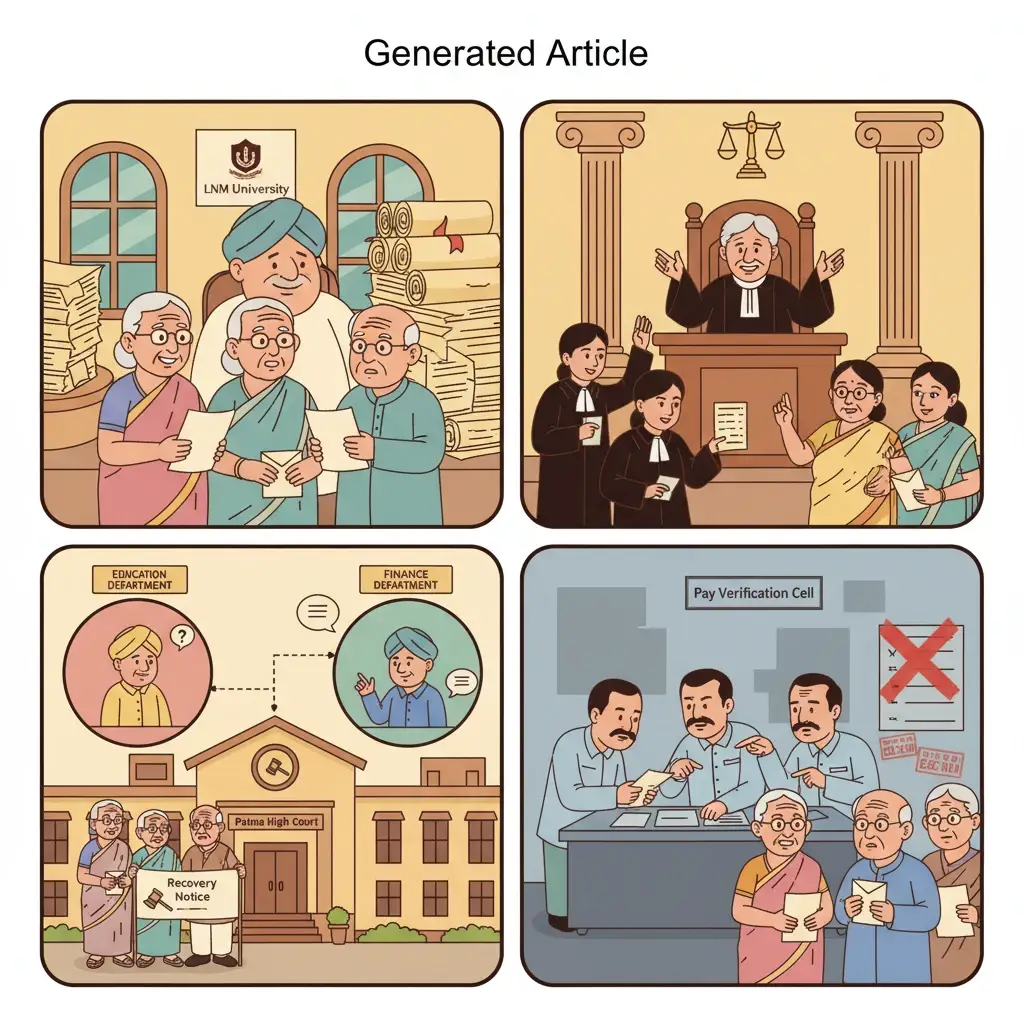
Case Background
The writ petitions were filed by retired non-teaching employees of Lalit Narayan Mithila University and its constituent college, G.D. College, Begusarai. They had served as Office Assistants, Accounts Assistants, Head Assistants and in similar posts.
After superannuation, they were initially granted pension and other retiral benefits based on higher pay scales. These included the benefits of the Assured Career Progression Scheme (ACP), Modified Assured Career Progression (MACP) and the 6th Pay Commission scales.
In line with the Supreme Court’s judgment in State of Bihar and Another v. Sunny Prakash and Others, (2013) 3 SCC 559, they were given the pay scale of Rs. 5500-9000 with effect from 01.01.1996, as well as 1st and 2nd ACP benefits, and later the revised scale of Rs. 15,600-39,100 with Grade Pay of Rs. 6600 from 01.01.2006. Their pensions were fixed on that basis and partial arrears were paid.
However, after some time, their pay fixation and corresponding pension were unilaterally reduced. The University and the State authorities, relying on the Pay Verification Cell, removed the 2nd ACP benefit and dropped them to the lower pay scale of Rs. 9300-34,800 with Grade Pay of Rs. 4600 from 01.01.2006. Orders for recovery of alleged excess payments were also issued.
Feeling aggrieved, the retirees approached the Patna High Court under Article 226 of the Constitution. They sought directions for restoration of full pension and retiral benefits on the earlier higher scales, implementation of the ACP and 6th Pay Scale benefits in full, payment of Group Insurance and deferred Dearness Allowance (DA) with interest, and quashing of recovery orders.
What the Court Examined and Decided
The core issue before the Patna High Court was whether the amended provisions of the ACP Rules, 2003, which apply to State Government employees, also apply to non-teaching employees of Bihar State Universities and their constituent colleges, including the petitioners. Connected to this was the question of legality of slashing down their pay scales and pensions and recovering alleged excess amounts.
The Court first traced the service profile of the petitioners as presented by the State. They were initially appointed as Lower Division Clerks in the pay scale of Rs. 260-408, promoted to Upper Division Clerks in the scale of Rs. 348-570, then granted 1st Time Bound Promotion to Rs. 505-665 (revised to Rs. 850-1360 from 01.01.1981) and 2nd Time Bound Promotion to Rs. 880-1510 (revised to Rs. 1640-2900 from 01.01.1986).
After ACP Rules, 2003 came into force, they were granted ACP benefits with effect from 09.08.1999 and, following the Sunny Prakash ruling, placed in the Rs. 5500-9000 scale from 01.01.1996. Later, they obtained 1st ACP in Rs. 6500-10500 on 09.08.1999, 2nd ACP in Rs. 10000-15200 also w.e.f. 09.08.1999 (after amendments), and finally Rs. 15,600-39,100 with Grade Pay Rs. 6600 from 01.01.2006.
The State’s stand was that these employees had effectively enjoyed four financial upgradations (promotions and ACPs) in their careers, which was said to be impermissible because non-teaching staff are to have only three financial upgradations: ACP-I, ACP-II and MACP. On that basis, the University approached the Pay Verification Cell and requested correction of earlier pay slips, citing Clause 3 of the ACP Rules and Statute-I notified by the Chancellor on 04.03.2014.
The Pay Verification Cell then revised its earlier certificates, reducing the pay scale to Rs. 9300-34,800 with Grade Pay Rs. 4600 from 01.01.2006, which led to the reduction of pension and issuance of recovery orders. The Education Department also sought an opinion from the Finance Department on whether petitioners could be given the higher scale of Rs. 10,000-15,200 after 1st ACP, similar to State Secretariat Assistants.
The Finance Department opined that amendments in ACP Rules, 2003 for State Government employees are not automatically applicable to University employees. It advised that the matter be governed by Statute-I notified on 04.03.2014 by the Chancellor. The Education Department, bound by that opinion, directed the University to proceed accordingly and communicated this to the petitioners.
The petitioners, on the other hand, argued that University Assistants have always been treated as equivalent to Secretariat Assistants. They relied on Government letter no. 123/C dated 25.02.1987 declaring non-teaching staff of Universities and Constituent Colleges equivalent to Government staff, a letter that was also noticed in the Sunny Prakash case. They placed a comparative chart showing identical pay scales between Secretariat Assistants and University Assistants from 1973 up to the 4th Pay Commission, and pointed out that the gap created in the 5th Pay Commission was later bridged by court orders culminating in the Supreme Court’s decision in Sunny Prakash.
The Court examined this history in detail. It noted that the State had entered into a written agreement with the College Employees’ Federation on 18.07.2007, accepting multiple demands including parity of pay scales, merger of DA, ACP facilities, and the Rs. 5500-9000 scale for Assistants in colleges and universities. That agreement was later enforced by a Division Bench of the Patna High Court in CWJC No. 10870 of 2008 by directing the Chief Secretary to implement it within one month.
The Supreme Court, in Civil Appeal No. 516 of 2013 (Sunny Prakash), upheld this order and directed the State of Bihar to implement the High Court’s decision within three months. The Supreme Court held that commitments made by the State must be honoured, that communications from higher State officers could not be ignored simply due to Article 166 technicalities, and that the agreement had to be implemented.
The Patna High Court then turned to the ACP Rules, 2003 and their amendments. It noted that in 2006, by notification no. 1802 dated 23.03.2006, Clause 3(1) was deleted and a clarification inserted that merger of scales would not be treated as promotion, meaning an employee could still get ACP even after a merger. Time Bound or Selection Grade promotions prior to 01.01.1996 were also clarified as not counting as financial upgradations.
In 2008, by notification no. 769 dated 28.01.2008, the Rules were further amended to state that when promotional avenues exist, ACP should give the scale of the promotional post rather than a pre-fixed schedule scale. The Court noted that in the University system, Assistants can be promoted to Section Officer and then to Assistant Registrar, with a scale of Rs. 15,600-39,100 plus Grade Pay Rs. 6600, which explained why that scale was earlier correctly granted to the petitioners.
The Court emphasised that these amendments were made under the proviso to Article 309 of the Constitution and were intended to make ACP more workable and beneficial. Importantly, they were made effective from 09.08.1999, the very date ACP Rules, 2003 came into force.
Against this backdrop, the Court questioned the State’s stand that these amendments would not apply to University staff unless separately ordered. It observed that when the State had already decided in 1987 to treat non-teaching University staff equivalent to Government staff, and later agreed in 2007 to extend ACP benefits to them as per ACP Rules, 2003 (which by then had already been amended in 2006), it could not subsequently use a 2014 Statute to deny the benefit of those amendments.
The Court held that any later notification or Statute that effectively ran contrary to the ACP Rules, 2003 and their amendments, or undermined the agreement enforced in Sunny Prakash, would be invalid to that extent. The rights that had vested in University staff under ACP/MACP from 2003 and under amendments of 2006 and 2008, effective from 09.08.1999, could not be retrospectively taken away by Statute-I notified on 04.03.2014.
The Court clearly rejected the Finance Department’s view that ACP amendments do not “automatically” apply to University employees. It held that ACP Rules, 2003 with all amendments framed for State Government employees are also applicable to non-teaching University and constituent college employees. Therefore, the petitioners were entitled to all benefits flowing from the amended rules and their financial consequences.
On the issue of the Pay Verification Cell’s role, the Court referred to earlier decisions, including Kedar Nath Pandey v. Magadh University, and reiterated that the Pay Verification Cell cannot annul or unilaterally modify pay-fixation notifications issued by the University. Its objections function as audit objections only. The proper course is: the Cell raises objections, the University issues notice to affected employees, seeks their response, and then takes a final decision. The Cell itself has no power to directly downgrade pay scales or pensions.
Regarding Group Insurance and deferred DA, the Court noted a consistent line of decisions where retirees had been granted 12.5% interest on Group Insurance amounts and 9% on deferred DA, particularly for those who retired before a Syndicate decision dated 22.09.2018. It referred to cases such as CWJC No. 349 of 2021 (Bina Rai), CWJC No. 18678 of 2018 (Chitra Mullick), CWJC No. 4666 of 2018 (Laxmi Devi), and CWJC No. 8700 of 2017 (Dr. Moti Lal Yadav), where such reliefs were granted and accepted without challenge.
The Court stressed that there must be uniformity in granting these benefits and that denial of similar interest to similarly placed retirees would violate Article 14. It also quoted from the Dr. Moti Lal Yadav judgment, where a Coordinate Bench had warned that repeated non-compliance with settled modalities for leave encashment and Group Insurance interest could invite suo motu contempt.
On the question of recovery of alleged excess payments from retirees, the petitioners had relied on State of Punjab v. Rafiq Masih, (2015) 4 SCC 334, where the Supreme Court laid down limits on recoveries from employees and retirees who were not at fault. Although the present judgment does not detail Rafiq Masih’s principles, the Court, in light of its findings, held that the recovery orders against these petitioners were unsustainable.
After examining all materials, the High Court allowed the batch of writ petitions. It directed the University to refix the petitioners’ pensions and other benefits by applying the amended ACP/MACP Rules in full, restore the higher pay scales, pay 12.5% interest on Group Insurance amounts, and 9% interest on deferred DA.
All recovery orders and reductions in pay scale made against the petitioners were declared invalid and stood cancelled. All interlocutory applications were disposed of. The Court also fixed a clear timeline: all calculations to be completed within three months from receipt/production of the order, and consequential payments to be made within a further two months, after verification by the Pay Verification Cell.
Why This Judgment Matters
This judgment is important for thousands of non-teaching employees and retirees of Bihar State Universities and their constituent colleges. It confirms that when the State has officially treated them as equivalent to Government staff and promised ACP benefits, it must also extend later beneficial amendments of those rules.
The ruling stops the practice of quietly cutting down pension and retiral benefits years after retirement by reinterpreting ACP provisions and counting earlier mergers or time bound promotions as “extra” upgradations. For retired employees, such post-retirement reductions and recoveries can cause serious financial and emotional distress. The Court’s decision protects them from such arbitrary actions.
It also reiterates that the Pay Verification Cell is an audit mechanism, not a parallel authority that can overrule University decisions on pay fixation. Universities must follow proper procedure, including notice and reasoning, before altering employees’ pay or pension.
On interest for Group Insurance and deferred DA, the judgment reinforces an existing judicial line: similarly placed retirees should receive 12.5% on Group Insurance and 9% on deferred DA, and authorities cannot pick and choose whom to pay. This brings clarity and uniform treatment across cases.
Legal Issues and Answers
- Issue: Are the amended ACP Rules, 2003 (including 2006 and 2008 amendments) applicable to non-teaching employees of Bihar Universities and constituent colleges, such as the petitioners?
Answer: Yes. The Court held that once the State decided to treat non-teaching University staff equivalent to Government staff and extended ACP benefits under ACP Rules, 2003, the later amendments also apply to them, and their benefits cannot be denied by relying on Statute-I of 2014. - Issue: Could the State, University and Pay Verification Cell lawfully slash the petitioners’ pay scales, reduce their pensions by withdrawing 2nd ACP benefits, and order recovery of alleged excess payments?
Answer: No. The Court held that the Pay Verification Cell has no power to unilaterally modify University pay-fixation; any such recovery and downgrade, made contrary to ACP amendments and the binding Sunny Prakash decision, is unsustainable and stands cancelled. - Issue: Are the petitioners entitled to interest on Group Insurance and deferred DA, and at what rates?
Answer: Yes. Consistent with earlier unchallenged decisions, the Court directed payment of 12.5% interest on Group Insurance amounts and 9% interest on deferred DA to the petitioners.
Cases Cited by the Court
- State of Bihar and Another v. Sunny Prakash and Others, (2013) 3 SCC 559 (Civil Appeal No. 516 of 2013)
- Som Prakash Rekhi v. Union of India & Another, 1981 (1) SCC 449
- Balram Gupta v. Union of India and Another, AIR 1987 SC 2354
- Bhupendra Nath Hazarika and Another v. State of Assam and Others, 2013 (2) SCC 516
- State of Haryana & Others v. Piara Singh & Others, 1992 (4) SCC 118
- State of Punjab & Others v. Rafiq Masih, (2015) 4 SCC 334
- CWJC No. 10870 of 2008 (Patna High Court order dated 07.08.2008, referred in Sunny Prakash)
- CWJC No. 4722 of 2020 and LPA No. 410 of 2021 (Indranath Jha v. State of Bihar & Others, referred)
- CWJC No. 14582 of 2018 (Patna High Court, order dated 25.09.2018, referred)
- CWJC No. 349 of 2021 (Bina Rai)
- CWJC No. 18678 of 2018 (Chitra Mullick)
- CWJC No. 4666 of 2018 (Laxmi Devi)
- CWJC No. 8700 of 2017 (Dr. Moti Lal Yadav v. State of Bihar & Others)
- CWJC No. 11219 of 2011 (order dated 31.08.2015) and LPA No. 1253 of 2016 (order dated 11.01.2018), referred
- CWJC No. 7636 of 2014 (Kedar Nath Pandey & Others v. Magadh University & Others)
- CWJC No. 2466 of 2019 (order dated 08.07.2021), referred
Case Details
Case Numbers: Civil Writ Jurisdiction Case No. 22953 of 2018; with CWJC No. 13402 of 2018; CWJC No. 15132 of 2018; CWJC No. 17468 of 2018; CWJC No. 18073 of 2018
Case Title: Bimal Kumar Bimal v. The State of Bihar & Others (lead case) with connected petitions by Arvind Prasad Singh, Murli Manohar Prasad Singh, Kumud Kishore Prasad and Umesh Prasad Choudhary v. The State of Bihar & Others
Court: High Court of Judicature at Patna
Coram: Hon’ble Mr. Justice Harish Kumar
Date of Judgment: 18-10-2024
Citation: 2025 (2) PLJR 670
Advocates (as recorded):
In CWJC No. 22953 of 2018:
For the petitioner: Mr. Hari Shankar Roy, Advocate; Mr. B. Mishra, Advocate; Ms. Tanuja Kumari Mishra, Advocate; Mr. Utkarsh Bhushan, Advocate.
For the State/respondents: Mr. Hitesh Suman, AC to SC-13.
For the University: Mr. Nadim Seraj, Advocate; Mr. Iqbal Asif Niazi, Advocate.
In CWJC No. 13402 of 2018:
For the petitioner: Mr. Shashi Bhushan Singh, Advocate; Mr. Bipin Kumar, Advocate.
For the State/respondents: AC to GA-12.
In CWJC No. 15132 of 2018:
For the petitioner: Mr. Shashi Bhushan Singh, Advocate.
For the State/respondents: Mr. Madanjeet Kumar, GP-20; Mr. Rajeev Ranjan, AC to GP-20.
For the University: Mr. Nadim Seraj, Advocate.
In CWJC No. 17468 of 2018:
For the petitioner: Mr. Shashi Bhushan Singh, Advocate.
For the State/respondents: Mr. Madhaw Prasad Yadaw, GP-23.
For the University: Mr. Nadim Seraj, Advocate; Mr. Iqbal Asif Niazi, Advocate.
In CWJC No. 18073 of 2018:
For the petitioner: Mr. Shashi Bhushan Singh, Advocate.
For the State/respondents: Mr. Jitendra Kr. Roy-1, SC-13; Mr. U. K. Singh, AC to SC-13.
Nature of the Case: Batch of writ petitions under Article 226 of the Constitution of India challenging reduction of pay scales and pension, denial of full ACP/MACP and 6th Pay benefits, non-payment of Group Insurance and deferred DA with interest, and recovery of alleged excess payments, by retired non-teaching employees of a State University and its constituent college.
Link to Judgment: https://patnahighcourt.gov.in/viewjudgment/MTUjMjI5NTMjMjAxOCMxI04=-SFyHyJ–ak1–2gXU=
If you found this explanation helpful and wish to stay informed about how legal developments may affect your rights in Bihar, you may consider following Samvida Law Associates for more updates.







