
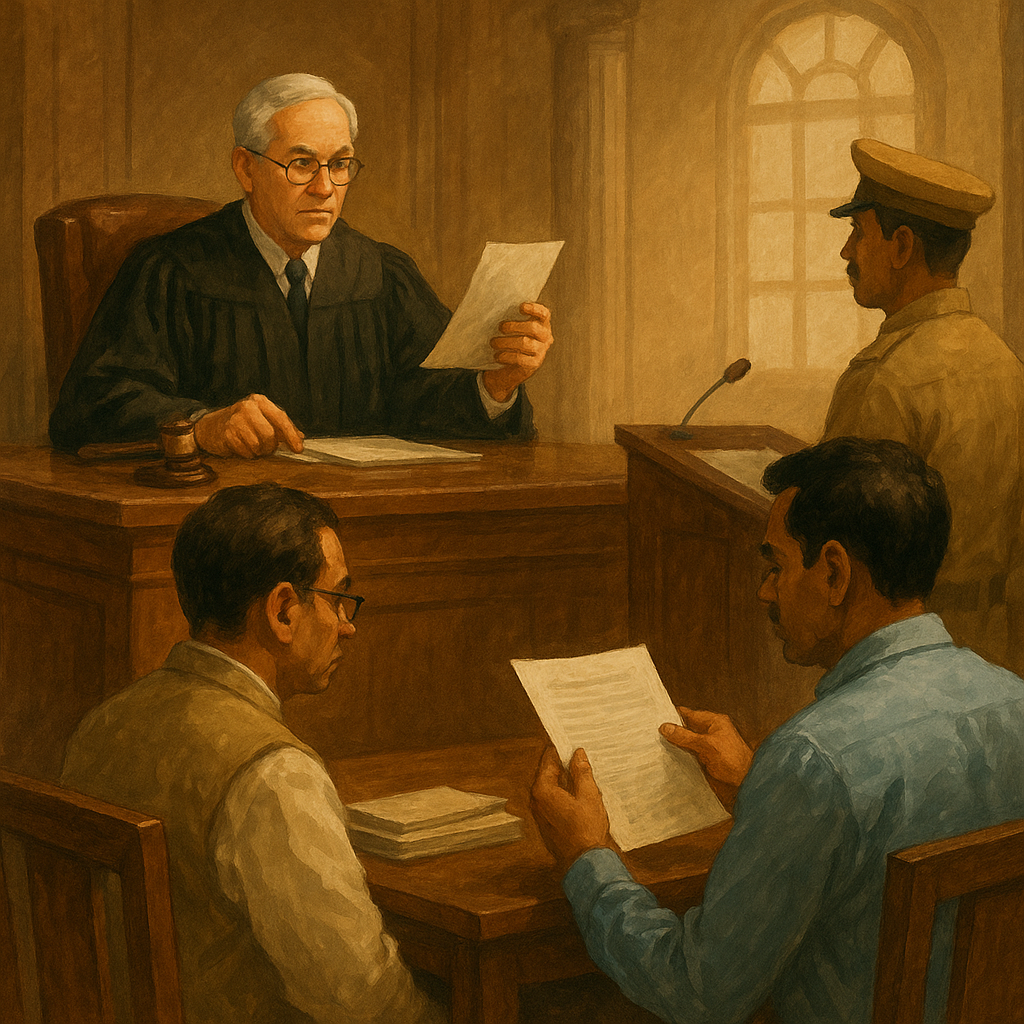
The Patna High Court, in a landmark judgment dated 11 October 2022, delivered by a Division Bench comprising Hon’ble Mr. Justice Ashwani Kumar Singh and Hon’ble Mr. Justice Shailendra Singh, addressed a batch of over a dozen writ petitions filed by contractors from different districts of Bihar. The petitioners had challenged the cancellation of their selection as district-level contractors under the Pradhan Mantri Poshan Yojana (formerly Mid-Day Meal Scheme).
The case is significant because it exposed widespread procedural lapses and arbitrary cancellations made by district authorities and the State Education Department, despite the petitioners having been duly selected and, in many cases, having completed the necessary formalities to begin work.
Simplified Explanation of the Judgment
The petitioners—contractors from various districts including Munger, East Champaran, Jamui, Kaimur, Gaya, Vaishali, Purnea, Samastipur, and others—had participated in tenders invited by the respective District-Level Contractor Selection Committees under the Pradhan Mantri Poshan Yojana, a flagship government scheme for providing nutritious meals to school children.
After undergoing scrutiny and evaluation, the petitioners were declared successful contractors. Many of them even received letters of intent or provisional work orders to supply and distribute mid-day meals in schools. However, to their shock, the State Education Department later issued directions to cancel these selections, alleging irregularities and procedural lapses at the district level.
The petitioners contended before the High Court that they were not given any notice or opportunity to respond before their selections were cancelled. They argued that such unilateral cancellations, without hearing them, were illegal, arbitrary, and violated the principles of natural justice. Furthermore, they maintained that the allegations of irregularity were vague and not supported by any inquiry report or evidence.
The State of Bihar, on the other hand, defended its action by saying that an internal departmental review revealed large-scale inconsistencies in how different district committees had finalized contractor selections. The State claimed that to ensure uniformity and transparency, it decided to cancel all the selections across Bihar and start the tender process afresh.
However, the Court found that this “blanket cancellation” affected numerous contractors who had lawfully completed the process and had legitimate expectations to commence work under the scheme.
The Court’s Observations
The Patna High Court carefully examined the documents and noted that the District-Level Contractor Selection Committees had carried out the tender process under duly issued guidelines. The State could not point out any concrete instance of fraud, corruption, or mala fide intent in the selection of the petitioners.
The Bench observed that the State’s justification—of “procedural irregularities” or “need for transparency”—was too vague to justify setting aside the entire tender process. Administrative actions that carry civil consequences, such as cancellation of a work contract or denial of a selected position, must be based on specific reasons and must follow due process.
The Court held that while the government has wide powers to regulate public contracts, those powers must be exercised reasonably, fairly, and transparently. Citing the landmark principles laid down in Tata Cellular v. Union of India (1994) 6 SCC 651, the Court emphasized that judicial review in contractual matters is limited to testing the decision-making process, but when that process is arbitrary or discriminatory, courts can and must intervene.
The Bench also referred to the doctrine of legitimate expectation, holding that once a bidder or contractor is selected after a transparent process and fulfills all financial and legal obligations, he acquires a reasonable expectation of being allowed to perform the contract unless strong public interest justifies otherwise.
Further, the Court found that no notice or opportunity of hearing was given to the contractors before their selections were cancelled. This amounted to a direct violation of the principles of natural justice, as enunciated in Dharampal Satyapal Ltd. v. Deputy Commissioner of Central Excise (2015) 8 SCC 519.
The Bench criticized the State’s approach of issuing general circulars or directives to cancel selections across all districts without verifying facts on a case-by-case basis. The judges remarked that such collective punishment undermines administrative fairness and shakes public faith in government tenders.
The Court’s Decision
After considering all submissions, the Patna High Court allowed the batch of writ petitions, setting aside the cancellation of contractor selections under the Pradhan Mantri Poshan Yojana across multiple districts.
The Court directed that:
- The selections made by the respective District-Level Contractor Selection Committees shall be treated as valid and subsisting.
- The State Government and its departments shall not cancel or interfere with these selections without issuing individual show cause notices and giving contractors an opportunity to be heard.
- The State may conduct district-specific inquiries if any concrete complaint of irregularity arises, but it cannot scrap the entire selection process for all districts in the name of “uniformity.”
- The government must ensure that future tender processes follow the due procedure and maintain transparency at every stage to avoid such disputes.
The Court thus reaffirmed the core administrative principle that “fairness in action is the soul of governance.”
Significance or Implication of the Judgment
This judgment has wide-reaching implications for Bihar’s administrative and procurement practices:
- Reinforcement of Natural Justice: The decision reiterates that no person can be deprived of a vested or legitimate right without being heard. Even in government contract matters, procedural fairness is essential.
- Accountability in Government Tenders: The ruling prevents departments from arbitrarily cancelling valid tenders on vague grounds like “procedural irregularity.” Each case must be examined on its own merits.
- Safeguard for Local Contractors: For small and medium contractors engaged in government welfare schemes like the Mid-Day Meal, the judgment provides strong protection against arbitrary administrative decisions that can destroy livelihoods.
- Administrative Consistency: The Court has made it clear that while uniformity and transparency are desirable, they cannot come at the cost of fairness and due process.
- Judicial Oversight in Welfare Schemes: The decision strengthens the role of the judiciary in ensuring that welfare schemes like the Pradhan Mantri Poshan Yojana are implemented lawfully and without bias.
Legal Issues Decided and the Court’s Reasoning
- Whether the State could cancel all district-level selections under the scheme citing procedural irregularities?
- Decision: No. Blanket cancellation without specific findings is arbitrary. Each case must be examined individually.
- Whether the contractors were entitled to a hearing before cancellation?
- Decision: Yes. Since the cancellation had civil consequences and affected livelihood, notice and hearing were mandatory.
- Whether the doctrine of legitimate expectation applied to selected contractors?
- Decision: Yes. Once selected through a transparent process, contractors gain a legitimate expectation to perform the work.
- Whether the government’s action was violative of Article 14 (right to equality)?
- Decision: Yes. The arbitrary and non-transparent cancellation discriminated against lawfully selected contractors.
Judgments Referred by Parties
- Tata Cellular v. Union of India, (1994) 6 SCC 651
- Dharampal Satyapal Ltd. v. Deputy Commissioner of Central Excise, (2015) 8 SCC 519
- State of Bihar v. Project Uchcha Vidyalaya Shikshak Sangh, (2006) 2 SCC 545 (on fairness in administrative decisions)
Judgments Relied Upon or Cited by Court
- Tata Cellular v. Union of India, (1994) 6 SCC 651
- Dharampal Satyapal Ltd. v. Deputy Commissioner of Central Excise, (2015) 8 SCC 519
- Union of India v. Hindustan Development Corporation, (1993) 3 SCC 499 (on legitimate expectation)
Case Title
Mithilesh Kumar Yadav & Ors. v. State of Bihar & Ors. (along with connected cases)
Case Number
CWJC No. 8807 of 2022 (with CWJC Nos. 6489, 7281, 8177, 8595, 8875, 8942, 8945, 8976, 9203, 9650, 9704, 9921, and 9972 of 2022)
Citation(s)
2023 (1) PLJR 47
Coram and Names of Judges
Hon’ble Mr. Justice Ashwani Kumar Singh
Hon’ble Mr. Justice Shailendra Singh
Names of Advocates and who they appeared for
- For Petitioners: Mr. Y.V. Giri, Sr. Advocate; Mr. Pranav Kumar, Ms. Shrishti Singh, Mr. Sumit Kumar, and other advocates across connected cases.
- For the State: Mr. Vikash Kumar (SC-11), Mr. Madanjeet Kumar (GP-20), and various Government Pleaders in different districts.
Link to Judgment
MTUjODgwNyMyMDIyIzEjTg==-lzDwEvV–am1–pw0=
If you found this explanation helpful and wish to stay informed about how legal developments may affect your rights in Bihar, you may consider following Samvida Law Associates for more updates.







