
Case Background
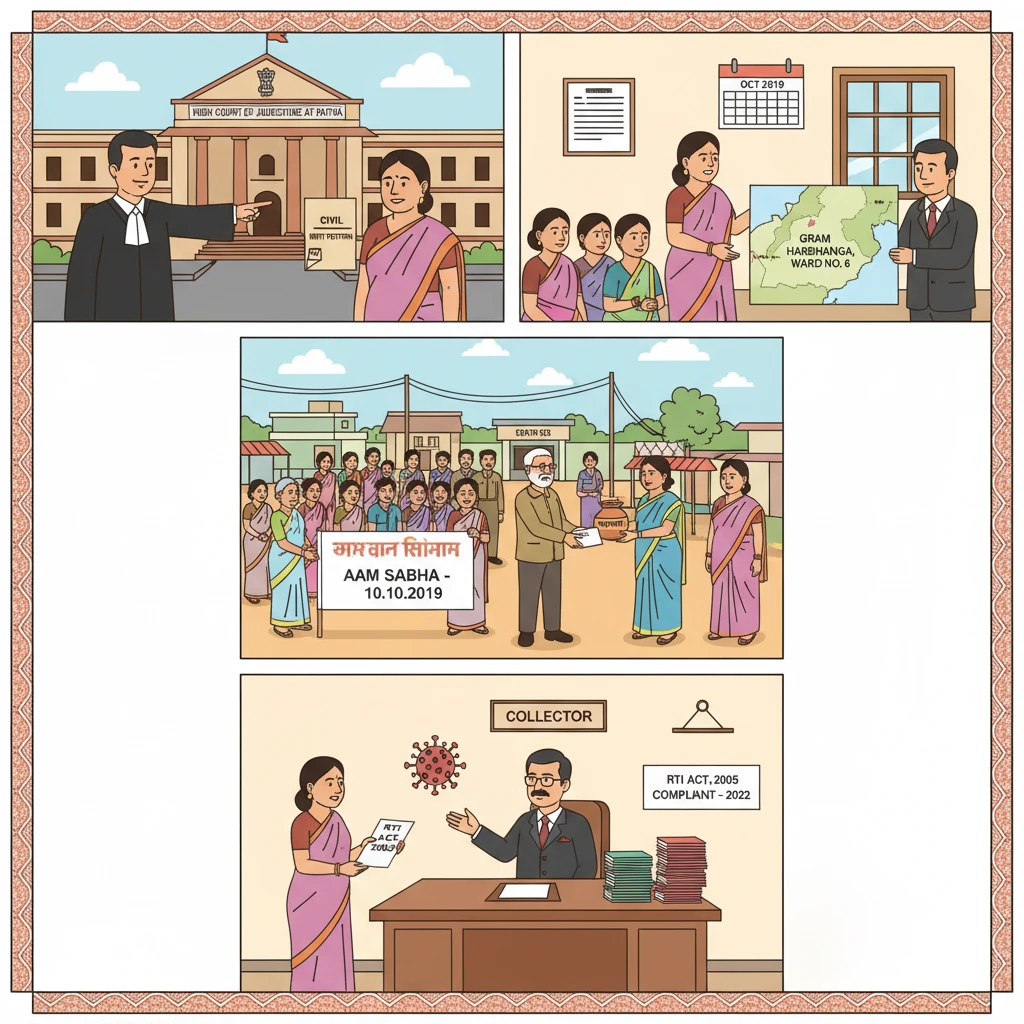
The matter arose from the selection of an Anganwadi Sevika for Gram Harbhanga, Panchayat Deep East, Ward No. 6, Anganwadi Centre No. 181 in Madhubani district.
An advertisement for selection of Anganwadi Sevika was published on 13.06.2018. The petitioner and others applied pursuant to this advertisement. As per the guideline, the majority class of the Centre was of Extremely Backward Caste.
For the actual selection, an Aam Sabha (general meeting) was to be held. A public notice was circulated on 10.10.2019 for holding this Aam Sabha at 11:00 AM on the same day at a public place for selection of Anganwadi Sevika/Sahayika. The petitioner signed and acknowledged this notice.
According to the State, the Aam Sabha was held on 10.10.2019, and respondent no. 6 was selected as Anganwadi Sevika. On the same date, a selection letter was issued in favour of respondent no. 6. The first amount of “पोषाहार” was transferred to the concerned Anganwadi on 28.01.2020.
The petitioner later challenged this selection. She did not immediately approach the authorities. She stated that due to the outbreak of the COVID-19 pandemic, she could not go to the Child Development Project Officer (CDPO) or the District Programme Officer (DPO). After normalcy returned, in 2022, she filed a complaint before the District Collector, Madhubani.
The Collector referred her complaint to the District Programme Officer, Madhubani. The complaint was registered as Anganwari Miscellaneous Case No. 29 of 2022. After hearing the parties and examining the records, the District Programme Officer held that the selection of respondent no. 6 was illegal and cancelled it.
Respondent no. 6 then filed Anganwari Appeal Case No. 106 of 2023 before the Collector-cum-District Magistrate, Madhubani, challenging the DPO’s cancellation order dated 26.09.2023. The petitioner appeared in that appeal and filed a detailed reply.
By order dated 27.08.2024, the Collector allowed the appeal, set aside the DPO’s order, and upheld the selection of respondent no. 6. Aggrieved, the petitioner approached the Patna High Court in Civil Writ Jurisdiction Case No. 19143 of 2024, challenging the Collector’s order.
What the Court Examined and Decided
The Patna High Court, through Hon’ble Mr. Justice Harish Kumar, heard both sides and examined the Collector’s order passed in Anganwari Appeal Case No. 106 of 2023.
The petitioner’s counsel argued that the selection process itself was flawed. He submitted that the public notice dated 10.10.2019 did not mention the specific place where the Aam Sabha was to be held. Because of this, although the petitioner signed the notice, she could not locate the venue and was thus unable to attend.
He further contended that, in reality, no Aam Sabha was actually held on 10.10.2019 and that the selection of respondent no. 6 was done surreptitiously. The petitioner claimed she later obtained, under the Right to Information Act, 2005, a copy of the proceedings of the Aam Sabha, placed on record as Annexure P/2. According to her, this proceeding did not refer to the notice dated 01.10.2019 which the Collector mentioned in the impugned order.
The petitioner’s counsel attacked the Collector’s order as illegal and without application of mind, alleging it was based on erroneous facts. He also argued that the guidelines governing selection of Anganwadi Sevika/Sahayika clearly require that the Aam Sabha be held at a fixed time and date at a specified public place. He maintained that this requirement was not followed and that the Collector failed to address this issue.
On the other side, the State’s counsel pointed the Court to the reasoning contained in the Collector’s order, annexed as Annexure P/1. He submitted that the Collector had considered each and every contention of the petitioner.
The State highlighted that the CDPO, Lakhnaur, by Office Order No. 391 dated 01.10.2019, had fixed the date of the Aam Sabha as 10.10.2019. It was undisputed that the petitioner acknowledged the notice on 10.10.2019 but did not attend the Aam Sabha.
Regarding the petitioner’s reliance on the Guidelines, 2016 and departmental letter no. 2222 dated 25.05.2018, which speak of holding a fresh Aam Sabha in the next week if it could not be held on the fixed date, the State submitted that these did not apply. According to the State and as recorded by the Collector, the Aam Sabha was in fact held on 10.10.2019, selection was made the same day, and the selection letter was issued in favour of respondent no. 6. Hence, there was no question of holding another Aam Sabha in the next week.
The State also relied on the timing of the petitioner’s complaint. The selection took place on 10.10.2019, and the first payment for “पोषाहार” was transferred on 28.01.2020. Yet, the petitioner moved the District Programme Officer only in 2022. The Collector had observed that the life of the merit list or panel of selected candidates is only one year. Thus, according to the State, the Collector rightly held that the petitioner had not approached the authority within a reasonable time.
After hearing the parties and reading the Collector’s order, the High Court agreed with the State’s submissions. It examined the petitioner’s claim that her case had been rejected merely as time-barred. The Court found that this was not correct. The Collector had considered the case on its merits.
The High Court noted that one of the points in the Collector’s reasoning was the delay in approaching the District Programme Officer. However, this was only one factor. The Collector also examined whether there was any irregularity or illegality in the selection process.
The High Court recorded that the grounds for rejecting the petitioner’s claim were properly explained in the impugned order. The Court found that no irregularity had been established in the selection process, and the petitioner had failed to show that the guidelines regarding selection of Anganwadi Sevika/Sahayika had been violated.
Beyond the factual findings, the High Court referred to binding legal precedents on the status of Anganwadi workers. The Court cited the decision of the Hon’ble Supreme Court in State of Karnataka and Others v. Ameerbi and Others, (2007) 11 SCC 681. In that case, the Supreme Court held that Anganwadi workers do not hold civil posts; their posts are created under a scheme and not under any statute, and their applications in that capacity are not maintainable as if they were civil servants.
The High Court also referred to a coordinate Bench decision in Parvati Devi @ Parvati Singh v. The State of Bihar and Ors., 2024(1) BLJ 178. In that decision, relying on Ameerbi, it was reiterated that Anganwadi workers do not hold civil posts, recruitment rules applicable to State employees do not apply to them, and therefore the State is not required to follow the full constitutional scheme of equality under Articles 14 and 16 in the same way as it must for regular government posts.
In light of these precedents, the High Court stressed that the post of Anganwadi Sevika is not a statutory civil post, and the scope of judicial review is limited. What is required, in the Court’s view, is that authorities provide a fair opportunity of hearing and follow the principles of natural justice, in line with the guidelines governing selection and service conditions of Anganwadi Sevika/Sahayika.
After reviewing the Collector’s order and the materials, the Court held that there was no infirmity in the process adopted by the authorities. No manifest injustice was shown that would justify interference in writ jurisdiction.
Accordingly, the Patna High Court dismissed the writ petition and upheld the Collector’s order dated 27.08.2024, thereby restoring and confirming the selection of respondent no. 6 as Anganwadi Sevika for the concerned Centre.
Why This Judgment Matters
This judgment is important for candidates and existing workers involved in Anganwadi selections in Bihar.
First, it shows that challenges to Anganwadi Sevika appointments must be brought promptly. The Court took note of the fact that the petitioner approached the authority years after selection, despite the one-year life of the panel.
Second, it underlines that the Patna High Court will not lightly interfere with selection decisions when authorities have followed the guidelines and given both sides a hearing. The Court looks for clear proof of irregularity or violation of rules, not just suspicion or delay-based complaints.
Third, by relying on the Supreme Court judgment in Ameerbi and the coordinate Bench decision in Parvati Devi, the judgment reiterates that Anganwadi workers do not hold civil posts. Their disputes are not treated the same way as disputes of regular government employees.
For people who wish to challenge Anganwadi selections, this decision signals that they must act within a reasonable time, must collect strong documentary proof of any alleged illegality in the Aam Sabha or selection process, and cannot expect the Court to re-do the entire selection exercise without such proof.
Legal Issues and Answers
- Issue: Whether the Collector’s order setting aside the District Programme Officer’s cancellation of the Anganwadi Sevika’s selection, and thereby upholding respondent no. 6’s selection, suffered from illegality or violation of selection guidelines so as to justify interference by the Patna High Court in writ jurisdiction.
Answer: No. The High Court held that the Collector had considered the petitioner’s case on merits, found no irregularity in the selection process, noted the delayed challenge, and adhered to the applicable guidelines and principles of natural justice. Therefore, no ground for interference was made out, and the writ petition was dismissed.
Cases Cited by the Court
- State of Karnataka and Others v. Ameerbi and Others, (2007) 11 SCC 681.
- Parvati Devi @ Parvati Singh v. The State of Bihar and Ors., 2024(1) BLJ 178.
Case Details
Case Number: Civil Writ Jurisdiction Case No. 19143 of 2024
Case Title: Manni Kumari @ Munni Kumari @ Manni Devi v. The State of Bihar & Ors.
Citation: 2025(3) PLJR 418
Court: High Court of Judicature at Patna
Coram: Hon’ble Mr. Justice Harish Kumar
Date of Judgment: 07.01.2025
Advocates:
For the petitioner: Mr. Bimal Kumar Jha, Advocate
For the respondents (State): Mr. Raghwanand, GA-11; Mr. Pratik Kumar, Advocate
Nature of the case: Writ petition under civil writ jurisdiction challenging the Collector’s appellate order in an Anganwadi selection dispute
Impugned Order: Order dated 27.08.2024 passed by the Collector, Madhubani in Anganwari Appeal Case No. 106 of 2023
Related Proceedings:
Anganwari Miscellaneous Case No. 29 of 2022 before the District Programme Officer, Madhubani (order dated 26.09.2023 cancelling selection of respondent no. 6, later set aside in appeal).
Link to judgement ; https://patnahighcourt.gov.in/viewjudgment/MTUjMTkxNDMjMjAyNCMxI04=-fEiW6YSJFGc=
If you found this explanation helpful and wish to stay informed about
how legal developments may affect your rights in Bihar,
you may consider following Samvida Law Associates for more updates.







