

Case Background
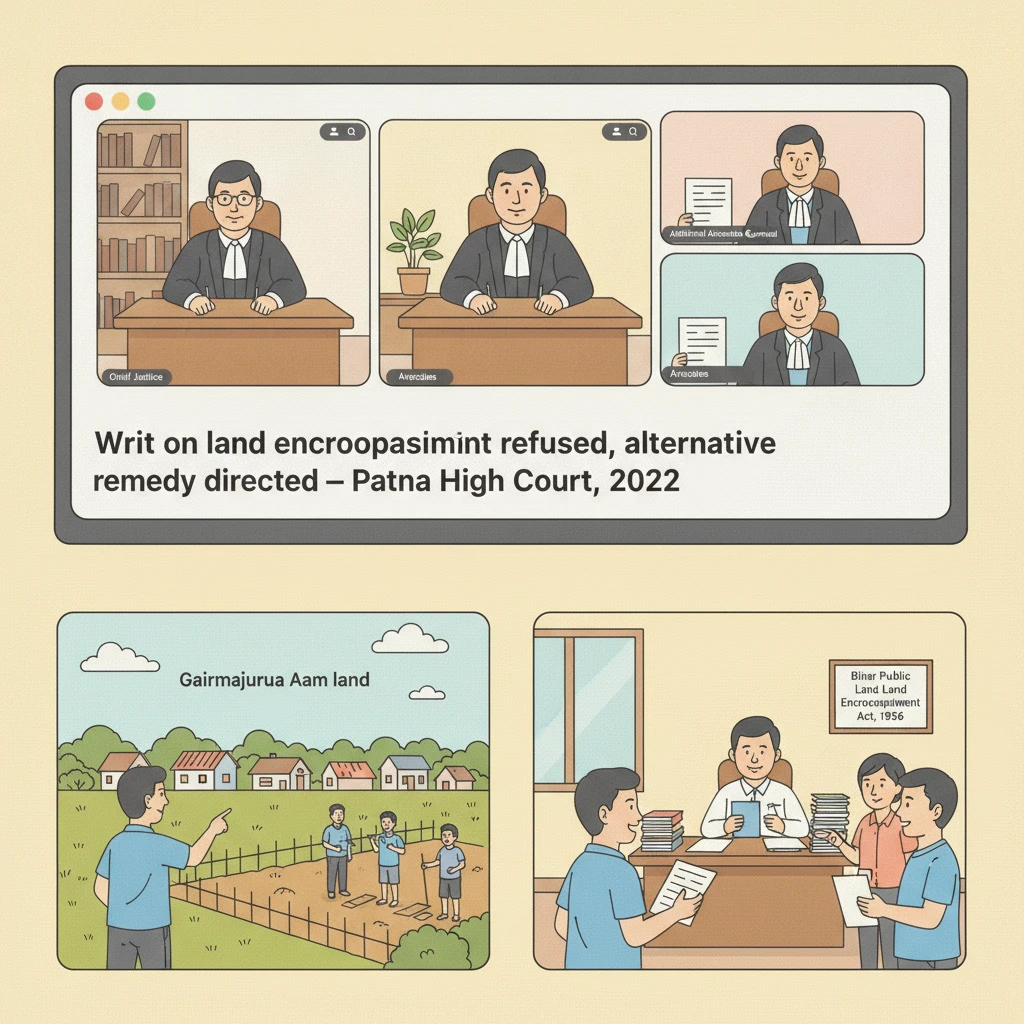
The case arose from a dispute over land in Village Bhadaula, Block-Kudra, District-Kaimur (Bhabua), Bihar. The petitioner, a resident of the same village, alleged that certain private respondents had encroached upon land recorded as Gairmajurua Aam land in the revenue records.
According to the writ petition, the land in question falls under different plot and khata numbers in Thana No. 626, Village Bhadaula. The petitioner claimed that private respondents, all residents of the same village, had made constructions and encroached on this public land.
Instead of first approaching the local revenue authorities under the Bihar Public Land Encroachment Act, 1956, the petitioner directly moved the Patna High Court under its writ jurisdiction. The case was registered as Civil Writ Jurisdiction Case No. 2632 of 2022.
The matter came up before a Division Bench comprising Hon’ble the Chief Justice and Hon’ble Mr. Justice Mohit Kumar Shah on 04-03-2022. Owing to the Covid-19 pandemic, the hearing was conducted through video conferencing, with the Judges, advocates and staff all participating from their respective residences or offices.
What the Court Examined and Decided
The Court first heard the learned counsel for the petitioner and the State. Though the detailed reliefs are not reproduced in full in the judgment, the order makes it clear that the petitioner sought directions in the nature of mandamus to remove alleged encroachment by private respondents on land described as Gairmajurua Aam land and to initiate and complete encroachment proceedings against them.
In simple terms, the petitioner wanted the High Court to order the Circle Officer and other authorities to treat the private respondents as encroachers on public land and to clear the land.
The Bench examined whether such relief could be granted directly in a writ petition under Article 226 of the Constitution, and whether this case truly raised a matter of public interest or was essentially a private dispute.
The Court recorded a clear finding that the petitioner had an “alternative remedy, equally efficacious” under the provisions of the Bihar Public Land Encroachment Act, 1956. That Act provides a complete procedure before local authorities to identify, inquire into and remove encroachments from public land.
When the Bench confronted the petitioner’s side with a simple question—why have you not taken recourse to this statutory remedy under the 1956 Act?—no satisfactory answer was forthcoming. In other words, the petitioner could not justify bypassing the specific legal route laid down by the Legislature for dealing with encroachments on public land.
On this basis, the Court concluded that the writ petition was not the appropriate first step. Writ jurisdiction is meant to be invoked when no adequate alternative remedy exists, or when there are exceptional circumstances like lack of jurisdiction, violation of natural justice, or a pure question of law of general importance. None of these situations were shown in this case.
The Bench also looked at the nature of the dispute and described the petition as being in the nature of “private interest litigation and not public interest litigation.” The order notes that the dispute between private parties stands highlighted.
In effect, although the land was described as Gairmajurua Aam, the Court saw the primary controversy as between the petitioner and the named private respondents — all villagers of Bhadaula — about who was on the land and what constructions had been raised. The Court therefore declined to treat it as a pure public interest case.
Based on this view, the Court also refrained from issuing notice in the writ petition. This shows the Bench’s reluctance to encourage litigants to treat the High Court as the first forum for fact-heavy disputes that the local authorities are better placed to handle.
The learned counsel for the State also opposed the petition. The State’s stand, as recorded in the judgment, was that the petition:
- was misconceived,
- raised disputed questions of fact,
- was not in public interest, and
- concerned an issue that could best be resolved at the local level by the appropriate authorities.
To support its approach to public interest litigation and writ remedies, the Patna High Court referred to the Supreme Court’s decision in D. N. Jeevaraj v. Chief Secretary, Government of Karnataka & Ors, (2016) 2 SCC 653. The Bench reproduced paragraphs 34 to 38 of that judgment.
From those paragraphs, the following key principles were highlighted:
- In genuine public interest litigations involving grave public importance or good governance, procedural technicalities should not overshadow substantive justice. The Court can be more liberal.
- However, litigations that are essentially directed against one organisation or one individual, or which do not raise issues of wider public importance, should generally not be treated as public interest litigations.
- Such cases usually have other effective remedies that public-spirited litigants should use instead of rushing to the High Court under the banner of public interest.
- For issuing a writ of mandamus, the petitioner must show a legal right and a corresponding public duty on the part of the authority, and often also show that a clear demand was made and refused.
The Patna High Court also relied on the broader principle that mandamus is not issued when there is no failure of a mandatory duty and when other remedies exist. The Court reproduced observations from Union of India v. S.B. Vohra and Saraswati Industrial Syndicate Ltd. v. Union of India, as discussed in D. N. Jeevaraj, to emphasise:
- Mandamus is a command to perform a public legal duty and is issued only when a clear legal right and unperformed duty are shown.
- Generally, before seeking mandamus, the authority should have been asked to act and should have refused or failed to act.
Applying these settled principles to the facts before it, the Patna High Court held that the petitioner should first use the statutory machinery under the Bihar Public Land Encroachment Act, 1956. Since no reason was shown for skipping that route, and since this was not a true public interest case, the Court declined to entertain the writ.
Yet, the Court did not shut the doors completely. Instead of dismissing the petition outright, the Bench “disposed of” the case with specific directions protecting the petitioner’s right to seek redress before the proper forum.
The operative directions were as follows:
- Liberty was reserved to the petitioner to take recourse to such remedies as are otherwise available in accordance with law. This clearly points to proceedings under the Bihar Public Land Encroachment Act, 1956.
- The Court expressed hope that once the petitioner approaches the appropriate forum, the matter will be dealt with “in accordance with law and with reasonable dispatch.”
- The concerned authority was required to consider and dispose of the matter expeditiously by a reasoned and speaking order, preferably within four months from the date the petitioner approaches that authority.
- The authority must follow the principles of natural justice, which includes giving due opportunity of hearing to all parties involved.
- Liberty was reserved to the petitioner to move the appropriate forum or Court again, if necessary, on the same or any subsequent cause of action.
- The Court made it explicit that it had not expressed any opinion on the merits of the dispute and that all issues were left open.
- Given the ongoing Covid-19 pandemic at the time, the Court also noted that proceedings would continue to be conducted through digital mode unless parties mutually agreed to physical hearings.
With these directions, the writ petition and any interlocutory applications were treated as disposed of.
Why This Judgment Matters
This judgment is important for villagers and citizens who feel that public land in their village has been encroached upon. It clarifies that they cannot directly rush to the Patna High Court and expect an immediate removal order.
The Court has clearly said that when a special law like the Bihar Public Land Encroachment Act, 1956 is available, affected persons must use that law first. The local authorities have the power and responsibility to conduct inquiries, measure land and decide whether an encroachment exists.
For lawyers and public-spirited persons, the decision underlines the difference between public interest litigation and private disputes. Merely labelling a petition as a public interest litigation will not work if the real fight is between private parties of the same village.
The judgment also protects genuine complainants by fixing a time expectation. If the petitioner approaches the competent authority, that authority is expected to decide his case preferably within four months, by a speaking order after hearing all sides. This helps ensure that people using the correct legal route are not left waiting indefinitely.
Legal Issues and Answers
-
Issue: Can the Patna High Court, in writ jurisdiction, directly entertain a plea to remove alleged encroachment from public land when a specific statutory remedy under the Bihar Public Land Encroachment Act, 1956 is available?
Answer: No. The Court held that the petitioner has an equally efficacious alternative remedy under the 1956 Act. Since no reason was shown for bypassing that remedy, the writ petition was not entertained, and the petitioner was directed to approach the appropriate authority under the Act. -
Issue: Was the writ petition a genuine public interest litigation warranting liberal treatment of procedure?
Answer: No. The Court found that the petition was in the nature of private interest litigation, as it mainly highlighted a dispute between private parties. It therefore refrained from issuing notice and disposed of the case with liberty to use statutory remedies.
Cases Cited by the Court
- D. N. Jeevaraj v. Chief Secretary, Government of Karnataka & Ors, (2016) 2 SCC 653 – paragraphs 34 to 38 were quoted regarding the scope of public interest litigation and writ of mandamus.
- Rural Litigation and Entitlement Kendra v. State of U.P., 1989 Supp (1) SCC 504 – cited within the quoted passage to explain that procedural technicalities should not obstruct genuine public interest litigation involving grave public importance.
- R&M Trust v. Koramangala Residents Vigilance Group, (2005) 3 SCC 91 – referred to in the discussion about the scope of public interest litigation and good governance.
- Union of India v. S.B. Vohra, (2004) 2 SCC 150 : 2004 SCC (L&S) 363 – quoted on the nature of the writ of mandamus and the requirement of a legal right and a corresponding legal duty.
- Saraswati Industrial Syndicate Ltd. v. Union of India, (1974) 2 SCC 630 – cited for the principle that writ of mandamus is generally not issued when there is no prior demand for performance and refusal, and where specific remedies exist.
Case Details
Case Number: Civil Writ Jurisdiction Case No. 2632 of 2022
Case Title: Akhilesh Kumar Singh v. The State of Bihar & Ors
Coram: Hon’ble the Chief Justice; Hon’ble Mr. Justice Mohit Kumar Shah
Date of Judgment: 04-03-2022
Citation: 2022(2) PLJR 133
Advocates:
For the petitioner: Mr. Ashok Kumar Garg, Advocate; Mr. Sanjiv Kumar Pathak, Advocate
For the respondents/State: Mr. Md. Khurshid Alam, AAG-12
Nature of the Case: Writ petition under Article 226 of the Constitution seeking mandamus regarding alleged encroachment on public land and initiation of encroachment proceedings.
Link to the Judgment: Click here to read the full judgment of the Patna High Court
If you found this explanation helpful and wish to stay informed about
how legal developments may affect your rights in Bihar,
you may consider following Samvida Law Associates for more updates.







