

Case Background
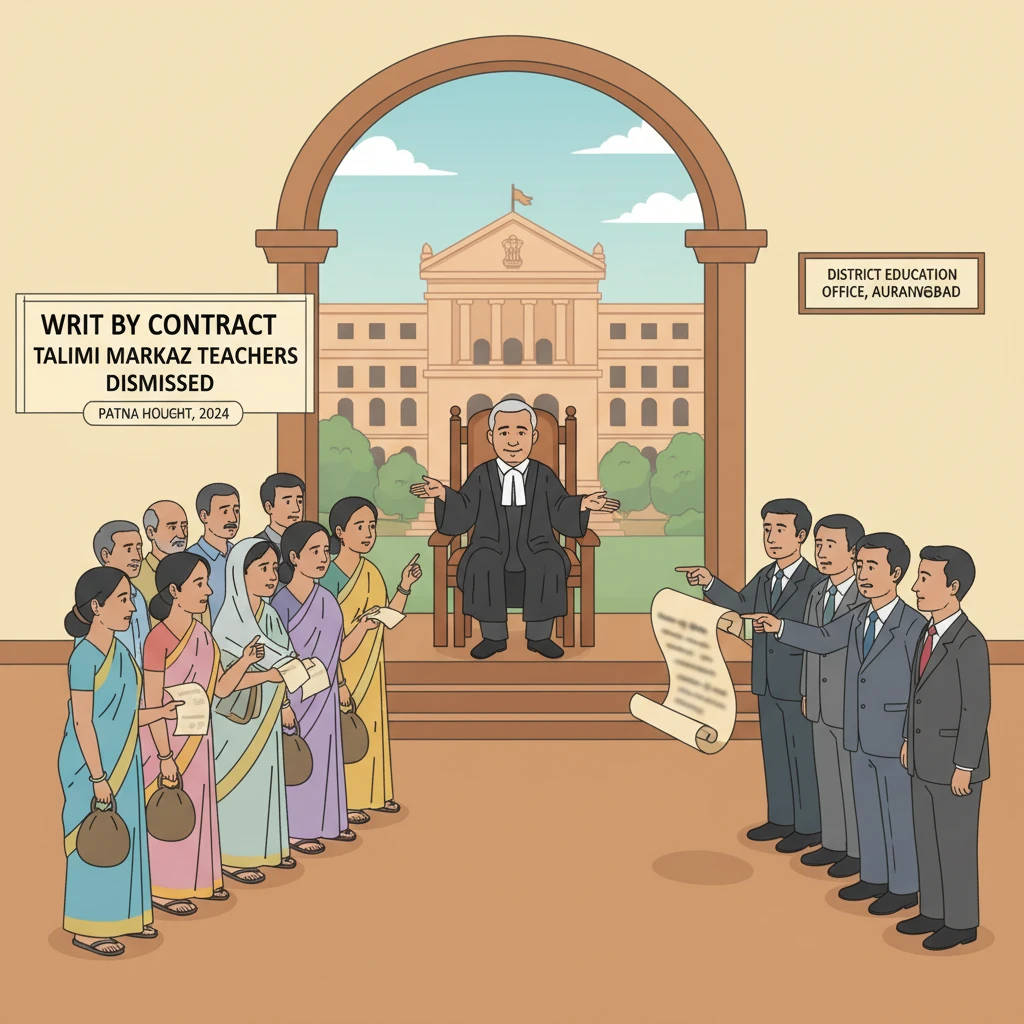
Nineteen petitioners approached the Patna High Court in Civil Writ Jurisdiction Case No. 15189 of 2019. They claimed to have been working as Talimi Markaz Shikshak Swayam Sevi, a category of volunteer teachers engaged under a government scheme.
According to the writ petition, they were not being paid their honorarium from the year 2013 onwards. They also stated that their services had effectively been discontinued, even though no formal termination letter had been issued to them.
On this basis, they filed the present writ application under Article 226 of the Constitution, making the State of Bihar and senior officers of the Education Department and district administration respondents.
What the Court Examined and Decided
The case came up before Hon’ble Mr. Justice Anil Kumar Sinha on 02.01.2024. Learned counsel for both sides were heard. The petitioners were represented by an advocate, and the State by Government Pleader 17.
The core reliefs sought by the petitioners were twofold. First, they asked for a writ commanding the authorities to pay them honorarium from 2013 till the date of decision. Second, they sought a direction to reinstate them on the post of Swayam Sewak or Talmi Markaj, arguing that no termination order had been served on them.
To decide whether this relief could be granted in writ jurisdiction, the Court first examined the nature of the post of Talimi Markaz Shikshak Swayam Sevi. The Court noted that such persons are appointed under a scheme on contract basis for one year. The engagement of Talimi Markaz Shikshak Swayam Sevi was described as being similar to that of Tola Sewak.
The Court recorded that the post of Talimi Markaz Shikshak Swayam Sevi is not a statutory post. No recruitment rules are followed for these appointments. They are, therefore, not regular civil posts under the State.
This aspect was crucial because writ jurisdiction under Article 226 is commonly invoked in service matters by persons who hold or claim civil posts under the State or where statutory rights are involved. Where an engagement is purely under a scheme, on contractual terms, and not backed by statutory rules, courts scrutinise whether writ petitions are maintainable at all.
To resolve this question, the Court referred to earlier decisions concerning Tola Sewaks, another category of workers appointed under a scheme. A co-ordinate Bench of the Patna High Court had previously examined the status of Tola Sewaks in C.W.J.C. No. 18107 of 2016, Raj Choudhary v. The State of Bihar and others.
In that case, the co-ordinate Bench had relied on an earlier judgment dated 17.08.2015 in CWJC No. 12390 of 2015 and a judgment dated 02.02.2017 in L.P.A. No. 2185 of 2015 delivered by a Division Bench. Those decisions held that engagement of Tola Sewaks is neither permanent appointment under the State nor a statutory appointment.
The earlier Bench had noted that the selection or hiring of Tola Sewaks was purely under a scheme. As such, it did not create any statutory right in favour of the persons engaged. On that basis, it was held that writ petitions filed by Tola Sewaks were not maintainable under Article 226 of the Constitution.
Quoting the reasoning from Raj Choudhary’s case, the present judgment records that the co-ordinate Bench treated the absence of a civil post and statutory backing as fatal to the maintainability of the writ. Since no enforceable statutory right existed, the proper course for the aggrieved persons was to seek other remedies in accordance with law, and not a writ.
The Court in the present matter observed that the order in Raj Choudhary had been affirmed by a Division Bench in the related Letters Patent Appeal. The Division Bench had upheld the view that the writ petition of a Tola Sewak was not maintainable.
Having considered this line of authority, the Court compared the position of Talimi Markaz Shikshak Swayam Sevi with that of Tola Sewaks. The Court found that both engagements are under schemes, on contract basis for one year, and not supported by any statutory recruitment rules. The Court also found that Talimi Markaz Shikshak Swayam Sevi do not hold civil posts.
Once these findings were recorded, the legal consequence was straightforward in light of the earlier decisions. If Tola Sewaks, who are similarly engaged, cannot maintain a writ petition, then Talimi Markaz Shikshak Swayam Sevi also cannot maintain such a petition for payment of honorarium or reinstatement.
The petitioners had pleaded that no termination letter had been issued to them, implying that their services continued and therefore they had a right to reinstatement and arrears. However, the Court’s focus remained on the larger question of jurisdiction and maintainability. Since the engagement itself was contractual and scheme-based, the absence or presence of a termination letter did not create a statutory service right that could be enforced through a writ.
The Court, therefore, concluded that the case was squarely covered by the earlier co-ordinate Bench judgment and its affirmation by the Division Bench. Given that Talimi Markaz Shikshak Swayam Sevi do not hold civil posts and the post is not statutory, the present writ petition was held to be not maintainable.
On this basis, without entering into detailed factual adjudication about whether honorarium had actually been withheld from 2013 or whether the petitioners were continuing in work, the Court dismissed the writ petition. It followed the same approach as in the Tola Sewak matters, in which the petition itself was rejected at the threshold for want of maintainability.
The result is that the petitioners did not get any direction for payment of honorarium or for reinstatement through this writ. The judgment, as reproduced from the earlier authority, also indicates that in similar cases liberty is given to seek other remedies available under law, such as those appropriate for contractual or scheme-based disputes, though the present judgment specifically emphasises dismissal on maintainability grounds.
Why This Judgment Matters
This decision matters for all persons engaged as Talimi Markaz Shikshak Swayam Sevi or in similar scheme-based, contractual roles in Bihar. It clarifies that such engagements do not amount to holding a civil post and are not backed by statutory recruitment rules.
Because of this, the Patna High Court has reaffirmed that these workers cannot normally use a writ petition under Article 226 to claim honorarium, back payment, or reinstatement. Their grievances will have to be pursued through other legal routes suited to contractual or scheme-based arrangements.
For government departments, the judgment reinforces that obligations towards such volunteers or contractual workers will not easily be enforced in writ proceedings unless there is a clear statutory right. For workers, it is a reminder to examine the exact legal nature of their appointment before approaching the High Court in writ jurisdiction.
Legal Issues and Answers
- Issue: Can persons engaged as Talimi Markaz Shikshak Swayam Sevi, appointed under a scheme on one-year contract without statutory rules, maintain a writ petition for payment of honorarium and reinstatement?
Answer: No. The Patna High Court held that such engagements do not create statutory rights or civil posts, and therefore writ petitions to enforce these claims are not maintainable.
Cases Cited by the Court
- C.W.J.C. No. 18107 of 2016, Raj Choudhary v. The State of Bihar and others, relating to Tola Sewaks, where writ petitions were held not maintainable for scheme-based, non-statutory engagements.
- Judgment dated 17.08.2015 in CWJC No. 12390 of 2015, concerning Tola Sewaks, holding that they do not hold permanent appointments under the State and have no statutory right enforceable in writ jurisdiction.
- Judgment dated 02.02.2017 in L.P.A. No. 2185 of 2015, where a Division Bench affirmed the view that writ petitions by Tola Sewaks are not maintainable.
Case Details
Case Number: Civil Writ Jurisdiction Case No. 15189 of 2019
Case Title: Md. Ahamad Ali and others v. The State of Bihar and others
Coram: Hon’ble Mr. Justice Anil Kumar Sinha
Citation: 2024(1) PLJR 475
Advocates: For the petitioners – Mr. Anil Kumar, Advocate; For the respondents – Mr. Kameshwar Kumar, GP 17
Nature of the Case: Writ petition under Article 226 of the Constitution seeking payment of honorarium and reinstatement for Talimi Markaz Shikshak Swayam Sevi
Date of Judgment: 02.01.2024
Link to Judgment: https://patnahighcourt.gov.in/viewjudgment/MTUjMTUxODkjMjAxOSMxI04=-lo4Y–am1–TVDypQ=
If you found this explanation helpful and wish to stay informed about
how legal developments may affect your rights in Bihar,
you may consider following Samvida Law Associates for more updates.







