

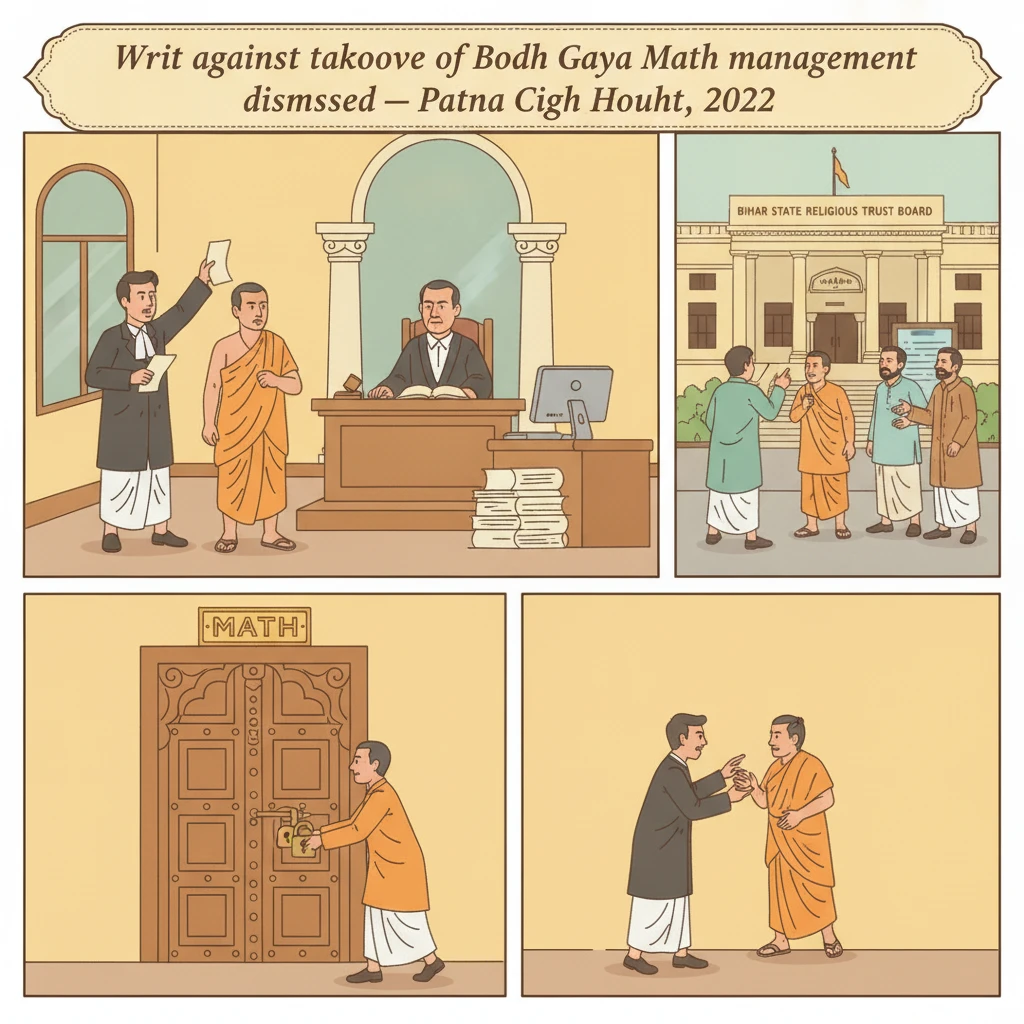
Case Background
The case arose from disputes relating to the management and properties of Bodh Gaya Math in district Gaya, Bihar. The petitioner claimed to have been elected as the Mahanth of the Math on 14.11.2013 according to the customs of succession. He asserted that his election was never objected to and therefore his position as Mahanth stood confirmed.
The petitioner stated that the Math is centrally located and has high-value immovable properties. According to him, several persons were continuously trying to take control of the Math in different ways. He alleged that one individual declared himself Chela and legal heir of a previous Mahanth without any valid basis, and that this was a ploy to grab land belonging to that earlier Mahanth. On learning of these developments, the petitioner complained to the District Magistrate, Gaya.
The petitioner further asserted that, to advance their alleged illegal motives, those trying to take over the affairs of the Math filed multiple complaints before various authorities, including the Bihar State Religious Trust Board. The pleadings in the writ petition, including in paragraphs 21 to 30 and 32 as noted by the Court, disclosed serious disputes of fact about the management of the Math and its properties.
Acting on some complaints received, the President of the Bihar State Religious Trust Board earlier passed an order dated 13.10.2020 reconstituting the trust of the Math. That order was challenged before the Patna High Court in C.W.J.C. No. 1491 of 2020. By judgment dated 04.03.2021 in that case, the Court set aside the President’s order primarily on the ground that the Board itself was not in existence as required by the regulations framed by it. The President therefore could not have exercised the Board’s powers. The Court declared the 13.10.2020 order illegal.
However, while quashing that earlier order, the Patna High Court clearly observed that as the Board had since been duly constituted, the President of the Board would be at liberty to exercise powers as per the statute and pass appropriate orders.
After this, on 09.04.2021, letter no. 89 was issued, initiating proceedings against the petitioner on the basis of complaints against him as Mahanth of Bodh Gaya Math. A notice was served on the petitioner, informing him of various allegations received from several quarters and calling upon him to appear before the Board on 16.04.2021 to present his case.
Following these proceedings, the Bihar State Religious Trust Board passed an order dated 27.07.2021 and, pursuant to it, the President of the Board issued a notification dated 29.07.2021 under Section 33 of the Bihar Hindu Religious Trusts Act, 1950. Considering disputes about management of the Math’s properties and inter-party disputes, and for better administrative and financial management as well as protection of the Math’s properties, a committee was constituted as an interim measure.
This committee consisted of: a Member of the Bihar State Religious Trust Board, the District Magistrate, Gaya, the Senior Superintendent of Police, Gaya, the Sub-Divisional Officer, Sadar, Gaya, the Deputy Collector Land Reforms, Gaya, and the Executive Officer, Bodh Gaya. The notification also laid down the duties of this committee.
In the present writ petition under Article 226 of the Constitution of India, the petitioner sought quashing of the entire proceeding initiated by letter no. 89 dated 09.04.2021, as well as the Board’s order dated 27.07.2021 and the notification dated 29.07.2021 constituting the committee under Section 33 of the Act.
What the Court Examined and Decided
The Division Bench of the Patna High Court, comprising Hon’ble Mr. Justice Chakradhari Sharan Singh and Hon’ble Mr. Justice Madhuresh Prasad, examined the legality of the Board’s decision to constitute the interim committee under Section 33 of the Bihar Hindu Religious Trusts Act, 1950, and whether prior removal of the existing trustee under Section 28(2)(h) was a necessary pre-condition.
On behalf of the petitioner, learned Senior Counsel Mr. Kamal Nayan Choubey argued that compliance with clause (h) of sub-section (2) of Section 28 of the Act was a condition precedent for exercising powers under Section 33. Clause (h) of Section 28(2) gives the Board power to remove a trustee on specified grounds. Counsel contended that only after such removal and resultant vacancy could the Board invoke Section 33 to appoint any temporary trustee or committee.
To support this argument, the petitioner relied heavily on earlier Patna High Court decisions: M/s Agrawal Dharamshala & Ors. vs. Bihar State Board of Religious Trust & Ors., 1988(1) PLJR 212 (Division Bench); Ishwari Prasad Jhunjhunwala vs. Bihar State Religious Trust Board, AIR 1989 Patna 349 (Single Bench); Mahanth Motilal Goswami vs. State, AIR 1993 Patna 171 (Division Bench); Tej Bahadur Verma vs. The State of Bihar and 6 Ors., 1998(3) PLJR 347 (Single Bench); and Mahanth Vijay Das vs. The State of Bihar & Ors., 2003(4) PLJR 710.
On the other side, learned Senior Counsel Mr. Ganpati Trivedi for the Bihar State Religious Trust Board argued that the earlier judgment dated 04.03.2021 had only invalidated the President’s prior action because at that time the Board was not properly constituted. Once a valid Board was in place, it could lawfully exercise powers under Section 33. He submitted that the Board acted in the best interest of the Math’s administrative and financial management and for protection of its properties, in view of serious disputes over the right of management.
He disputed the petitioner’s position that removal of a trustee under Section 28(2)(h) and the consequent vacancy was the only situation in which Section 33 could be invoked. According to the Board, Section 33, in clear terms, permits the Board to appoint a temporary trustee even in other specified situations, and the committee in question was constituted under that provision.
The Court then closely analysed Section 33 of the Bihar Hindu Religious Trusts Act, 1950. It concluded that the Board may appoint any person to act as trustee of a religious trust, for a period not exceeding one year, in three kinds of situations:
First, where there is a vacancy in the office of trustee and there is no one competent to be appointed as trustee under the terms of the trust deed.
Second, where there is a bona fide dispute regarding the right of any person to act as trustee, and in the opinion of the Board there is a likelihood of breach of peace or serious interference with management of the trust property.
Third, where there is a vacancy caused by an order of the Board passed under clause (h) of sub-section (2) of Section 28, i.e., after the Board removes a trustee on the grounds mentioned there.
From this analysis, the Court held that the third situation under Section 33 arises only when a trustee has already been removed under Section 28(2)(h) and a vacancy has occurred for that reason. But that does not mean that this is the only situation when Section 33 can be used. The Court rejected the argument that without removal under Section 28(2)(h), the Board cannot act under Section 33 at all.
The Division Bench referred to its earlier judgment in M/s Agrawal Dharamshala. In that case, the Court had already interpreted Section 33 and held that whenever there is a vacancy in the office of trustee and no one is competent under the trust deed to be appointed, or where there is a bona fide dispute as to the right of a person to act as trustee along with likelihood of breach of peace or serious interference with management, the Board may, subject to orders of a competent court, appoint any person to act as trustee.
After noting that earlier ruling, the Bench observed that Agrawal Dharamshala further clarified that trustees can be appointed under Section 33 even where vacancies are caused by an order under Section 28(2)(h), but only after the trustee has been removed according to that provision. The present Bench found that this earlier judgment supported the wider reading of Section 33, not the narrow reading suggested by the petitioner.
Turning to Ishwari Prasad Jhunjhunwala, the Court highlighted paragraph 24 of that judgment. In that paragraph, the Single Judge had stated that there was a dispute about whether the petitioner in that case was the owner of certain property, and that such a disputed question of title could not be decided under Articles 226 and 227 of the Constitution. Instead, such disputes should be resolved under the then Section 43 of the Bihar Hindu Religious Trusts Act. Referring to this, the present Bench noted that Section 43 of the Act has since been substituted by Sections 43 to 43F through Act No. 1 of 2007, but the core principle that title disputes are not to be decided in writ remains relevant.
The Division Bench further explained why the other authorities cited by the petitioner did not assist him. In Mahanth Motilal Goswami, the issue was that the petitioner had been appointed as Mahanth on the basis of a recommendation made by a Member of Parliament to the Chief Minister, which was then forwarded to the Board. The Court there held that a statutory body like the Board cannot act merely on such recommendations, and quashing one illegal order should not lead to revival of another illegal order. That factual background was completely different from the present case, where the Board was acting within its statutory powers.
Similarly, the decisions in Tej Bahadur Verma and in Mahanth Vijay Das were found not to support the petitioner’s argument that exercise of power under Section 28(2)(h) is the only condition precedent for invoking Section 33.
Applying the law to the facts, the Bench observed that, from the petitioner’s own pleadings, there were serious disputes concerning the administrative and financial management of the Math. The disputes included allegations of attempts by various persons to take over the Math and conflicting claims about succession and rights over properties.
In such a situation, the Board had considered it necessary, for safety and protection of the Math’s properties and to avoid serious interference with management, to issue the notification dated 29.07.2021 and to constitute an interim committee of responsible officers under Section 33.
The Court held that this decision of the Board, taken as an interim measure, could not be called unauthorised, illegal, or suffering from such legal infirmity as would justify interference under Article 226. It emphasised that the preconditions under Section 33 did exist in this case, particularly the bona fide dispute about the right to manage the Math and the risk of serious interference with its properties.
Accordingly, the Division Bench concluded that the writ petition had no merit. It dismissed the application and made no order as to costs.
Why This Judgment Matters
This judgment is important for maths, temples, and other Hindu religious trusts in Bihar that face internal fights or competing claims over management and property. The Patna High Court has confirmed that the Bihar State Religious Trust Board can step in under Section 33 of the Bihar Hindu Religious Trusts Act, 1950 even when the existing trustee has not been formally removed under Section 28(2)(h).
Where there is a genuine dispute about who has the right to manage a religious trust, and there is risk of breach of peace or serious disturbance in the management of properties, the Board can appoint a temporary trustee or committee for up to one year. This can include district-level officers, as was done for Bodh Gaya Math.
For ordinary devotees and local people, the judgment shows that if the management of a religious institution is under serious dispute, the Board can take temporary control to protect assets and maintain order. At the same time, the Court has made it clear that complex title disputes or questions about who is the real owner are not to be decided in a writ petition, but under the specific mechanisms of the Bihar Hindu Religious Trusts Act.
The case also reassures that earlier, invalid actions by an improperly constituted Board do not permanently block the Board. Once the Board is properly formed, it can lawfully use its powers again, as long as statutory conditions are met.
Legal Issues and Answers
Issue: Can the Bihar State Religious Trust Board invoke Section 33 of the Bihar Hindu Religious Trusts Act, 1950 to constitute a temporary committee for managing a Math without first removing the existing trustee under Section 28(2)(h)?
Answer: Yes. The Court held that Section 33 can be used in three separate situations, including where there is a bona fide dispute about the right of any person to act as trustee and a likelihood of breach of peace or serious interference with management. Removal under Section 28(2)(h) is only one of the possible situations, not the sole precondition.
Issue: Did the facts of the Bodh Gaya Math dispute justify the Board’s use of Section 33 to form an interim committee of officers to manage the Math?
Answer: Yes. Based on the petitioner’s own pleadings and the record of complaints, the Court found serious disputes over administrative and financial management of the Math and a need to protect its properties. Therefore, the statutory conditions for invoking Section 33 were satisfied.
Issue: Was there any ground for the Patna High Court to interfere with the Board’s decision in its writ jurisdiction under Article 226 of the Constitution?
Answer: No. The Court held the decision to be within the Board’s statutory powers, taken as an interim measure and not suffering from such illegality as to warrant judicial interference. The writ petition was dismissed without costs.
Cases Cited by the Court
- M/s Agrawal Dharamshala & Ors. vs. Bihar State Board of Religious Trust & Ors., 1988(1) PLJR 212 (Division Bench).
- Ishwari Prasad Jhunjhunwala vs. Bihar State Religious Trust Board, AIR 1989 Patna 349 (Single Bench).
- Mahanth Motilal Goswami vs. State, AIR 1993 Patna 171 (Division Bench).
- Tej Bahadur Verma, Managing Trustee of Sri Shyam Lal Rashtriya Vidyalaya Trust Board, Khagaria vs. The State of Bihar and 6 Ors., 1998(3) PLJR 347 (Single Bench).
- Mahanth Vijay Das vs. The State of Bihar & Ors., 2003(4) PLJR 710.
Case Details
Case Number: Civil Writ Jurisdiction Case No. 16795 of 2021
Case Title: Mahanth Ramesh Giri @ Ramesh Giri vs. The State of Bihar & Ors.
Citation: 2022 (1) PLJR 775
Coram: Hon’ble Mr. Justice Chakradhari Sharan Singh; Hon’ble Mr. Justice Madhuresh Prasad
Advocates: For the petitioner: Mr. Kamal Nayan Choubey, Senior Advocate; Mr. Amit Kumar, Advocate; Mr. Ravi Ranjan, Advocate; Mr. Ambrish Kumar, Advocate. For the Respondent State: Mr. S.K. Mandal, S.C.-3. For the Bihar State Religious Trust Board: Mr. Ganpati Trivedi, Senior Advocate.
Nature of the case: Writ petition under Article 226 of the Constitution of India challenging proceedings and orders under the Bihar Hindu Religious Trusts Act, 1950.
Date of Judgment: 17.01.2022
Link to Judgment: Click here to read the full judgment of the Patna High Court
If you found this explanation helpful and wish to stay informed about
how legal developments may affect your rights in Bihar,
you may consider following Samvida Law Associates for more updates.







