
Case Background
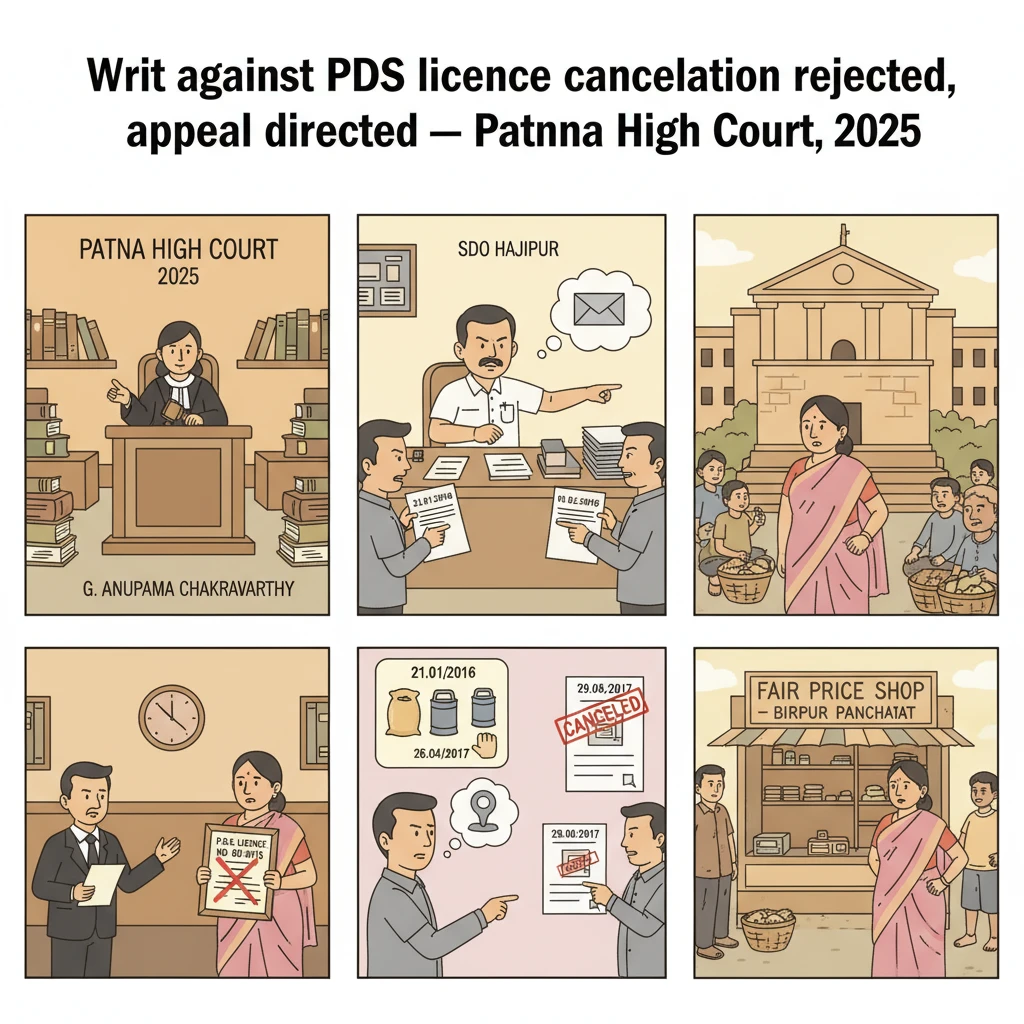
The petitioner, an ex-PDS dealer from Birpur Panchayat in Raghopur Block, Vaishali, held P.D.S. Licence No. 08/2013 to operate a Fair Price Shop. According to the writ petition, she had been running the shop without any earlier complaints or violations.
On 29.08.2017, the Sub-Divisional Officer (SDO), Hajipur passed an order cancelling her PDS licence. This order became the central point of challenge before the Patna High Court in Civil Writ Jurisdiction Case No. 15719 of 2018.
In the writ petition, the petitioner sought three main reliefs: quashing of the cancellation order dated 29.08.2017, restoration of her PDS licence so she could resume running the shop, and any other appropriate directions in her favour.
The cancellation proceedings themselves traced back to a joint inspection report dated 19.12.2015, after which show cause notices were issued in January and February 2016. The petitioner claimed that she was never served with these notices or with any inquiry report, whereas the State authorities asserted that notices were duly issued and that she failed to respond.
What the Court Examined and Decided
Justice Hon’ble Smt. G. Anupama Chakravarthy of the Patna High Court heard the matter. The core dispute was whether the cancellation of the petitioner’s PDS licence was in violation of the principles of natural justice and the Bihar Targeted Public Distribution System (Control) Order, 2016, and whether the writ petition was maintainable despite an available appellate remedy.
The petitioner argued that the order dated 29.08.2017 was illegal because it was passed without following basic fairness. She alleged that she was not given a copy of the complaint, not given the show cause notices, not given the inquiry report of respondent authorities, and not given the order of the Sub-Divisional Grievance Redressal Officer. As a result, she claimed she never got a real chance to defend herself.
She specifically invoked Clause 27(ii) of the Bihar Targeted PDS (Control) Order, 2016, which requires adherence to procedural safeguards before cancelling a licence, and Article 14 of the Constitution of India, which guarantees equality and fairness in State action.
Another limb of her argument was delay. She pointed out that, as per her case, cancellation proceedings started on 19.12.2015 but were concluded only after about 20 months, with the final order dated 29.08.2017. She relied on Clause 27(iii) of the Control Order, which mandates that such proceedings be concluded within two months. According to her, the long delay itself showed illegality and arbitrariness.
To strengthen her claim of violation of natural justice, the petitioner cited three decisions: Satwati Deswal v. State of Haryana [(2010) 1 SCC 126], Sri Niwas Choubey v. State of Bihar [2015(2) PLJR 376], and Smt. Fulpati Devi v. State of Bihar [2013(1) PLJR 718]. She argued that these judgments show that when natural justice is violated, High Courts can directly interfere under writ jurisdiction without insisting that the person first file an appeal.
The petitioner’s counsel also contended that the State had not produced any reliable proof that notices were actually served on her. He argued that merely attaching documents in the counter affidavit could not cure the original defect if proper service and real opportunity were not given at the time of the proceeding.
On the other side, the State respondents (including the Collector, SDO, and supply officers) filed a detailed counter affidavit. They stated that a joint inspection report was prepared on 19.12.2015. Based on this report, show cause notices were issued to the petitioner by the SDO, Hajipur, via Memo No. 80 dated 21.01.2016 and Memo No. 113 dated 01.02.2016.
The State’s stand was that the petitioner did not file any reply to these show cause notices. Thereafter, the Sub-Divisional Public Grievance Redressal Officer gave findings on 26.04.2017, alleging that the petitioner had not distributed food grains and kerosene oil from November 2016 to January 2017 and had shown disinterest in running the Fair Price Shop. Relying on these findings, the competent authority cancelled the PDS licence on 29.08.2017.
The respondents further submitted that the petitioner did not avail the statutory appellate remedy provided under Clause 32(iii) of the Bihar Targeted PDS (Control) Order, 2016, which allows an appeal to the District Magistrate. Therefore, they argued, the writ petition was not maintainable at all.
In rejoinder, the petitioner maintained that she never received any show cause notice, inquiry report, or complaint. She stated that the documents now produced in the counter affidavit had never been served on her before the cancellation order was issued. She also reiterated that when natural justice is violated, the existence of an appeal provision does not bar a writ petition.
After hearing both sides and examining the records, including the annexures to the counter affidavit, the Court recorded a clear finding. It held that show cause notices were indeed issued to the petitioner through Memo No. 113 dated 01.02.2016 and Memo No. 80 dated 21.01.2016, and clarification had been sought from her. The Court noted that the petitioner failed to respond to these notices.
The Court observed that the petitioner’s plea that she was never served with notices did not have sufficient support, especially when matched against the documentary evidence produced by the respondents. In other words, the Court accepted that notices were issued and opportunity was given, and it did not accept the bare denial of service without stronger proof from the petitioner.
Because of this factual finding, the Court held that the judgments relied upon by the petitioner, such as Satwati Deswal, Sri Niwas Choubey, and Smt. Fulpati Devi, were distinguishable. Those cases dealt with situations where natural justice was actually violated, whereas here the record showed that notice and opportunity had been afforded.
The Court then turned to the question of alternative remedy. Under Clause 32(iii) of the Bihar Targeted Public Distribution System (Control) Order, 2016, a person aggrieved by such an order has a statutory remedy of appeal before the District Magistrate. In light of this provision, and considering that documentary material indicated that the petitioner had been given notice and opportunity, the Court found no justification to exercise its extraordinary powers under Article 226 of the Constitution at this stage.
However, the Court also took into account that the petitioner had already approached the High Court in 2018 and had not filed an appeal during this period. To ensure fairness, the Court did not dismiss the matter outright without any protection. Instead, it disposed of the writ petition with specific directions.
The Patna High Court directed the petitioner to file an appeal before the concerned District Magistrate within four weeks from the date of receipt of the Court’s order. It further directed that any delay in filing the appeal must be condoned by the District Magistrate, expressly noting that the writ petition had been pending since 2018.
Finally, the Court ordered that the appellate authority should decide the appeal within three months from the date of its filing. With these directions, the writ petition and all interlocutory applications were disposed of.
Why This Judgment Matters
This judgment is important for PDS dealers and other licence holders in Bihar who may face cancellation proceedings. The Patna High Court has sent a clear message that when a statutory appeal is available, it should ordinarily be used instead of rushing directly to the High Court under writ jurisdiction, especially when the record shows that notices were issued.
For PDS dealers, the decision highlights two key points. First, if a show cause notice is received, it must be replied to in time, because silence can be treated as acceptance of allegations. Second, if an order is passed against them, the first step is usually to file an appeal before the authority mentioned in the relevant Control Order or statute.
The judgment also shows that the Court will closely examine records before accepting a claim of “no notice” or “no opportunity.” Merely alleging violation of natural justice is not enough; it must be supported by facts. Where the record shows that notices were issued, the Court is likely to treat the statutory appellate forum as the proper place to challenge the merits of the order.
At the same time, the Court has protected the petitioner by allowing her to file a delayed appeal and directing the District Magistrate to condone the delay and decide the matter within a fixed time. This balances the need to follow proper procedure with the need to ensure that an aggrieved person still has a real chance to be heard.
Legal Issues and Answers
-
Issue: Was the cancellation of the petitioner’s PDS licence vitiated by violation of principles of natural justice and Clause 27 of the Bihar Targeted PDS (Control) Order, 2016, due to alleged non-service of show cause notices and inquiry report?
Answer: No. The Court found from the record that show cause notices were issued through specific memo numbers and that opportunity was given. The petitioner’s claim of non-service was not sufficiently substantiated. -
Issue: Is a writ petition maintainable against the cancellation order when a statutory appeal lies under Clause 32(iii) of the Bihar Targeted PDS (Control) Order, 2016?
Answer: In the facts of this case, no. Given the availability of an efficacious alternative remedy of appeal and the existence of documentary proof of notice and opportunity, the Court declined to exercise its writ jurisdiction and directed the petitioner to file an appeal instead.
Cases Cited by the Court
- Satwati Deswal v. State of Haryana, (2010) 1 SCC 126 — cited by the petitioner, but held distinguishable on facts.
- Sri Niwas Choubey v. State of Bihar, 2015(2) PLJR 376 — cited by the petitioner, but held distinguishable on facts.
- Smt. Fulpati Devi v. State of Bihar, 2013(1) PLJR 718 — cited by the petitioner, but held distinguishable on facts.
Case Details
Case Number: Civil Writ Jurisdiction Case No. 15719 of 2018
Case Title: Chano Devi v. The State of Bihar & Ors.
Citation: 2025(4) PLJR 383
Coram: Hon’ble Justice Smt. G. Anupama Chakravarthy
Advocates:
- M/s Aditya Narayan, Akhilesh Kumar Sinha, Advocates — for the petitioner
- Mr. S. Raza Ahmed, AAG 5 — for the State
- Alok Ranjan, AC to AAG 5 — for the State
Nature of the Case: Writ petition under Article 226 of the Constitution challenging cancellation of PDS/Fair Price Shop licence and seeking restoration, in the face of an available statutory appellate remedy.
Date of Judgment: 09-09-2025
Link to Judgment: View full judgment on Patna High Court website
If you found this explanation helpful and wish to stay informed about
how legal developments may affect your rights in Bihar,
you may consider following Samvida Law Associates for more updates.







