
Case Background
The petitioners are licensed porters with valid badge numbers working at different railway stations under the Sonepur Division of East Central Railway. In 2008, the Railway Board took a decision to give such licensed porters a one-time chance to be absorbed or regularised in Group-D posts of Gangman.
This decision was communicated through Railway Board letters dated 01.04.2008 and 10.04.2008. Acting on this, the General Manager (Personnel), East Central Railway, Hajipur issued a letter dated 10.04.2008 laying down time-bound modalities for absorption of licensed porters under this one-time scheme.
A list of 768 licensed porters was prepared. Call letters were issued to 740 licensed porters, including the present petitioners, asking them to appear in a screening test. Eligible candidates had applied in the prescribed format dated 23.04.2008 and the screening test was held on 01.05.2008. After the test and other due procedures, 413 porters were appointed as Gangman.
The remaining candidates, including the petitioners, were not appointed, absorbed or regularised in Group-D posts. According to the Railways, most of the petitioners were found unsuitable and in several cases there was mismatch in the father’s name, date of birth and address. In the case of petitioner no. 8, the Railways stated that he was found medically unfit, so his case could not be considered.
The Railways say they communicated rejection of the petitioners’ claims by letters issued in July 2010, which were annexed as Annexure R/3 series before the Central Administrative Tribunal (CAT), Patna Bench. The scheme itself required that all work relating to absorption or regularisation of licensed porters be completed within two months from the issue of the Railway Board letter dated 01.04.2008.
Despite this, the petitioners did not immediately challenge the rejection. Only in 2021 did they approach the CAT, Patna Bench by filing Original Application OA/050/00266/2021 seeking relief in respect of absorption or regularisation.
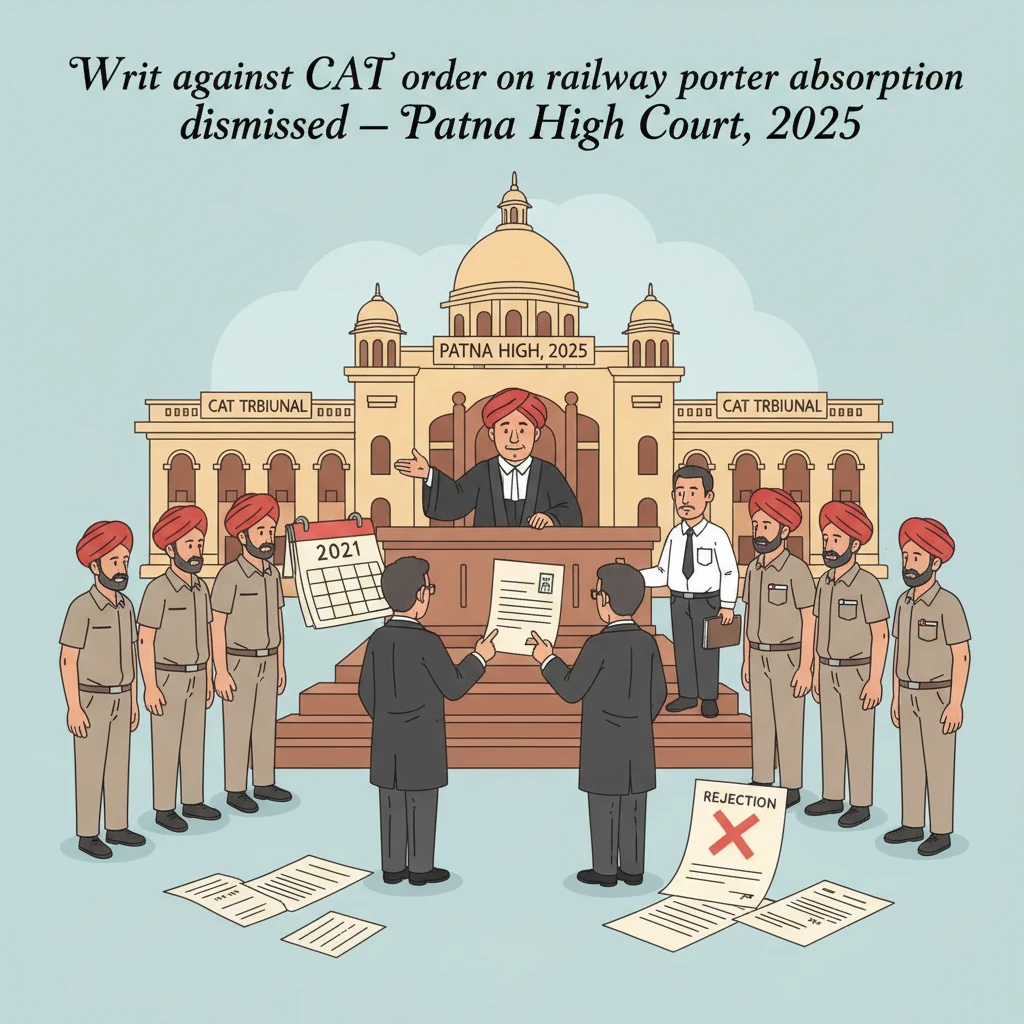
On 10.12.2024, the learned CAT dismissed their Original Application on the ground of delay of about 11 years in approaching the Tribunal. Aggrieved by this, the petitioners filed the present Civil Writ Jurisdiction Case No. 14048 of 2025 before the Patna High Court.
What the Court Examined and Decided
The Patna High Court, through an oral judgment delivered on 09.12.2025 by Hon’ble Mr. Justice Mohit Kumar Shah (for the Bench also comprising Hon’ble Justice Smt. Soni Shrivastava), examined whether the CAT was justified in dismissing the Original Application for delay and whether any interference was called for.
The core dispute before the High Court was not about the details of the selection process itself but about the timing of the challenge. The Court focused on when the cause of action arose and when the petitioners chose to knock at the doors of the Tribunal.
According to the Railways’ written statement before the CAT, the cause of action arose in 2008, when the screening and appointments took place, and at the latest in July 2010, when reasons for denying appointment were communicated to the petitioners. The Railways stressed that the petitioners remained completely silent for about 11 years before finally filing the Original Application in 2021.
The Railways further argued that the one-time absorption scheme was time-bound. Only licensed porters between 18 and 50 years of age as on 26.02.2008 could be appointed as Gangman, and all exercise under the scheme had to be finished within two months from 01.04.2008. On this basis, they contended that any claim raised after such a long lapse could not be entertained.
The petitioners’ counsel, on the other hand, argued that in similar matters absorption had been allowed by authorities and courts even after some delay and that the CAT had illegally rejected their case purely on the ground of limitation. However, no detailed factual explanation for the 11-year delay is recorded in the judgment.
The High Court recorded that it had heard both sides and examined the record. It accepted as an admitted position that the petitioners were informed of the rejection of their cases by letters issued in July 2010. Even so, they approached the CAT only in 2021, leading to an inordinate delay of 11 years. The Court termed this as clear delay and laches on the part of the petitioners.
The Bench then discussed the general legal principles governing delay and laches in approaching courts exercising extraordinary and equitable jurisdiction, such as High Courts and tribunals dealing with service matters. The Court emphasised that although such courts protect citizens’ rights, they must also be mindful that those who sleep over their rights without adequate reason are not entitled to relief.
To support this, the Court referred to several Supreme Court decisions. It cited Government of Andhra Pradesh and Ors. v. M.A. Kareem and others, 1991 Supp (2) SCC 183, and Surya Prakash Jaiswal v. Osmania University and Another, (2007) 15 SCC 716, for the principle that settled situations in service matters should not be disturbed after long delays.
The High Court noted the Supreme Court’s observation that a right not exercised for a long time is treated as non-existent, even where no statutory limitation period is prescribed. In such circumstances, courts apply the doctrine of delay, laches and acquiescence to non-suit litigants who come late without a justifiable explanation. Reference was made to Prabhakar v. Sericulture Department, (2015) 15 SCC 1.
The Court explained that the doctrine of laches is an application of the equity maxim “delay defeats equities” and that equity aids only the vigilant, not those who slumber on their rights. To highlight this, the judgment quoted at length from the Supreme Court’s decision in Chennai Metropolitan Water Supply & Sewerage Board & Others v. T.T. Murali Babu, (2014) 4 SCC 108.
In that case, the Supreme Court had stressed that courts must seriously consider whether to entertain claims filed after enormous delay and that they are not expected to indulge indolent persons who wake up after long periods, likening them to “Kumbhakarna” or “Rip Van Winkle.” The High Court reproduced paragraphs 1, 16, 17 and 34 of that decision, which clearly warn that inordinate delay can itself be a ground to dismiss a petition at the threshold.
The Bench further relied on other Supreme Court rulings cited in the judgment: State of Uttranchal & Anr. v. Shiv Charan Singh Bhandari & Ors., 2013 AIR SCW 6627; C. Jacob v. Director of Geology & Mining & Anr., AIR 2009 SC 264; State of Jammu & Kashmir v. R.K. Zalpuri & Others, AIR 2016 SC 3006; and State of Tamil Nadu v. Seshachalam, (2007) 10 SCC 137.
The Court also referred to P.S. Sadasivaswamy v. State of Tamil Nadu, (1975) 1 SCC 152. In that case, the Supreme Court held that in service or promotion matters an aggrieved person should approach the court within about six months to one year of the cause of action. Entertaining stale claims was said to be a waste of the court’s time and an impediment to dealing with genuine grievances, and such petitions should be dismissed in limine.
Applying these principles to the case at hand, the Patna High Court concluded that an 11-year delay in challenging the rejection of absorption could not be termed reasonable by any standard. There was no material on record showing any justified explanation for this long silence.
The Bench therefore held that the CAT was right in dismissing the Original Application on the ground of delay alone. It added that considering the Supreme Court precedents and the maxim that “equity aids the vigilant and not those who slumber on their rights,” the Tribunal and the High Court were under no legal obligation to entertain the petitioners’ claims after such an unexplained lapse.
On this reasoning, the Court found no infirmity in the impugned CAT order dated 10.12.2024 in OA/050/00266/2021. As a result, the writ petition was dismissed as devoid of merit, and the petitioners did not get any relief in respect of absorption or regularisation in the Railways.
Why This Judgment Matters
This judgment is important for railway workers, contractual staff, and other temporary or casual employees who hope to challenge old service decisions. The Patna High Court has made it clear that even when a person feels genuinely wronged, waiting for many years before going to a tribunal or court can completely close the door on their claim.
For licensed porters and similar categories of workers, this decision shows that one-time schemes for absorption are strictly time-bound. Once the scheme period is over and appointments are made, those who do not move promptly against rejection may not get a second chance later through litigation.
The ruling also reinforces that courts will apply the doctrine of delay and laches strongly in service matters. This helps maintain certainty in government employment decisions and prevents very old recruitment exercises from being reopened after many years, which could unsettle the service conditions of those already appointed.
Legal Issues and Answers
Issue: Whether the petitioners, licensed porters whose claims for absorption as Gangman were rejected in 2010, could seek relief in 2021 before the CAT and then in writ before the Patna High Court after a delay of about 11 years.
Answer: No. The Patna High Court held that the inordinate and unexplained delay of 11 years amounted to delay and laches. Applying Supreme Court precedents, the Court upheld the CAT’s dismissal of the Original Application and dismissed the writ petition as lacking merit.
Cases Cited by the Court
- Government of Andhra Pradesh and Ors v. M.A. Kareem and others, 1991 Supp (2) SCC 183
- Surya Prakash Jaiswal v. Osmania University and Another, (2007) 15 SCC 716
- Prabhakar v. Sericulture Department, (2015) 15 SCC 1
- Chennai Metropolitan Water Supply & Sewerage Board & Others v. T.T. Murali Babu, (2014) 4 SCC 108
- State of Uttranchal & Anr. v. Shiv Charan Singh Bhandari & Ors., 2013 AIR SCW 6627
- C. Jacob v. Director of Geology & Mining & Anr., AIR 2009 SC 264
- State of Jammu & Kashmir v. R.K. Zalpuri & Others, AIR 2016 SC 3006
- State of Tamil Nadu v. Seshachalam, (2007) 10 SCC 137
- P.S. Sadasivaswamy v. State of Tamil Nadu, (1975) 1 SCC 152
Case Details
Case Number: Civil Writ Jurisdiction Case No. 14048 of 2025
Case Title: Hare Ram Rai & Ors v. The Union of India & Ors
Coram: Hon’ble Mr. Justice Mohit Kumar Shah and Hon’ble Justice Smt. Soni Shrivastava
Date of Judgment: 09.12.2025
Citation: 2026 (2) PLJR 71
Advocates:
- For the petitioners: Mr. Uday Kumar, Advocate
- For the Union of India / respondents: Mrs. Parul Prasad, Central Government Counsel, and Mr. Aditya Anand, Advocate
Nature of the Case: Writ petition challenging an order of the Central Administrative Tribunal dismissing an Original Application in a service/appointment matter concerning absorption of licensed railway porters in Group-D post of Gangman.
Link to Judgment: View full judgment of Patna High Court
If you found this explanation helpful and wish to stay informed about
how legal developments may affect your rights in Bihar,
you may consider following Samvida Law Associates for more updates.







