

Case Background
The petitioner said he was appointed as a Peon, a Class IV post, in Maharaja College, Ara on 27.01.1986 under the staffing pattern and joined duty on 01.02.1986. His name appeared at serial number 7 in a staff list of 4th grade employees dated 02.03.1986 issued by the Principal of the College.
Several other 4th grade employees, including one Habibur Rahman, whose names appeared along with the petitioner in that staff list, earlier approached the Patna High Court in C.W.J.C. No. 9535 of 2004. They sought regularisation of their services. On 28.09.2010, the Court directed them to file representations before the Vice Chancellor of Veer Kunwar Singh University.
Following that order, the University regularised the services of all those writ petitioners by a notification dated 29.02.2012. The petitioner’s name stood above some of those persons in the same staff list, yet his own services were not regularised at that time.
The petitioner then submitted several representations to the University, including one dated 15.03.2012, asking for regularisation on the same pattern. When no decision came, he filed C.W.J.C. No. 11365 of 2012. On 06.07.2012, the Patna High Court directed the University to consider his grievance and pass a reasoned order, particularly in light of the notification dated 29.02.2012 in favour of similarly situated employees.
Pursuant to this direction, the University constituted a three-member committee. On the basis of its report dated 07.05.2013, the petitioner’s services were regularised by memo no. 616/ESTAB/2013 dated 01.06.2013. He joined on the same day and the Principal wrote to the Registrar regarding his pay fixation.
However, on 30.07.2013, the University suddenly issued another notification, memo no. 1050/ESTAB/2013, cancelling the notification dated 01.06.2013. The stated ground was an interim order of the Supreme Court in S.L.P. No. 12409 of 2013, under which actions taken between 27.04.2013 and 26.07.2013 were said to be annulled.
The petitioner challenged this cancellation in C.W.J.C. No. 20184 of 2013. On 01.07.2014, the High Court disposed of that writ petition, giving him liberty to file a fresh representation before the Vice Chancellor. He did so on 10.07.2014 and 05.09.2014, enclosing documents.
As no decision came, he moved M.J.C. No. 3816 of 2014 for contempt. During its pendency, the Vice Chancellor passed a reasoned order dated 03.09.2015 rejecting the claim, leading to disposal of the contempt case on 18.09.2015 with liberty to challenge that order separately.
The present writ petition, C.W.J.C. No. 17957 of 2015, was then filed to challenge both the cancellation notification dated 30.07.2013 and the rejection order dated 03.09.2015.
What the Court Examined and Decided
The petitioner argued that he was appointed under the staffing pattern in 1986, his name appeared in the 4th grade employees’ list, and he had worked continuously since then. He stressed that similarly situated employees, whose names appeared alongside his in that list, had already been regularised and confirmed. He claimed that once the University itself regularised him by notification dated 01.06.2013 after a three-member committee’s report, it could not cancel that benefit arbitrarily.
He attacked the rejection order dated 03.09.2015, which relied on two main points: a mistake in his age stated in an earlier writ affidavit and alleged irregularities in his original appointment. On age, the petitioner produced his School Leaving Certificate issued on 08.01.1986 showing his date of birth as 01.01.1968. He said the age “36 years” mentioned in the affidavit in C.W.J.C. No. 11365 of 2012 was a clerical mistake by an advocate’s clerk and could not justify denying him regularisation.
On the legality of his initial appointment and staffing pattern, he relied on the Full Bench decision in Braj Kishore Singh v. State of Bihar, 1997 (1) PLJR 509, which held that posts under staffing pattern are deemed sanctioned and lack of formal State approval under Section 35(2) of the Bihar State Universities Act, 1976 does not invalidate such appointments. He also pointed out that the three-member committee had already examined his service and recommended regularisation after finding him eligible.
The petitioner further relied on the judgment of the Patna High Court in C.W.J.C. No. 12657 of 2017 (Mithilesh Kumar Singh and Others v. State of Bihar and Others). In that case, 129 non-teaching employees, including persons similar to him whose names were in the same 4th grade list, had their termination and non-regularisation overturned. That decision was later affirmed in LPA No. 1467 of 2019 and by the Supreme Court in S.L.P. (Civil) Diary No. 1465 of 2024.
The State and the University opposed the writ. They argued that the petitioner was only a daily-wage employee engaged by the Principal on the Peon post, not a regular staffing pattern appointment. Under Section 10(6) of the Bihar State Universities Act, 1976, they said, only the Vice Chancellor could make Class III and IV appointments against sanctioned posts. Therefore, the Principal lacked competence, no sanctioned vacancy or advertisement existed, and the engagement violated Articles 14 and 16 of the Constitution.
Relying on Government Circular No. 989 dated 10.05.1991 dealing with staffing pattern appointments, the State argued that only those appointed on or before 10.05.1986 against sanctioned posts and with proper approval could be regularised. That circular was later withdrawn by notification dated 28.11.1995, so the petitioner could not claim benefit now.
They also submitted that there was no documentary proof of his continuous work or payment of wages, and highlighted that in his earlier writ petition he had disclosed his age as 36 years, implying he would have been around 10 years old at the time of the alleged 1986 appointment, making such appointment impossible. The University further argued that the earlier regularisation order dated 01.06.2013 was issued by an Acting Vice Chancellor who, in view of the Supreme Court’s interim order in S.L.P. No. 12409 of 2013, could not take policy decisions and could only perform routine functions. Hence, his act of regularisation was beyond his authority and was rightly cancelled on 30.07.2013.
Justice Anil Kumar Sinha first noted from the record that the petitioner had indeed been engaged as a Class IV employee on 27.01.1986 and that the University and College had repeatedly recognised his engagement by listing him in staff lists and assigning duties. The three-member committee’s report recorded that he was appointed as Peon under the staffing pattern, his name appeared at serial number 7 in the 4th grade employees list, and his case was similar to other persons whose services were regularised via notification dated 29.02.2012.
The Court scrutinised the cancellation notification dated 30.07.2013. It found that the notification simply annulled his regularisation, citing the Supreme Court’s interim order, without any individual reasoning. The Court examined the Supreme Court’s order dated 18.03.2013 and noted that it had stayed certain notifications appointing Vice Chancellors and Pro-Vice Chancellors and, as a stop-gap arrangement, directed senior-most Deans to discharge their functions. Crucially, the Supreme Court did not restrict the Acting Vice Chancellor from discharging the functions of the Vice Chancellor.
Therefore, the High Court held that the mechanical recall of the petitioner’s regularisation was unsupported by valid reasons. No defect in the committee report, no fraud, and no misrepresentation by the petitioner were cited. A benefit already conferred after scrutiny could not be withdrawn in such a blanket fashion.
On the age issue, the Court held that the School Leaving Certificate, a contemporaneous public record issued well before the current dispute, recorded his date of birth as 01.01.1968 and there was no contrary evidence. In that context, the inconsistent age mentioned in one affidavit could reasonably be seen as a bona fide clerical error. To elevate that single discrepancy over decades of service and documentary proof would be unjust.
The Court then dealt with the grounds in the order dated 03.09.2015, where the Vice Chancellor termed his engagement illegal for want of sanctioned post, advertisement, approval and continuous service record, and for lack of State Government approval under Section 35(2). Justice Sinha noted that in Mithilesh Kumar Singh, objections on the same grounds were already considered and rejected. That judgment, in turn, had relied on the Full Bench in Braj Kishore Singh to hold that staffing pattern posts are deemed sanctioned and that employees working for nearly three decades cannot be denied regularisation for technical irregularities in initial appointment.
The Court compared the petitioner’s position with that of employees in Mithilesh Kumar Singh and others such as Habibur Rahman whose names appeared in the same 4th grade staff list. It noted that the petitioner’s name appeared even above several persons whose cases had been upheld up to the Supreme Court. Their services had been regularised in the same way as the petitioner’s, based on staffing pattern and long service.
Given that the objections raised by the State and University were identical to those already rejected in Mithilesh Kumar Singh, and that judgment had attained finality, the Court found no legally sustainable distinction between the petitioner and those employees. Denying him similar treatment would amount to “step-motherly” or selective discrimination.
Applying parity and non-discrimination, the Court held that the petitioner was entitled to the same benefits as the employees in Mithilesh Kumar Singh. It therefore set aside the Vice Chancellor’s rejection order dated 03.09.2015 and the cancellation notification dated 30.07.2013, and restored the original regularisation notification no. 616/ESTAB/13 dated 01.06.2013.
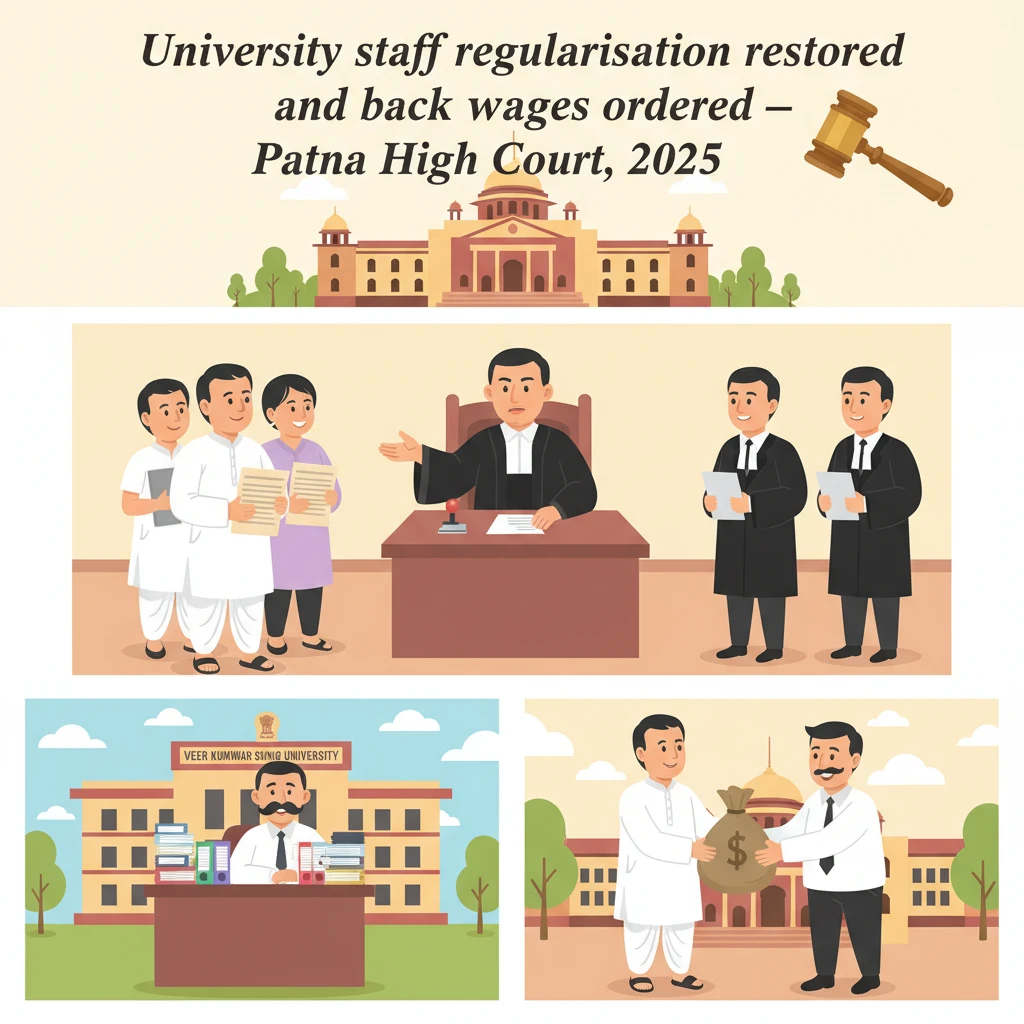
The Court directed that the petitioner shall be treated as regularised with effect from 01.06.2013 and entitled to 50% of salary and allowances from that date, along with notional benefits such as length of service and seniority. The University and State were ordered to pay arrears of 50% salary and allowances within two months. The University was also directed to accept his joining as Peon/Lab Boy immediately and to pay current salary for the post. The writ petition was allowed without any order as to costs.
Why This Judgment Matters
This judgment is important for long-serving non-teaching staff in Bihar’s universities and affiliated colleges who were engaged under the staffing pattern but later faced cancellation or denial of regularisation.
The Patna High Court has made it clear that once an employee’s service has been examined by a committee, regularised, and recognised for decades, the University cannot cancel that benefit through a blanket order without specific reasons. Clerical errors in affidavits cannot be used to overturn genuine documentary proof like school certificates.
The Court also reinforced that employees standing on the same footing, especially those listed together and regularised under the same scheme, must be treated equally. Authorities cannot pick and choose some to benefit and others to deny, when the legal objections raised have already been rejected in earlier final judgments such as Mithilesh Kumar Singh.
Practically, this decision gives a clear path to similarly placed workers whose regularisation has been withheld or cancelled on grounds already tested and rejected by the courts. It also sends a message to universities and the State that they must respect final judicial pronouncements and cannot reopen settled issues under new pretexts.
Legal Issues and Answers
Issue: Could Veer Kunwar Singh University cancel the petitioner’s regularisation on the basis of a Supreme Court interim order and alleged lack of authority of the Acting Vice Chancellor?
Answer: No. The Patna High Court held that the Supreme Court’s interim order did not restrict the Acting Vice Chancellor from functioning, and the cancellation notification was a mechanical recall without any specific reasons or defects in the petitioner’s case.
Issue: Could the petitioner be denied regularisation on the ground that his initial appointment was irregular and his age was wrongly mentioned in an earlier affidavit?
Answer: No. The Court accepted the School Leaving Certificate showing his date of birth as 01.01.1968 and treated the affidavit mistake as clerical. It further held, relying on Braj Kishore Singh and Mithilesh Kumar Singh, that long-serving staffing-pattern employees cannot be denied regularisation for such technical objections.
Issue: Was the petitioner entitled to parity with other 4th grade employees whose services had been regularised and whose cases were upheld up to the Supreme Court?
Answer: Yes. The Court found the petitioner to be identically situated with those employees and held that denying him the same benefits would be discriminatory and legally unsustainable.
Cases Cited by the Court
- Braj Kishore Singh and others v. The State of Bihar and others, 1997 (1) PLJR 509 (Full Bench of Patna High Court) – staffing pattern posts deemed sanctioned.
- Ram Sevak Yadav v. State of Bihar, 2013 (1) PLJR 694 – cited by the University on regularisation principles.
- C.W.J.C. No. 12657 of 2017, Mithilesh Kumar Singh and Others v. The State of Bihar and Others – regularisation of 129 non-teaching employees; affirmed in LPA No. 1467 of 2019 and S.L.P. (Civil) Diary No. 1465 of 2024.
- L.P.A. No. 586 of 2013 – relied on by the University regarding illegality of initial engagement and regularisation.
- Supreme Court interim order in S.L.P. No. 12409 of 2013 – regarding appointment of Vice Chancellors and Pro Vice Chancellors.
- Other Supreme Court authorities cited in argument: Jago v. Union of India, 2024 SCC OnLine SC 3826; Shripal and Another v. Nagar Nigam, Ghaziabad, 2025 SCC OnLine SC 221; Dharam Singh and Others v. State of U.P. and others, 2025 SCC OnLine SC 1735.
Case Details
Case Number: Civil Writ Jurisdiction Case No. 17957 of 2015
Case Title: Atal Bihari Singh v. The State of Bihar & Ors.
Coram: Hon’ble Mr. Justice Anil Kumar Sinha
Date of Judgment: 12.12.2025
Citation: 2026 (2) PLJR 86
Advocates:
For the Petitioner: Mr. Sanjeev Kumar Mishra, Senior Advocate; Ms. Manini Jaiswal; Ms. Adya Pandey
For the State: Mr. Abbas Haider, SC 16
For the University: Mr. Rajesh Choudhary
Nature of the Case: Writ petition (Civil) challenging cancellation of regularisation order and rejection of representation regarding Class IV employment in university-affiliated college.
Link to Judgment: Click here to read the full judgment on the Patna High Court website
If you found this explanation helpful and wish to stay informed about
how legal developments may affect your rights in Bihar,
you may consider following Samvida Law Associates for more updates.







