
Case Background
This criminal revision arose from a prosecution under the Protection of Children from Sexual Offences (POCSO) Act, registered as Mahila P.S. Case No. 82 of 2017 in the district of Patna.
The case was being tried as Spl. Case (POCSO) No.167 of 2017/C.I.S. No.167 of 2017 before the Court of the 6th Additional Sessions Judge-cum-Special Court POCSO, Patna.
The petitioner is a male accused who, according to the First Information Report (FIR), was staying in the house of his maternal aunt (Mausi) for studies. The victim girl is described as his cousin (Mauseri sister).
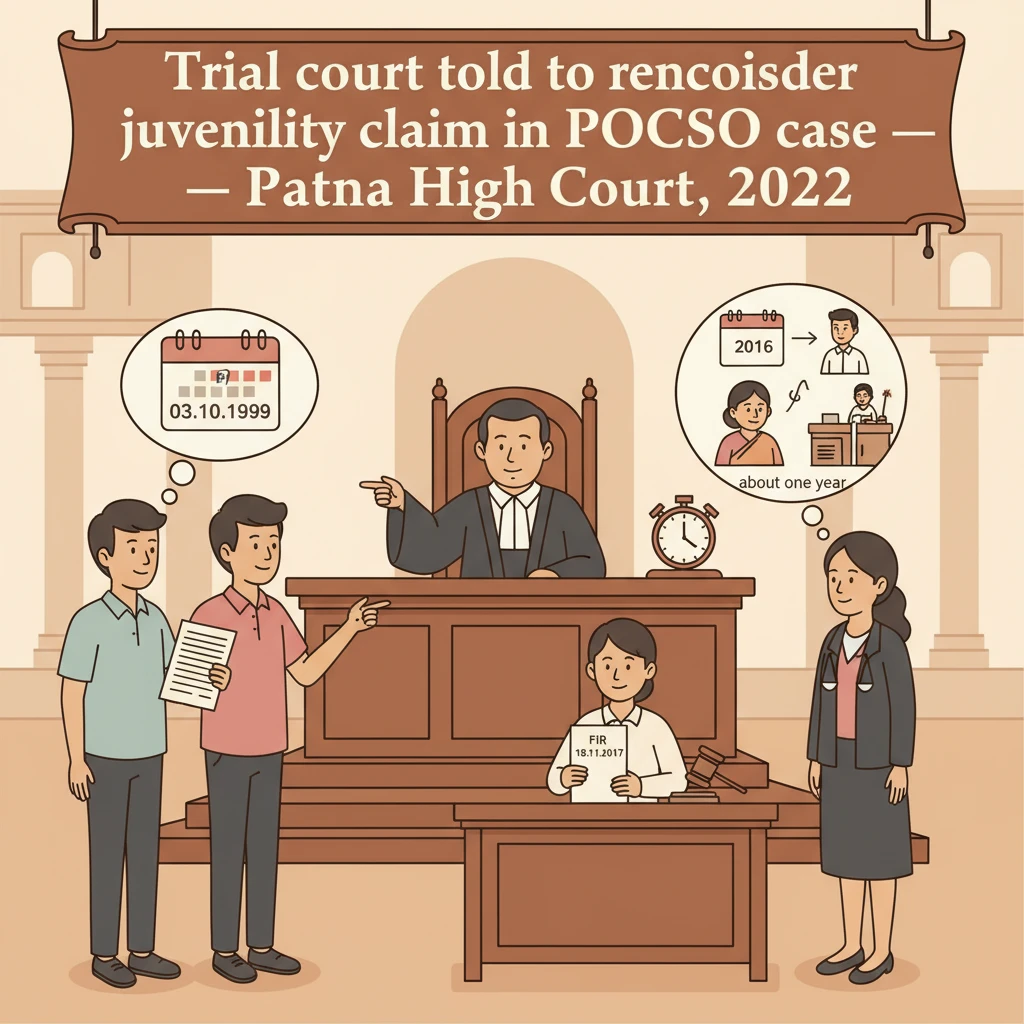
The FIR was lodged on 18.11.2017. The allegation in the FIR is that about one year prior to lodging the FIR, the petitioner had established physical relations with the victim by threatening her and continued such relations on the pretext of marriage.
In the trial court, the petitioner raised a plea that he was a juvenile at the relevant time. His date of birth, as per his matriculation certificate, was stated to be 03.10.1999. On that basis, he claimed that when the alleged occurrence of 2016 took place, he had not yet attained majority.
By order dated 08.04.2021, the 6th Additional Sessions Judge-cum-Special Court POCSO, Patna, refused to accept or consider his claim of juvenility in light of materials that had come during trial, particularly the deposition of the victim girl. Aggrieved by this refusal, the petitioner approached the Patna High Court in Criminal Revision No. 453 of 2021.
What the Court Examined and Decided
The criminal revision was heard by Hon’ble Mr. Justice Rajeev Ranjan Prasad on 21.07.2022. The Court heard learned counsel for the petitioner and learned counsel for opposite party no. 2 (the victim). For the State of Bihar, Mr. Akhileshwar Dayal, learned APP, appeared on the request of the Court, as the advocate assigned for the State was not present.
The core dispute before the Patna High Court was narrow but important: whether the trial court had properly considered all relevant materials, especially the victim’s deposition, while deciding the petitioner’s plea that he was a juvenile at the time of the alleged offences.
The petitioner’s counsel emphasized that the petitioner’s date of birth, as recorded in his matriculation certificate, is 03.10.1999. The FIR alleged that the incident began “about one year ago” from the date of lodging, i.e., in 2016, and that the petitioner had physical relations with the victim by threatening her and on the pretext of marriage.
On the basis of these dates, counsel argued that in the year 2016, when the alleged occurrence initially took place, the petitioner was a juvenile. He attained majority only on 03.10.2017, about one and a half months before the FIR was lodged on 18.11.2017.
Further, counsel drew attention to the wording of the FIR. According to him, there was no clear statement in the FIR that the alleged acts continued right up to the date of lodging of the complaint. The allegation that the petitioner “continued” physical relationship on the pretext of marriage, he argued, does not necessarily mean that such acts were ongoing up to 18.11.2017.
Thus, from the FIR alone, the counsel argued, the principal occurrence would appear to have taken place in 2016, when the petitioner was still below 18 years of age. The timing was critical because, if he was indeed a juvenile at the relevant time, the Juvenile Justice (Care and Protection of Children) Act, 2015, would apply and he would have to be dealt with by the Juvenile Justice system, not as an adult offender.
The petitioner’s counsel then focused on what came out in the trial itself. In the course of trial, on 08.05.2018, the victim girl was examined in court. In her deposition, she stated that the alleged incident had taken place about two years before, when the petitioner had forcibly committed the act with her. Thereafter, similar acts were allegedly repeated on many occasions on the pretext of marriage. She also stated that the petitioner used to write love letters to her.
The deposition gave some further time-related details. In paragraph 4, she stated that about two months after the alleged first occurrence, she suffered certain medical problems, went to the doctor, and at that time disclosed everything to her mother.
In paragraph 18 of her cross-examination, the victim stated that she lodged the FIR one year after the alleged occurrence and two years prior to her deposition in court. This, according to the petitioner, further supported the stand that the main occurrence took place in 2016, well before he turned 18.
The petitioner’s counsel argued that, despite such clear material being on record, the trial court failed to consider the entire deposition of the victim when deciding the juvenility plea. Instead, the trial court rejected the application by only looking at the allegations in the FIR and the victim’s statement recorded under Section 164 of the Code of Criminal Procedure (Cr.P.C.).
The High Court noted that the counsel for opposite party no. 2 (the victim) opposed the application, but eventually accepted that the specific materials highlighted by the petitioner—particularly the parts of the deposition—had not been considered by the trial court while deciding the claim of juvenility.
Upon examining the submissions and the record, the Patna High Court found that the deposition of the victim girl had not been considered in its entirety for the purpose of deciding whether the petitioner was a juvenile at the relevant time. Certain key paragraphs, including her statement that she had medical problems and approached a doctor two months after the occurrence, and that the FIR was lodged one year after the occurrence, had a bearing on the timeline.
The High Court observed that these materials, when taken together, gave rise to a prima facie view that the petitioner’s plea of juvenility required fresh consideration. The victim’s own counsel agreed at least to the extent that, up to two months after the alleged occurrence, the petitioner was a juvenile. Since the FIR was lodged one year after the occurrence, this gap in time became a crucial factual element.
Against this background, the High Court concluded that the trial court’s refusal to consider the claim of juvenility, without examining the full deposition, could not be sustained.
Accordingly, the Patna High Court set aside the impugned order dated 08.04.2021 passed in Spl. Case (POCSO) No.167 of 2017/ C.I.S. No.167 of 2017. The matter was remitted back to the trial court for a fresh consideration of the petitioner’s plea of juvenility.
The High Court directed that this fresh consideration must be carried out in terms of sub-section (2) of Section 9 of the Juvenile Justice (Care and Protection of Children) Act, 2015. The trial court was asked to conduct an enquiry into the juvenility claim after giving adequate opportunity of hearing to both sides.
The Court clarified that its observations in the order were only for the limited purpose of remitting the matter and should not prejudice the trial court. The trial court was specifically told to exercise its own independent and judicious mind while deciding the juvenility issue.
Thus, the criminal revision was allowed to the extent indicated: the earlier order was set aside, and the claim of juvenility was ordered to be re-examined by the competent court.
Why This Judgment Matters
This judgment is significant because it reinforces that a claim of juvenility cannot be brushed aside casually. When an accused says he was a child at the time of the alleged offence, the court must carefully look at all relevant evidence, including what the victim herself has said about when the incident took place.
For accused persons who were near the age of 18 at the time of the alleged crime, the exact dates can make a big difference. If they are found to be juveniles, they are entitled to be tried under the Juvenile Justice Act, which has a different approach focused more on rehabilitation than punishment.
The judgment also shows that higher courts like the Patna High Court will step in if a trial court ignores important evidence on the record while deciding such a crucial issue. It sends a message to trial courts handling POCSO and other serious cases that procedure and rights of the accused, especially juveniles, must be fully respected.
For victims and their families, the judgment clarifies that a reconsideration of juvenility does not end the case. It only ensures that the correct legal forum and procedure are followed depending on the age of the accused at the time of occurrence.
Legal Issues and Answers
- Issue: Whether the trial court was right in rejecting the petitioner’s claim of juvenility without considering the full deposition of the victim girl and other materials on record.
Answer: No. The Patna High Court held that the trial court failed to consider key parts of the victim’s deposition and other relevant materials, and therefore set aside the order, directing a fresh enquiry into juvenility under Section 9(2) of the Juvenile Justice Act, 2015. - Issue: What course should be followed when there are materials suggesting that the accused may have been a juvenile at the time of the alleged offence.
Answer: The Court directed that the matter must be remitted to the trial court to conduct an enquiry into the juvenility claim in accordance with Section 9(2) of the Juvenile Justice (Care and Protection of Children) Act, 2015, after giving adequate opportunity of hearing to both sides.
Case Details
Case Number: Criminal Revision No. 453 of 2021; arising out of Mahila P.S. Case No. 82 of 2017, District – Patna; Spl. Case (POCSO) No.167 of 2017/C.I.S. No.167 of 2017.
Case Title: Aman Kumar @ Satyam Kumar Aanu vs. The State of Bihar & Alka Kumari
Coram: Hon’ble Mr. Justice Rajeev Ranjan Prasad
Citation: 2023 (1) PLJR 707
Advocates:
- For the Petitioner: Mr. Rajesh Ranjan, Advocate; Ms. Maria Nazir, Advocate
- For Opposite Party No. 1 (State of Bihar): Mr. Akhileshwar Dayal, APP
- For Opposite Party No. 2: Mr. Bishwajeet Pandey, Advocate
Nature of the Case: Criminal revision against an order of the Special POCSO Court refusing to consider the petitioner’s claim of juvenility.
Link to Judgment: https://patnahighcourt.gov.in/vieworder/NyM0NTMjMjAyMSMzI04=-Lb–am1–vSsH6qrM=
If you found this explanation helpful and wish to stay informed about how legal developments may affect your rights in Bihar, you may consider following Samvida Law Associates for more updates.







