

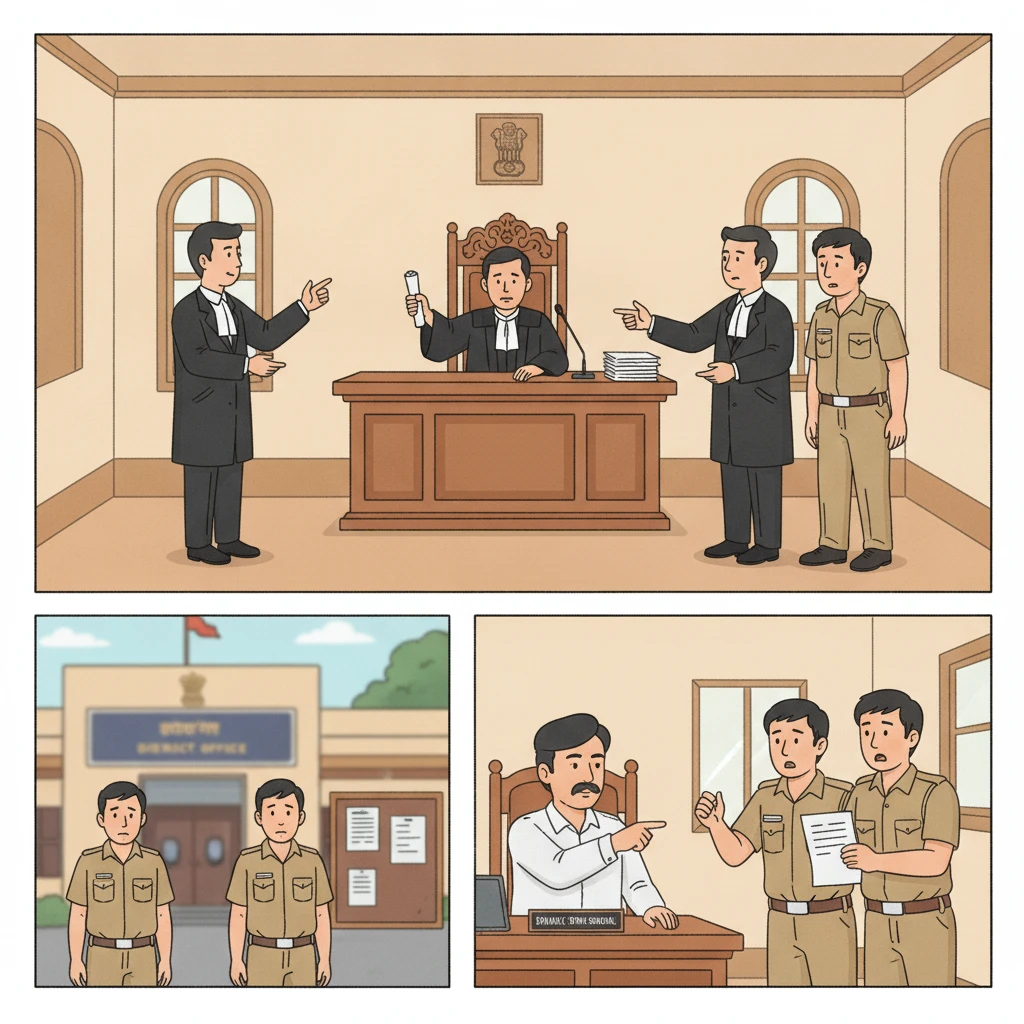
Case Background
The petitioners were trainee constables undergoing training at the Constable Training School, Nath Nagar, Bhagalpur. They came under the administrative control of the police authorities during this period.
On 4 November 2018, the Senior Superintendent of Police, Patna issued Memo No. 13624. On the basis of this memo, Patna District Order No. 4522/2018 was issued, declaring 168 trainee constables, excluding the petitioners, as unfit to be constables and terminating their services with immediate effect.
Subsequently, the Principal, Constable Training School, Nath Nagar, issued Training Order No. 487/2018 through Memo No. 1263 dated 6 November 2018, terminating the services of those 168 trainee constables in pursuance of the same memo of the Senior Superintendent of Police, Patna.
Later, the Principal issued Training Order No. 576/2018 through Memo No. 1489 dated 17 December 2018, terminating the services of the present petitioners with effect from 4 November 2018. The termination was thus ante-dated to the date of the Senior Superintendent of Police’s memo.
The petitioners approached the Patna High Court by way of Civil Writ Jurisdiction Case No. 3659 of 2019. They sought quashing of the termination orders, reinstatement, back wages, protection from coercive steps in a related criminal case, and other consequential reliefs.
What the Court Examined and Decided
The matter came before Hon’ble Mr. Justice P. B. Bajanthri. The core question framed by the Court was whether the termination of the petitioners’ services was in accordance with law.
The petitioners attacked the termination primarily on two grounds. First, they argued that an incompetent authority, namely the Principal of the Constable Training School, had passed the termination order. Second, they submitted that the termination was made in violation of the principles of natural justice because no notice or opportunity of hearing was given to them.
On the first point, the petitioners contended that the Principal lacked jurisdiction to terminate their services, especially ante-dating the termination to 4 November 2018 in pursuance of Memo No. 13624 issued by the Senior Superintendent of Police, Patna. They highlighted that their services were said to have been terminated “illegally and arbitrarily in a very mechanical manner having without jurisdiction.”
On the second point, the petitioners claimed that their removal from service was punitive in nature because it was based on allegations against them. Therefore, they argued that they were entitled to at least a notice and a proper enquiry before being terminated.
In response, the State, represented by the learned Government Advocate, submitted that the order of termination had in fact been passed by the Senior Superintendent of Police, Patna, and not by the Principal. It was further argued that, in terms of paragraph 668 of the Bihar Police Manual, no notice was required before terminating the services of probationers or trainees. On that basis, the State contended that the petitioners were not entitled to any relief.
The Court examined the records and found that both the Principal of the Constable Training School and the Senior Superintendent of Police, Patna had passed termination orders in relation to the petitioners.
The Court noted that there was a dispute about who was the competent disciplinary authority as on 4 November 2018. It observed that on that date, the Principal of the Constable Training School had exercised power even though the petitioners were no longer under his administrative control. At the same time, the Senior Superintendent of Police, Patna also terminated the services of the petitioners along with others through the same memo.
Even assuming that the order of the Principal was illegal or without authority, the Court observed that the termination order passed by the Senior Superintendent of Police, Patna on 4 November 2018 was in accordance with law as far as competence of that authority was concerned.
The Court then turned to the second and more crucial question: whether notice was required before terminating the services of the petitioners, who were trainee constables.
The State relied heavily on paragraph 668 of the Bihar Police Manual. The Court reproduced this provision in the judgment. Paragraph 668 deals with “Removal or reversion of officers appointed direct or promoted on probation.” It states that all officers are initially appointed or promoted on probation, and that the appointing or promoting authority may, at any time during the probationary period and without following the formalities of rule 828, remove or revert an officer who has not fulfilled the conditions of appointment or who has shown himself unfit. It also states that the probationary period may be extended without show-cause notice and that no appeal shall lie in such cases. Clause (b) extends this liability to executive officers appointed or promoted in non-permanent vacancies.
Based on this, the State argued that no notice was necessary to remove the petitioners as they were probationers or trainees and that the termination was simply a matter of unsuitability during probation.
The Court accepted that, on a plain reading of paragraph 668, probationary officers are generally not entitled to notice before termination. However, the Court drew an important distinction based on the nature and basis of the termination in this case.
The Court emphasized that the petitioners’ termination was not a simple case of unsuitability or failure to fulfil conditions of appointment in a routine sense. Instead, the termination was “pursuant to the allegation levelled against the petitioners.” The Court also observed that the termination was “on account of his defects to hold the post of Constable,” which indicated that misconduct or blameworthiness was being attributed to them.
In such a situation, the Court held, principles of natural justice cannot be brushed aside. When there are specific allegations against an employee, even a temporary or probationary employee is entitled to notice and a domestic enquiry. The Court clearly stated that “when there are allegations against petitioner, even temporary employee is entitled to notice/domestic enquiry.”
Therefore, the Court concluded that paragraph 668 of the Police Manual was not attracted in the present case. It was inapplicable “only for the reasons that order of termination is with reference to allegations levelled against the petitioners.” Because the termination was linked to alleged misconduct, it took on a punitive character, and the safeguards of natural justice had to be followed.
In light of these findings, the Court held that the petitioners had made out a case for relief “only on the ground that termination order is without notice to him and so also without holding enquiry with reference to the allegations levelled against the petitioners.”
Accordingly, the Patna High Court allowed the writ petition. It directed that the petitioners be taken back to duty. The Court also ordered the First Respondent (the State of Bihar through the Principal Secretary, Department of Home) to extend all monetary benefits to the petitioners for the intervening period from the date of termination till the date of the judgment.
At the same time, the Court balanced the interests of the State by granting liberty to the respondents to initiate appropriate proceedings in respect of the alleged allegations against the petitioners. It directed that such proceedings, if initiated, must be completed within four months from the date of receipt of the Court’s order.
Why This Judgment Matters
This judgment is important for trainee constables and other probationary government employees in Bihar.
The Patna High Court made it clear that the protection of natural justice does not depend only on whether an employee is permanent or temporary. What matters is the nature of the termination and whether it is based on allegations.
If termination is simply because a probationer is not suitable, or has not passed tests, paragraph 668 of the Police Manual may allow removal without notice. But where there are specific allegations or blame attached to the person, the authority cannot bypass notice and enquiry by merely labelling the action as removal of a probationer.
This decision also shows that even where the competent authority has power to terminate, the manner of exercising that power must be fair. Failing to give an employee any chance to explain, when serious allegations are involved, can render the termination illegal.
For police trainees and government recruits, the ruling reinforces that they can challenge punitive terminations done behind their back, and that courts are willing to insist on basic fairness even during probation.
Legal Issues and Answers
Issue: Was the termination of the petitioners’ services lawful when passed without notice or enquiry, relying on paragraph 668 of the Bihar Police Manual?
Answer: No. Although paragraph 668 generally allows termination of probationers without notice, it does not apply where termination is based on specific allegations. In such cases, even temporary employees are entitled to notice and a domestic enquiry, which was not given here.
Issue: Did the question of competence of the Principal of the Constable Training School to terminate the petitioners’ services affect the outcome?
Answer: The Court noted that both the Principal and the Senior Superintendent of Police, Patna issued termination orders, and that the Senior Superintendent’s order dated 04.11.2018 was in accordance with law regarding competence. However, the termination was ultimately set aside on the ground of violation of natural justice, not solely on the ground of competence.
Cases Cited by the Court
- The judgment does not mention or rely upon any other reported case law.
Case Details
Case Number: Civil Writ Jurisdiction Case No. 3659 of 2019
Case Title: Abhinandan Kumar and Anr vs. The State of Bihar and Ors
Citation: 2022 (1) PLJR 888
Coram: Hon’ble Mr. Justice P. B. Bajanthri
Advocates:
- For the petitioners: Mr. Ranjan Kumar Singh
- For the respondents: Mr. Partha Sarthy (GA4)
Nature of the case: Writ petition under civil writ jurisdiction challenging termination of trainee constables and seeking reinstatement with consequential benefits.
Date of Judgment: 08-12-2021
Link to Judgment: View official Patna High Court judgment
If you found this explanation helpful and wish to stay informed about how legal developments may affect your rights in Bihar, you may consider following Samvida Law Associates for more updates.







