
Case Background
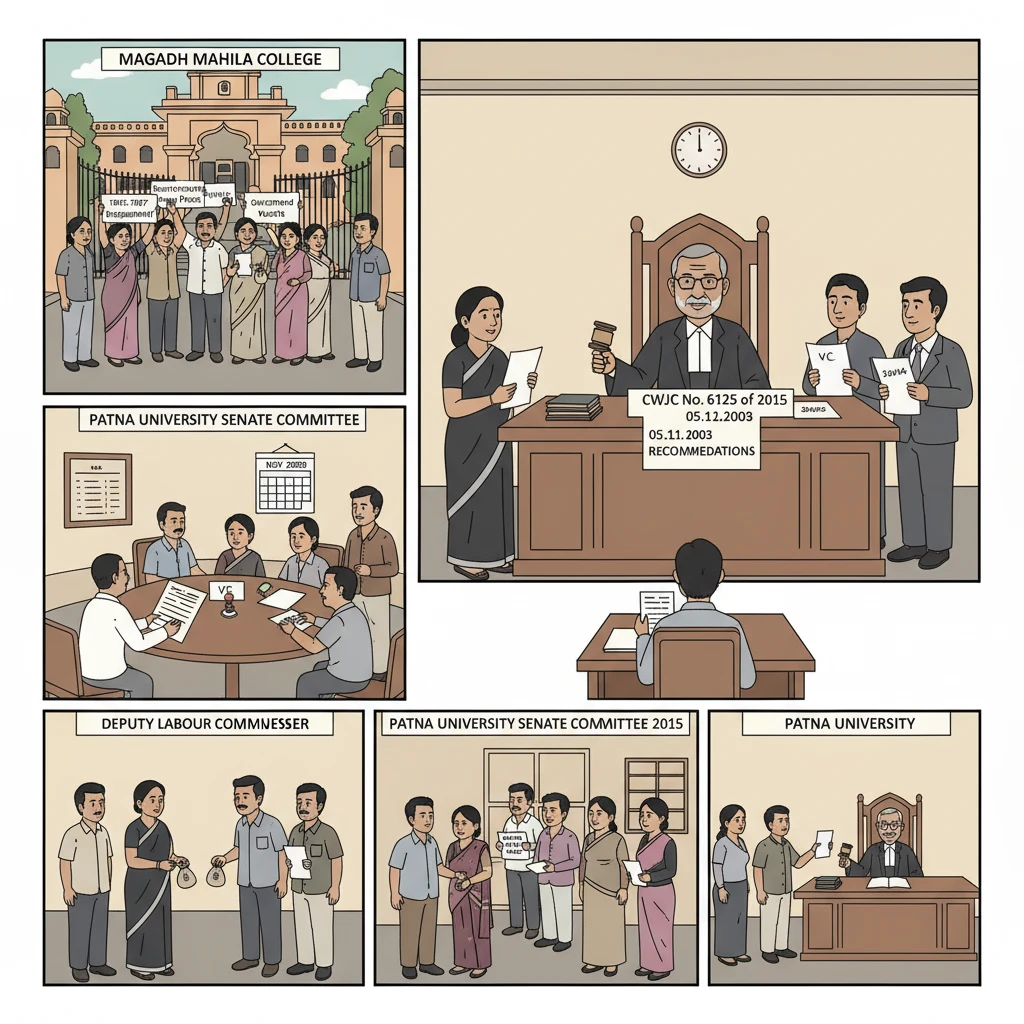
The petitioners were Class III and Class IV staff engaged on daily wage basis in Magadh Mahila College, a constituent unit of Patna University. They were taken between 1995 and 1997 after an advertisement and interview by a Selection Committee consisting of the Principal, Heads of Departments and the Bursar, with approval of the Vice-Chancellor under the Patna University Act, 1976.
They worked continuously for nearly two decades on sanctioned vacant posts, performing regular, permanent work. Over the years they were paid as daily wagers, often below statutory minimum wages, and had to approach the Deputy Labour Commissioner for part payments.
In 2003, Patna University’s Senate set up a Committee for Absorption headed by the Vice-Chancellor. After several meetings, this Committee, by report dated 05.11.2003, recommended that daily wage employees appointed against sanctioned posts up to 31.12.2000 and continuing in service should be absorbed. The petitioners’ names were included in this recommendation.
On the basis of this report, many daily wage employees from the same list were regularised through office orders dated 29.01.2004, 04.04.2006, 05.12.2011 and 29.12.2011. The petitioners, however, were left out, though they were similarly placed.
They first approached the Patna High Court earlier for implementation of the 05.11.2003 recommendations (CWJC No. 1080 of 2005). That case was disposed of on 03.01.2011 without final relief, in view of the then legal position. The petitioners continued to work thereafter.
In 2015, they again moved the Court through CWJC No. 6125 of 2015, seeking enforcement of the Senate Committee decision and their regularisation. On 08.07.2015 the Court issued notice to the Principal and Patna University, calling for counter affidavits.
Meanwhile, the Patna University College Employees’ Union called a strike from 10.08.2015 over long pending demands, including regularisation of daily wage workers. Minutes of meeting dated 08.09.2015 and issues approved by the Vice-Chancellor on 09.09.2015 recorded that there would be no victimisation of any employee for participating in this strike.
Despite this settlement, on 10.09.2015 the Principal sent a letter stating that the petitioners had not reported for duty from 10.08.2015 to 09.09.2015. The petitioners disputed this, showing attendance entries up to mid-August and official duties performed by one of them under letters dated 17.08.2015 and 31.08.2015.
On 11.09.2015 they submitted joining reports but were allegedly not allowed to sign the attendance register and were asked to hand over charge, keys and records. Finally, by office order dated 19.09.2015, issued by the Head Clerk on the direction of the Principal, quoting telephonic orders of the Vice-Chancellor, they were told their services were no longer required because they had stayed on strike and that they should hand over records to named colleagues.
The petitioners filed CWJC No. 18289 of 2015 challenging this termination order dated 19.09.2015 and seeking reinstatement with consequential benefits, along with their pending plea for regularisation in CWJC No. 6125 of 2015. Both writ petitions were heard together.
What the Court Examined and Decided
The Patna High Court, through Hon’ble Mr. Justice Alok Kumar Sinha, first considered whether the writ petitions were maintainable in spite of an alternative remedy under the Industrial Disputes Act, 1947.
Relying on the Supreme Court decision in M/s Godrej Sara Lee Ltd. v. Excise and Taxation Officer-cum-Assessing Authority, the Court noted that Article 226 gives plenary writ powers to High Courts. The rule that parties should normally use alternative statutory remedies is a rule of convenience and discretion, not a bar on jurisdiction. Writ petitions can be entertained where there is breach of natural justice, lack of jurisdiction, arbitrary State action or violation of fundamental rights.
Here, the petitioners were not merely complaining about service conditions, but about the legality of the termination itself. They alleged violation of Articles 14, 16 and 21, breach of settlement assuring no victimisation, and failure to follow basic procedure. The Court held that such issues were of public law nature. It rejected the objection of Patna University that the petitioners should go to the labour machinery and held the writ petitions maintainable.
Next, the Court looked at the nature of the impugned order dated 19.09.2015. The text of the order, reproduced in the judgment, clearly stated that the petitioners had been on strike from 10.08.2015 to 09.09.2015, that on telephonic directions of the Vice-Chancellor their work was being taken off and that their services were no longer required in the college for remaining on strike.
The Court held that such an order is “stigmatic”. It accuses the workers of misconduct, namely, remaining on strike and staying away from duty. In law, even daily wagers cannot be removed on such allegations without a proper domestic enquiry. The employer must issue a show cause notice, frame charges, and conduct an enquiry respecting principles of natural justice.
It was undisputed that no charge-sheet was issued, no opportunity of hearing was given and no enquiry was held against the petitioners. Further, the strike itself had ended in a settlement dated 08.09.2015, approved on 09.09.2015, which promised no punitive action for the strike period. By still using the strike as the ground for termination, the college and university acted contrary to their own settlement. The Court therefore held that the order was illegal, arbitrary and in violation of natural justice and the binding settlement.
The Court then considered the position even on the assumption that the termination was a simple disengagement of daily wage workers without stigma. Under Section 2(oo) of the Industrial Disputes Act, “retrenchment” covers termination of a workman’s service for any reason other than by way of disciplinary punishment, subject to certain exceptions.
The Court found that none of the statutory exceptions applied. There was no case of superannuation, voluntary retirement, non-renewal of contract, continuous ill-health or other excluded category. Therefore, even a simple discontinuance of daily wage work would amount to “retrenchment”.
Section 25F of the Industrial Disputes Act lays down mandatory conditions before retrenchment: one month’s notice or wages in lieu and payment of retrenchment compensation at the time of termination. The respondents did not claim that any notice pay or compensation was paid when the 19.09.2015 order was issued. The Court held that this non-compliance made the retrenchment void ab initio and unsustainable in law.
Another serious defect was that the order was said to be based on telephonic instructions of the Vice-Chancellor. The Court emphasised that termination of service with civil consequences must be through a written order by the competent authority, not through oral or telephonic directions conveyed by a Head Clerk. Such informal instructions have no legal validity.
The Court also examined whether the principle of “last-come-first-go”, embodied in Section 25G of the Industrial Disputes Act, had been followed. This rule requires that, in retrenchment, the junior-most employee in a particular category should ordinarily be retrenched first, unless recorded reasons justify deviation.
The petitioners had specifically pleaded that they were engaged in 1995-1997 and that several daily wage workers appointed later were still working, including Vishnu Prasad, Madan Kumar (typist), Binod Prasad (driver), Vijay Kumar Singh (peon), Akhilesh Kumar (peon) and Rita Devi (routine clerk). The respondents did not produce any seniority list or material to show that the petitioners were the junior-most, or that posts held by them had been abolished.
The Court drew an adverse inference from this silence. It held that the selective removal of the petitioners, while juniors and other similarly placed daily wagers continued, showed a clear breach of the “last-come-first-go” principle and resulted in hostile discrimination, violating Articles 14 and 16.
The respondents had tried to justify the termination by relying on State Government policy decisions: Sankalp Memo dated 10.05.1991 setting 10.05.1986 as cut-off for absorption of daily wagers; letters dated 07.10.2009 and 04.03.2011 imposing complete bans on fresh appointments and permitting outsourcing of low-end activities. The Court noted that these policies mainly regulate future appointments and rationalisation of posts.
There was no material to show that the petitioners were terminated because their posts had been abolished or their work outsourced. The University did not produce any order of outsourcing or reorganisation relating to the petitioners’ posts. The Court therefore held that reliance on these embargo and outsourcing policies could not legally sustain the termination.
Turning to CWJC No. 6125 of 2015, the Court considered whether the petitioners were entitled to regularisation/absorption in Patna University service based on the 05.11.2003 Senate Committee recommendations.
The Court found several important facts to be undisputed: the petitioners were engaged through a proper selection process after advertisement and interviews; they were appointed against sanctioned vacant posts; the Vice-Chancellor, as appointing authority, had approved their engagement; they had worked continuously since 1995–1997; and the Senate Committee for Absorption, chaired by the Vice-Chancellor, had recommended their absorption, fixing 31.12.2000 as the cut-off date. The petitioners fell well within this cut-off.
The Court held that these engagements were not “backdoor” or illegal appointments. At best they were irregular because the workers were taken on daily wages rather than as regular appointees. Such irregularity stood cured by long continuation and institutional approval.
The University had selectively implemented the Committee’s recommendations, regularising some persons from the same list while refusing to regularise the petitioners. The Court described this “pick-and-choose” as manifestly arbitrary and contrary to Article 14.
The Court then analysed the impact of Supreme Court decisions, particularly State of Karnataka v. Uma Devi. It noted that Uma Devi permits consideration, as a one-time measure, of irregular but not illegal appointees who have worked for ten years or more in sanctioned posts without court orders. The Court held that the petitioners squarely fit within this exception.
The judgment relied on later Supreme Court decisions such as Dharam Singh v. State of U.P., Shripal v. Nagar Nigam, Ghaziabad, and Jaggo v. Union of India, where the Supreme Court condemned prolonged “ad-hocism”, misuse of daily wage and temporary arrangements, and selective regularisation. These decisions stress that where workers have rendered long service on sanctioned posts and others similarly placed have been regularised, denial of regularisation is unjust and discriminatory.
Applying these principles, the Court concluded that the University’s reliance on changing State policies and cut-off dates could not be used retrospectively to defeat the petitioners’ accrued and legitimate expectation created by the 2003 Committee recommendations. It held that the petitioners’ engagements were regular in substance and that they had acquired a strong equitable right to regularisation.
Finally, in moulding relief, the Court noted that the petitioners had earlier approached the High Court in 2005 and that the earlier writ was disposed in 2011 without a decision on merits. It treated the filing of the present writ in 2015, after even longer service, as a fresh and matured cause of action. To balance justice with administrative convenience, the Court directed regularisation not from 2003, but from 17.04.2015, the date of filing CWJC No. 6125 of 2015.
In the result, the Court quashed the termination order dated 19.09.2015, directed reinstatement within four weeks, treated the entire period from termination till reinstatement as continuous service, and ordered that the petitioners be absorbed/regularised on the sanctioned posts on which they were working, with effect from 17.04.2015, with all consequential monetary and service benefits.
Why This Judgment Matters
This Patna High Court judgment is significant for daily wage and ad-hoc employees in universities and other public institutions who have worked for many years on sanctioned posts.
First, it clearly holds that even daily wagers cannot be removed on allegations of misconduct, such as participation in a strike, without due process. An oral or telephonic direction cannot end someone’s livelihood. Written orders, notice and opportunity of hearing are essential.
Second, the Court applies labour law safeguards to daily wagers. Any simple discontinuance of their services amounts to “retrenchment”, requiring prior notice and compensation, and adherence to the “last-come-first-go” principle. Selective targeting of senior workers while juniors continue is illegal and unconstitutional.
Third, the judgment strengthens the idea that long-serving workers engaged through a fair process, on sanctioned posts, have a strong right to seek regularisation, especially where the employer itself has recommended their absorption and has regularised others from the same list.
For workers across Bihar, this decision shows that Patna High Court is willing to look beyond technical policies and ask whether the State and its universities are acting fairly, consistently and in line with Articles 14, 16 and 21 of the Constitution.
Legal Issues and Answers
- Issue: Was the writ petition barred because the petitioners could have gone under the Industrial Disputes Act?
Answer: No. The Court held the writ petition maintainable since the challenge was to arbitrary and unconstitutional termination, attracting Article 226 despite availability of an alternative remedy. - Issue: Was the order dated 19.09.2015 a valid disengagement of daily wagers?
Answer: No. The Court found it stigmatic, based on alleged strike participation, passed without enquiry, notice or authority, and also illegal as retrenchment without compliance with Sections 25F and 25G of the Industrial Disputes Act. - Issue: Were the petitioners entitled to regularisation in Patna University service?
Answer: Yes. The Court held that their long, continuous service on sanctioned posts; fair initial selection; inclusion in the 05.11.2003 Senate Committee recommendations; and selective regularisation of others entitled them to absorption/regularisation with effect from 17.04.2015.
Cases Cited by the Court
- M/s Godrej Sara Lee Ltd. v. Excise and Taxation Officer-cum-Assessing Authority & Ors., Civil Appeal No. 5393 of 2010
- State of Uttar Pradesh v. Mohd. Nooh, 1958 SCR 595
- Whirlpool Corporation v. Registrar of Trade Marks, Mumbai & Others, (1998) 8 SCC 1
- Assistant Commissioner of State Tax v. M/s Commercial Steel Limited, 2021 SCC OnLine SC 884
- State of Karnataka v. Uma Devi, AIR 2006 SC 1806
- Dharam Singh v. State of U.P., Civil Appeal No. 8558 of 2018
- Shripal & Another v. Nagar Nigam, Ghaziabad, 2025 SCC OnLine SC 221
- Jaggo v. Union of India, 2025 (1) PLJR 165
- Deepak Kumar v. State of Bihar & Ors., CWJC No. 10507 of 1997 and MJC No. 1741 of 2002 (referred for background policy)
Case Details
Case Number: CWJC No. 18289 of 2015 with CWJC No. 6125 of 2015
Case Title: Madhwi Jha & Ors. v. The Patna University & Ors.
Citation: 2026(1) PLJR 560
Court: High Court of Judicature at Patna
Coram: Hon’ble Mr. Justice Alok Kumar Sinha
Date of Judgment: 23-12-2025
Advocates:
- For the petitioners (both cases): Mr. Sidharth Prasad, Advocate; Mr. Om Prakash Kumar, Advocate; with Mr. Sunit Kumar, Ms. Swetang Sinha, Mr. Shashank Shekhar, Mr. Shantam Kriti (in CWJC 18289/2015)
- For the respondents / State: Mr. Digvijay Singh, Advocate
- For Patna University: Mr. Mrigank Mauli, Senior Advocate; Mr. Manish Dhari Singh, Advocate
- For Magadh Mahila College: Mrs. Kalpana, Advocate
Nature of the Case: Writ petitions under Article 226 of the Constitution of India challenging termination/disengagement of daily wage employees and seeking mandamus for regularisation/absorption on sanctioned posts.
Link to Judgment: Click here to access the full Patna High Court judgment
If you found this explanation helpful and wish to stay informed about
how legal developments may affect your rights in Bihar,
you may consider following Samvida Law Associates for more updates.







