

Case Background
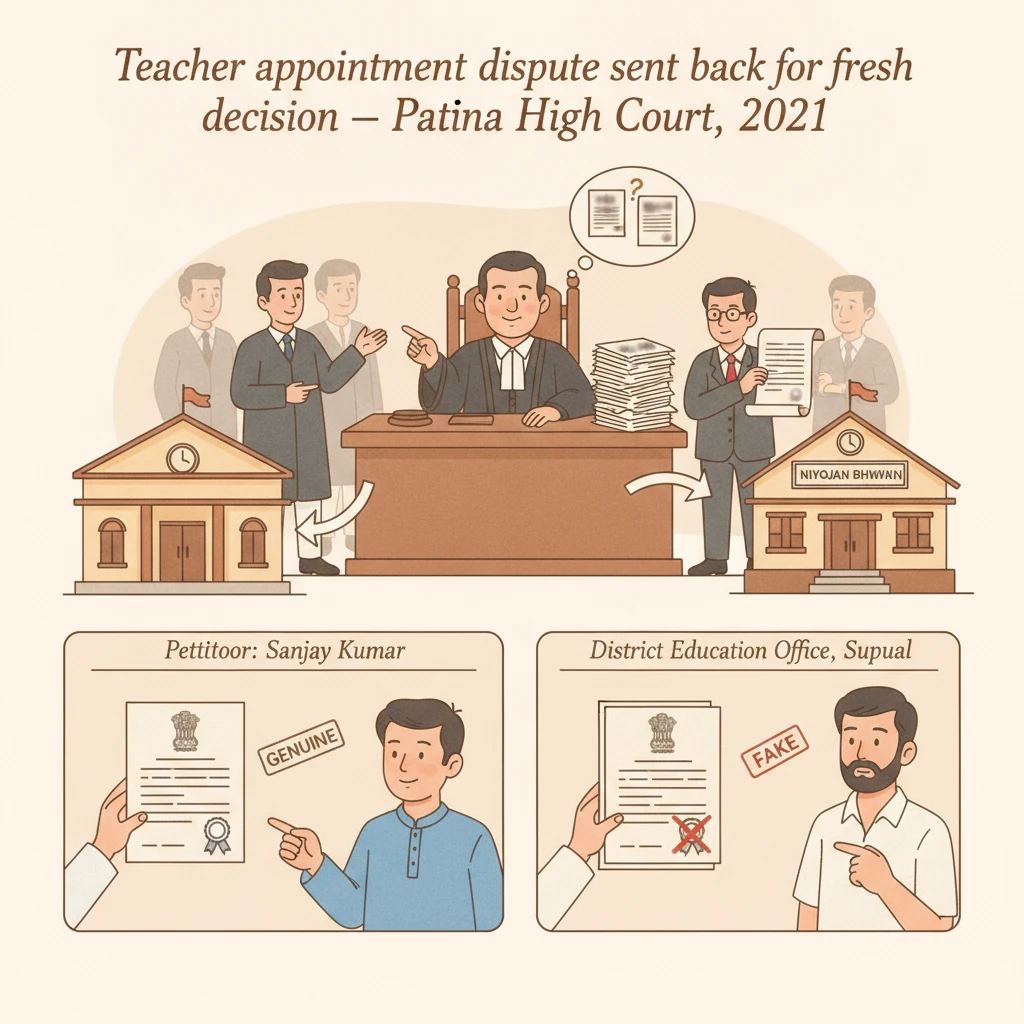
The case arises from the appointment of a Panchayat Teacher in Kishanpur South, District Supaul. Two persons are central to the dispute: the petitioner and respondent no. 10, both candidates for the same teaching post.
Respondent no. 10 was first appointed as Panchayat Teacher. Later, it was discovered that there was a problem with his educational qualifications, specifically his degree or training certificate. This led to an enquiry into the genuineness of his documents.
The District Teacher Employment Appellate Authority, Supaul, examined the matter. It found that respondent no. 10 was not entitled to be appointed. As a result, it annulled his appointment and validated the appointment of the petitioner on the same post.
The petitioner belongs to the Backward Classes (B.C.) category and had been placed second in the merit list for the post. His appointment was thus treated as valid once the first candidate’s appointment was cancelled.
Respondent no. 10 challenged the order of the District Teacher Employment Appellate Authority before the State Appellate Authority, Niyojan Bhawan, Patna. The State Appellate Authority, relying on the material placed before it, declared his certificate to be genuine and directed that he be reinstated in service.
Feeling aggrieved by this reversal, the petitioner approached the Patna High Court under its civil writ jurisdiction in CWJC No. 19833 of 2018, seeking to challenge the order of the State Appellate Authority.
What the Court Examined and Decided
The Patna High Court, presided over by Hon’ble Mr. Justice Ashutosh Kumar, heard counsel for the petitioner, for the State, and for respondent no. 10. The core question was whether the State Appellate Authority’s order, which favoured respondent no. 10, could stand in light of all the verification reports concerning his certificates.
The Court first noted that respondent no. 10 had initially been appointed as a Panchayat Teacher. When doubts were raised about his degree, an enquiry was conducted. On the basis of that enquiry, the District Teacher Employment Appellate Authority concluded that respondent no. 10 was not entitled to the appointment.
Consequently, the appellate authority at the district level validated the petitioner’s appointment on the same post. The petitioner, as the B.C. category candidate ranked second in the merit list, was treated as the proper appointee after respondent no. 10’s appointment was cancelled.
However, respondent no. 10 did not accept this outcome. He filed an appeal before the State Appellate Authority. That authority ultimately took the view that the certificates of respondent no. 10 were genuine and ordered that he be reinstated in his teaching job.
This reinstatement order effectively displaced the petitioner, who had been validated by the District Teacher Employment Appellate Authority. The petitioner’s challenge before the High Court was therefore centred on the validity of the State Appellate Authority’s decision-making process.
The High Court closely examined the counter affidavit filed by the official respondents (the State authorities). It emerged that, at the request of respondent no. 10 himself, his training certificate had been sent again to the Bihar School Examination Board for verification.
The Board’s report on this verification was specific. It stated that the matriculation certificate of respondent no. 10 was genuine. However, the certificate showing that he had passed the Teachers Training Examination was incorrect because there was tampering in the certificate.
This finding raised serious doubts about the validity of the training qualification relied upon by respondent no. 10 for the Panchayat Teacher post. The High Court then noted that this report was not the first verification report on record.
Earlier, the District Education Officer (D.E.O.) had also obtained verification from the Bihar School Examination Board and submitted a report. There was a difference between the initial report and the later report mentioned above. Because of this discrepancy, the District Programme Officer (Establishment), Supaul, considered it necessary to conduct another round of verification.
For this third verification, another officer, Shri Shiv Dayal Prasad, who was then the Programme Officer (Establishment), Supaul, was deputed. He visited the office of the Bihar School Examination Board to check the records himself.
After examining the records, this officer submitted a report on 17.06.2014. In that report, he confirmed that the matriculation certificate of respondent no. 10 was correct. But he also clearly reported that the training certificate was fake, because the roll number mentioned in that certificate actually belonged to another candidate and not to respondent no. 10.
These later reports were crucial. They went to the heart of whether respondent no. 10 had a valid training qualification to hold the Panchayat Teacher post. However, as the High Court noted, these facts had not been placed before the State Appellate Authority.
From the counter affidavit filed by respondent no. 10, it appeared that only the initial report about the correctness of his certificate had been presented to the State Appellate Authority. The later verification reports, which showed that the training certificate was fake or tampered with, were not brought to its notice.
Because the State Appellate Authority decided the appeal in favour of respondent no. 10 without having the full set of verification reports before it, the High Court found that its decision was incomplete and unsatisfactory. Important material facts had been withheld or not produced.
In such a situation, the High Court held that it had no option but to interfere. The Court set aside the appellate order of the State Appellate Authority.
However, instead of directly deciding whether the petitioner or respondent no. 10 should finally hold the post, the High Court chose to remand the matter. It sent the case back to the State Appellate Authority for a fresh decision.
The Court directed that the State Appellate Authority must now hear both parties again. It must also consider the verification reports concerning the genuineness of respondent no. 10’s certificates, as well as the petitioner’s claim, before passing a fresh order.
The High Court requested the State Appellate Authority to pass its final order within three months from the date of receipt or production of a copy of the High Court’s order.
To maintain fairness during this period, the Court ordered that status quo should be maintained until the State Appellate Authority takes a fresh decision. This means that the existing situation regarding service and appointment as on the date of the High Court’s order should continue unchanged for the time being.
With these directions and observations, the High Court disposed of the writ petition.
Why This Judgment Matters
This judgment is important for teachers and other job-holders facing disputes over educational or training certificates. The Patna High Court has stressed that appellate authorities must have access to all relevant verification reports before deciding who should hold a government job.
In this case, the State Appellate Authority treated the certificates of respondent no. 10 as genuine because it only saw an earlier favourable report. It did not see the later reports stating that his training certificate was fake and that the roll number belonged to someone else.
By setting aside that order and remanding the matter, the Court has shown that decisions affecting livelihoods cannot be based on half-information. All sides must be heard and all official verifications must be considered.
This is particularly significant for Panchayat Teachers and other locally appointed teachers in Bihar. Many disputes arise around training certificates, degree authenticity and merit lists. The judgment reinforces that if there are conflicting verification reports, authorities must examine them carefully and transparently.
For candidates like the petitioner, who came second in the merit list and later got appointed after the first candidate was disqualified, the decision gives some protection. It signals that their appointment cannot be disturbed casually, especially when there are serious doubts about the rival candidate’s certificates.
Legal Issues and Answers
Issue: Could the State Appellate Authority’s order reinstating respondent no. 10 as Panchayat Teacher stand when it was passed without considering later verification reports showing his training certificate to be fake or tampered?
Answer: No. The Patna High Court set aside the order and remanded the matter to the State Appellate Authority to decide afresh after considering all verification reports and hearing both sides.
Issue: What course of action should be followed when an appellate decision is based on incomplete or misleading material regarding the genuineness of certificates?
Answer: The proper course is to remand the case to the appellate authority to reconsider the matter on the basis of the complete record, as directed by the High Court.
Cases Cited by the Court
- No prior judicial decisions or case law have been cited or relied upon in the text of this judgment.
Case Details
Case Number: Civil Writ Jurisdiction Case No. 19833 of 2018
Case Title: Sanjay Kumar v. The State of Bihar & Ors.
Citation: 2022(1) PLJR 134
Court: High Court of Judicature at Patna
Coram: Hon’ble Mr. Justice Ashutosh Kumar
Date of Judgment: 29-11-2021
Advocates:
- For the petitioner: Mr. Rajeev Kumar Singh, Advocate
- For the State/respondents: Mr. Jitendra Kumar Roy No. 1, Standing Counsel-13
- For respondent no. 10: Mr. Girijanand Prasad, Advocate
Nature of the Case: Writ petition challenging the order of the State Appellate Authority relating to appointment to the post of Panchayat Teacher.
Link to Judgment: Patna High Court Judgment in CWJC No. 19833 of 2018
If you found this explanation helpful and wish to stay informed about how legal developments may affect your rights in Bihar, you may consider following Samvida Law Associates for more updates.







