

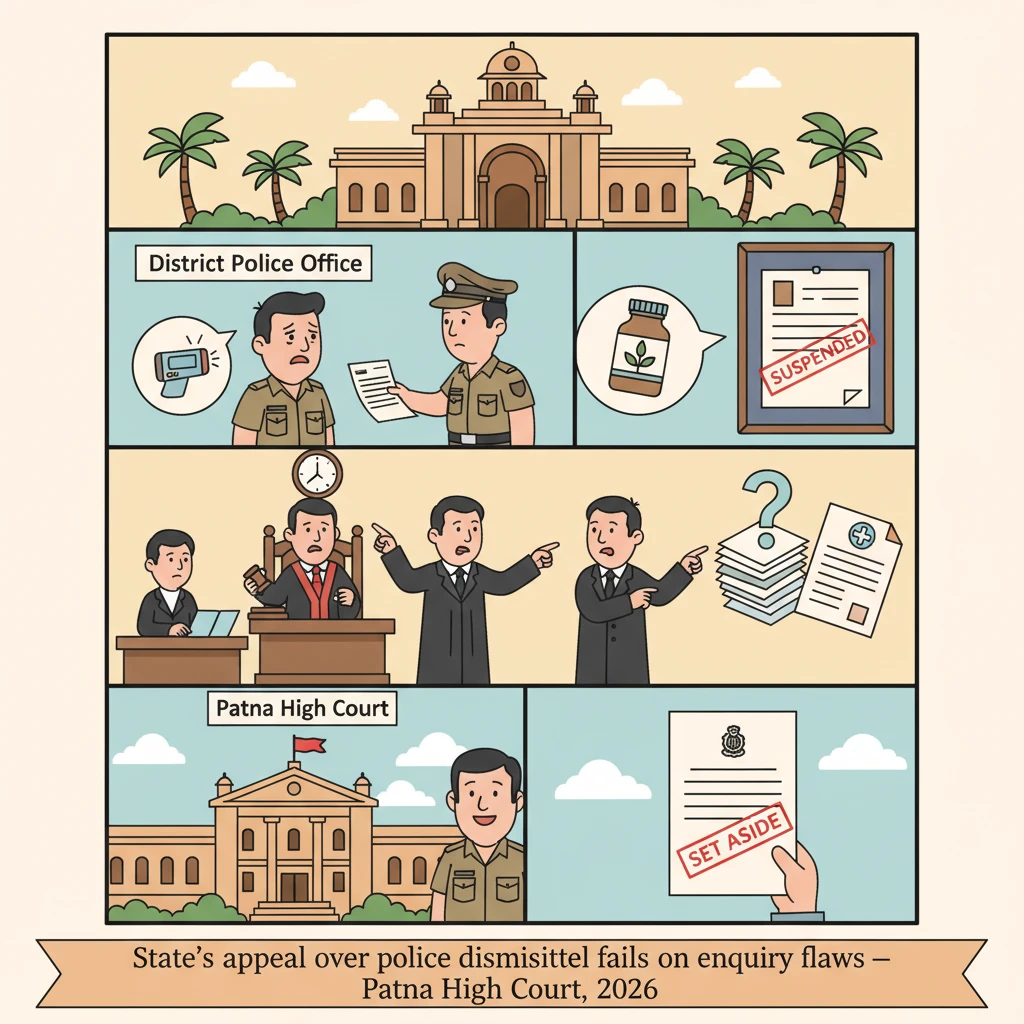
Case Background
The case concerns a Sub-Inspector of Police posted at Vishwavidyalaya Police Station, Muzaffarpur. On 28.10.2016, Excise Case No. 330 of 2016 was lodged against him under section 37(B) of the Bihar Prohibition and Excise Act, 2016, on the allegation that he had consumed liquor during duty hours.
He was arrested and sent to judicial custody mainly on the basis of a Breath Analyzer Test report. On the same day, the Senior Superintendent of Police, Muzaffarpur, placed him under suspension by memo no. 4455 dated 28.10.2016.
A departmental proceeding, numbered 84/16, Muzaffarpur District Police, was initiated. Charges were framed against him through memo no. 3574 dated 09.11.2016. Mr. Rajiv Ranjan was appointed as the conducting (enquiry) officer. No Presenting Officer was appointed.
The officer was granted bail on 09.11.2016. Only thereafter was the memo of charge supplied to him. According to him, neither the Breath Analyzer Test report nor other relevant documents were provided, contrary to Rule 17 of the Bihar Government Servants (Classification, Control & Appeal) Rules, 2005.
His suspension was revoked on 22.11.2016. In the departmental proceeding, he filed his first show-cause, stating clearly that he had not consumed liquor. He claimed that he had been taking a particular homeopathic medicine for many years which contained alcohol.
The Enquiry Officer proceeded with the case and ultimately submitted a report recommending dismissal. A copy of this report was served on the officer. The report, as communicated, mentioned that the petitioner was found guilty and recommended for dismissal, which was also confirmed by the Superintendent of Police.
After receiving the enquiry report, the officer filed a second show-cause. This time he again referred to his homeopathic medicine and attached a medical prescription as support. However, the disciplinary authority did not accept his explanation.
On 24.07.2017, the Deputy Inspector General of Police, Tirhut Range, Muzaffarpur, acting on the recommendation of the Senior Superintendent of Police, passed memo no. 1173 ordering dismissal from service.
The officer preferred an appeal under Rule 852(a) of the Bihar Police Manual before the Inspector General of Police, Muzaffarpur Range. The appellate authority dismissed the appeal by Muzaffarpur Range District order No. 2358/17, memo no. 6073 dated 24.11.2017, upholding the dismissal.
In 2022, he approached the Patna High Court in C.W.J.C. No. 3073 of 2022. He challenged the charge memo dated 09.11.2016, the entire departmental proceeding, the dismissal order dated 24.07.2017, and the appellate order dated 24.11.2017. He also sought reinstatement with all consequential and monetary benefits.
The learned Single Judge allowed the writ petition by order dated 12.07.2024. The Judge held that the Breath Analyzer Report was not conclusive proof of liquor consumption, relying on the Supreme Court decision in Bachubhai Hassanalli Karyani vs. State of Maharashtra, and that blood and urine tests had not been conducted. The dismissal was set aside, and the officer was held entitled to all financial and consequential reliefs from the date of suspension till superannuation. Pensionary benefits were directed to be calculated on that basis.
The State of Bihar and senior police officers filed Letters Patent Appeal No. 27 of 2025 against this order. During pendency, it was noted that the officer had already retired from service in 2019.
What the Court Examined and Decided
The Division Bench, comprising Hon’ble the Chief Justice and Hon’ble Mr. Justice Harish Kumar, heard the appeal. The central question was whether the single judge’s order granting full relief to the officer should stand.
First, the Bench carefully examined on what legal basis the single judge had interfered with the disciplinary orders. The single judge had essentially held that:
(a) Breath Analyzer Report was not conclusive proof of liquor consumption; (b) in the absence of blood and urine examination, dismissal based on mere smelling of alcohol and such report was unsustainable; and (c) this amounted to violation of natural justice.
The Division Bench looked into the Supreme Court decision in Bachubhai Hassanalli Karyani vs. State of Maharashtra, (1971) 3 SCC 930, which the single judge had relied on. The Advocate General argued that this case did not lay down any rule that Breath Analyzer Test is not a conclusive proof. It was a case where the Special Leave Petition was confined only to the question of sentence.
From the record, the Supreme Court had observed that since there was no urine test and no chemical analysis report of blood, it could not be definitely held that the accused was drunk at the time of the accident, and thus the sentence was reduced. There was no discussion on whether a breath analyzer is, or is not, a conclusive test as a matter of principle.
The Division Bench agreed with this reading. It held that the single judge’s understanding of Bachubhai Hassanalli Karyani as laying down a firm proposition against reliance on breath analyzer report was not correct.
The State also drew support from section 75 of the Bihar Prohibition and Excise Act, 2016. Section 75 empowers designated officers to conduct breath analyzer and medical tests. Section 75(3) specifically states that the reports of such tests are admissible as evidence under the Indian Evidence Act.
Further reference was made to section 185 of the Motor Vehicles Act, 1988. This section prescribes punishment where a person driving or attempting to drive has alcohol exceeding a specified level detected in a test by breath analyzer or in any other test including a laboratory test. The Bench noted that the use of the word “or” shows that a breath analyzer test alone can be sufficient, and other tests are alternative methods.
The Court also referred to State Tr. P.S. Lodhi Colony, New Delhi vs. Sanjeev Nanda, (2012) 8 SCC 450, where the Supreme Court recognised breath analyzer testing as a method to instantly detect alcohol content in the blood.
Thus, the Division Bench held that there was no binding legal principle that a breath analyzer report is never conclusive. On this narrow reasoning, the single judge’s view could not be sustained.
However, the Bench did not stop there. It turned to other grounds that the officer had raised in his writ petition but which the single judge had not fully considered. These were crucial procedural lapses in the departmental enquiry.
The officer had specifically pleaded that:
(i) No Presenting Officer had been appointed in the departmental proceeding, though mandated by the 2005 Rules; and (ii) copies of the Breath Analyzer Test report and other relied-upon documents were not supplied to him along with the charges.
The counter affidavit filed by the State, through respondent no. 5 (S.D.P.O., Saraiya, Muzaffarpur), did not specifically deny these assertions. Though the affidavit stated that the officer had been found drunk during a raid and that the enquiry relied on the Breath Analyzer Report, it was silent about appointment of a Presenting Officer and about supply of crucial documents.
The Court then examined Rule 17 of the 2005 Rules. Under Rule 17(4), the disciplinary authority must deliver to the government servant a copy of the articles of charge, statement of imputations, and a list of documents and witnesses by which each article of charge is proposed to be sustained. Under Rule 17(5)(c), where an inquiry is ordered, the disciplinary authority may appoint a government servant or legal practitioner as Presenting Officer to present the case in support of the charges.
The Bench relied on settled legal principles. It cited Nazir Ahmad vs. King Emperor, AIR 1936 PC 253(2), which held that when a law prescribes that a thing must be done in a particular manner, it must be done in that manner or not at all.
Referring to earlier decisions of the Patna High Court, the Bench highlighted Narayan Prasad Sah vs. Union of India, 2008(2) PLJR 581. There, non-appointment of a Presenting Officer and the Enquiry Officer acting as prosecutor was held to be a blatant violation of natural justice, vitiating the entire enquiry.
Another co-ordinate Bench decision, Upendra Pandit vs. State of Bihar, 2023(4) PLJR 568, was also quoted. That judgment emphasised that non-supply of the list of documents and witnesses and conducting proceedings without a Presenting Officer amounted to serious non-compliance with Rule 17(3) and (4). In such circumstances, dismissal from service could not be sustained.
Building on these precedents, the Division Bench underlined the vital role of the Presenting Officer. The Presenting Officer acts as the agent of the disciplinary authority, presenting the case, marshalling evidence, examining prosecution witnesses and cross-examining defence witnesses. His role helps maintain fairness and ensures that evidence is properly tested and recorded. When this role is missing, and the Enquiry Officer effectively steps into both prosecuting and adjudicating shoes, the enquiry is tainted.
In the present case, the admitted failure to appoint a Presenting Officer and the non-supply of key documents like the Breath Analyzer Report meant that mandatory procedural safeguards were ignored. This went to the root of the enquiry and violated the principles of natural justice.
Therefore, even though the Bench disagreed with the single judge’s reasoning about the legal value of Breath Analyzer Reports, it held that the final relief granted by the single judge—quashing dismissal and granting full consequential benefits—was correct for other reasons.
The Advocate General requested that, since the Bench had found procedural flaws, the matter be remitted for a fresh enquiry after curing defects. The Court declined this request. It noted that the officer had already retired in 2019, and the disciplinary authority had earlier had full opportunity to conduct the enquiry in accordance with law. The failure to observe mandatory provisions could not now be cured by a remand.
The Bench endorsed earlier Division Bench observations in Srikant Singh vs. State of Bihar (L.P.A. No. 58 of 2024) and State of Bihar & Others vs. Vikash Kumar @ Vikas Kumar (L.P.A. No. 446 of 2024). In those cases, it was held that remand after finding an enquiry vitiated on technical grounds is intended to avoid prejudice to the employee, not to cover up negligence or laxity of the disciplinary authority.
Given all this, the Court dismissed Letters Patent Appeal No. 27 of 2025. The order of the single judge setting aside dismissal and granting financial and pensionary benefits remained in force.
Why This Judgment Matters
This Patna High Court judgment is important for government servants and police personnel facing departmental proceedings, especially under the Bihar Prohibition and Excise Act, 2016.
First, it clarifies that the core question in service matters is often not only whether the allegation is serious, but whether the enquiry was conducted strictly as per the prescribed rules.
Here, allegations were grave—drunkenness on duty in the middle of prohibition. Even so, the Court held that if the State ignores basic safeguards like appointment of a Presenting Officer and supply of crucial documents, the entire proceeding can be struck down.
Second, the decision shows that higher courts will not automatically order a fresh enquiry after setting aside a defective one, particularly where the employee has already retired and the employer had a full chance earlier to follow the law.
For police and other government employees in Bihar, this ruling reinforces that disciplinary authorities must respect Rule 17 of the 2005 Rules. For citizens, it also underlines that even in prohibition-related offences, due process cannot be bypassed.
Legal Issues and Answers
- Issue: Did the learned Single Judge rightly hold that a Breath Analyzer Report is not conclusive proof of liquor consumption based on Bachubhai Hassanalli Karyani?
Answer: No. The Division Bench held that the Supreme Court judgment in Bachubhai Hassanalli Karyani did not lay down such a proposition. The single judge’s reasoning on this point was not justified. - Issue: Were the departmental proceedings against the officer vitiated due to non-compliance with the Bihar Government Servants (Classification, Control & Appeal) Rules, 2005?
Answer: Yes. The admitted non-appointment of a Presenting Officer and non-supply of vital documents like the Breath Analyzer Report and other relied-upon materials violated Rule 17 and principles of natural justice, vitiating the entire enquiry. - Issue: Should the matter be remitted for a fresh enquiry after finding such procedural flaws, particularly when the officer had already retired?
Answer: No. The Court refused remand, holding that remand is not meant to cover up negligence or laxity of the disciplinary authority, especially when the officer had retired and the authority had already enjoyed full opportunity to conduct a proper enquiry.
Cases Cited by the Court
- Bachubhai Hassanalli Karyani vs. State of Maharashtra, (1971) 3 SCC 930
- State Tr. P.S. Lodhi Colony, New Delhi vs. Sanjeev Nanda, (2012) 8 SCC 450
- Nazir Ahmad vs. King Emperor, AIR 1936 PC 253(2)
- Narayan Prasad Sah vs. Union of India, 2008(2) PLJR 581
- Upendra Pandit vs. State of Bihar, 2023(4) PLJR 568
- The State of Bihar & Ors. vs. Aswasthama Mahto @ Ashwathama Mahto, LPA No. 1095 of 2024 (decided on 26.02.2026)
- Srikant Singh vs. The State of Bihar & Ors., L.P.A. No. 58 of 2024
- The State of Bihar & Others vs. Vikash Kumar @ Vikas Kumar, L.P.A. No. 446 of 2024
Case Details
Case Number: Letters Patent Appeal No. 27 of 2025 in Civil Writ Jurisdiction Case No. 3073 of 2022
Case Title: The State of Bihar & Ors. vs. Bhagwan Singh
Citation: 2026(3) PLJR 106
Court: High Court of Judicature at Patna
Coram: Hon’ble the Chief Justice Sangam Kumar Sahoo and Hon’ble Mr. Justice Harish Kumar
Date of Judgment: 30-03-2026
Advocates for Appellants (State): Mr. P.K. Shahi, Advocate General; Mr. Manoj Kumar, A.C. to G.P.-4
Advocates for Respondent (writ petitioner): Mr. Upendra Mishra, Advocate; Mr. Sunil Kumar, Advocate; Mr. Sanjeeb Kumar Sanju, Advocate; Mr. Bhaskar Sandilya, Advocate; Mr. Ravi Kumar, Advocate
Nature of Case: Letters Patent Appeal against a single judge order in a writ petition challenging departmental proceedings and dismissal from service
Key Statutes and Rules Involved: Bihar Prohibition and Excise Act, 2016 (including section 37(B) and section 75); Bihar Government Servants (Classification, Control & Appeal) Rules, 2005 (Rule 17); Motor Vehicles Act, 1988 (section 185); Bihar Police Manual (Rule 852(a))
Link to Judgment: Click here to read the full judgment of the Patna High Court
If you found this explanation helpful and wish to stay informed about
how legal developments may affect your rights in Bihar,
you may consider following Samvida Law Associates for more updates.







