

Case Background
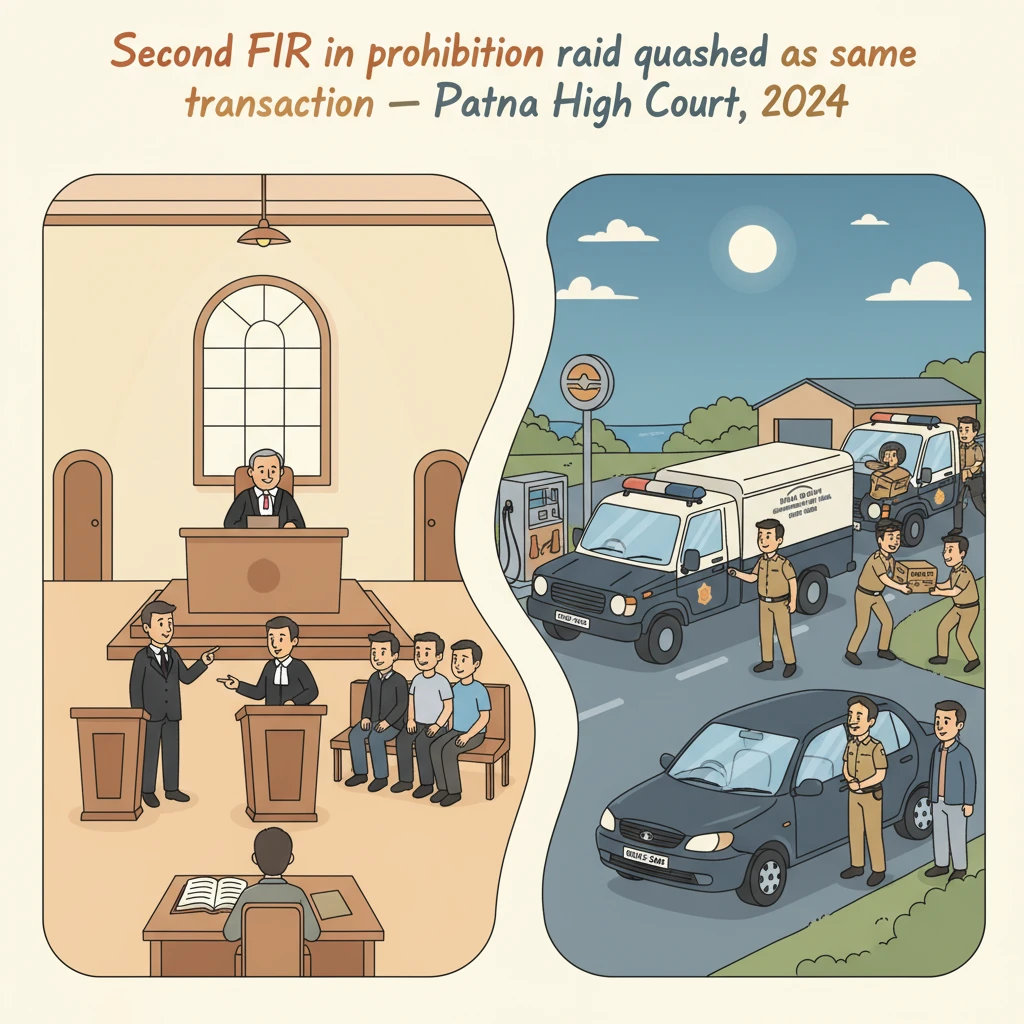
This case arises from enforcement of Bihar’s prohibition law against an alleged liquor syndicate operating between Haryana and Bihar.
On 4 February 2017, late at night, officers from Khusrupur Police Station and the Special Task Force (STF), Patna, received secret information. They were told that people from Haryana had formed an organised syndicate to sell liquor in dry State Bihar. Liquor was allegedly being brought in closed containers inside pickup vans, followed by a car, and supplied to different parts of the State including Diara area via Gyaspur Pipa Pul and Khusrupur.
Acting on this information, the police laid a trap near Hardas Bigha Petrol Pump on NH-30 (old road) under Khusrupur Police Station. Around 11.00 p.m., they intercepted a security van with registration no. HR-62-8670, bearing a sticker “Bank Duty, Government of India” and “ZX Plus Security”. Immediately after, they also stopped a Tata Indigo ECSXL car bearing registration no. BR01CF-2486.
Search of the security van in the presence of independent witnesses led to recovery of a carton of 375 ml Royal Stag Classic Whisky (24 bottles, two empty), stamped “for sale in Harayana only”. The driver identified himself as Sumit Bajaj, and the person seated beside him as Mayank Bajaj, both residents of Hisar, Haryana.
The Tata Indigo car was being driven by the present writ petitioner. Three other persons were in the car. On search, another carton of 375 ml Royal Stag Classic Whisky was recovered from the boot space of this car. None of the persons apprehended could produce any document justifying possession or sale of such liquor in Bihar.
On 5 February 2017, Khusrupur P.S. Case No. 21 of 2017 was registered on the basis of a suo motu complaint by the Station House Officer, under Sections 420 and 120B of the Indian Penal Code and Sections 30(a), 38 and 41 of the Bihar Prohibition and Excise Act, 2016.
During interrogation in this Khusrupur case, the accused disclosed that they ran a liquor syndicate, that large quantities of IMFL had been ordered by one person and were to be unloaded at Virpur Diara within Jurabanpur Police Station limits. They also stated that liquor had been supplied to another person at Patna and that 116 cartons were stored at a house and shop there. It was further stated that 70 cartons had been unloaded behind a warehouse belonging to one Arjun Rai at Virpur Diara.
Acting on this disclosure, information was passed to Jurabanpur Police Station. In the early hours of 5 February 2017, Sub-Inspector Navin Kumar Singh of Jurabanpur P.S., along with his force, officers of Khusrupur P.S., STF personnel and armed police, conducted a joint raid near Shivnagar Lakarbaba Chowk and at Virpur Diara. They searched the house of one Bindeshwar Rai. From one room of this house they recovered 70 cartons of IMFL of different brands, again in the presence of independent witnesses.
On the basis of the Jurabanpur officer’s own suo motu complaint about this recovery, Jurabanpur P.S. Case No. 4 of 2017 was registered on 5 February 2017 under Section 120B IPC read with Sections 30(a), 38 and 41 of the Bihar Prohibition and Excise Act, 2016.
The writ petitioner, who was already an accused in the Khusrupur case, approached the Patna High Court seeking quashing of the later Jurabanpur FIR on the ground that it was a second FIR in respect of the same transaction.
What the Court Examined and Decided
The Patna High Court, through Hon’ble Mr. Justice Bibek Chaudhuri, examined in detail how the events unfolded between the night of 4 February and early 5 February 2017.
The Court first summarised the Khusrupur case. The police, acting on secret information received through the STF, intercepted a Haryana-registered security van and a Tata Indigo car. Both vehicles were allegedly part of a liquor syndicate transporting IMFL from Haryana into Bihar. From the van and the car together, two cartons of Royal Stag Classic Whisky were recovered. The accused persons were arrested, and the first FIR, Khusrupur P.S. Case No. 21 of 2017, was lodged.
In their statements to the Khusrupur police, the accused allegedly said that large quantities of liquor had been unloaded at Virpur Diara, within the jurisdiction of Jurabanpur Police Station, including 70 cartons allegedly kept behind a warehouse. This information prompted the officers of Jurabanpur Police Station, joined by Khusrupur police and STF, to carry out a raid at Virpur Diara. During this raid, a substantial quantity of IMFL was seized from the house of one Bindeshwar Rai, and several persons were examined.
On these facts, the petitioner’s core argument was simple: both the Khusrupur and Jurabanpur FIRs arose out of a single continuous liquor trafficking operation, i.e., the same transaction. Therefore, registering a fresh FIR at Jurabanpur for the later raid was illegal. According to him, the second FIR should be treated only as part of the investigation of the first case.
To support this, the petitioner relied on a line of Supreme Court decisions including T. T. Antony v. State of Kerala, Babubhai v. State of Gujarat, Chirra Shivraj v. State of Andhra Pradesh, Amitbhai Anilchandra Shah v. CBI, Awadesh Kumar Jha @ Akhilesh Kumar Jha v. State of Bihar, and a co-ordinate Bench decision in Dipu Singh @ Braj Kishor v. State of Bihar.
From these authorities, the petitioner highlighted the principle that there can ordinarily be only one FIR for one occurrence or transaction. The first information recorded under Section 154 of the Code of Criminal Procedure sets the criminal law in motion. Any later information about the same incident should be treated as a statement under Section 162 CrPC and investigated within the same case. Multiple FIRs for the same transaction are not permitted; otherwise, an accused would be exposed to repeated investigations and trials for what is, in reality, one set of acts.
The petitioner also referred to the Supreme Court’s recent decision in Haji Iqbal @ Bala v. State of U.P. to emphasise the Court’s duty, when asked to quash an FIR under Article 226 or Section 482 CrPC, to look beyond the bare wording of the FIR and examine the surrounding circumstances, especially where the case appears frivolous or vexatious.
Applying these precedents, counsel for the petitioner argued that:
- the interception of vehicles at Khusrupur,
- the disclosure about unloading liquor at Virpur Diara, and
- the raid and recovery at Jurabanpur jurisdiction
were all “one and the same transaction” of transporting and distributing illicit liquor in Bihar. Hence, a second FIR at Jurabanpur could not stand.
The State, on the other hand, argued that the two FIRs were different in nature. The Khusrupur FIR concerned interception of two vehicles and certain accused, while the Jurabanpur FIR concerned another place, different accused, and a separate recovery. The State relied on decisions including Anju Chaudhary v. State of U.P., Rameshchandra Nandlal Parikh v. State of Gujarat, and a Division Bench decision in M/s Majhaulia Sugar Industries Pvt. Ltd. v. State of Bihar to assert that a second FIR is permissible where there is a distinct cause of action, different accused, or different scope of investigation.
The Court carefully considered both lines of authority and noted that the Supreme Court itself has used the “test of sameness”—whether two FIRs relate to the same incident or are parts of the same transaction. The Court accepted that a second FIR is admissible only when allegations are “absolutely distinct and separate” from those in the first FIR, even if arising out of the same broad background.
To make this clearer, the Court gave an example of a shopkeeper lodging an FIR that his shop was burnt, and another person later lodging an FIR about communal hatred and arson that led to burning of several properties including that shop. In such a case, the two FIRs might be distinct, the second involving larger allegations of communal violence and breach of peace beyond the first complainant’s grievance.
Turning back to the liquor case, the Court held that this example did not apply. The facts showed a continuous chain of events:
- interception of the van and car with liquor at Khusrupur,
- confessional statements of the accused about unloading liquor at Virpur Diara,
- communication of this information to Jurabanpur police, and
- joint raid and recovery of 70 cartons of IMFL from the house of Bindeshwar Rai.
According to the Court, this was one organised liquor-running transaction that happened to cut across two police station jurisdictions. The same offence under the Bihar Prohibition and Excise Act, 2016 and Section 120B IPC was being committed through this entire sequence. The later raid at Virpur Diara was only a step in the investigation of the first case, not a new and independent incident.
The Court illustrated its reasoning by comparing the situation to a narcotics case, where a drug peddler caught in one police station discloses other places where he has supplied drugs. If, based on his statement, police in different police stations conduct raids and recover drugs, all those recoveries would still form part of the same transaction, and only one FIR should exist. The subsequent recoveries based on the accused’s statement would be treated as part of investigation under Section 162 CrPC, and admissible as discovery under Section 27 of the Evidence Act, but would not justify multiple FIRs and multiple trials.
Applying this logic, the Court concluded that the Jurabanpur FIR was, in truth, a second FIR for the same offence and occurrence already covered by Khusrupur P.S. Case No. 21 of 2017. Therefore, it could not be sustained.
The Court accordingly quashed Jurabanpur P.S. Case No. 4 of 2017, dated 5 February 2017, under Section 120B IPC read with Sections 30(a), 38 and 41 of the Bihar Prohibition and Excise Act, 2016.
However, the Court was careful to ensure that the prohibition enforcement effort would not fail. It directed that the incident of arrest and recovery of IMFL from the house of Bindeshwar Rai be “tagged with” Khusrupur P.S. Case No. 21 of 2017. All investigation would continue in the Khusrupur case in relation to all accused persons, including those found in Jurabanpur, under the same first FIR.
With these findings and directions, the Criminal Writ Jurisdiction Case No. 649 of 2017 was disposed of.
Why This Judgment Matters
This judgment is significant for people facing multiple criminal cases over the same alleged act, especially under Bihar’s strict prohibition law.
The Patna High Court has clarified that when one liquor operation or crime is carried out across different police station areas, the police cannot register fresh FIRs every time they make a new recovery linked to the first case. All such steps must ordinarily be part of the same investigation.
For ordinary citizens, this means that if the police have already registered one case about a specific incident or operation, they should not keep opening new FIRs for different parts of the same story, exposing the accused to several overlapping criminal cases.
At the same time, the Court made it clear that quashing a second FIR does not stop lawful investigation. The police can still continue their probe, add new facts and recoveries, and proceed against all involved persons, but under the first FIR itself.
Legal Issues and Answers
- Issue: Can the police register a second FIR at a different police station for recovery of liquor when the entire operation forms one continuous transaction already covered by an earlier FIR?
Answer: No. The Patna High Court held that the Khusrupur interception and the Jurabanpur raid were parts of the same transaction involving illegal transportation and delivery of IMFL. Therefore, Jurabanpur P.S. Case No. 4 of 2017, being a second FIR for the same occurrence, was quashed. The later recovery must be investigated within Khusrupur P.S. Case No. 21 of 2017.
Cases Cited by the Court
- T. T. Antony v. State of Kerala & Ors., (2001) 6 SCC 181
- Babubhai v. State of Gujarat & Ors., (2010) 12 SCC 254
- Chirra Shivraj v. State of Andhra Pradesh, (2010) 14 SCC 444
- Amitbhai Anilchandra Shah v. Central Bureau of Investigation & Anr., (2013) 6 SCC 348
- Awadesh Kumar Jha @ Akhilesh Kumar Jha & Anr. v. State of Bihar, (2016) 3 SCC 8
- Dipu Singh @ Braj Kishor v. State of Bihar, Criminal Writ Jurisdiction Case No. 1169 of 2021, judgment dated 21 March 2020 (Patna High Court, Co-ordinate Bench)
- Haji Iqbal @ Bala through S.P.O.A. v. State of U.P. & Ors., Criminal Appeal No. 2343 of 2023
- M/s Majhaulia Sugar Industries Pvt. Ltd. & Anr. v. The State of Bihar & Ors., 2024(1) PLJR 574
- Anju Chaudhary v. State of Uttar Pradesh & Anr., (2013) 6 SCC 384
- Rameshchandra Nandlal Parikh v. State of Gujarat & Anr., (2006) 1 SCC 732
Case Details
Case Number: Criminal Writ Jurisdiction Case No. 649 of 2017
Case Title: Ranjit Kumar @ Guddu v. The State of Bihar & Ors.
Coram: Hon’ble Mr. Justice Bibek Chaudhuri
Date of Judgment: 01-03-2024
Originating Police Cases: Khusrupur P.S. Case No. 21 of 2017; Jurabanpur P.S. Case No. 4 of 2017
Citation: 2024(2) PLJR 208
Advocates:
- For the Petitioner: Mr. Sanjeev Ranjan, Advocate; Ms. Aastha Ananya, Advocate
- For the State/Respondents: Mr. Arvind Kumar, Advocate
- For the EOU (Economic Offences Unit): Mr. V.N.P. Sinha, Senior Advocate; Mr. Vijay Anand, Advocate
Nature of the Case: Criminal writ petition under Article 226 of the Constitution seeking quashing of FIR (Jurabanpur P.S. Case No. 4 of 2017) in a prohibition and conspiracy matter.
Link to Judgment: Patna High Court Judgment – CR WJC No. 649 of 2017
If you found this explanation helpful and wish to stay informed about
how legal developments may affect your rights in Bihar,
you may consider following Samvida Law Associates for more updates.







